Email id: info@ijclinmedcasereports.com
Efficacy and Safety of CisLean™ in Adults with Overweight or Class I Obesity: A Randomized, Double-Blind, Multicenter, Placebo-Controlled Clinical Trial
Vineet K Malhotra1, Aishwarya Gandas1, Nilesh Londhe2, Sarika Londhe2, Sanjay Tamoli3, Girish S Soman4,* and Arati D Soman4
1Department of General OPD, Vignaharta Health Care Clinic, Pune Solapur Road Hadapsar, Pune, Maharashtra., Pune, India
2Department of General OPD, Nirvikar Ayurveda Hospital Consultant Physician, Bhosari, Pune, Pimpri-Chinchwad, Maharashtra 411039., Pune, India
3Department of Medical Education and Research, Target Institute of Medical Education and Research Pvt.Ltd. Jaswanti Allied Business Center, Malad West, Mumbai- 400064, Mumbai, India
4Nisarga Biotech Pvt. Ltd. J2/1 Addl. MIDC, Satara 415004, Maharashtra, India, Satara, India
Received Date: 08/10/2026; Published Date: 09/12/2026
*Corresponding author: Girish S. Soman, Nisarga Biotech Pvt. Ltd. J2/1 Addl. MIDC, Satara 415004, Maharashtra, India, Satara, India
Trial registration: Clinical Trials Registry-India (CTRI): CTRI/2024/01/061102 (registered on 03/01/2024)
Abstract
Obesity is a major global health concern associated with metabolic and cardiovascular disorders. This randomized, double-blind, multicenter, placebo-controlled clinical study evaluated the efficacy and safety of CisLean™, a 500 mg Cissus quadrangularis extract capsule, in healthy obese adults. Sixty-three participants with BMI 25–34.9 kg/m² completed the 16-week intervention and received CisLean™ or placebo twice daily. Primary outcomes were changes in body weight and BMI, while secondary outcomes included anthropometric measures, body composition, metabolic parameters, and safety. At 16 weeks, CisLean™ produced significantly greater reductions in body weight (3.51% vs. 0.42%; p<0.05) and BMI (3.20% vs. 0.41%; p<0.05) than placebo. Significant reductions were also observed in waist, hip, neck, upper mid-arm, and calf circumferences, as well as body fat percentage, total body water, lean body mass, and basal metabolic rate. Lipid profiles and well-being scores showed no significant changes. No treatment-related adverse events were reported. Overall, CisLean™ was well tolerated and demonstrated potential as a weight-management intervention.
Keywords: Cissus quadrangularis; Obesity; Overweight; Body Weight; Anthropometry; Randomized Controlled Trial
Introduction
Overweight and obesity are interconnected health conditions that profoundly affect cardiovascular, metabolic, musculoskeletal, and cancer-related health, posing a major global public health challenge [1]. In 2022, 2.5 billion adults were overweight, including 890 million with obesity, while childhood overweight and obesity also increased substantially. The primary causes include excessive calorie intake, low physical activity, obesogenic environments, genetic and psychological factors, and medical conditions. Obesity increases the risk of noncommunicable diseases (NCDs), including heart disease, diabetes, and cancer, and contributes significantly to mortality and economic burden [2]. Obesity is an abnormal accumulation of excess body fat and is a leading preventable cause of death worldwide [3-7]. High-calorie diets, processed foods, physical inactivity, and genetic susceptibility are major contributing factors [8-10], with complications including hypertension, type 2 diabetes, atherosclerosis, infertility, fatty liver, and osteoarthritis [10-12]. Although lifestyle modification, physical activity, and pharmacotherapy remain the main treatments, long-term effectiveness is limited [8,13-17]. Cissus quadrangularis has demonstrated weight-reducing effects [18-20]. However, evidence for CisLean™ remains limited. Therefore, this study evaluated its efficacy and safety over 16 weeks in overweight and obese participants.
Materials and Methods
This randomized, double-blind, multicenter, placebo-controlled clinical study evaluated the efficacy and safety of CisLean™ in healthy obese participants. Following Ethics Committee approval from Nirvikar Ayurved Hospital, Pune and Mhaske Hospital and Research Centre, Pune, the study was registered with CTRI (CTRI/2024/01/061102; 03/01/2024) and conducted according to the Declaration of Helsinki and Good Clinical Practice from 08 January to 10 May 2024. A total of 74 participants were screened and 69 randomized; 30 CisLean™ and 33 placebo participants completed 16 weeks. Participants aged 21–55 years with BMI 25–34.9 kg/m² received identical CisLean™ (500 mg Cissus quadrangularis extract) or placebo capsules twice daily after meals for 16 weeks, without structured diet or exercise intervention. Primary outcome was change in body weight and BMI; secondary outcomes included anthropometric, body-composition, lipid, appetite, global assessment, tolerability, and safety parameters. Statistical analysis used GraphPad InStat 3.6, with appropriate parametric/non-parametric tests and chi-square test; p<0.05 was considered significant.
Observations and Results
The demographic characteristics were comparable between the CisLean™ capsule and placebo groups, with similar mean ages (36.60 vs. 37.03 years) and no significant differences in demographic parameters, TSH, or blood glucose levels. The CisLean™ group comprised 10 males (33.33%) and 20 females (66.66%), while the placebo group comprised 9 males (27.27%) and 24 females (72.72%); one placebo participant had controlled pre-existing hypertension (Table 1, Figure 1).
The CisLean™ capsule group showed a significant, progressive reduction in body weight from 74.75 ± 9.50 kg at baseline to 72.12 ± 8.16 kg at 16 weeks, with significant weight loss evident from week 8, unlike the non-significant change in the placebo group (p<0.05). BMI similarly declined significantly from week 8 onward, with a 3.2% reduction at 16 weeks versus 0.41% with placebo (p<0.05) (Table 2; Figure 2).
At 16 weeks, the CisLean™ capsule group demonstrated significantly greater reductions than placebo in waist (5.65% vs. 3.86%), hip (5.24% vs. 2.78%), neck (8.12% vs. 1.92%), upper mid-arm (7.79% vs. 3.72%), and calf circumference (5.94% vs. 1.98%), with between-group significance generally emerging from weeks 8–12 onward (p<0.05; Table 3, Figure 3). Body fat percentage, total body water, and lean body mass also decreased significantly in the CisLean™ group, with 16-week reductions of 3.99%, 3.69%, and 1.66%, respectively, compared with 0.24%, 0.19%, and 0.58% with placebo (p<0.05; Table 3); basal metabolic rate decreased by 1.68% vs. 0.08%.
Notably, waist, hip, and neck circumference reductions exceeded the commonly referenced ≥5% benchmark for clinically meaningful anthropometric improvement. Given that reduced waist circumference is associated with favorable cardiometabolic outcomes, these findings suggest potential clinical benefit of CisLean™, although confirmation in larger studies is warranted.
Lipid profile parameters remained stable from baseline to week 16 in both groups, with no notable trends. Safety assessments, including CBC, liver and renal function tests, and vital signs, showed no significant changes or between-group differences, with all values remaining within normal ranges throughout the study. A total of 23 adverse events were reported in 20 participants in the CisLean™ group and 29 events in 21 placebo participants; none were considered related to the study product or procedures.
Table 1: Assessment of demographic parameters.
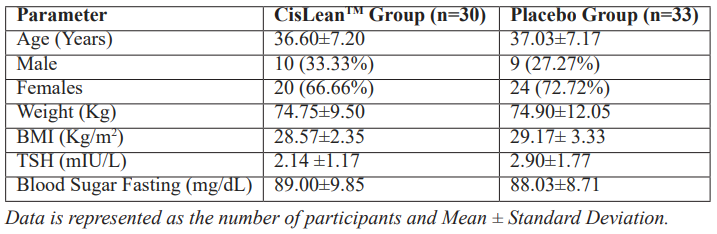
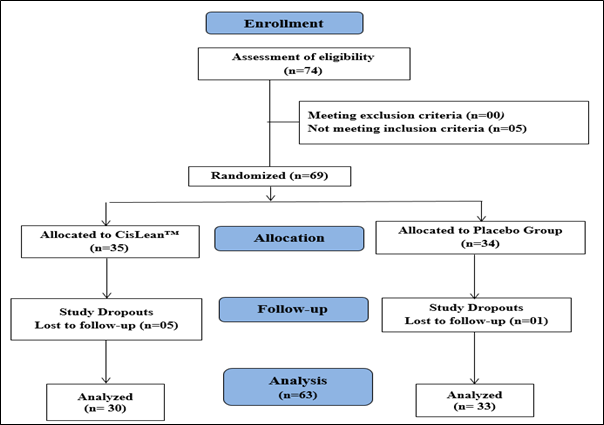
Figure 1:Consort Diagram.
Table 2: Assessment of change in weight and BMI.
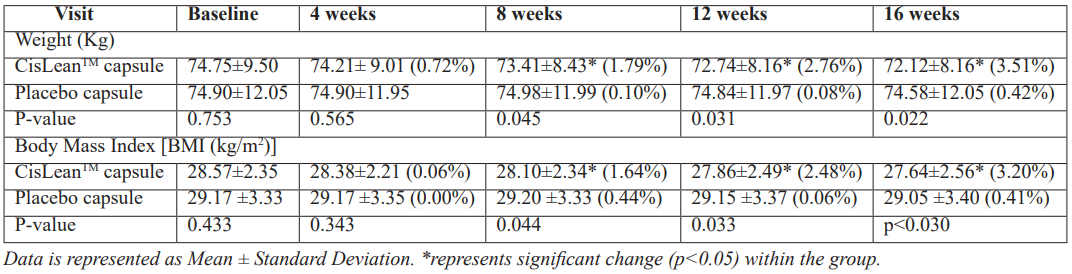
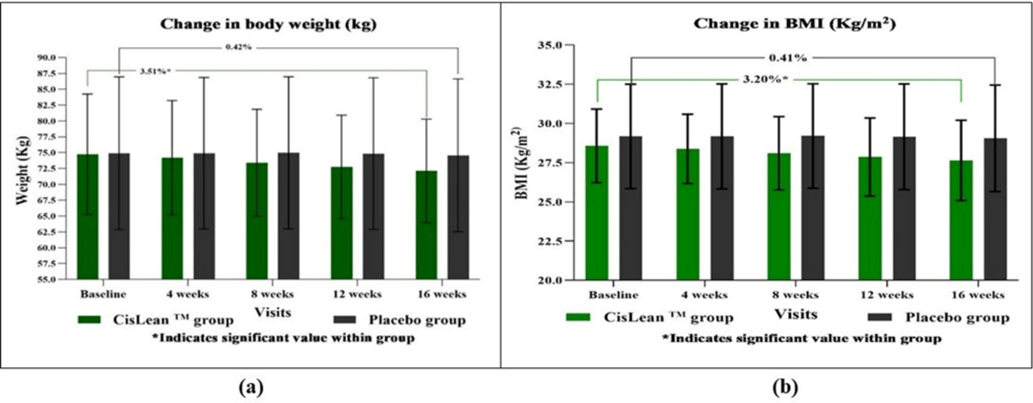
Figure 2: Change in body weight and BMI over 16 weeks.
Table 3: Assessment of Anthropometric measurements.
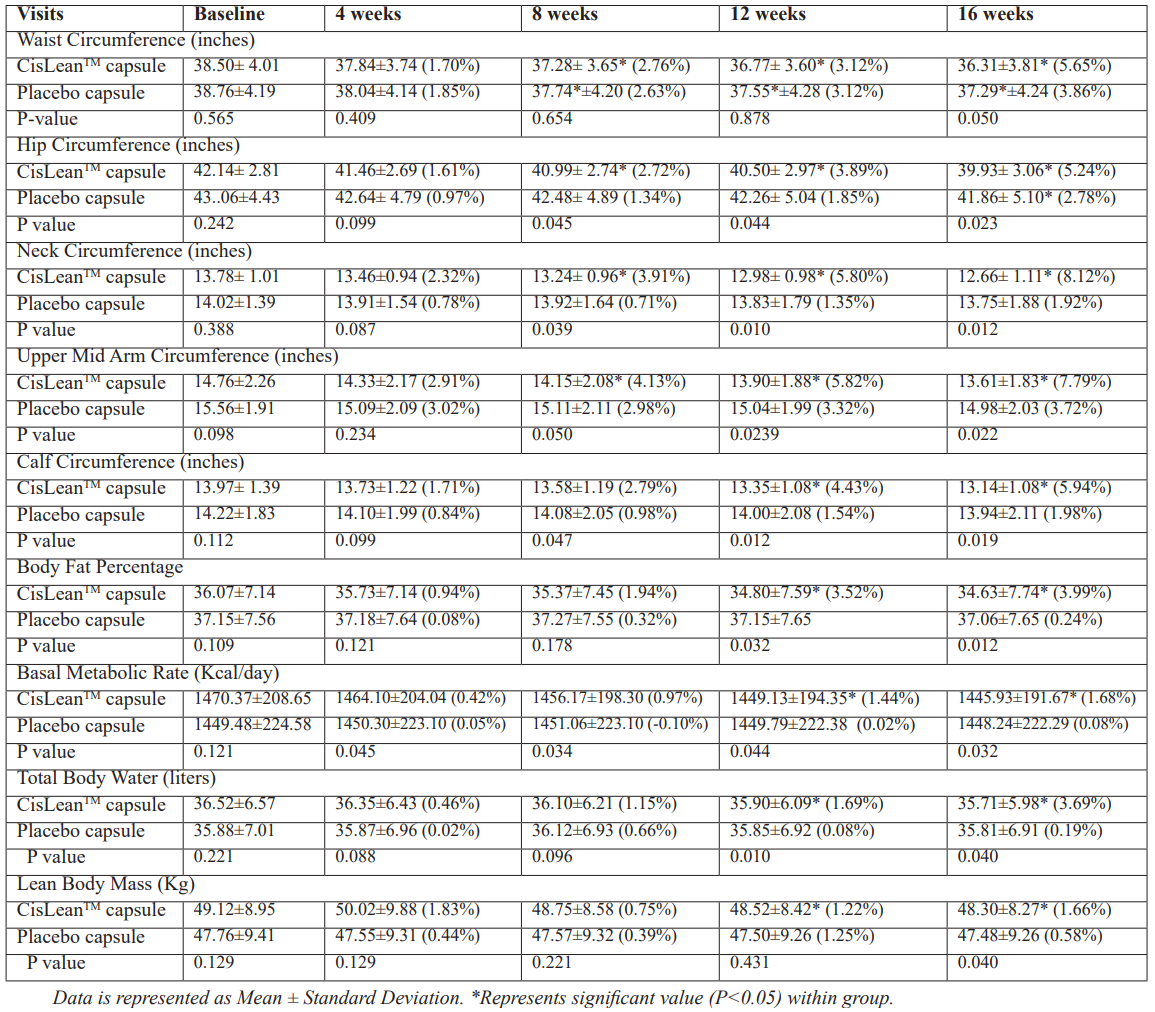
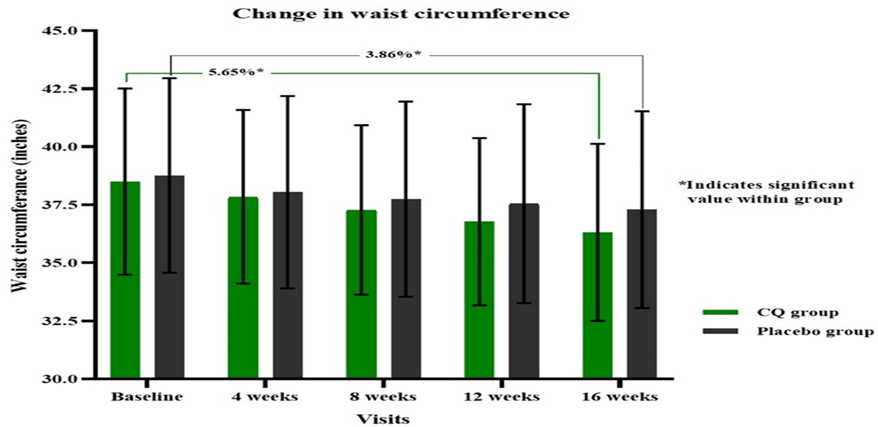
Figure 3: Change in waist circumference over the study period.
Discussion
The present study evaluated the efficacy and safety of CisLean™ capsules in healthy obese participants. CisLean™ significantly reduced body weight (3.51% vs. 0.42%) and BMI (3.2% vs. 0.41%) versus placebo at 16 weeks (p<0.05), consistent with previous Cissus quadrangularis findings [18]. Waist (5.65%), hip (5.24%), neck, upper-arm, and calf circumferences also decreased significantly versus placebo, supporting earlier CisLean™ and CQR-300 findings [19,20]. Body fat, basal metabolic rate, total body water, and lean body mass showed greater reductions from week 12 onward, while lipid parameters and general well-being remained unchanged. Proposed mechanisms of C. quadrangularis include leptin modulation, reduced adipocyte glycerol release, and UCP1-mediated thermogenesis [19,22,23], although formulation-specific evidence is not yet available. CisLean™ was well tolerated, with no clinically significant safety changes or related adverse effects. Limitations included the small sample size, 16-week duration, healthy obese population, and limited lifestyle control. Larger, longer-term studies are warranted.
Conclusion
In this short-term clinical trial in healthy obese adults, CisLean™ was associated with modest but statistically significant reductions in body weight, BMI, and multiple anthropometric measures, particularly those related to central adiposity. No meaningful changes were observed in lipid profile parameters. The product was well tolerated over 16 weeks, with no safety concerns identified. Larger, longer-duration, and controlled studies are needed to confirm these findings and to further evaluate the efficacy and safety of CisLean™ in broader clinical populations.
Author Contribution: Concept and design: Girish S. Soman, Arati D. Soman.
Acquisition, analysis, or interpretation of data: Vineet K. Malhotra, Aishwarya Gandas, Nilesh Londhe, Sarika Londhe, Sanjay Tamoli
Drafting of the manuscript: Vineet K. Malhotra, Aishwarya Gandas, Nilesh Londhe, Sarika Londhe, Girish S. Soman, Arati D. Soman, Sanjay Tamoli
Critical review of the manuscript for important intellectual content: Vineet K. Malhotra, Aishwarya Gandas, Nilesh Londhe, Sarika Londhe, Girish S. Soman, Arati D. Soman, Sanjay Tamoli
Supervision: Vineet K. Malhotra, Aishwarya Gandas, Nilesh Londhe, Sarika Londhe, Girish S. Soman, Arati D. Soman, Sanjay Tamoli.
Funding Statement: The material and testing expenses of the study were borne by Nisarga Biotech Pvt. Ltd.
Conflict of Interest Statement: Girish Sudhakar Soman, and Dr. Arati Devendra Soman are associated with Nisarga Biotech Pvt. Ltd. Other authors declare no conflict of interest.
Data Availability Statement: The datasets generated and/or analysed during the current study are not publicly available due to intellectual property constraints.
References
- World Health Organization. (n.d.). Obesity and overweight factsheet. Retrieved, 2021.
- World Health Organization, 2025.
- Panuganti KK, Nguyen M, Kshirsagar RK. . In: StatPearls [Internet] ; 2025 Jan.. Treasure Island (FL) (ed): StatPearls Publishing, 2023.
- Nammi S, Koka S, Chinnala KM, Boini KM: Obesity: An overview on its current perspectives and treatment options. Nutrition Journal. 2004, 10:1186/1475. doi: 10.1186/1475-2891-3-3.
- Blackburn GL: Effect of degree of weight loss on health benefits. Obesity Research, 1995; 3: 211S-216S. doi: 10.1002/j.1550-8528.1995.tb00466.x.
- WHO Consultation on Obesity, & World Health Organization. Obesity: Preventing and managing the global epidemic, 2000; 894.
- Whitlock G, Lewington S, Sherliker P. Body-mass index and cause-specific mortality in 900,000 adults: Collaborative analyses of 57 prospective studies. The. Lancet, 2009; 373: 1083-1096. doi: 10.1016/S0140-6736(09)60318-4.
- Lau DC, Douketis JD, Morrison KM. Canadian clinical practice guidelines on the management and prevention of obesity in adults and children [summary]. CMAJ, 2007; 176: S1-S13. doi: 10.1503/cmaj.061409.
- Bleich S, Cutler D, Murray C. Why is the developed world obese? Annual Review of Public Health. 2008, 29:273-295. doi: 10.1146/annurev.publhealth.29.020907.090954.
- Powell-Wiley TM, Poirier P, Burke LE. Obesity and cardiovascular disease: A scientific statement from the American Heart Association. Circulation, 2021; 143: e984-e1010. doi: 10.1161/CIR.0000000000000973.
- Grundy SM. Obesity, metabolic syndrome, and cardiovascular disease. The. Journal of Clinical Endocrinology & Metabolism. 2004, 89:2595-2600. doi: 10.1210/jc.2004-0372.
- Blüher M. Obesity: Global epidemiology and pathogenesis. Nature Reviews Endocrinology, 2019; 15: 288-298. doi: 10.1038/s41574-019-0176-8.
- S. Department of Health and Human Services. (2017). 2015-2020 dietary guidelines for Americans. Skyhorse Publishing Inc, 2019.
- Jensen MD, Ryan DH, Apovian CM. 2013 AHA/ACC/TOS guideline for the management of overweight and obesity in adults: A report from the American College of Cardiology/American Heart Association Task Force on Practice Guidelines and The Obesity Society. Circulation, 2014; 129: 102-138. doi: 10.1161/01.cir.0000437739.71477.ee.
- Shick SM, Wing RR, Klem ML. Persons successful at long-term weight loss and maintenance continue to consume a low-energy, low-fat diet. Journal of the American Dietetic Association. 1998, 98:408-413. doi: 10.1016/S0002-8223(98)00093-5.
- Heymsfield SB, Wadden TA. Mechanisms, pathophysiology, and management of obesity. The. New England Journal of Medicine. 2017, 376:254-266. doi: 10.1056/NEJMra1514009.
- Colquitt JL, Pickett K, Loveman E, et al. Surgery for weight loss in adults. The Cochrane Database of Systematic Reviews, 2014; 8. doi: 10.1002/14651858.CD003641.pub4.
- Oben JE, Enyegue DM, et al. The effect of Cissus quadrangularis (CQR-300) and a Cissus formulation (CORE) on obesity and obesity-induced oxidative stress. Lipids in Health and Disease. 2007, 6:4-10. doi: 10.1186/1476-511X-6-4.
- Chatree S, Sitticharoon C, Maikaew P. Cissus quadrangularis enhances UCP1 mRNA, indicative of white adipocyte browning and decreases central obesity in humans in a randomized trial. Scientific Reports. 2021, 1038:41598-021. doi: 10.1038/s41598-021-81606-9.
- Nash R, Azantsa B, Kuate D. The use of a stem and leaf aqueous extract of Cissus quadrangularis (CQR-300) to reduce body fat and other components of metabolic syndrome in overweight participants. Journal of Alternative and Complementary Medicine. 2021, 25:98-106. doi: 10.1089/acm.2018.0016.
- Deka DK, Lahon LC, Saikia J. Effect of Cissus quadrangularis in accelerating healing process of experimentally fractured radius-ulna of dog: A preliminary study. Indian Journal of Pharmacology, 1994; 26: 44-45.
- Oben J, Kuate D, Agbor G. The use of a Cissus quadrangularis formulation in the management of weight loss and metabolic syndrome. Lipids in Health and Disease. 2006, 5:24-10. doi: 10.1186/1476-511X-5-24.
- Lee HJ, Lee DR, Choi BK. Cissus quadrangularis extracts decreases body fat through regulation of fatty acid synthesis in high-fat diet-induced obese mice. Journal of Applied Biological Chemistry. 2016, 59:49-56. doi: 10.3839/jabc.2016.010.Top of Form