
Email id: info@ijclinmedcasereports.com
The LimusTrack Very Thin-Strut Sirolimus-Eluting Stent with a Biodegradable Polymer in Real-World All-Comers Coronary Artery Disease Patients: Clinical Performance of The VISTUS–INFORM Registry
Lirza Gorani, Idriz Merovci, Agon Nuhiu, Artan Krasniqi, Daut Gorani, Liman Keka, Eleftherios Malakoudis*
Department of cardiology clinical Center Pristina, Kosovo, Greece
Received Date: 29/10/2026; Published Date: 14/12/2026
*Corresponding author: Eleftherios Malakoudis, Department of cardiology clinical Center Pristina, Kosovo, Greece
Abstract
Background: Very thin struts, biodegradable polymer, drug eluting stents have shown reduced restenosis rate, less readmissions and low rates of strut thrombosis related with the reduced response of the vessels wall to the minimized foreign body volume and the favorable metal tissue ratio. The present post marketing observation retrospective registry assessed clinical performance of patients who received LimusTrack very-thin-struts SES in real practice. Aim: to investigate years’ clinical safety and performance/outcomes of LimusTrack very thin struts SES in real practice.
Methods: Data obtain from a single center Cohort of patients who have received LimusTrack stent as a part of treatment for Coronary Disease, Between May 2025 and august 2026 (12±2 months). These patients were identified out of the hospital database and collected for analysis. There were no exclusion criteria but only the lost ones in follow-up. The primary study endpoint was determining the rate of Target Lesion Failure (TLF) defined as the aggregate of cardiac death, target vessel Q-wave or non Q-wave Myocardial Infraction (MI) and TLR procedure during the follow-up period after the index procedure. Secondary endpoint was MACE defined as a composite of all cause mortality, any MI and any repeat revascularization (includes all target and non-target vessels). The Stent Thrombosis (ST) was also evaluated and was classified according to the definitions of the academic research consortium.
Results: A total of 105 patients with 106 lesions were enrolled. Of these, 77 were males (73%) and 28 (27%) were females. The most common comorbid condition was diabetes mellitus (DM) 43% / hypertension (63%), a history of smoking (7%), dyslipidemia (37%), coronary artery bypass graft (10%), none (2%). Furthermore, the majority of the enrolled patient (73%) were treated for symptomatic ischemic coronary heart disease due to the de novo lesions, or restenosis lesions of the coronary arteries -40% presenting with angina and 33% wit unstable angina, procedural success was achieved in all patients and no in hospital MACE was reported. The composite of TLF (target Lesion Failure) at 12± two months period was 3.8% with one cardiac death (0.95%),1 MI attributed to the target vessel (0.95%) and 2 TLRs solved by PCI. MACE rates during the follow up duration in brief were reported 7 (6.67%) patients consisting of: one cardiac death, one no cardiac death, one myocardial infarction attributed to the target vessel, one myocardial infarction non attributed to the target vessel (095%). TLR events were 2 patients (1.90%). All TLR events solved with PCI, with full recovery after treatment. TVR was observed in one patient (0.95%), solved by PCI. One incidence of ST was observed during the following period. No sub-acute ST was observed.no in hospital MACE and no late or very late thrombosis were observed.
Conclusion: Based to the absence of very low midterm rate of TLF and MACE and overall absence of acute, subacute or very late thrombosis in this, single center, observational, retrospective registry and from the other part the very good technical performance of the LimusTrack very thin struts sirolimus eluting biodegradable stent this coronary endoprosthesis can be considered as safe and effective and can be suggested as an alternative one to the contemporary stents for the treatment of the de novo lesions in coronary artery disease.
Keywords: Very thin strut drug eluting stents (DES); Percutaneous Coronary Interventions; PLGA MACE stent thrombosis
Introduction
The usage of drug eluted stents is intended for narrowed coronary vessels of patients with Coronary Artery Diseases (CAD). They developed to minimize the risk of restenosis by the local delivery of antiproliferative drugs, integrated with various polymers to optimize drug kinetics. At the first generation of DES, the total scaffold structure, entry profile, strut width, interaction with the durable polymer coatings, led to poor improvement of the mortality following Percutaneous Coronary Intervention (PCI). These results were relevant to the limited biocompatibility of the polymers and the strong vessel response to the bulky metal structure of these early phase DES struts [1]. The second generation of stents showed more favorable results and better clinical outcomes based on the biodegradable polymers and thinner metallic structures. The current third generation DES, with very thin strut structure and biodegradable polymers shown improved deliverability in tortuous and challenging anatomies and overall better clinical/technical performance. Particularly the combination of resistible in temperature biodegradable polymers (PLGA) and very thin strut structure was manufactured to inhibit the inflammation and also the favorable less vessel wall response due to the favorable metal/tissue ratio. Therefore, we accessed in all comer patient population the safety, efficacy and overall clinical – technical performance of LimusTrack biodegradable polymer Sirolimus eluting very thin strut stent.
Study Design: Data obtain from a single center cohort of patients who have received LimusTrack stent as a part of treatment for coronary artery disease, between May 2025 and August 2026. These patients were identified out of the hospital database and collected for analysis. There were no exclusion criteria but only the lost ones in follow-up.
Description of Device
The LimusTrack is an ultrathin cobalt- chromium platform with a strut thickness of 65 μm and a biodegradable polymer-based coating. In LimusTrack a biodegradable polymer Poly Lactic-co-Glycolic Acid (PLGA) is used to achieve a controlled drug release using a validated formulation of sirolimus (1.40 μm/mm2) timed to elute in 90 – 120 days in parallel; with the polymer resorption. The configuration of the coating is asymmetrical and thicker on the abluminal side than on the luminal side (5 μm vs. 3 μm, respectively), which results in a higher drug dose on the abluminal side of the DES. The LimusTrack is available in sizes ranging from 8 to 48 mm length and from 2.25 to 4.00 mm diameter.
Study procedure and data collection
This was an all-comer study, and the indications for the angioplasty procedure and technique of stent implantation were as per the discretion of the treating physician. All patients were advised to receive dual antiplatelet therapy with clopidogrel and aspirin. Patients who were not pretreated received a bolus dose of 300-600 mg of clopidogrel or 60 mg of prasugrel and ≥ 100 mg of soluble aspirin just before the procedure.
Data was sourced from clinical notes, including in-patient progress notes and out-patient notes and letters, angiogram reports, and procedural angiographic images. Case report forms were completed for all patients, and completely anonymized data were stored in a secure, off-site database. Follow-up data were collected using telephonic interactions by using structured questionnaires developed for this study to determine endpoint status.
Endpoint definitions
The primary endpoint of the study was to determine the rate of Target Lesion Failure, which is defined as the aggregate of cardiac death, target vessel Q-wave or no Q-wave Myocardial Infarction (MI), and TLR procedure during the follow-up period after the index procedure. Secondary endpoint was MACE which is defined as the aggregate of all-cause mortality, any MI and any repeat revascularization (including all target and non-target vessel). The Stent Thrombosis (ST) was classified according to the definitions of the Academic Research Consortium [2]. Procedural success was defined as successful stent placement at the desired position with <30% residual stenosis.
Statistical analysis
Categorical data were presented as counts and percentages. Continuous variables were recorded as mean ± standard deviation. All data were processed using Statistical Package® SPSS 22.0 for Windows® (SPSS, Chicago, IL, USA).
Baseline Demographics and clinical characteristics
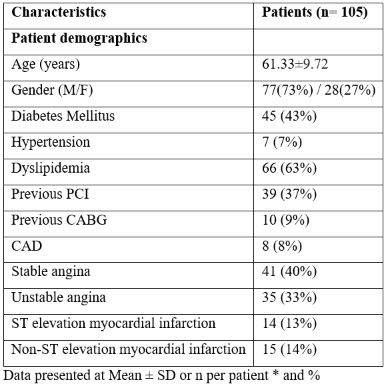
In total 105 patients with 105 lesions were retrospectively analyzed. Baseline demographics and clinical characteristics are summarized in Table 1. Mean age of patients was 61,33 9.72 years, 73% of them were men and 27% were women. The most common comorbid conditions were diabetes mellitus 43%, smoking, 7%, hypertension 63% and hyperlipidemia 37%. 28% of patients presented ST/No ST elevation myocardial infarction and 33% Unstable angina.
Table 1: Baseline Clinical Characteristics.
Lesion Characteristics
58.5% of lesions were moderate to high risk, B2/C lesions as per ACC/AHA criteria and 72.5% of the lesions had a TIMI flow grade below 3. The average length and diameter of the stent was 26.10±10.88 and 3.02±0.48 respectively. Clinical, procedural and technical success was 100%.
Lesion and pre-procedural characteristics
Table 2: Lesion characteristic.
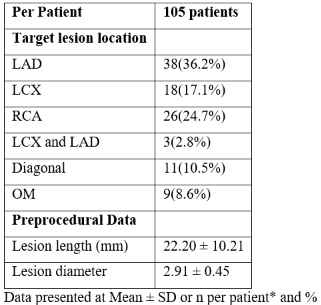
Most lesions were located in LAD (36.2 %), RCA (24.7 %), and LCx (17.1 %) (Table 2). Lesion length was 22.20 ± 10.21 mm and lesion diameter was 2.91 ± 0.45 mm. 22.85 % of patients had a lesion length longer than 30 mm. The stenosis rate was 84. 2±9.5.
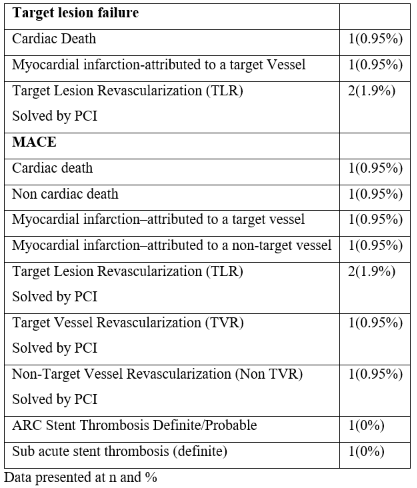
Table 3: Clinical outcomes.
Clinical outcomes during follow up period
The composite of TLF (target Lesion Failure) at 12± two months period was 3.8% with one cardiac death (0.95%),1 MI attributed to the target vessel (0.95%) and 2 TLRs solved by PCI. MACE rage during the follow up duration in brief were reported 7 (6.67%) patients consisting of: one cardiac death, one no cardiac death, one myocardial infarction attributed to the target vessel, one myocardial infarction non attributed to the target vessel (095%). TLR events were 2 patients (1.90%). All TLR events solved with PCI, with full recovery after treatment. TVR was observed in one patient (0.95%), solved by PCI. One incidence of ST was observed during the following period. No sub-acute ST was observed.no in hospital MACE and no late or very late thrombosis were observed.
Discussion
The above featured retrospective observational study was conducted to support the safety of LimusTrack very thin strut, sirolimus eluted, biodegradable polymer stent, in real-world clinical practice. The early and mid-term follow-up results demonstrated the favorable safety and performance of the stent with low rates of TFL (3.8%), MACE (6.67%) and total absence of ST (0%).
The real-world data of LimusTrack in an unselected clinical practice population with diverse clinical profiles, which included diabetes mellitus (45%), hypertension (63%), unstable angina (33%), and ACC/AHA type B, B2 and C lesions. The presentation of patients was similar to that reported in studies of other similar stents [3-10].
The LimusTrack stent is designed to have thin struts (65 μm) on a cobalt-chromium platform (L605) with an open cell design with three interlinks/nine crowns per segment which provides an optimum balance among the high radial strength, no foreshortening but also high flexibility and extreme deliverability, making it ideal for all lesion locations including ostial lesions, bifurcations and tortuous anatomies.
The first-generation DES were built on bulky stent platforms, making deliverability quite challenging [15]; however, the thin struts and growth of 8% from nominal pressure to rated burst pressure of this new-generation LimusTrack DES offer good deliverability and conformability, thereby allowing complete deployment and good wall apposition. The design leads to a minimal balloon overhang, minimizing the risk of edge dissection/injury, which is a common procedural complication of PCIs. The finding that procedural success was achieved in 100% of patients in this study supports these claims.
Compared with BMS, first-generation DES with a durable polymer has reduced the rate of restenosis but are associated with higher late ST [11]. Delayed endothelial healing secondary to a hypersensitivity reaction to the durable polymer could be responsible for the observed high rate of ST with such DES [16-18]. BP-DES was developed to address this potential limitation of durable polymer DES. The drug encapsulated in polymer is completely released within 3–9 months, and the polymer also gradually degrades into carbon dioxide and water molecules. Therefore, BP-DES initially provides anti-proliferative benefits similar to durable polymer DES and later behaves like BMS once drug delivery and polymer biodegradation are complete [12-15].
Given the importance of ST in evaluating the overall performance of DES, we estimated the ST rate in our study. The rates of both possible and probable late ST were 0.0% in the present registry, which is highly comparable or better to those of other standard BP-DES such as sirolimus-eluting Orsiro stents (0.4%), biolimus-eluting Nobori stents (1.2%), and Biolimus A9 stents (0.2%) at 1-year follow-up [19-22].
The low rate of ST observed in our study could be attributed to complete wall apposition of the LimusTrack stent and favorable complete endothelial healing over the 1-year period.
Although there is no scientific difference between indigenously developed DES vs. those developed and marketed by global manufacturers, cost effectiveness remains a key factor in the decision-making process for patients and health care providers worldwide [23-26]. The most promising results of this retrospective study are 100% procedural success rate and low rates of MACE (6.67%) and especially the low rates of TLF (primary endpoint – 3.8%) in our study are comparable to widely reported TLF incidence rates for other BP-DES: Ultimaster stent (4.1%), Resolute Onyx stent (4.4%), Synergy stent (5.8%) and XScience stent (3.18%) [27-29].
Study Limitations
A major limitation of the present study is the observational design and retrospective analysis of data. However, observational data allows true representation of all-comer population unlike randomized trials with restricted enrollment criteria. Therefore, our results must be further substantiated in well-designed studies with longer follow-up duration.
Conclusion
In conclusion, the relatively low rates of TLF, MACE and total absence of ST in this cohort of patients after more than one year of follow-up support the favorable safety and performance of LimusTrack stents. Product characteristics such as advanced very thin strut stent design with the use of short-term polymer degradation could be responsible for these results. LimusTrack could be suggested as an effective alternative to other contemporary stents available in the market for the treatment of de novo lesions in native coronary arteries, bifurcations, small vessels and other tortuous anatomies.
Disclosures
Conflict of interest: None
Funding: The analysis was funded by L2M Tech GMDH.
References
- Gupta R, Mohan I, Narula J. Trends in coronary heart disease epidemiology in india. Annals of Global Health, 2016; 82(2): 307-315.
- Sample Registration System Report Office of the Registrar General, New Delhi, India, 2011. Registrar General of India, 2011.
- Boden WE, O'Rourke RA, Teo KK, Hartigan PM, Maron DJ, Kostuk WJ, et al. Optimal medical therapy with or without pci for stable coronary disease.N Engl J Med, 2007; 356: 1503-1516.
- Sedlis SP, Hartigan PM, Teo KK, Maron DJ, Spertus JA, Mancini GBJ, et al. Effect of pci on long-term survival in patients with stable ischemic heart disease.N Engl J Med, 2015; 373: 1937-1946.
- Fihn SD, Gardin JM, Abrams J, Berra K, Blankenship JC, Dallas AP, et al. 2012 ACCF/AHA/ACP/AATS/PCNA/SCAI/STS guideline for the diagnosis and management of patients with stable ischemic heart disease: a report of the American college of cardiology foundation/American heart association task force on practice guidelines, and the American college of physicians, American association for thoracic surgery, preventive cardiovascular nurses association, society for cardiovascular angiography and interventions, and society of thoracic surgeons.J Am Coll Cardiol, 2012; 60: e44-164.
- Hamon M, Niculescu R, Deleanu D, Dorobantu M, Weissman NJ, Waksman R. Clinical and angiographic experience with a third-generation drug-eluting orsiro stent in the treatment of single de novo coronary artery lesions (bioflow-i): A prospective, first-in-man study.EuroIntervention, 2013; 8: 1006-1011.
- Garg S, Serruys P, Onuma Y, Dorange C, Veldhof S, Miquel-Hébert K, et al. 3-year clinical follow-up of the xience v everolimus-eluting coronary stent system in the treatment of patients with de novo coronary artery lesions: The spirit ii trial (clinical evaluation of the xience v everolimus eluting coronary stent system in the treatment of patients with de novo native coronary artery lesions).JACC Cardiovasc Interv, 2009; 2: 1190-1198.
- Finn AV, Nakazawa G, Joner M, Kolodgie FD, Mont EK, Gold HK, et al. Vascular responses to drug eluting stents: Importance of delayed healing.Arterioscler Thromb Vasc Biol, 2007; 27(7): 1500-1510.
- Parsa E, Saroukhani S, Majlessi F, Poorhosseini H, Lofti-Tokaldany M, Jalali A, et al. Biodegradable-polymer biolimus-eluting stents versus durable-polymer everolimus-eluting stents at one-year follow-up: a registry-based cohort study.Tex Heart Inst J, 2016; 43(2): 126-130.
- Goyal BK, Kalmath BC, Kawar R, Sharma A, Khemnar B, Rangnekar H. Experience with biomatrix bes and other des in all-comers setting: A retrospective overview.Indian Heart J, 2013; 65(6): 678-682.
- Stefanini GG, Byrne RA, Serruys PW, de Waha A, Meier B, Massberg S, et al. Biodegradable polymer drug-eluting stents reduce the risk of stent thrombosis at 4 years in patients undergoing percutaneous coronary intervention: A pooled analysis of individual patient data from the ISAR-TEST 3, ISAR-TEST 4, and LEADERS randomized trials.Eur Heart J, 2012; 33(10): 1214-1222.
- Cutlip DE, Windecker S, Mehran R, Boam A, Cohen DJ, van Es GA et al. Clinical end points in coronary stent trials: A case for standardized definitions.Circulation, 2007; 115(17): 2344-2351.
- Prakasa Rao VS, Narayana Rao ASV, Kapardhi PLN, Shah PK, Viswanath R, Mehetre SG, et al. Safety and performance of sirolimus-eluting coronary stent system with biodegradable polymer: A retrospective analysis in real-world patient population.World J Cardiovasc Dis, 2017; 7(5): 163-173.
- Mehta AB, Chandra P, Dalal J, Shetty P, Desai D, Chocklingam K, et al. One-year clinical outcomes of BioMatrix™-Biolimus A9™ eluting stent: The e-BioMatrix multicenter post marketing surveillance registry in India.Indian Heart J, 2013; 65(5): 593-599.
- Navarese EP, Kowalewski M, Kandzari D, Lansky A, Górny B, Kołtowski L, et al. First-generation versus second-generation drug-eluting stents in current clinical practice: Updated evidence from a comprehensive meta-analysis of randomised clinical trials comprising 31 379 patients.Open Heart, 2014; 1(1): e000064.
- Finn AV, Nakazawa G, Kolodgie FD, Virmani R. Temporal course of neointimal formation after drug-eluting stent placement: Is our understanding of restenosis changing?JACC Cardiovasc Interv, 2009; 2(4): 300-302.
- Nebeker JR, Virmani R, Bennett CL, Hoffman JM, Samore MH, Alvarez J, et al. Hypersensitivity cases associated with drug-eluting coronary stents: A review of available cases from the Research on Adverse Drug Events and Reports (RADAR) project.J Am Coll Cardiol, 2006; 47(1): 175-181.
- Joner M, Finn AV, Farb A, Mont EK, Kolodgie FD, Ladich E, et al. Pathology of drug-eluting stents in humans: Delayed healing and late thrombotic risk.J Am Coll Cardiol, 2006; 48(1): 193-202.
- Vorpahl M, Finn AV, Nakano M, Virmani R. The bioabsorption process: Tissue and cellular mechanisms and outcomes. EuroIntervention, 2009; 5 Suppl F: F28-F35.
- Jensen LO, Thayssen P, Maeng M, Ravkilde J, Krusell LR, Raungaard B, et al. Randomized comparison of a biodegradable polymer ultrathin strut sirolimus-eluting stent with a biodegradable polymer biolimus-eluting stent in patients treated with percutaneous coronary intervention: The sort out vii trial.Circ Cardiovasc Interv, 2016; 9(7): e003610.
- Sastry BKS, Nallamalla KR, Kumar N, Kodati D, Menon R. One-year clinical outcomes of different coronary drug eluting stents-data from a prospective registry.Indian Heart J, 2018; 70(4): 580-583.
- Maeng M, Tilsted HH, Jensen LO, Kaltoft A, Kelbæk H, Abildgaard U, et al. 3-Year clinical outcomes in the randomized SORT OUT III superiority trial comparing zotarolimus- and sirolimus-eluting coronary stents.JACC Cardiovasc Interv, 2012; 5(8): 812-818.
- Natsuaki M, Kozuma K, Morimoto T, Kadota K, Muramatsu T, Nakagawa Y, et al. Final 3-year outcome of a randomized trial comparing second-generation drug-eluting stents using either biodegradable polymer or durable polymer: Nobori biolimus-eluting versus xience/promus everolimus-eluting stent trial.Circ Cardiovasc Interv, 2015; 8(10): e002817.
- Kim et al. Efficacy and Safety of Sirolimus-Eluting Stent With Biodegradable Polymer Ultimaster™ in Unselected Korean Population: A Multicenter, Prospective, Observational Study From Korean Multicenter Ultimaster Registry. Korean Circulation Journal, 2024; 54(6): 339–350. doi:10.4070/kcj.2024.0023.
- Ananthakrishna R, Kristanto W, Liu L, et al. Incidence and predictors of target lesion failure in a multiethnic Asian population receiving the SYNERGY coronary stent: A prospective all-comers registry. Catheterization and Cardiovascular Interventions, 2018; 92(6): 1097–1103. doi:10.1002/ccd.27577.
- A Multi-Center Prospective Cohort of Patients With Coronary Artery Disease Treated With Xience Alpine/Sierra, an Everolimus-Eluting Stent: Results From the Xience-Sierra Registry. Journal of Cardiovascular Intervention, https://e-jci.org/DOIx.php?id=10.54912/jci.2025.0028
- Tam CC, Chan K, Lam S, et al. One-year clinical outcomes of patients implanted with a Resolute Onyx™ zotarolimus-eluting stent. Journal of International Medical Research, 2018; 46(3): 1202–1212. doi:10.1177/0300060517717826.
- CERC Europe. EucaLimus Post-Market Registry.
- Lemos PA, Chandwani P, Saxena S, et al. Clinical outcomes in 995 unselected real-world patients treated with an ultrathin biodegradable polymer-coated sirolimus-eluting stent: 12-month results from the FLEX Registry. BMJ Open, 2016; 6(2): doi:10.1136/bmjopen-2015-010028.