Email id: info@ijclinmedcasereports.com
Nurses Perception Regarding Usage of Glasgow Coma Scale for Assessing the Neurological Status of Stroke at a Selected Hospital in Bangladesh
Mst Shahinur Khatun1,*, Md Shariful Islam2, Mohammad Nurul Anowar2, Dipali Rani Mallick3 and Mohammad Hafizur Rahman4
1MSN student, Adult and Elderly Health Nursing, National Institute of Advanced Nursing Education and Research (NIANER), Dhaka, Bangladesh
2Faculty of Adult and Elderly Health Nursing, NIANER, Dhaka, Bangladesh
3Faculty of Women Health and Midwifery Nursing, NIANER, Dhaka, Bangladesh
4Nursing Instructor, Madaripur Nursing Institute, Dhaka, Bangladesh
Received Date: 04/08/2026; Published Date: 18/10/2026
*Corresponding author: Mst. Shahinur Khatun, MSN student, National Institute of Advanced Nursing Education and Research (NIANER), Dhaka, Bangladesh
Abstract
Background: Stroke is the most debilitating cardiovascular event. Early identification and detection of neurological status of stroke is an important monitoring role of a nurse. The Glasgow coma scale is one of the most effective and reliable tools that has been widely used to assess any changes of a patient’s neurological status.
Objective: The aim of this study was to assess the nurses' perception regarding usage of Glasgow coma scale for assessing the neurological status of stroke.
Methods: This was a descriptive cross-sectional study conducted at Dhaka Medical College Hospital in Bangladesh. A total of 112 nurses were included in this study who were working at neuro-medicine ward, general medicine ward, ICU and emergency department. A convenience sampling technique was used to select the sample. Previously developed and validated 15 items Perception on Glasgow Coma Scale related self-administered questionnaire was used to collect the data. The questionnaire is consisted of two sections. Section I is related to Socio-Demographic Characteristics Questionnaire. Section II is comprised of Nurses' Perception on Glasgow Coma Scale related Questionnaire. Data were analyzed by using Descriptive and Inferential statistics. The data collection period was from December 2021 to January 2022.
Results: The result showed that the mean perception of the participants on Glasgow Coma Scale was 8.54 (SD=4.53) out of maximum of 15 points indicating moderate level of perception. The results also found that education (p=.000), work setting (p=.000), and refresher training on GCS (p=.000) were statistically significantly correlated with nurses’ perception on Glasgow Coma Scale. The findings of the study would contribute to develop education program on Glasgow Coma Scale for nurses to increase their skills and competency for assessing the neurological status of stroke.
Conclusion: Nurses obtained moderate level of perception on usage of Glasgow Coma Scale for assessing the neurological status of stroke which is important for nurses to minimize stroke related health problems. For that, nurses must have a sound perception of Glasgow Coma Scale. Education program on usage of Glasgow Coma Scale may be designed and training can be conducted to enhance nurses’ perception on Glasgow Coma Scale for assessing the neurological status of stroke.
Keywords: Nurse; Nurses Perception; Glasgow Coma Scale; Stroke
Introduction
Stroke is defined as spinal cord, or retinal cell death attributable to ischemia, based on neuropathological, neuroimaging, and/or clinical evidence of permanent injury to the brain and is a leading cause of death around the world [1]. In Bangladesh, stroke is the third leading cause of death. The mortality rate of stroke is estimated at 15.31% in Bangladesh, whereas 11.8% of stroke death occurred globally. Stroke causes an increase in the use of hospital resources, patient care cost, and length of hospital stays [2]. Bangladesh spent less than 2.7% of its total Gross Domestic Products (GDP) on health care costs including stroke [2]. In western countries treatment cost of stroke ranges from 3% to 4% of total health care cost. In the United States, the annual cost of stroke care is around US $140,048 dollar which includes inpatient care, rehabilitation, and follow-up care [3].
Stroke assessment is clinically important because of its clinical characteristics. Post-stroke seizures, urinary incontinence, bowel incontinence, cognitive impairment, hemiplegic shoulder pain, wrist and hand flexion were identified as neurological complications of stroke [4]. Nurses’ role is critical in assessing neurological status of stroke. Competency in stroke assessment contributes to improving nurses’ performance in assessing neurological status of stroke. There is a various gold standard neurological scales in the world including Glasgow Coma Scale (GCS), the National Institutes of Health Stroke Scale (NIHS), the Canadian Secondary Scale, and the Four Score [5]. Among these scales, GCS is the best neurological scale to assess the characteristics of stroke. A study on observing and recording neurological dysfunction identified that GCS enables practitioners to assess neurological status in adults regularly and quickly as well as to determine trends that can be easily interpreted and explained to other team members [6].
However, nurses’ perception regarding GCS to assess the characteristics of stroke is inadequate. Previous research showed that nurses who had sound knowledge and skills on GCS had better perception for assessing neurological status of stroke [7]. Finding also revealed that the majority of nurses answered correctly about accuracy rates for each component of the GCS and about half of the nurses had poor perception to assess the neurological status of stroke using GCS. Therefore, Vietnamese nurses were unable to integrate their GCS theory into clinical practice [8]. In Kenya, most of the nurses had poor perception of GCS to assess the clinical characteristics of stroke [9]. Another study at a tertiary hospital in Ghana showed that more than half of the participants had a good theoretical understanding of GCS but they were mostly unable to integrate their understanding into clinical practice for assessing the neurological status of stroke [10]. Based on the above discussion it has been showed that the majority of nurses had poor understanding about GCS for assessing the neurological status of stroke. However, most authors conducted a study on nurses’ knowledge, attitude and skills on stroke assessment, but they did not focus on nurses’ perceptions. Hence, this study emphasized on nurses’ perception regarding Glasgow Coma Scale for assessing the neurological status of stroke.
There is a dearth of study conducted in Bangladesh on nurses’ perception regarding usage of Glasgow Coma Scale for assessing the neurological status of stroke patient. Therefore, it is important to assess the level of Bangladeshi nurse’s perception regarding usage of GCS for assessing the neurological status of stroke. The findings of the study would contribute to develop an educational program on GCS for nurses to increase their knowledge and competency in assessing the neurological status of stroke. Therefore, it is necessary to conduct this study entitled nurses perception on GCS for assessing the neurological status of stroke at Dhaka Medical College Hospital.
Methods
A descriptive cross-sectional study design was used to assess the nurses’ perception regarding usage of Glasgow Coma Scale for assessing the neurological status of stroke. The approval was obtained from the Institutional Review Board (IRB) of NIANER and BMU and from Director of Dhaka Medical College Hospital. The data were collected at Dhaka Medical College Hospital in between July 2021 to June 2022. A convenient sampling technique was employed to select the nurses. Total of 112 nurses were students were selected based on the following inclusion criteria. Nurses who had at least three years of diploma in nursing, and who had at least six months of working experience in the selected wards and who could understand, read, write and speak Bengali language well were included in this study. Nurses who had casual leave, maternity leave, sick leave, day off, and night shift were excluded from the study.
Nurses who had at least three years of diploma in nursing, and who had at least six months of working experience in the selected wards and who could understand, read, write and speak Bengali language well were included in this study. Nurses who had casual leave, maternity leave, sick leave, day off, and night shift were excluded from the study.
The questionnaire is divided into two sections: Section I is related to Socio-demographic Characteristics related Questionnaire and Section II is related to Nurses' Perception on Glasgow Coma Scale related Questionnaire. This section consists of 15 items questionnaire that was previously developed by Matter, Liaw and Chan in 2013 for assessing the level of nurse’s perception regarding usage of GCS. Each item had yes, no and don’t know options. The correct response for each item receives a ‘1’ point and for the incorrect response ‘0’ point. The score was ranged from 0 to 15 and it was converted into a percentage. The perception was categorized into three levels. A low level of perception was considered 33% and less, a moderate level of perception was considered 34%-66% and a high level of perception was considered as more than 67%.
Results
Demographic Characteristics of the Nurses
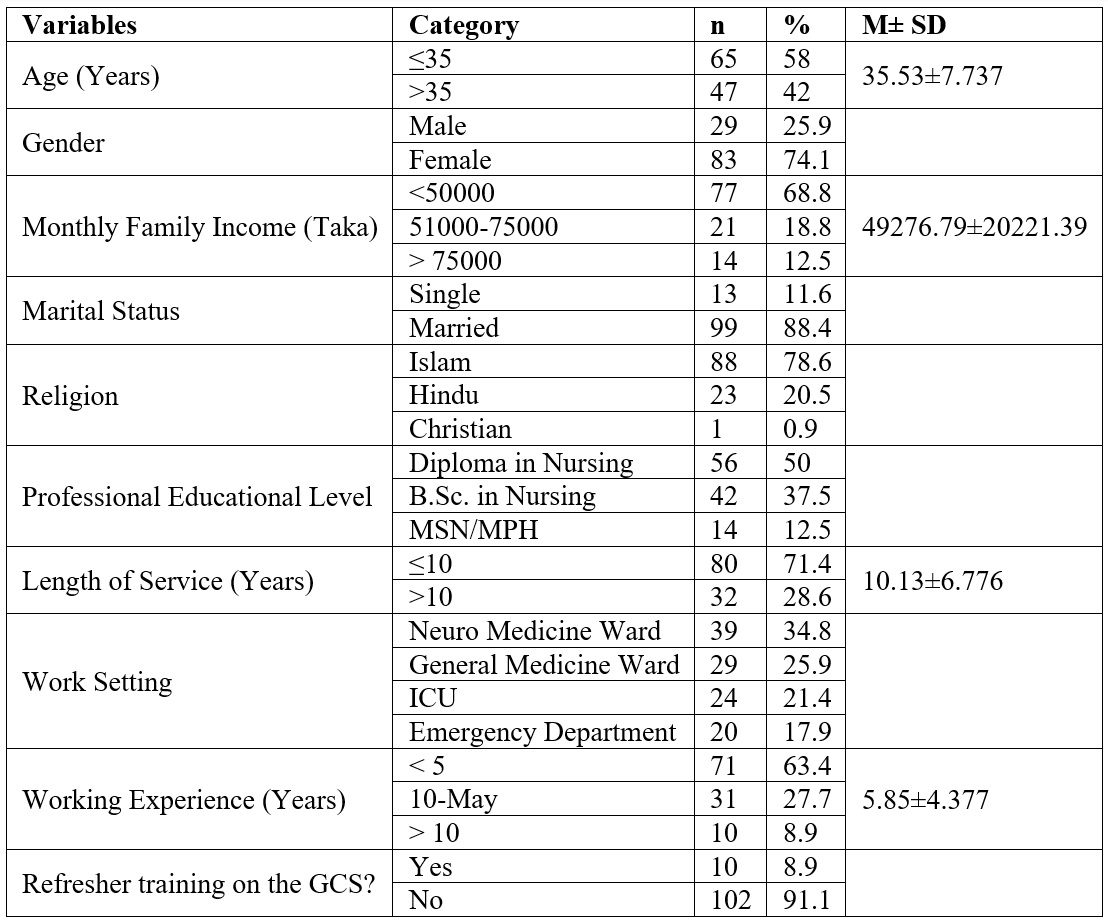
Table 1 illustrates the frequency and percentage of participants' socio-demographic characteristics. In accordance with the findings the mean age of the nurses was 35.53 (SD=7.737) years old. Most of the nurses (58%) were in the age group of less than 35 years. The mean monthly family income of the nurses was 49,276.79 (SD=20221.39) taka, and most of their (68.8%) monthly family income was less than 50000 taka. The nurses were mostly Muslim (78.6%) and majority (88.4%) of them were married. In term of professional education, half (50%) of the nurses had held Diploma in Nursing degree, above one third (37.5%) had held B.Sc. in Nursing degree and few of them (12.5%) had held MSN/MPH and above degree. The mean length of service of the nurses was 10.13 (SD=6.77) years and majority of their service length was less than 10 years. Considering working area, one third (34.8%) of nurses were working at neuro-medicine ward, about quarter (25.9%) of them were working at general medicine ward, less than quarter (21.4%) of nurses were working at ICU and few (17.9%) of them were working at emergency department. The mean working experience of the nurses was 5.85 (SD=4.37) years and most of their working experience was less than 5 years. However, majority of the nurses (91.1%) did not receive any refresher training course on usage of Glasgow Coma Scale.
Table 1: Demographic Characteristics of the Nurses (N=112).
Nurses’ Perception Regarding Usage of GCS for Assessing the Neurological Status of Stroke
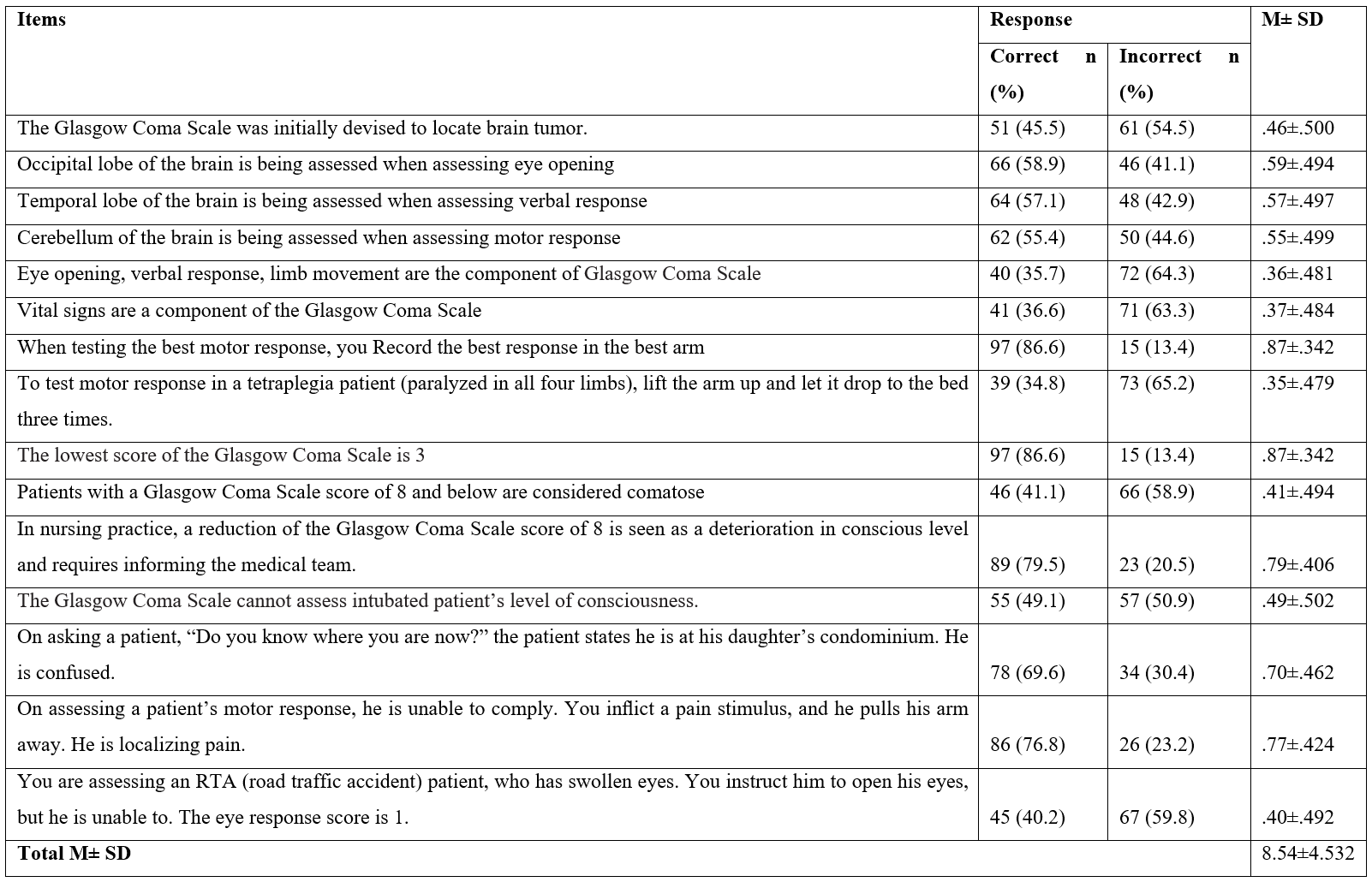
Table 2 shows the distribution of nurses' perception regarding GCS. According to the findings, it showed that the mean perception of GCS was 8.54 (SD=4.532) out of maximum of 15 points indicating a moderate level. In term of item analysis, results indicates that the majority of the nurses responded correctly to the best motor response testing (97%), the lowest score of the GCS (97%), deterioration of GCS score and the need to inform the medical team (89%), the verbal response by asking a question (78%), and localization of pain (86%). More than half of the nurses responded correctly to the invention of GCS (51%), part of the brain being assessed during eye-opening (66%), part of the brain being assessed during the verbal response (64%), and part of the brain being assessed during the motor response (62%).
In contrast, majority of the nurses responded incorrectly about the components of GCS (72%), vital signs in GCS (71%) and the test of motor response in a tetraplegia patient (73%). However above half of the nurses responded incorrectly about the comatose score of GCS (66%) and most of them answered wrongly that the assessment of Road Traffic Accident (RTA) patients eye-opening (67%) respectively.
Table 2: Distribution of Nurses’ Perception Regarding Usage of GCS for Assessing the Neurological Status of Stroke (N=112).
Relationship between Socio-demographic Characteristics and Nurses’ Perception Regarding Usage of GCS
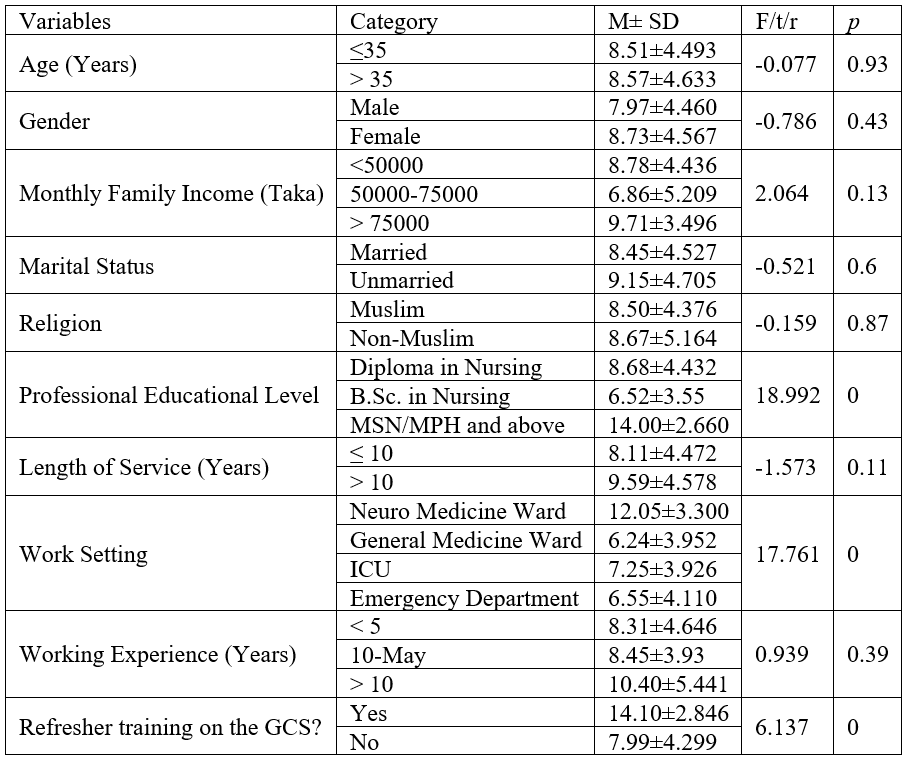
Table-3 illustrates the relationship between socio-demographic characteristics and nurses' perception on GCS. Independent t-test and one way ANOVA was performed to examine the relationship between socio-demographic characteristics and nurses' perception on GCS Results found that professional educational level (p=.000), work setting (p=.000) and refreshing training (p=.000) were statistically significantly correlated with nurses’ perception on GCS. It means that nurses those who had higher education had high perception on GCS than those of others. The nurses who were working in neuro-medicine wards had high perception regarding GCS than those who were working at other wards. Nurses receiving refreshers training on GCS had high perception than those who did not.
Rest of the variables are non-significant regarding nurses’ perception on usage of GCS for assessing the neurological status of stroke.
Table 3: Relationship between Socio-demographic Characteristics and Nurses’ Perception on GCS (N=112).
Discussion
The aim of the current study was to assess the nurse’s perception regarding usage of Glasgow Coma Scale for assessing the neurological status of stroke. The study was conducted at Dhaka Medical College Hospital (DMCH). The findings of this study are discussed below.
The overall nurse’s perception on GCS was moderate. The findings of this current study is similar to the previous study conducted in Nepal [11]. In Nepal it was showed that above half of the nurses had an average level of perception on GCS. It might be due to inadequate knowledge, education and contents of GCS was not included in the curriculum. The findings of this current study is also related to the another study conducted in Singapore [12]. In Singapore it was found that more than half of the participants had moderate level of perception. It is probably due to nurses’ inadequate perception about the guidelines of GCS assessment and lack of continual educational program. The findings of the current study is differed from the previous study conducted in Ghana [10]. It was showed that more than half of the nurses had low perception on GCS. This result is incongruent with the current study. It may be due to poor quality of teaching skills during pre-service training and they were taught about GCS in a very brief and in a superficial manner. The findings of the current study are inconsistent from another previous study conducted in Ghana [13]. It was showed that above half of the nurses had good perception on GCS. This result is differed from current study. This may be because of the different context, differences in educational background, and nursing facilities. They also had high level of confidence when performing the GCS for patient assessment. Whereas study conducted in Iraq found inadequate perception of nurses regarding GCS. This was because of they had lack of basic knowledge and information about GCS [14].
Present study found a statistically significant relationship between educational level and nurses’ perception regarding GCS. It means nurses those who had higher education had better perception than those who had not. The reasons for better perception are that Nurses might be learned from different sources like internet, textbook, observation of clinical practice and learned from other professionals. Prior studies showed that there was a statistically significant association between level of education and perception of GCS among the nurses [7,9,15]. However, some other studies [16-19], showed different results that there was no significant relationship found between the level of education and nurses perception on GCS. It was probably due to their educational system, teaching skills and content were differed from Bangladesh. That is inconsistent with the current study.
This study found that there was a statistically significant relationship between work setting and nurses’ perception on GCS. Nurses who were working at neuro-medicine ward had more perception than others. This may be because of their frequently assessing the patient by using GCS. Previous study, showed that nurses who were working at neurological ward had high perception on GCS [17], because they perform GCS assessment on a more frequent basis. However, study conducted in different setting showed that nurses who were working at neurosurgical ward, neuro-intensive care unit and emergency room had more perception on GCS [10,13,20] because in those wards a large number of patients were admitted and nurses frequently assessed the patients requiring GCS monitoring.
The current study showed that there was a statistically significant relationship between refreshers training and nurses’ perception on GCS. Nurses who had refreshers training had high perception on GCS. Several studies showed similar results [14,21,22]. This study also revealed that majority of the nurses did not receive any training on GCS which is similar to the previous studies [9,10,23]. It might be due to a lack of available training facilities for nurses.
According to item analysis, majority of the participants did answer incorrectly about GCS which is initially devised to locate brain tumor and GCS cannot assess intubated patient’s level of conscious. This finding is relatively consistent with the previous study conducted by Shoqirat in Scotland. It was an explorative survey conducted to explore third year nursing students’ understanding of the Glasgow Coma Scale. The finding of the study showed that more than half of the respondents were not confident in practical use of the GCS (Shoqirat, 2006).
Above half of the participants did answer incorrectly about the GCS score that considered as comatose. This finding is congruent with the previous study conducted by Njoki and Motari, in Kenya. It was a descriptive cross-sectional study that aimed to assess the level of perception on GCS among nurses. The finding of the study pointed out that half of the nurses had poor perception of the GCS [24]. This finding is also similar to another previous study which was conducted by Sedain and Bhusal in Nepal. In Nepal a descriptive cross-sectional study was conducted to assess the level of perception on GCS among nurses. The finding of the study reflected that the nurses mostly had an average level of perception of the GCS.
Majority of the nurses did answer incorrectly about the component of GCS. This result is compatible with the previous study performed by Nawaz, Hussain, Afzal and Gilam in Pakistan. This was an observational study which was aimed to examine nurse’s knowledge and practice regarding GCS techniques implementation. The finding of the study revealed that the majority of nurses had insufficient knowledge and poor level of technique regarding GCS [25].
A large number of nurses did answer incorrectly about the vital sign as a component of GCS, motor response test for tetraplegia patient and eye-opening response for road traffic accident patient. This result is inconsistent with the previous study carried out by Basauhra et. al., in Malaysia. The aim of this study was to explore the knowledge and competence in assessing the GCS among staff nurses working in the Emergency and Outpatient Departments. The finding of the study indicated that more than half of the nurses had poor knowledge on GCS [7,26].
Limitations
Several limitations are listed in this study. Firstly, the study was conducted with a small number of sample due to constraints of time. Secondly, only one hospital is selected for the study and result cannot be generalized to the other similar hospital.
Conclusion
The level of nurse’s perception regarding usage of GCS was moderate. Professional educational level, work setting and refresher training were statistically significantly correlated with nurse’s perception regarding usage of GCS. It is recommended that a well-designed GCS training program, the development of GCS protocol in the working unit, and the distribution of a designated booklet on GCS to all nurses working in different wards would increase their practical knowledge and skills to improve their nursing practice for assessing neurological status of stroke using GCS.
Recommendations
Education program on GCS can be developed and training may be conducted for nurses to enhance their perception and competency regarding usage of GCS while assessing neurological condition of stroke. A similar study in the future to be conducted with large sample size in different settings and further intervention study maybe conducted to improve nurses’ perception on GCS. Adequate contents on the use of GCS can be included in the curriculum and that students are given enough opportunity to practice using the GCS. Finding of the study will put formulated for policy maker to arrange organization refreshers training for the nurses to recruit their confidence and ability in assessing neurological status of stroke patients by using GCS. Finding would contribute to act as a baseline data for researcher to conduct a study on the area in several setting to assess the actual perception of nurses on GCS.
References
- Sacco RL, Kasner SE, Broderick JP, Caplan LR, Connors JJ, Culebras A, et al. An updated definition of stroke for the 21st century: A statement for healthcare professionals from the American Heart Association/American Stroke Association. Stroke, 2013; 44(7): 2064–2089.
- Islam Md. N, Moniruzzaman M, Khalil Md I, Basri R, Alam MK, Loo KW, et al. Burden of stroke in Bangladesh. International Journal of Stroke, 2013; 8(3): 211–213. https://doi.org/10.1111/j.1747-4949.2012.00885.x.
- Katan M, Luft A. Global Burden of Stroke. Seminars in Neurology, 2018; 38(2): 208–211. https://doi.org/10.1055/s-0038-1649503.
- Chohan SA, Venkatesh PK, How CH. Long-term complications of stroke and secondary prevention: An overview for primary care physicians. Singapore Medical Journal, 2019; 60(12): 616–620. https://doi.org/10.11622/smedj.2019158.
- Iacono LA, Wells C, Mann-Finnerty K. Standardizing Neurological Assessments. Journal of Neuroscience Nursing, 2014; 46(2): 125–132. https://doi.org/10.1097/JNN.0000000000000035.
- Stern S. Observing and recording neurological dysfunction: Sarah Stern presents findings from a literature review of the advantages and disadvantages of the Glasgow Coma Scale in assessing levels of patient consciousness. Emergency Nurse, 2011; 18(10): 28–32.
- Basauhra Singh HK a/p, Chong MC, Thambinayagam HC a/l, Zakaria MI bin, Cheng ST, Tang LY, et al. Assessing Nurses Knowledge of Glasgow Coma Scale in Emergency and Outpatient Department. Nursing Research and Practice, 2016; e8056350. https://doi.org/10.1155/2016/8056350.
- Nguyen TH. The accuracy of Glasgow coma scale Knowledge and Performance among Vietnamese nurses (Thesis), 2011.
- Kariuki PN, Omariba M. KNOWLEDGE OF THE GLASGOW COMA SCALE AMONG NURSES IN MASABA NORTH SUB-COUNTY HOSPITAL. British Journal of Medical and Health Research, 2020; 7(7): 73–88. https://doi.org/10.46624/bjmhr.2020.v7.i7.007.
- Alhassan A, Fuseini A-G, Musah A. Knowledge of the Glasgow Coma Scale among Nurses in a Tertiary Hospital in Ghana. Nursing Research and Practice, 2019; 1–7. https://doi.org/10.1155/2019/5829028.
- Sedain P, Bhusal MK. Knowledge Regarding Glasgow Coma Scale among Nurses Working at Selected Hospitals of Chitwan, Nepal. Journal of College of Medical Sciences-Nepal, 2019; 15(4): 276–281. (Nepal). https://doi.org/10.3126/jcmsn.v15i4.24529.
- Mattar I, Liaw SY, Chan MF. A Study to Explore Nurses’ Knowledge in Using the Glasgow Coma Scale in an Acute Care Hospital. Journal of Neuroscience Nursing, 2013; 45(5): 272–280. https://doi.org/10.1097/JNN.0b013e31829db970.
- Ayoub AY, Saifan A, Alaween M, Almansouri ES, Hussain HY, Salim NA. Assessment of Nurse’s Knowledge About Glasgow Coma Scale at al Dhafra Hospitals, Abu Dhabi, United Arab Emirates, 2018.
- Jaddoua BA, Mohammed WK, Abbas AD. Assessment of Nurse’s Knowledge Concerning Glasgow Coma Scale in Neuro Surgical Wards. 2013; 10.
- Enriquez CM, Chisholm KH, Madden LK, Larsen AD, de Longpré T, Stannard D. Glasgow Coma Scale: Generating Clinical Standards. Journal of Neuroscience Nursing, 2019; 51(3): 142–146. https://doi.org/10.1097/JNN.0000000000000448.
- Al-Quraan H, Aburuz M. Assessment of Jordanian Nurses’ Knowledge to Perform Glasgow Coma Scale. European Scientific Journal, 2016; 12. https://doi.org/10.19044/esj.2016.v12n27p208.
- Ehwarieme TA, Anarado AN. Nurses use of Glasgow coma scale in neurological assessment of patients in university of Benin Teaching Hospital, Benin City Edo State, Nigeria. Journal of Medicine and Biomedical Research, 2017; 16(1): 47–61. https://doi.org/10.4314/jmbr.v16i1.
- Kim B-R, Lee J, Sohn MK, Kim DY, Lee S-G, Shin Y-I, et al. Risk Factors and Functional Impact of Medical Complications in Stroke. Annals of Rehabilitation Medicine, 2017; 41(5): 753–760. https://doi.org/10.5535/arm.2017.41.5.753.
- Vink P, Tulek Z, Gillis K, Jönsson A-C, Buhagiar J, Waterhouse C, et al. Consciousness assessment: A questionnaire of current neuroscience nursing practice in Europe. Journal of Clinical Nursing, 2018; 27(21–22): 3913–3919. https://doi.org/10.1111/jocn.14614.
- Elmer C. Improving Glasgow Coma Scale (GCS) Competency of Nurses in One Acute Stroke Unit—A Nursing Initiative Project. Journal of Nursing and Practice, 2019; 3(1). https://doi.org/10.36959/545/370
- Waterhouse C. The use of painful stimulus in relation to Glasgow Coma Scale observations. British Journal of Neuroscience Nursing, 2009; 5(5): 209–215. https://doi.org/10.12968/bjnn.2009.5.5.42125.
- Woodward S. Conference sparks great pain debate. British Journal of Neuroscience Nursing, 2007; 3(4): 137–137. https://doi.org/10.12968/bjnn.2007.3.4.23312.
- Ahamed ST, Ebraheim MN. Glasgow Coma Scale Technique: Effect of Theoretical and Practical Educational Program on Nurses’ Compliance, 2017; 8.
- Njoki KP, Motari O. (n.d.). Knowledge of the Glasgow Coma Scale among Nurses in Masaba North Sub-County Hospital.
- Nawaz A, Hussain M, Afzal M, Gilani SA. Nurses knowledge and practice regarding GCS techniques implementation, https://doi.org/10.5281/zenodo.3860813.
- Uchida K, Yoshimura S, Hiyama N, Oki Y, Matsumoto T, Tokuda R, et al. Clinical prediction rules to classify types of stroke at prehospital stage: Japan urgent stroke triage (JUST) score. Stroke, 2018; 49(8): 1820–1827.