Email id: info@ijclinmedcasereports.com
Evaluation of the Effectiveness of a Music Video Model to Promote Awareness of Sexual and Gender-Based Violence Against Girls
Brenda Tusubira1, Anna Kabona1, Andrew Macnab2,3,* and Innocent Besigye1
1Department of Family Medicine, College of Health Sciences, Makerere University Kampala, Uganda
2Stellenbosch Institute for Advanced Study (STIAS), Wallenberg Research Centre at Stellenbosch University, Stellenbosch, South Africa
3Department of Pediatrics, University of British Columbia, Vancouver, BC, Canada
Received Date: 18/06/2026; Published Date: 28/08/2026
*Corresponding author: Andrew Macnab, Stellenbosch Institute for Advanced Study (STIAS), Wallenberg Research Centre at Stellenbosch University, Stellenbosch, South Africa; Department of Pediatrics, University of British Columbia, Vancouver, BC, Canada
Abstract
This evaluation was done to assess the impact of a music video produced and promoted nationwide to raise awareness of sexual and gender-based violence (SGBV) in Uganda. Pupils (12-17 years of age) and adult stakeholders in a Kampala primary school participated through 4 focussed discussion groups and key informant interviews for adult stakeholders. Recordings were transcribed and content coded. Major findings were: Pupils viewed the music video model as attractive and accessible to youth, effective for communicating culturally sensitive information adults find difficult to articulate, and valued using social media to optimize reach, enhance messaging impact and promote feedback. Adults assessed the video as factually informative and suited to wide use in schools to promote SGBV awareness and discussion. The consensus: music videos produced using health promotion guidelines and promoted through social media are an innovative, valuable and effective resource able to promote broader awareness of the causes of SGBV and the priorities society needs to address to improve the safety and wellbeing of girls.
Keywords: Education-entertainment media; Focussed discussion groups; Health promotion; Social empowerment; Social media
Introduction
The United Nations sustainable development goal number 5 aims to achieve gender equality and empowerment of all women and girls though the ending of discrimination, violence and exploitation. Additionally, the goal aims to eliminate forced marriages and genital mutilation, and promote sharing of domestic responsibilities and full participation in leadership and decision-making [1]. While some significant gains have been made, the 2030 target for this goal will not be met [2], consequently the WHO and UNICEF continue to call for innovative evidence-based approaches to promote greater awareness of sexual and gender-based violence (SGBV) [3].
SGBV is deeply embedded in African culture, so, to be effective, any approaches need to encompass social factors and cultural norms, including the demographic that 50% of sub-Saharan Africa’s population are under 20 years of age. Traditional music and folk tales have always been used to propagate cultural knowledge and values, and the popularity of celebrity musicians has made them effective messengers about SGBV, avoidable maternal and infant death, and HIV [4,5]. Currently, most young people have phones and are on social media, which offer important ways to increase the reach and impact of health promotion interventions focussed on youth.
Young girls need to learn how they are at risk of SGBV, and understand how to deal with such situations as one in three in sub-Saharan Africa experience violence during childhood [6]; and an unfortunate fact is that older family members, close relatives and school teachers are common perpetrators of SGBV [7]; adults need to be engaged in dialogue to counter the silent acquiesce of SGBV prevalent within society.
In response to the WHO and UNICEF calls to raise SGBV awareness, girls of school age were engaged to identify youth-focussed priorities and essential messaging; these were incorporated into a music video professionally recorded using a validated health promotion format. The music video was disseminated via nationwide promotion through radio and TV broadcasts reaching an estimated audience of > 10.5 million. Social media with free downloads allowed universal access by youth for viewing, comment posting and tracking to evaluate reach. A description of the video’s development, production and promotion, and a summary photo essay have been published previously [8,9].
Aim of the study
To learn from a post hoc evaluation how Ugandan youth and adult stakeholders were impacted in the longer term by a nationwide initiative to raise awareness of SGBV using a music video health promotion model. The evaluation was conducted at the school where the initial inquiry was conducted that defined the youth-focussed priorities that were highlighted through the words of the song and scenarios portrayed in the celebrity recorded music video. The opportunity to contribute feedback was central to the project’s design and our commitment to the participating school. Such evaluation is often omitted, but the process is an essential component of valid health promotion initiatives; our aim was to understand and share ‘what worked and why’ in order to guide future application of similar models.
Methods
Design and setting: This was a cross-sectional qualitative study conducted at Stand Tall School, in Kira Municipality of Kampala, Uganda.
Study population and sampling process: All pupils aged 12 years and above were engaged through Focus Group Discussions (FGDs), and adult stakeholders (headteacher, director of studies, chairman of the parents’ and teachers’ association, and principal of the school) through key informant interviews (KIIs). Mixed methods research and focus group guidelines were followed [10,11]; evaluation data gathered included qualitative insights (participants’ experiences, reasons, suggestions) plus quantitative measures (ratings, counts). Sessions began with 1) Opening overview (purpose, confidentiality, process) 2) Warm-up (introductions, simple questions to build rapport), 3) Core topic evaluations (with open-ended prompts and quick quantitative measures) 4) Closing (summary, ratings, check for missing perspectives).
Data collection: Four FGDs were conducted using a FGD guide [11], two for girls and two for boys, and individual KIIs were conducted with each adult stakeholder. Questions included open probes (“Tell me about …” “Why do you think …?”), Probes for depth (“Can you give an example?”, “How did that make you feel?”), and Rating of specific items (1-5, or top rank) to qualify perceptions. All sessions were audio-recorded (with consent).
Data analysis: The audio recordings were transcribed verbatim; transcripts cross-checked with the recordings, then cleaned and uploaded into Atlas for analysis using an approved mixed methods framework approach [10]; a content coding index was then applied and the categories interpreted for emerging themes and sub-themes.
Ethical consideration: Ethical approval for both the original intervention and follow up evaluation study was obtained from Makerere University School of Public Health Research and Ethics Committee. The headteacher gave consent for the school’s participation and informed staff, pupils and parents. Written individual parental consent for participating children was also obtained, with assent sought from children aged 12 to 17 years. Adult stakeholders provided informed consent.
Results
The pupils strongly agreed that using music is a good way to improve SGBV awareness among youth because of the its widespread popularity among young people. They also emphasized that young people talk with their peers about the songs they hear, discuss the videos they watch, and repeat what their celebrity recording idols say. They also saw music a culturally appropriate way to reach out to the wider population.
Pupils were able to recall specific content in the video and identify that it contained messaging about child abuse, scenes illustrating how acts of SGBV occur, and how to make life better particularly for girls. They also confirmed that they were now familiar with the principal ways girls are at risk of becoming victims of SGBV and what to do if this happens. Hence, it was clear that the video was informative.
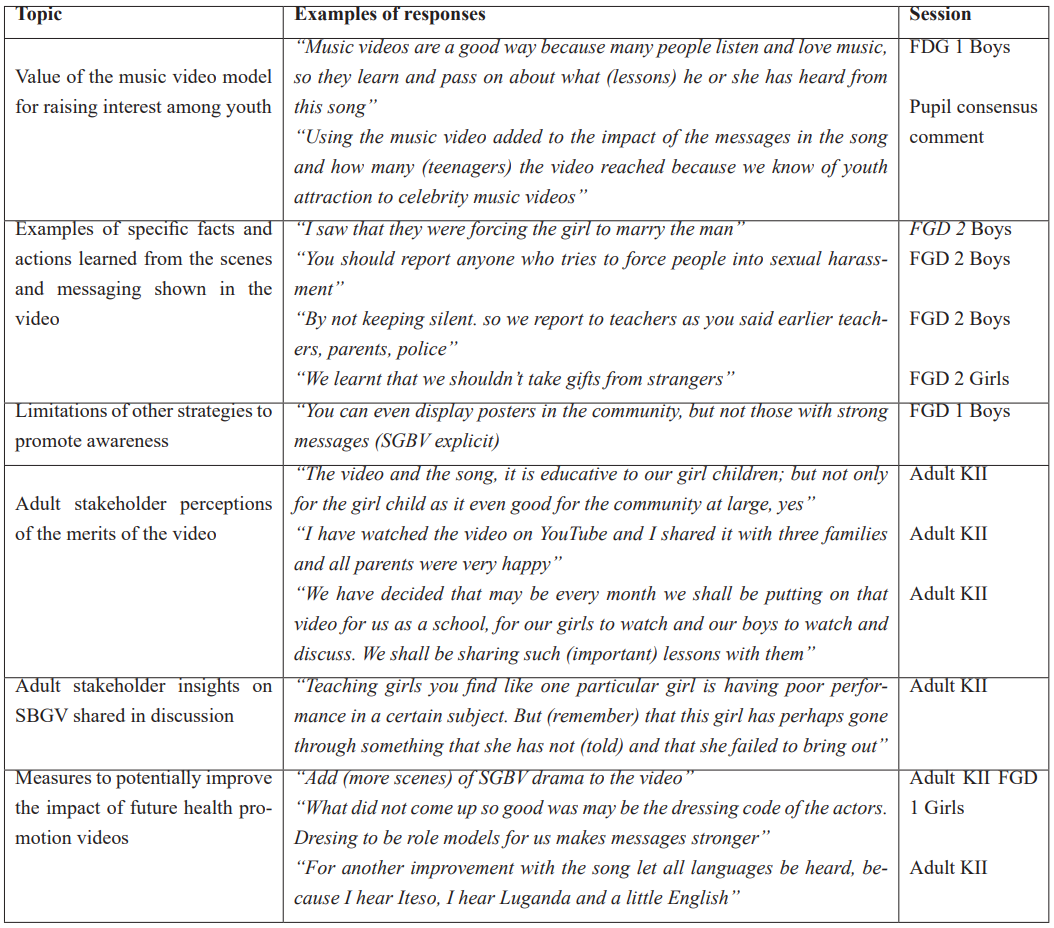
Examples of responses from pupils and adult stakeholders are shown in Table 1.
The pupils agreed they had learned new information from watching the video. Examples given included how parents’ poverty can motivate them to take money from older men who want to victimize their children through child marriage; that consequences of SGBV include unwanted pregnancy and mental health problems, there are preventive strategies they should employ, and the importance of reporting all forms of SGBV to parents, teachers and police. The perceived value of some lessons learned were gender-specific. Female pupils particularly valued where the video taught them how to prevent becoming victims. Girls specifically recalled the emphasis on avoiding ‘bad touches’ from older family members, teachers and strangers, not to accept gifts from strangers, to avoid walking alone at night, to be careful of encounters with strangers, and to be assertive when faced with situations posing potential risk.
Table 1: Examples of responses given by pupils and adults evaluating the video’s impact.
Suggestions on ways to further increase youth awareness of SGBV included greater use of social media with promotion of dialogue through the posting of comments; the continuation of broadcasts of the song and video, and involvement of the celebrities through TV interviews. Coverage by newspapers was considered less relevant for youth, and the production and circulation of posters in communities was seen as potentially unpopular.
Pupils also suggested future videos should include messaging in more local languages as the predominant use of English presented a challenge because of low education levels among some vulnerable youth. Adult stakeholders viewed the video as educative for young people, especially so for girls, and also valid for the community at large. All indicated they had shared the video with others in the community through the YouTube link, and their consensus was that music videos are an appropriate way to promote individual and community empowerment in dealing with SGBV. Importantly, teachers and parents who watch the video and learn from it, were seen as being more likely to then talk about SGBV, particularly with their girl children, and encourage them to open up.
The adults reported valuable learning from the video, especially new understanding where common perpetrators of SGBV exist, and identified such lessons as important to enable stakeholders to empower potential victims to deal with SGBV, and to improve ways in which they handle situations of actual or suspected SGBV reported to them.
Leaders within the school pledged to play the video regularly and use its educational content to maintain dialogue about SGBV. These efforts point to the potential value and sustainability of the video as an educational tool.
Ways stakeholders suggested to improve future videos included adding more scenes with examples of SGBV scenarios, and they echoed the pupils’ suggestion to record in various local languages.
Discussion
Health promotion initiatives can be pivotal in fostering positive health behaviors. However, it is crucial to evaluate the longer-term impact of any model and understand the components and logistic elements that make one effective; this allows others to rationalize future use of a given model, informs evidence-based practice and aids the creation of other relevant models. This retrospective evaluation was conducted to assess the impact of a health promotion initiative that used a music video model to promote awareness about SGBV in Uganda. The consensus of the participating pupils and key adult stakeholders was that music videos are an appropriate, effective and socially applicable tool for promoting awareness about SGBV. The respondents also identified the use of social media in parallel to video as an innovative and important element that contributed to the intervention’s reach and impact, because it promoted youth access and generated dialogue through posted comments.
In this context, music videos are recognized to be a valid form of health promotion when produced using Education-Entertainment guidelines; such media have proved effective as a way to change knowledge, attitudes, and behavior, as they “evoke emotions, create role models, stimulate discussion among listeners and viewers, and show the ultimate consequences of both healthy and unhealthy behavior to large, audiences [12].” In addition, the combined the use of music and social media was novel and innovative and recognized that social media are an increasing important communication platform for youth [13].
The music video was evaluated as educative; both pupils and adults described learning valuable lessons from it relating to the causes, effects, prevention and handling of SGBV. Adults stated that dialogue between teachers and girls at risk could potentially improve academic performance by relieving some of the emotional burden girls experience due to SGBV. Adult respondents also identified the video as having an educational role for the community at large as well as the ‘at risk’ target population, and stated the video should continue to be used in schools as an educational resource to promote awareness and dialogue.
Important strengths of this intervention model recognized by the respondents, included: 1) the engagement of high school pupils to identify the SGBV issues and interventions they saw as priorities; this ensured the relevance of the messaging for youth; 2) the inclusion of renowned music celebrities coupled with professional recording; both recognized factors that attract African youth, the demographic of the target population; and 3) the use of social media to disseminate the video and promotion of the song by music industry professionals; elements that ensured maximum reach for the intervention.
In Africa, music has long been used to promote health and raise awareness. One particularly successful example is the music video ‘Everyone’ by the group All Stars led by Bobi Wine; this focussed on preventable maternal and infant death and had a proven impact on youth in Uganda. Other African countries have used recordings by local celebrities to engage the public and raise awareness; in South Africa a Rebecca Malope song focussed on SGBV, and in Nigeria music was used for a similar purpose during the COVID 19 pandemic to engage and inform; an assessment of such songs found them to be impactful in highlighting issues of rape, femicide and the need to empower women [14].
Live music performances are used in Africa to inform and motivate young people in the context of improving health, education and equity. But concert going is limited due to cost; in contrast, the music video model combined with social media has a broad reach among youth. In addition, impact across society was achieved through repeated playing of the song via radio and TV broadcasts which extended its messaging nationwide [8]. However, live concert performances were one component of the national program used to promote the original initiative; this was managed by professionals from the music industry who were also the conduit whereby celebrity artists became involved in the recording, and promotion of the video through live concerts, TV shows and personal appearances.
As SGBV is widely entrenched in the general population initiatives aimed at raising awareness need to be innovative both in what they say and how they make use of popular platforms. Being ‘in tune’ by incorporating the use of social media is one way to achieve a wider reach among youth, and promotion through broadcasting also conforms with the current popularity of radio and TV among adults in many sub-Saharan African countries.
Strengths and Limitations
While a strength of our evaluation is that the data obtained do provide an understanding of how both youth and adult respondents evaluated the impact of the music video six months after its release, we recognize limitations in what we report that affect the applicability and reproducibility of what report.
Because the findings come from only one school, we recognize that the generalisability of how effectively the music video raised SGBV awareness is limited, and reflects only the views of pupils and stakeholders at this particular school. The sample size of the group of pupils and adults evaluated was also small, and the pupils were likely influenced by the fact that it was their school where health education sessions had identified the priorities selected to be highlighted through the video, which introduces potential bias. However, this exploratory process, and the later study to evaluate the high school pupils assessment of the video’s utility and effectiveness as a health promotion strategy, were both relevant because girls of school age are particularly vulnerable to SGBV [15], and a retrospective lens has value after any health promotion initiative. In addition, in the context of validity, we note the views expressed by the pupils do correspond with the comments posted on social media by youth respondents from across the country, as reported previously [8].
Importantly, the evaluation was also conducted using a valid process that followed defined guidelines to optimize the clarity, reliability and potential relevance of the data obtained. Focussed discussion groups and key informant interviews are recognized to gather qualitative insights regarding participants’ experiences, reasons and suggestions plus quantitative measures [9,10].
Conclusion
Evaluation by school pupils aged 12 – 17 years and adult stakeholders of the impact of a celebrity recorded music video highlighting issues related to SGBV identified this model as an innovative and effective approach for raising awareness. Particular strengths were that the issues and messaging highlighted were priorities identified by girls of school age rather than adults, the nationwide reach for the messaging achieved through the combination of free availability of the video on social media and music industry promotion, and how youth learned important, culturally sensitive information that could not be easily be conveyed by parents or other adult community members. This analysis of ‘what worked and why’ is relevant to future use of similar health promotion models. In future, more music videos should be produced to raise awareness of SGBV; post hoc evaluations should be included, ideally with more schools involved to improve the generalisability of the findings, in parallel with other studies able to measure effect.
Author Contributions
BT: Conduct of study, acquisition of data, analysis and interpretation of data, drafting the article and final approval of article to be published
AK: Conduct of study, acquisition of data, analysis and interpretation of data, and final approval of article to be published
AJM: Concept and design of study, interpretation of data, revision to provide final article to be published
IB: Concept and design of study, conduct of the study, acquisition of data, interpretation of data and final approval of article to be published.
Competing Interests: The authors have none to declare
Grant Information: This study was funded by a grant from the Hillman Medical Education Fund (Canada) and Rose Charities Canada.
Acknowledgments: The authors wish to acknowledge the contributions made by the pupils staff and parents at Stand Tall School in Kampala. In addition to being instrumental in the creation of the music video used to promote awareness of sexual and gender-related violence against girls and women in Uganda, these individuals also contributed by making the post hoc evaluation of the impact of this nationwide initiative possible.
References
- International Institute for Sustainable Development. SDG 5: Achieve Gender Equality and Empower All Women and Girls New York: IISD, 2024.
- Lewington J, Geddes R, Gabagaya G. Female empowerment to improve sexual and reproductive health outcomes and prevent violence in adolescent girls and young women in Uganda: evidence reviews for policy. African Health Sciences, 2022; 22(4): 413.
- Kuupiel D, Lateef MA, Adzordor P, Mchunu GG, Pillay JD. Injuries and/or trauma due to sexual gender-based violence among survivors in sub-Saharan Africa: a systematic scoping review of research evidence. Archives of Public Health, 2024; 82(1): 78.
- McNeill FG, James D. Singing songs of AIDS in Venda, South Africa: performance, pollution, and ethnomusicology in a'neo-liberal'setting. SAMUS: South African Music Studies, 2008; 28(1): 1-25.
- Macnab AJ, Mukisa R. Celebrity endorsed music videos: innovation to foster youth health promotion. Health Promotion International, 2019; 34(4): 716-725.
- Beyene AS, Chojenta C, Roba HS, Melka AS, Loxton D. Gender-based violence among female youths in educational institutions of Sub-Saharan Africa: a systematic review and meta-analysis. Systematic Reviews, 2019; 8(1): 59.
- Wandera SO, Clarke K, Knight L, Allen E, Walakira E, Namy S, et al. Violence against children perpetrated by peers: A cross-sectional school-based survey in Uganda. Child abuse & neglect, 2017; 68: 65-73.
- Macnab AJ, Besigye I, Tusubira B. Sexual and gender-related violence against girls in sub-Saharan Africa: a need for effective interventions. Academia Mental Health and Well-Being, 2024; 1(3).
- Macnab AJ, Besigye I, Tusubira B. “We can make it better you and I” : How Ugandan girls raised awareness of sexual and gender related violence. Global Health Management Journal, 2024; 7(3): 148–155.
- Creswell JW, Piano Clark VL. Designing and conducting mixed methods research. Sage publications, 3rd edition, Thousand Oaks, CA, USA, 2017.
- Kreuger RA, Casey MA. FOCUS GROUPS. A practical appproach for applied research. Springer International, 5th edition, New York, USA, 2014.
- Piotrow PT, De Fossard E. Entertainment-education as a public health intervention. In: Entertainment-Education and social change. Eds: Singhal A, Cody M, Rogers E, Sabida M, 2003; pp. 61-82. Routledge, New York.
- Ghahramani A, De Courten M, Prokofieva M. The potential of social media in health promotion beyond creating awareness: an integrative review. BMC Public Health, 2022; 22(1): 2402.
- Ayinla FI, Amenaghawon F. Music Advocacy and Gender-Based Violence (GBV) During Covid-19 Pandemic. Gender and Behaviour, 2021; 19(3): 18520-18529.
- Brown DW, Riley L, Butchart A, Meddings DR, Kann L, Harvey AP. Exposure to physical and sexual violence and adverse health behaviours in African children: results from the Global School-based Student Health Survey. Bulletin of the World Health Organization, 2009; 87(6): 447-455.