
Email id: info@ijclinmedcasereports.com
A Low-Cost, Improvised, Highly Efficient Muscle Stimulator for Sphincter Localization in Anorectal Malformation Repair: A Prospective Study
Mohammed Hussein1,*, Omar Alsamahy2, Abdelbasit Ali3, Ahmed Alolyet1, Abeer Alrasheedi4, Khaled Alfaify3, Fazal Nouman3, Nabil Shiba3 and Hany Elembaby5
1Pediatric Surgery Associate Consultant, King Saud Medical City, Riyadh, Saudi Arabia
2Professor of Pediatric Surgery, Al-Azhar University Faculty of Medicine for Girls, Egypt; Pediatric Surgery Consultant, Bisha Maternity & Children's Hospital, Saudi Arabia
3Pediatric Surgery Consultant, King Saud Medical City, Riyadh, Saudi Arabia
4Pediatric Surgery Resident, King Saud Medical City, Riyadh, Saudi Arabia
5Fellow and consultant of Pediatric Surgery, Ahmed Maher Teaching Hospital,ministry of health, Egypt
Received Date: 20/04/2026; Published Date: 24/06/2026
*Corresponding author: Mohammed Hussein, Pediatric Surgery Associate Consultant, King Saud Medical City, Riyadh, Saudi Arabia
Abstract
Introduction: In anorectal anomaly surgeries, a muscle stimulator is mandatory for proper muscle complex allocation to obtain successful repair; however, the conventional Peña muscle stimulator is expensive and scarcely available. To overcome this problem, we improvised a physiotherapy device to be used efficiently as a muscle stimulator.
Methods: A prospective study was conducted between 2021 and 2025 in two centers in Saudi Arabia on 33 patients with different types of anorectal malformation anomalies, 19 males and 14 females, using a modified muscle stimulator.
Results: The improvised stimulator efficiently located the boundaries of the muscle complex in all patients (100%) with clear and reproducible contraction patterns comparable to Peña stimulator. No device-related complications or technical difficulties were encountered, also sterility was maintained throughout intraoperative use.
Conclusion: The TENS (Transcutaneous Electrical Nerve Stimulation) improvised device proved to be safe, efficient, and extremely low-cost alternative for sphincter localization during anorectal malformation repair.
Keywords: Improvised Muscle stimulator; Anorectal malformations; TENS (Transcutaneous Electrical Nerve Stimulation); Sphincter localization; Peña anorectoplasty
Introduction
Anorectal malformation is one of the common conditions encountered by pediatric surgeons. These anomalies require meticulous operative technique to ensure adequate repair, improve continent potentiation, and consequently allow affected children to have a good quality of life.
A case of anorectal malformation with expected good continence, instead having incontinence as a surgical complication due to severe deviation of the rectum from the muscle complex, is catastrophic for the patient and the surgeon.
Employment of a muscle stimulator is of paramount necessity in locating the exact sphincter position [1].
Due to the lack of resources in numerous developing countries, it is very costly to obtain the original muscle stimulator described by Professor Peña, which would exceed US $12,000 in cost, proving to be prohibitively expensive [2]. Consequently, surgeons’ resort to locating the muscle complex based on their experience, which then becomes a game of luck.
To overcome such a problem, we resorted to a commercially available physiotherapy device to serve as our new muscle stimulator. After some improvisation of the device, we managed to turn it into an efficient muscle stimulator, however we needed to prove the applicability and safety of the device in anorectal malformation repair.
Objective
To standardize optimal rectoplasty within the muscle complex utilizing an improvised globally available muscle stimulator that could be easily used preoperatively or intraoperatively without compromising the sterile field.
Methods
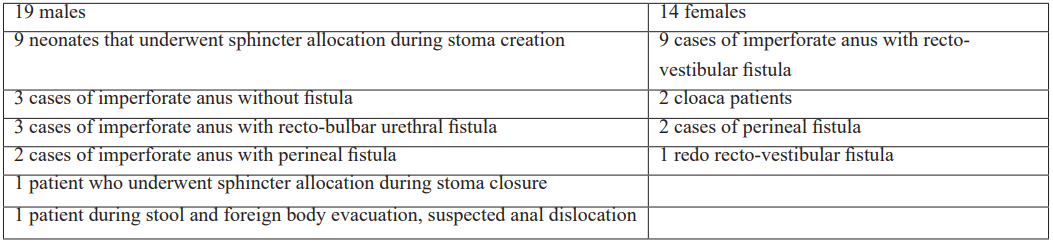
A prospective study was conducted at two centers in Saudi Arabia (King Saud Medical City in Riyadh and Bisha Maternity & Children's Hospital) between 2021 and 2025, including 33 patients with different types of anorectal malformation anomalies: 19 males and 14 females, as shown in Table 1. No exclusion criteria were specified regarding age, weight, or sex.
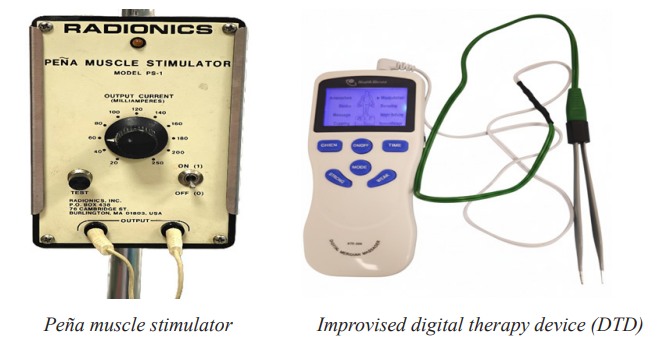
These patients underwent anorectoplasty with the aid of our improvised digital therapy device (DTD) to delineate the exact site of the muscle complex in comparison to the original muscle stimulator device described by Professor Peña. This device has FDA approval for various muscle physiotherapy applications [3].
We improvised the device connection to accommodate preoperative and intraoperative usage. For this, we used a conventional bipolar probe. As it is already known that the bipolar consists of a disposable wire and a separate reusable probe, so we took one disposable wire, cut 40 cm of it, then connected it permanently to our digital therapy device (DTD). Now the device needs only to get connected to the probe when desired to produce the current for stimulation preoperatively, or to place the device and the wire in a camera cover, then connect it to the sterile probe if intraoperative usage is desired.
Table 1: Showing types of anorectal malformations included in the study.
Results
The improvised muscle stimulator successfully identified the sphincter–muscle complex in all 33 patients (100%). The contraction response was clear, reproducible, and comparable to that achieved with the conventional Peña stimulator. No technical difficulties were encountered during device operation. Additionally, no complications related to the stimulation process were observed. Intraoperative application was feasible and did not compromise sterility, as the device setup allowed safe integration within the surgical field.
Discussion
Electrical muscle stimulation is a very old medical tool that was early used by our ancestors, the Ancient Egyptians, to treat muscle pain and some diseases [4-7].
The electric catfish of the Nile, also known as “thunder of the Nile,” was depicted in Narmer Palette, an important archaeological artifact from ancient Egypt. This ceremonial palette dates back to approximately 3100 BCE [5,6].
History shows that the Egyptians used to put small catfish over the diseased area to create a tingling sensation to relieve muscle pain or other disorders [5].
From that time, experimental scientific studies started only in the 18th century by many, such as Luigi Galvani and Alessandro Volta, and continued to evolve through the 19th and 20th centuries [8,9].
Nowadays, Electrical Muscle Stimulation (EMS) is a well-established branch, including different types of electrical stimulation such as TENS (Transcutaneous Electrical Nerve Stimulation), Interferential Current (IFC) Electrical Stimulation, High Voltage Electrical Stimulation, Electrical Muscle Stimulation, Functional Electrical Stimulation, Neuromuscular Electrical Stimulation, Russian Electrical Stimulation, Galvanic Electrical Stimulation, and Faradic Electrical Stimulation [10].
They differ from each other in the type of current [12] as low-voltage current: less than 100 volts, under 1 Hz. High-voltage direct current: extremely short-duration pulse in the range of 300 to 500 volts. Interferential current in the range of 4000 to 4100 Hz, with a net frequency in the interference zone of 80 to 100 Hz, and the power is in the low-voltage range. Medium-frequency current in the range of 2400 to 2500 Hz (Russian type). And finally, low frequency current, utilizing frequencies in the range of 1 to 330 Hz, pulse width from 50 to 300 msec. with a medium range amplitude of 10 to 50 mA.
They are applied in medicine in many conditions such as Pain management, Wound healing, Incontinence, Physical rehabilitation, Atrophy, weight loss, enhance athletic performance, ETC [11-16].
We are using TENS (Transcutaneous Electrical Nerve Stimulation) device, which boasts numerous advantages, including its affordable price between $5 and $9. Its dimensions are (15 cm by 6 cm). It's light in weight (90 g), which enhances its portability, using 3 ordinary batteries of AAA size, producing low-frequency waves of 1-330 Hz, and producing 1-7 volts. The device comes with preset modes that differ from each other in the frequency, amplitude, and duration of the impulse, with a button to increase or decrease the intensity from 0 to 15. We usually use the massage mode in neonates, starting the intensity with 1 and increasing as desired. In older patients, we prefer to use the manipulation mode as it provides a stronger contraction effect. We usually prefer to mark the site of maximum muscle contraction after anesthesia induction. We have acquired several techniques to optimize muscle contraction efficacy. Firstly, it is advisable to refrain from using muscle relaxants. Secondly, moistening the skin with normal saline is beneficial. Thirdly, positioning both ends of the probe as far apart as possible facilitates the propagation of current through the tissues. Finally, ensuring that the probe adheres to the skin for a minimum of three seconds is crucial for achieving proper contractions. Implementing these strategies consistently yields reproducible results with every application.
Intraoperative usage is also feasible by covering the device with a sterile camera cover, then connecting a sterile bipolar probe to it, and then the classic steps of the procedure can be carried out to allocate the anterior and posterior boundaries of the muscle complex.
Furthermore, we observed that in high anomaly patients, usually the muscle contraction is less prominent than in low anomaly patients; this could be attributed to the underdeveloped muscle complex.
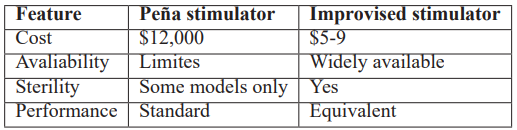
Our study demonstrates that a TENS improvised device can provide comparable functional outcomes in terms of sphincter localization in different types of malformation and different age even in neonates where some surgeons prefer to perform the repair. An additional advantage of the improvised device is its affordability, portability, and ease of use, making it particularly suitable for low-resource environments, (Table 2).
However, some limitations should be acknowledged. The sample size is relatively small and multinational study was not done. Future studies are recommended to validate these findings.
Table 2: Comparing between Peña stimulator and our improvised muscle stimulator.
Conclusion
The improvised TENS (Transcutaneous Electrical Nerve Stimulation) device proved to be safe, efficient, and extremely low-cost in assisting sphincteric muscle contraction in anorectal malformation repair. Its adoption may significantly enhance surgical percision, particularly in resource-limited settings.
References
- Kapuller V, Arbell D, Udassin R, Armon Y. A new job for an old device: a novel use for nerve stimulators in anorectal malformations. J Pediator Sung, 2014; 49(3): 495–496.
- Frykman P, Frykman G, Zhai S, Kimble K, Short S. A Low-Cost Improvised Nerve Stimulator is Equivalent to High-Cost Muscle Stimulator for Anorectal Malformation Surgery. European Journal of Pediatric Surgery, 2013; 23(1): 25–28.
- https://www.fda.gov/search?s=Guidance1+Document+for+Powered+Muscle+Stimulator+510%28k%29s&sort_bef_combine=rel_DESC
- Heidland A, Fazeli G, Klassen A, Sebekova K, Hennemann H, Bahner U, et al. Neuromuscular electrostimulation techniques: historical aspects and current possibilities in treatment of pain and muscle waisting. Clin Nephrol, 2013; 79(Suppl 1): S12–23. doi: 10.5414/CNX77S106.
- Kellaway P. The part played by electric fish in the early history of bioelectricity and electrotherapy. Bull Hist Med, 1946; 20(2): 112-137.
- Howes George J. "The phylogenetic relationships of the electric catfish family Malapteruridae (Teleostei: Siluroidei)". Journal of Natural History, 1985; 19: 37–67.
- Finger Stanley, Marco Piccolino. 'The Shocking Catfish of the Nile', The Shocking History of Electric Fishes: From Ancient Epochs to the Birth of Modern Neurophysiology, 2011; online edn, Oxford Academic, https://doi.org/10.1093/acprof:oso/9780195366723.003.0002.
- Edwards Paul. "A Correction to the Record of Early Electrophysiology Research on the 250th Anniversary of a Historic Expedition to Île de Ré", 2021. HAL open-access archive. hal-03423498.
- Alexander Mauro. "The role of the voltaic pile in the Galvani-Volta controversy concerning animal vs. metallic electricity". Journal of the History of Medicine and Allied Sciences, 1969; XXIV (2): 140–150. doi:10.1093/jhmas/xxiv.2.140.
- Levine D, Bockstahler B. Electrical stimulation (Chapter 20). In D. Millis & D. Levine (Eds.), Canine Rehabilitation and Physical Therapy. Elsevier, 2014.
- Juckett L, Saffari TM, Ormseth B, Senger JL, Moore AM. The Effect of Electrical Stimulation on Nerve Regeneration Following Peripheral Nerve Injury. Biomolecules, 2022; 12(12): 1856. doi: 10.3390/biom12121856.
- Fisher LE, Lempka SF. Neurotechnology for Pain. Annu Rev Biomed Eng, 2023; 25: 387-412. doi: 10.1146/annurev-bioeng-111022-121637.
- Borges D, Pires R, Ferreira J, Dias-Neto M. The effect of wound electrical stimulation in venous leg ulcer healing-a systematic review. J Vasc Surg Venous Lymphat Disord, 2023; 11(5): 1070-1079.e1. doi: 10.1016/j.jvsv.2023.05.005.
- Sharifi-Rad L, Ladi-Seyedian SS, Alimadadi H, Yousefi A. Non-retentive faecal incontinence in children: Conventional therapy alone or combined electrical stimulation. J Paediatr Child Health, 2022; 58(12): 2225-2229. doi: 10.1111/jpc.16194.
- Dantas MTAP, Fernani DCGL, Silva TDD, Assis ISA, Carvalho AC, Silva SB, et al. Gait Training with Functional Electrical Stimulation Improves Mobility in People Post-Stroke. Int J Environ Res Public Health, 2023; 20(9): 5728. doi: 10.3390/ijerph20095728.
- Mizrahi M, Ben Ya'acov A, Ilan Y. Gastric stimulation for weight loss. World J Gastroenterol, 2012; 18(19): 2309-2319. doi: 10.3748/wjg.v18.i19.2309.