
Email id: info@ijclinmedcasereports.com
Clinical Perspective on The Mechanisms of Intervertebral Discography Replication Pain: Chemical Mediated or Stress Stimulation?
Yanqing Liu1,2,* ,Changxi Li2, Qishan Yi3 and Ye Zhu3
1Department of Algology, Beijing Tiantan Hospital, Capital Medical University Beijing, China
2Department of Algology, Guiqian International Hospital, Guiyang, China
3Department of Algology, Yibin First People's Hospital, Chongqing Medical University, Yibin, China
Received Date: 04/11/2025; Published Date: 15/12/2025
*Corresponding author: Yanqing Liu, Department of Algology, Beijing Tiantan Hospital, Capital Medical University Beijing, 100070, China; Department of Algology, Guiqian International Hospital, Guiyang, 550000, China
Abstract
Objective: To study the value of classical discography and ozone discography in the diagnosis of discogenic low back pain and to explore the mechanism of discography replication pain.
Methods: A single-blind prospective study was conducted on 181 patients with discogenic low back pain who needed to undergo ozonolysis,and which followed up in 1,2, and 3 years after treatment for visual analogue scores (VAS). The curative effect after ozonolysis treatment was evaluated with weighted VAS scores , and the positive rate of replication pain test in the two kinds of discography was compared.
Results: The total effective rates were respectively 88%,72% and 78% for 1 year ,2 years and 3 years in the 181 cases followed up. The excellent and good rates were 67%,63% and 57%. The incidence rate of duplication pain for ozone discography was respectively 89.7% and 45.2% in 2 groups of effect and ineffect, and there are obvious differences in statistical comparison.The positive rate of replication pain test for ozone discography was significantly higher than that of classical discography (57%:25%).
Conclusion: The long-term efficacy for ozonolysis is obvious in the treatment of discogenic low back pain. The positive rate of duplication pain for ozonography is positively correlated with the curative effect. This study found that the replication pain for ozone discography is related to sensitization of the sinus vertebrae nerve caused by disc lesions and chemical stimulation, and there is no significant correlation with pressure stimulation during disc injection.
Keywords: Discogenic low back pain; Ozonolysis; Classical CTD; Ozone CTD; The mechanism of replication pain; No: ChiCTR2000030521.
Introduction
Low back pain is the most common cause of disability in people under 45. Clinically, the production of lumbar and leg pain mainly emphasizes the role of compression mechanism for the herniated disc, but compression mechanism cannot explain all clinical phenomena. For a long time, the mechanism of discogenic low back pain is unclear, which brings great difficulties to diagnosis and treatment. Because of the complex anatomical and pathophysiological reasons of low back pain, it is difficult for clinicians to give accurate diagnosis of low back pain. Often clinically, patients are given advanced imaging, such as MRI or CT. Studies have shown that MRI findings such as disc degeneration have no specific diagnostic significance with low back pain or low back pain severity. A large number of studies have confirmed that lumbar disc discography can show the pathological anatomy and morphology of the intervertebral disc and determine whether the intervertebral disc is the cause of chronic low back pain, that is, the responsible disc. If the patient presents with severe low back pain, disc degeneration is shown on the MRI, and after excluding other possible causes of low back pain, it is still uncertain whether this degenerative disc is a source of low back pain. In this case, lumbar discography is only option. A systematic review has concluded that discography is an effective method for the diagnosis of discogenic low back pain[1,2]In recent years, there have been many new methods of minimally invasive interventional therapy for low back pain, such as ozonolysis and radiofrequency thermocoagulation.These methods have a good effect after clinical observation, but the long-term efficacy of ozonolysis in the treatment of discogenic low back pain is not reported, and the mechanism of replicative pain response of discography has also been controversial. this study explored these issues from the perspective of clinical practice.
Information and Methodology
1. General information
Of 181 patients who were followed up, 47 males, 134 females, Average age 55 years (31~79 years). All the patients were treated with ozonolysis, of these ,64 was followed up for 1 year, Of 76 cases in two years, 41 cases in 3 years. Treatment of 305 intervertebral discs by ozonolysis, A total of 168 discs were performed during the procedure of classical and ozone discography.
2. Inclusion criteria
(1) Recurrent low back pain over 6 months, With or without pain in the hips, thighs, Long standing, sitting or bending back pain aggravated; (2) There was no abnormal lumbar spine in the X film, No lumbar disc herniation CT or MRI, The MRI T2 weighted image signal is reduced. (3) After conservative treatment, Discectomy and interbody fusion were not considered.
3. Exclusion criteria
Mental disorders; severe neurological deficit; coagulation dysfunction; severe spinal deformity and spondylolisthesis; spinal stenosis and lateral recess stenosis; reluctance to perform ozone-dissolution surgery and psychiatric patients; disc herniation with calcification, large protrusion, compression of dura mater sac more than 50%; severe organ disorders with surgical risk.
4. Operating methods
Patients take prone position, lumbar disc puncture all use posterolateral path that puncture needle through the "safe triangle area" into the lesion disc, puncture point location is generally parallel to the lesion intervertebral space, using CT axial scanning to directly measure the distance and puncture depth of the para-open midline. After puncture CT axial scanning confirmed that the puncture needle tip should be located at the center of the disc or at the middle and posterior 1/3 junction.the low pressure was slowly injected with contrast agent (iodohydrol)2 ml/ the disc and asked the patient if there was a duplication pain response. the type of disc lesion was again judged CT the scan (refer to D allas-CTD grade). Then through the puncture needle low pressure slowly injected into the disc ozone 2 ml, ozone concentration of 50 ug/ml, asked the patient whether there is a duplication pain response. The amount of ozone injection can be adjusted according to the patient's tolerance, generally 5 ml~20 ml. per discAt most, two discs were worn at one time, which were suspected lesions and adjacent discs. The needle was then retreated near the intervertebral foramen and injected with an ozone concentration of 30 ug/ml, about 10 ml~15 m l..absolute bed rest 24 hours after operation, supine position. A small number of patients after 1~2 weeks will appear symptoms "rebound ", can use analgesic and dehydrating agent symptomatic treatment.
5. Evaluation methods and criteria of efficacy
Analogue visual pain score (VAS) was used to evaluate the curative effect before, after 1,2 and 3 years. and the obtained VAS scores were weighted.VAS weighted value = Curative, (a-b) / a × 100% ≥75%, good, (a-b) / a × 100% ≥ 50% ~ < 75%, effective, (a-b) / a × 100% ≥ 25% ~< 50%, ineffective: (a-b) / a × 100% < 25%. The total effective rate = (cureative n + good n + effective n) sum/ all n × 100%. The excellent rate is the sum of curative and good rate.
a: VAS before treatment; b: VAS post cure 1 month.
6. Statistics processing
SPSS 10.0 statistical software is used to process the statistical data. t test was used for measurement statistics and chi-square test was used for counting index, p<0.05 was significant difference.
Results
In this group ,181 patients were followed up, the incidence of ozone-replicating pain was 89.7% in 243 intervertebral discs for effective treatment. The incidence of ozone-replicating pain was 45.2% in 62 discs for Ineffective treatment (Table 1). In comparison, the former is significantly higher than the latter. Table 2 shows, the intervertebral disc is divided into three types according to ozone CTD lesion :1. internal fissure type (Figure a): the inner layer tear of the fibrous ring is not more than 1/3, C T D visible ozone diffusion does not exceed 1/3 within the fiber ring. 2. Tear type (Figure b): The fibrous ring is torn to a third of the outer layer, C T D ozone escapes to the trailing edge of the fiber ring; 3. Rupture type (Figure c): rupture of outer ring of fiber, C T D ozone leaks into the epidural space.Of those who are effective, the percentage of fracture, tear and internal fissure is 50%,38% and 12% respectively. Of those who are ineffective, the percentage of fracture, tear and internal fissure is 38%,29% and 33% respectively.In 168 disc,the positive rates of reproduction pain caused by classical discography and ozone discography were 25% and 57% respectively. The latter is significantly higher than the former in comparison of 2 groups (Table 3).
Table 1: Comparison of positive rate for replicating pain between two groups in effective and ineffective treatment.

Table 2: The percentage of types with ozone discography in 2 groups.

Table 3: Compare in the percentage of evoked pain by classic and ozone discography.
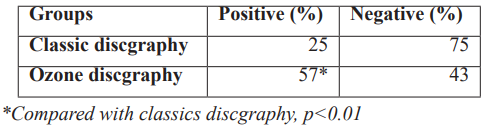
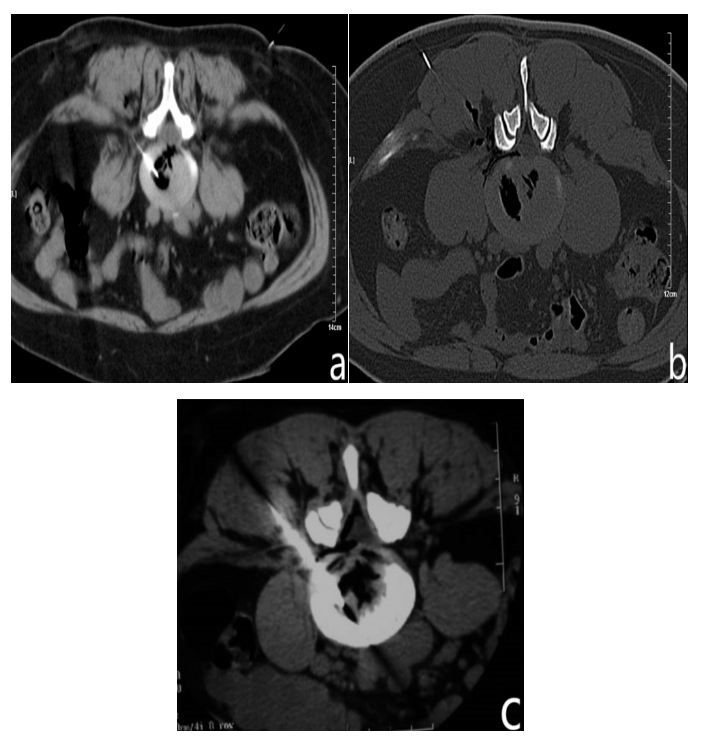
Figure a-c: (a) Image of intervertebral disc inner rupture in ozone contrast; (b) Image of strata externum disc tear in ozone contrast; (c) Image of intervertebral disc rupture in ozone contrast.
Discussion
Discogenic low back pain refers to the low back pain caused by various lesions in the intervertebral disc, which stimulating the pain receptor in the intervertebral disc, without the symptoms of nerve root, without the radiologic evidence of nerve compression or excessive segmental activity, but it can cause the loss of function. Because the pathogenesis of the disease is unclear, it brings great difficulties to diagnosis and treatment, especially in patients with discogenic low back pain without lumbar disc herniation by imaging examination. In recent years, many scholars have carried out a lot of in-depth research on the pathogenesis of discogenic low back pain. Most studies suggest that the pathogenesis of discogenic low back pain is that disc degeneration produces inflammatory mediators, secondary inflammatory granulation zone formation, and stimulation of sinus nerve endings distributed in the outer layer of fibrous ring to develop hypersensitivity, resulting in discogenic low back pain. Some studies have shown that the characteristic pathological change is the formation of the fibrous ring from the outer layer to the nucleus pulposus with a wide distribution of nerve granulation tissue band region, corresponding to the lumbar discography showed fractures. In normal intervertebral disc, there are only vascular distribution on the surface of the fibrous ring, and in asymptomatic normal aging intervertebral disc, the vascular distribution is only found in the outer fibrous ring, not in the inner fibrous ring and nucleus pulposus [3]. Reduced pressure in the intervertebral disc and reduced proteoglycan contents can promote neurovascular growth [4,5]. Nerve growth factor (Nerve Growth Factor, NGF) can promote the growth of nociceptive sensory nerve fibers, increase the expression of NGF, promote axonal regeneration of NGF sensitive neurons, and cause inflammatory pain [6]. The inflammatory response is an important pathogenesis of discogenic low back pain. Pain-causing chemicals such as TNF-α, IL-1, IL-6, NO and phospholipase A2, have been found in degenerative intervertebral discs [7]. Macrophages are the most common of the inflammatory cells; there are few macrophages in the normal intervertebral disc [8].
Discography also known as nucleus pulposus radiography, is an imaging method to inject contrast agent into the intervertebral disc to observe the shape of the nucleus pulposus and reflect the pathological characteristics of the intervertebral disc. CT discography (CTD) has been widely used to assess low back pain [9-12]. Standard discography is required to inject suspected pathdisc and adjacent disc for self-control of the patient's disc. Discography can not only reflect the shape of the disc, but also show the pathological characteristics of the disc. S eung-Min Kim reported [13] that fiber ring rupture is divided into 4 grades, which is called Dallas-CTD classification. By CTD of the classification of fiber ring rupture, it can reflect the changes of the inner layer of fiber ring rupture, outer layer rupture and rupture beyond the outer layer of fiber ring combined with the complete rupture of longitudinal ligament. In addition to the significance of observing the morphological changes of the intervertebral disc, the most important thing in discography is to observe the pain replication reaction of patients during injection, especially the positive reaction of replication pain that occurs during low pressure injection is more important for diagnosis. Research evidence [14] there was a significant correlation between rupture of the fibrous ring and positive discography. Studies have shown that patients with CTD positive for replication pain, whether in pain-inconsistent or partially consistent discs or pain-consistent discs, had 79.31% and 86.27% of patients with pain replication-positive in Dallas-CTD grades 2 and 3 respectively. This suggests that positive replication pain is an accurate indicator of disc rupture. H Vanharanta et al noted that pain response by discography correlates with the extent of annular disruption [15], Normal or Grade 1 disc rarely produces pain, yet discs with over Grade 3 disruption usually provoked pain response. Tanghua Liu et al reported [16] that Ozone CT discography is consistent with Dallas-CTD grade and has good clinical application value. By comparing the positive rate of Ozone CT discography with classical discography, the former was significantly higher than the latter (57/25%). In addition, compared between the effective treatment group and the ineffective treatment group, the positive rate of replication pain for ozone discography showed that the former was significantly higher than the latter (89.7/45.2%). This indicated that there was a positive correlation between the positive rate of replication pain and the therapeutic effect. This also suggests that discogenic low back pain, whether diagnosed or treated, is associated with discography, and that Ozone CTD is more sensitive than classical CTD. The positive rate of duplication pain for ozone CTD was 89.7%, which indicated that the degree of disc rupture was consistent with the positive rate of intervertebral disc duplication pain , which was similar to H Vanharanta,B L Sachs,Mark Spivey,et al reported [15]. The results showed that there was little relationship between the pain response and the pressure stimulation of intervertebral disc, and the degree of disc lesion was related. Similarly, in the case of low pressure injection of the intervertebral disc, the positive rate of replication pain for ozone CTD is higher than the classic CTD, because ozone is a strong oxidant and is stronger than contrast agent to stimulate the ruptured intervertebral disc. this further suggests that chemical mediation is the main cause of pain replication in intervertebral discography rather than stress stimulation.
The discogenic lumbar pain of chemically mediated has a wide range of clinical manifestations, often characterized by recurrent lumbar pain. In addition to stimulating sinus nerves leading to low back pain, degenerative disc-induced inflammatory pain can also stimulate adjacent nerve roots and trigger local neuritis, leading to reactive pain in the lower limbs of some patients [17]. It is believed that the pathogenesis of chronic discogenic lumbago is that the rupture of the inner fibrous ring and the injury for the endplate of cartilage make the pain receptors in the outer layer of the fibrous ring and adjacent endplate directly contacting with the proteoglycan in the nucleus pulposus, which long-term direct contact with irritants in nerve endings is considered to be the main cause of local triggering of low back pain. Studies have found [18] there is a good correlation between the tear of the outer fibrous ring in the intervertebral disc and the positive reaction of the replication pain of the intervertebral disc. The fracture does not produce the pain reaction when it extends to 1/3 of the inner layer in the fibrous ring, and produce the pain replication reaction when it extends to 1/3 of the outer layer. The results indicated that the positive of the pain replication reaction for CTD was related to the tear degree of fibrous ring.
Previous discography is considered to be the gold standard for the diagnosis of discogenic low back pain and is the only reliable diagnostic method at present [19,20]. However, there are some controversies in discography, such as the subjective feeling of pain induced by radiography, which is influenced by psychological factors. Classification of disc degeneration which is not designed to detect the structural changes inside disc has a limitation to localize the degenerative changes, and which can be related with clinical judgement report [21,22]. That Elastance measured during discography showed significant differences between normal and degenerative discs. There was statistically significant change between Grade 0 and Grade 4&5.
The authors compared the incidence of replicative pain caused by intraoperative classical CTD and Ozone CTD, the results showed that the incidence and efficacy of replicative pain caused by Ozone CTD were positively correlated, and significantly increased than that caused by classical CTD. Which suggesting that Ozone CTD is more sensitive to the diagnosis and efficacy evaluation of discogenic lumbago than classical CTD, and has great value of clinical application.
References
- Buenaventure RM, Shah RV, Patel V, et al. Systematic review of discography as a diagnostic test for spinal pain. An update. Pain Physician, 2007; 10: 147-164.
- Manchikanti L, Glaser SE, Wolfer L, et al. Systematic review of discography as a diagnostic test for chronic low back pain. Pain Physician, 2009; 12: 541-559.
- Peng B, Wu W, Hou S, et al. The pathogenesis of discogenic low back pain.J Bone Joint Surg(Br), 2005; 87: 62-67.
- Yasuchika A,Seiji O,Hidetoshi I. Disc inflammation potentially promotes axonal regeneration of dorsal root ganglion neurons innervating lumbar intervertebral disc in rats[J]. Spine,2007; 29(23): 2621-2626.
- Yasuchika A,Koji A,Howard A,et al. Nerve fiber ingrowth into scar tissue formed following nucleus pulposus extrusion in the rabbit anular-puncture disc degeneration model:effects of depth of puncture[J]. Spine,2007; 31(21): 774-780.
- Freemont AJ, Watkins A, Maitre CL, et al. Nerve growth factor expression and innervation of the painful intervertebraldisc[J]. J Patho, 2002; 197: 286-292.
- Lam KS,Carlin D,Mulholland RC. Lumbar disc high-intensity zone:the value and significance of provocative discography in the determination of the discogenic pain source[J]. J Eur Spine,2000; 9(1): 36-41.
- Granblad M, Virri J, Tolonen J, et al. A controlled immunohisto-chemical study of inflammatory cells in disc herniation tissue[J]. Spine, 1994; 19: 2744-2751.
- Braithwaite I, White J, Saifuddin A, et al. Vertebralend-plate (Modic) changes on lumbar spine MRI: correlation with pain reproduction at lumbar discography. Eur Spine J, 1998; 7: 363-368.
- Brightbill TC, Pile N, Eichelberger RP, et al. Normal magnetic resonance imaging and abnormal discography in lumbar disc disruption. Spine, 1994; 19: 1075-1077.
- Buirski G, Silberstein M. The symptomatic lumbar disc in patients with low-back pain. Magnetic resonance imaging appearances in both a symptomatic and control population. Spine, 1993; 18: 1808-1811.
- Carragee EJ, Chen Y, Tanner CM, et al. Can discography cause long-term back symptoms in previously asymp-tomatic subjects? Spine, 2000; 25: 1803-1808.
- Seung-Min Kim, Sang-Heon Lee, Bo-Ram Lee, et al. Analysis of the Correlation Among Age, Disc Morphology, Positive Discography and Prognosis in Patients with Chronic Low Back Pain. Ann Rehabil Med, 2015, 39(3): 340-346.
- Chunyang Fang, Wenbin Zhang, Liqiu Chen and Hongjie Li. The correlation between the high-intensity zone on a T2-weighted MRI and positive outcomes of discography: a meta-analysis. Journal of Orthopaedic Surgery and Research, 2017; 12: 26. DOI 10.1186/s13018-017-0523-1.
- Vanharanta H,Sachs BL,Mark Spivey, et al. The Relationship of Pain Provocation to Lumbar Disc Deterioration as Seen by CT/Discography.Spine,1987; 12(3): 295-298.
- Tanghua Liu, Xiaoqin Wen, Fang Xie, et al. A Comparative Study of Ozone CT Discography and Dallas-CT Discography. J Orthop Ther, 2019; 10: 1133. DOI: 10.29011/2575-8241.001133.
- Guo Jun, Chen Zhongqiang, Guo Shaoqing, et al. clinical features and treatment of discogenic low back pain. Chinese Journal of Spinal Spinal Cord, 2007; 17(3):177-181.
- Moneta GB, Videman T, Kaivanto K, et al. Reported pain during lumbar discography as a function of anular ruptures and disc degeneration:a re-analysis of 833 discograms.Spine,1994; 19(17): 1968-1974.
- Carragee EJ,Lincoln T,Parmar VS,et al. A gold standard evaluation of the“discogenic pain”diagnosis as determined by provocative discography[J].Spine,2006; 31(18): 2115-2123.
- Guyer RD,Ohnmeiss DD.Lumbar discography[J]. Spine J,2003; 3(Suppl): 11-27.
- Resnick DK, Choudhri TF, Dailey AT, Groff MW, Khoo L, Matz PG, et al. Guidelines for the performance of fusion procedures for degenerative disease of the lumbar spine. Part 6: magnetic resonance imaging and discography for patient selection for lumbar fusion. J Neurosurg Spine, 2005; 2: 662-669.
- Resnick DK, Malone DG, Ryken TC. Guidelines for the use of discography for the diagnosis of painful degenerative lumbar disc disease.Neurosurg Focus, 2002; 13: E12.