Email id: info@ijclinmedcasereports.com
What Lurks in Your Lunch? The Alarming Truth about Food Borne Pathogens
Dushyant Singh*, Amita Gaurav Dimri and Mukul Das
Analytical Science Division-Biology, Shriram Institute for Industrial Research, India
Received Date: 02/04/2026; Published Date: 05/06/2026
*Corresponding author: Dr. Dushyant Singh, Shriram Institute for Industrial Research, 19, University Road, Delhi-110007, India
Food borne infections are widespread around the world and are brought on by consuming tainted food and beverages. Every year, an estimated 600 million cases are reported globally, leading to over 300,000 hospital admissions and an estimated 42,000 fatalities. Numerous pathogens, or bacteria that cause disease, can contaminate food and cause a range of food borne diseases. In addition, toxic chemicals, or other potentially hazardous substances if get contaminated to the food, can also cause food borne diseases [1]. We dwell in a microbial environment, and there are several opportunities for food to get contaminated during preparation and production. During slaughter, low levels of intestinal contents may contaminate meat and poultry. In a similar vein, fresh produce becomes contaminated if they are cleaned or washed with contaminated water that may contains human or animal origin pathogens.
Bacteria, yeasts, molds, viruses, parasites and toxins are the main causes of food borne diseases. The most frequent cause of food borne illnesses is bacterial infestations. Due to their short-lived duration and self-limited nature, viral diseases are likely to occur but are seldom proven. This food originated diseases exhibit a variety of symptoms, but no single "syndrome" is distinctive to a specific food borne pathogen [2]. Furthermore, in the majority of food borne infections, a microbe or toxin enters the body through the gastrointestinal tract and frequently results in symptoms like nausea, vomiting, cramping in the abdomen, and diarrhea. Food contamination typically results from inappropriate food handling, preparation, or storage. Maintaining adequate hygiene before, during, and after food preparation helps lower the risk of infection. Process of handling, preparing, and storing food in a way that prevents food borne disease and ensures that it is safe for human consumption is known as food safety.
In most cases, no sensory test can detect the presence of harmful bacteria, and occasionally they go unnoticed. However, during processing, pathogens may get enter the raw materials. Additionally, the air, dirty hands, hygienic utensils and equipment, contaminated water, sewage, and cross-contamination between raw and cooked food can all introduce them into food during processing. Numerous high-risk viruses that infect people are spread via a variety of food products [2].
Food-borne illnesses cause enormous annual costs worldwide due to a rise in illness, which results in wasted time at work and decreased productivity. The number of instances of gastroenteritis, often known as problems in the gastrointestinal system, linked to food is estimated to be between 68 and 275 million annually since outbreaks of food borne diseases may be under reported by a factor of 30. Food-borne illness is a significant public health issue even at the lower end of this spectrum. Over 3 million people die from diarrhea every year in the under developed nations. Children continue to be more vulnerable, particularly those who are nutritionally deficient. Over 3 million children under the age of five have died from 1.5 billion episodes of diarrhea. These studies demonstrate food contamination is a significant factor in the etiology of diarrhea in addition to polluted water [3]. The likelihood of cross-contamination and food contamination increases, particularly in lower socioeconomic due to unsatisfactory conditions of environment, poor personal hygiene, poor quality and insufficient water supplies, unhygienic preparation storage and feeding of foods. Health education in food safety must be given top emphasis since environmental sanitation and personal cleanliness are crucial in preventing diarrhea [4]. In order to avoid diarrheal illnesses in young children, educating caregivers, especially mothers, on the fundamentals of food safety should be taken into considerations.
Table 1: Some of the common food borne pathogens [1].
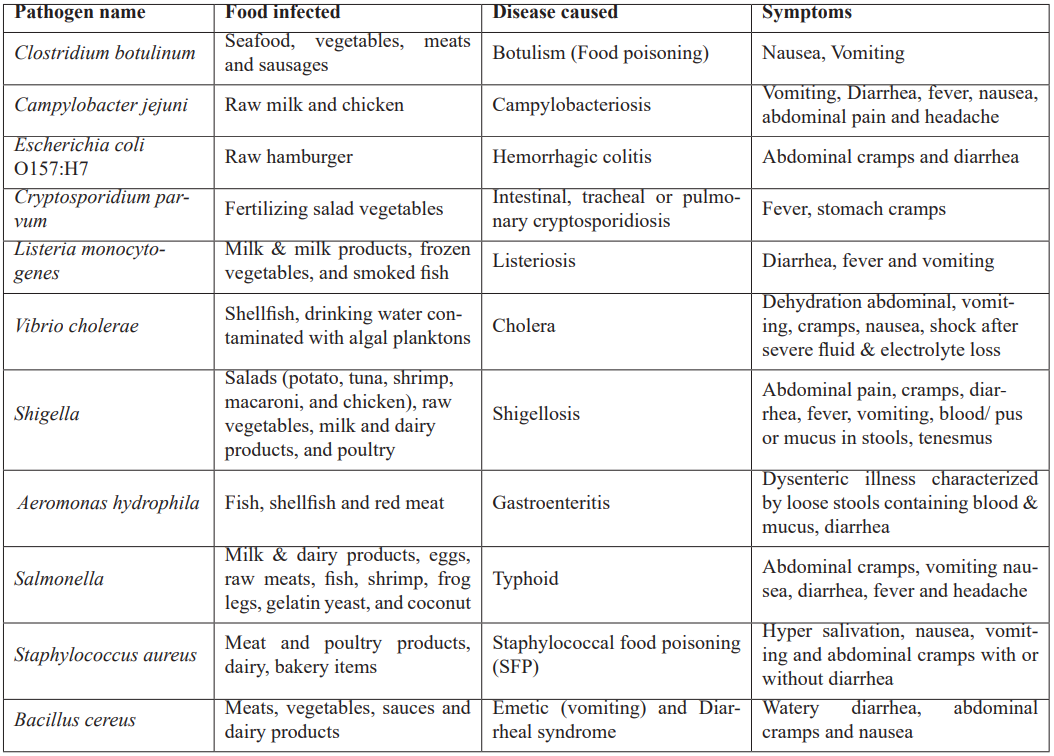
Evaluation of food safety and quality is essential for human health. Salmonella spp. and Escherichia coli strains are prevalent pathogenic bacteria that cause food-borne illnesses. Some of the prevalent food borne pathogens is depicted in Table 1. The traditional microbiological techniques for identifying these bacteria are time-consuming and labor-intensive since they often need many subcultures and biotype or serotype identification stages. The fact that food pathogens are typically found in extremely small quantities (< 100 colony forming units, cfu/g) among up to a million or more other bacteria is one of the inherent challenges in their identification. A backdrop of native microflora may eradicate these microorganisms, and ingredients in the food itself may make recovery more difficult [5]. Additionally, it might be challenging to prove that the strains isolated from a food sample are indeed harmful to humans. Precautionary steps to ensure safe food will be made easier by the rapid and easy identification of pathogenic organisms.
Despite the invention of gene probe methods, certain bacterial strains may now be rapidly identified without the requirement to isolate pure cultures. The polymerase chain reaction (PCR) is a method that uses a pair of primers to amplify certain DNA segments. Sensitive detection of individual genes in samples may frequently be achieved using a million-fold amplification of a specific area. PCR is used to identify genes involved in the pathogenicity of food-borne bacteria as well as to amplify genes specific to taxonomic classifications of bacteria. The currently developed methods for amplifying target specific DNA sequences, allow to capture small quantity of target DNA in various specimens. The amplification techniques can be used to indirectly identify extremely low quantities of microorganisms by amplifying a sequence specific to the pathogenic bacterium of interest.
The global food safety regulatory bodies contribute with modern technology made available to the society to make the food and drinks safe and reduce food borne diseases and assuring food safety by rigorously testing raw and processed food items, and packaging materials for contaminants—be they physical, chemical, or microbiological. The sector also encompasses shelf-life studies, certify organic products, and validate analytical methods to meet national and international standards. Similarly, the air, water & waste water sections play a crucial supporting role by monitoring environmental factors that directly or indirectly impact food safety. Expert trainings are also provided to the technical staff, officials and regulators to effectively apply the modern science and technology in public life. Together, these sectors help maintain a clean and safe ecosystem for food cultivation, processing, and consumption.
Conflict of Interest: None
Acknowledgments: The authors extend sincere thanks to the management of Shriram Institute for Industrial Research for providing support bringing the opinion report to its present form. The opinion report has been identified with Number SRI-MS#20260316-01 by Shriram Institute for Industrial Research.
References
- Das M. Food contamination and adulteration, e-book. Environmental Biochemistry, National Science Digital Library, 2007; 1-32.
- Olaimat AN, Taybeh AO, Al-Nabulsi A, Al-Holy M, Hatmal MM, Alzyoud J, et al. Common and potential emerging foodborne viruses: a comprehensive review. Life, 2024; 14(2): 190.
- Burton E, Borriello SP, Gregory PJ, Healing J, Nicholson C, Oliver TH, et al. Identification of evidence gaps and future research needs in food safety. Trends Food Sci Technol, 2026: 105544.
- Awad DA, Masoud HA, Hamad A. Climate changes and food-borne pathogens: the impact on human health and mitigation strategy. Clim Change, 2024; 177: 92.
- Nemati M, Hamidi A, Maleki Dizaj S, Javaherzadeh V, Lotfipour F. An Overview on Novel Microbial Determination Methods in Pharmaceutical and Food Quality Control. Adv Pharm Bull, 2016; 6(3): 301-308.