Email id: info@ijclinmedcasereports.com
Addressing Nursing Workforce Needs as a Public Health Concern in Community Health Educational Initiatives
Debra Penrod*
Nursing, School of Health Sciences, College of Health and Human Sciences, Southern Illinois University Carbondale, USA
Received Date: 11/07/2025; Published Date: 15/08/2025
*Corresponding author: Debra Penrod, DNP, RN, CRRN, Nursing, School of Health Sciences, College of Health and Human Sciences, Southern Illinois University Carbondale, 1365 Douglas Drive, Carbondale, IL, USA
Abstract
As nurse educators, we are aware of the current and projected nursing shortage occurring globally. The Health Resources and Services Administration projected in 2022 that there would be over 78,000 registered nurse position vacancies by 2025 and nearly 64,000 by 2030. Various factors that have led to this phenomenon need to be addressed but, most urgently, nursing programs need to recruit and train future registered nurses for practice.
A teaching strategy was implemented in Summer 2024 to, not only attract high school students to the profession, but also to develop future leaders within the profession. For a Population Health course in a baccalaureate nursing program, an assignment was created for students to address this public health concern--the nursing shortage. A three-day Nursing Career Camp was developed by senior-level nursing students for area high school students who were interested in nursing during Spring 2024 with another cohort of senior level nursing students implementing the camp the following summer. Community partners were invited to provide education as well as a career fair on the third day. Twenty-seven high school students attended this event that generated excitement with activities created by current nursing students to benefit future nursing students. A survey was distributed following the event with overwhelmingly positive results. More community health educators should consider offering a camp that is developed by current students and run by students to not only develop leadership/management skills but also impact the nursing workforce.
Keywords: Nursing shortage; Public health; Nursing recruitment; Teaching
Introduction
A global public health concern for many years now has been the nursing shortage. I 2023, the National Institute for Health listed multiple reasons why a nursing shortage has occurred and why this is considered a public health concern [1]. The population is aging in general as baby boomers are entering their 60s, 70s and 80s. By 2029, the last of the Baby Boomer population will be over 65 years of age, a 73% increase. This phenomenon has resulted in a greater need for health services that will continue.
The nursing workforce itself is aging as well at the bedside as well as in academia. In 2023, there will be one million nurses over the age of 50 [1]. The aging nursing educator population poses a concern since there is a direct relationship between the number of educators and the ability to train more nurses for practice. Some states restrict the number of nursing students per faculty member in the clinical setting which is a key component of nursing education.
The healthcare environment plays a role in nursing shortage as well. Nursing burnout varies from 8.8% to 37.0 % depending on geographical location and specialty. Some reasons for burnout can be the level of emotional and sometimes physical abuse that nurses endure on the job. The abusive situations added to an already stressful environment results in decreased satisfaction. Nurses may leave temporarily or leave the profession all together [1].
The American Nurses Association Illinois stated that, although there are currently 227,601 active registered nurse licenses practicing in Illinois, there is a projected need of 15,000 new RNs to meet the projected need in 2025 [2]. According to the Illinois Nursing Workforce Center RN 2024 Survey Review, 41% of the nursing workforce is over the age of 55 and 25% stated an intent to retire within the next 5 years [3]. When asked about the primary factors for retirement, the surveyed nurses stated salary, longer/less flexible work hours and physical demands as reasons. To counteract retiring nurses, new Illinois registered nurse graduate numbers have held steady at about 7,000 per year but fall short of the 15,000 new nurses needed for 2025. This nursing shortage has a direct impact on the health of the geographical area being served. When considering Illinois, the amount of healthcare services provided in urban areas such as Cook County (Chicago) and Peoria County (Peoria) have a Health Professional Shortage Area (HPSA) score of 14-19 out of 25 depending on the services provided [4]. Forty Illinois rural counties have a HPSA score greater than 15, with 14 of those counties located in southern Illinois.
In southern Illinois, there are two organizations that provide most of the healthcare: Southern Illinois Healthcare and Deaconess Illinois Medical Center. Currently, there are 62 registered nurse positions vacant at Southern Illinois Healthcare, an organization that has 162 beds that offer Level II Trauma Care, a Birthing Center, Level II Special Care Nursery and Primary Care centers across southern Illinois [5]. Deaconess is a Level II Trauma Care Center as well with Primary Care Centers and a 94 acute care beds [6]. Deaconess Illinois Medical Center has 27 registered nurse openings.
There has been some action related to the reasons for nurses leaving as well as attracting new nurses to the profession. The Illinois Economic Policy Institute has recommended that the state improve the nursing environment by mandating nurse to patient ratios and the forming of staffing committees and addressing nursing well-being and reasons for burnout (2024). To attract people to nursing, loan forgiveness, scholarships and developing pathways to licensure are recommendations that are being implemented.
Case Report
The imbalance between practicing registered nurses and the healthcare need in both rural and urban areas points to community colleges and universities continuing efforts at nursing student recruitment. The lack of nurses practicing at the bedside regionally and nationally is a public health concern. An innovative means to address this concern was to develop a project for a community health student to create a Nursing Career Day and implement the camp to attract more high school students to nursing in our area.
From this regional public health concern, the state of Illinois approved Southern Illinois University Carbondale to offer a baccalaureate nursing program with their first traditional four-year track beginning in Fall 2020. Soon after, an accelerated track comprised of 3 semesters started. The traditional BSN track offered a Level 3 community health nursing course called, Population Centered Healthcare the spring semester prior to graduation with the ABSN track taking this course in the summer prior to their graduation. The way the community health courses were offered set up an optimal situation for the Traditional BSN students to develop a Nursing Career Day and the ABSN students to take the plan for each day and implement it to area high school students.
In planning this pilot Nursing Career Camp, SIUC nursing faculty targeted as participants area high school students who had attended a health occupations course, a certified nursing assistant course or had a special interest in nursing. The faculty placed a cap on attendees of 30 to keep the group small and provide a more specialized experience. The camp was also designed as a daylong camp with a morning session running 9am-12pm and an afternoon session running 12:30pm—3:30pm. Flyers were distributed to area high schools with a QR code for registration. For this pilot run, the camp was offered for free, and funds were obtained from the SIU Foundation.
For the traditional BSN group developing the Nursing Career Day, the students were divided into three groups aligned with the topics for each day of the camp. The first group was assigned the theme, “The Human Body” for Day 1 of the camp, the second group was assigned, “Careers in Nursing” and the third group was assigned, “Specialties in Nursing”. The assigned project mirrored a Community Needs Assessment that involved the nursing process that was communicated in a series of posts to the instructor:
Post 1: Assessment Phase, Part 1: Research what other colleges/universities have done at nursing career camps. What activities seem to be the most exciting and inspirational to your group? Collect potential ideas for your day at SIUC’s Nursing Career Camp. Be creative!
Post 2: Assessment Phase, Part 2: Assess the problem in our region/nationally/globally with the nursing shortage. Research reasons why high school students don’t go into nursing as a career. What barriers exist that prevent some high school students from choosing nursing as a career? What opportunities exist for high school students to go into nursing as a career?
Post 3: Planning Phase, Part 1: Set specific goals/objectives for the day. What do you want to accomplish on the day assigned?
Post 4: Planning Phase, Part 2: Design activities to meet those goals/objectives. Be creative and use your resources such as the nursing simulation lab assistant for nursing lab activities, the anatomy/physiology lab on campus, and area resources at the SIUC Health Center, Wellness Center, SIH, Marion VA, SSM, and Heartland Regional Medical Center.
What you plan will be implemented by the ABSN students this summer (about 36 students). Eighteen ABSN students will run the morning session and eighteen students to run the afternoon session of camp. Specify what jobs need to be done based on a maximum of 18 people for each session. What activities will attract high school students to nursing? Make it fun!!!
Post 5: Planning Phase with Implementation/Evaluation: Submit the entire plan for the day which includes goals and objectives and times and activities. Be sure to give any contact names needed to implement the plan. Consider how you would evaluate the effectiveness of the day? What questions would you ask to evaluate goals/objectives set for your part of the Career Camp?
Post 5 was given to the ABSN students as a rough draft of the Nursing Career Camp’s activities. The students were asked to continue where the traditional BSN students left off and use resources on campus and in the community to make the camp enjoyable, inspirational and successful at recruiting high school graduates to become nurses. A faculty member was given the role of facilitator for the event and ABSN students were asked to assign themselves the following roles reporting to the facilitator every week:
Team Leader: This person ensures that the team is cohesive and knows their roles before, during and after the activities. Team Leader will meet with the facilitator via Zoom weekly until the camp is finished
Assistant Team Leader: This person fills in for the Team Leader if this person is unable to make the weekly meeting with the facilitator. The Assistant Team Leader also meets with the nursing simulation lab assistant in Week 2 & 3 to ensure that supplies are available for the group’s activities and any training is completed for the group to run any simulations. The nursing simulation lab assistant will be used as a resource only since the team will be running any simulations.
Community/Student Communicator: This person is the point of contact with any speakers or outside agencies involved in the activities. This person ensures that the schedule is shared with any people, so the activity runs smoothly. This person oversees the final schedule of events so that everyone understands what is going on and what role they are playing in the session.
Curriculum Chair: This person ensures that activities are aligned with goals/objectives for the day. This person also develops two questions that can be asked at the end of the day to evaluate participant learning or reflection.
General Assistants: One or two team members assist the Team Leader and/or Assistant Team Leader with planning and communication as needed and in carrying out the activities. Everyone will be helping but the General Assistants will help to get it done.
Zoom Meeting 1: Discuss with the faculty facilitator how your group will “own” your activities. Discuss the objectives for your activities. Do the activities seem doable? At this stage, you may change aspects of the plan or come up with replacement activities. Specific roles need to be assigned within your group. As a result of your meeting, post the progress you have made, and any other assignments made by the faculty facilitator.
Zoom Meeting 2: Discuss with the faculty facilitator any difficulty you are having with the content or your plan of implementation. Identify the roles within your group. Also, assign the other students’ specific roles to assist in your activities. There are 35 ABSN students who will be helping so give them specific jobs. Let the faculty facilitator know if any other resources are needed. As a result of this meeting, post the progress you have made, and any other assignments made by the faculty facilitator as well as any feedback from the meeting with the nursing simulation lab assistant.
Zoom Meeting 3: Share with faculty facilitator the finalized plan at your meeting so you can polish the plan or make any small changes to it. Does everyone have a specific job in implementing the activities? As a result of your meeting, post the progress you have made, and any other assignments made by the faculty facilitator as well as any feedback from a follow-up meeting with the nursing simulation lab assistant.
Zoom Meeting 4: This is the final meeting with the faculty facilitator to ensure that a solid plan is in place and no further questions need answered. The Team Leader reports the two questions that the Curriculum Chair developed that might be asked at the end of the day to verify that the participants met objectives for the day. As a result of your meeting, post the progress you have made, and any other assignments made by the faculty facilitator.
Final Post following the event: The Curriculum Chair needs to post an evaluation of the event. How did you measure the effectiveness of the activities? What would you have done differently to be more impactful? What activities would you advise to repeat again next year?
Twenty-five high school students from 13 different high schools from southern Illinois participated in the event. Both BSN tracks of students developed several learning activities that kept the camp moving for high school students. Activities included Kahoot, Jeopardy and charades games, a scavenger hunt and relay races. Also, high school students were given a tour of the cadaver lab on campus which is utilized for Anatomy & Physiology class (a prerequisite for the nursing program).
A post-camp survey was given to gauge the experience for future programming. One limitation of the participant survey was an error that was made in scheduling the camp. Initially, Nursing Career Camp was scheduled for Tuesday, Wednesday, and Thursday but it was discovered that Thursday was a federal holiday and campus would be closed. So, the last day of camp was rescheduled for a Friday so, on the last day, only 14 of the 25 students were available to finish the camp and take the survey. The results were overwhelmingly positive about the camp (Table 1).
Table 1: Nursing career camp participant survey results.
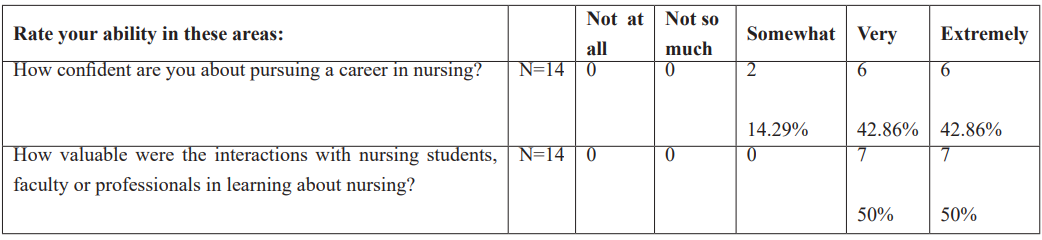
In response to the question, “How would you rate your change in perception of nursing based on the Nursing Career Camp?” eight campers stated a noticeable change, 4 campers stated a significant change and 2 campers stated a “complete transformation”. Of the 14 surveyed campers, all of them stated confidence on some level in pursuing a nursing career. Open-ended questions revealed a change in perspective as well. These open-ended questions fell into three categories: learning about nursing training and abilities, nursing opportunities as a career, and nursing skills. One camper’s statement summed up the experience: “I was surprised by how much I learned. I didn’t really know what to expect, but I learned so much and had so much fun. Everyone helping out was great!!!”
Discussion
This assignment accomplished several objectives, both for the traditional and accelerated BSN students, the high school students and, more broadly, the nursing profession. One group of senior nursing students developed skills in designing the three-day Nursing Career Camp that was geared toward the potential interests of high school students who expressed an interest in nursing as a career path. When students are asked to develop an activity, they learn to communicate their needs with each other and outside community partners. Management and leadership skills were developed as well. Within their group, they were asked to collaborate, divide roles, and create a session together. When faculty develop assignments in which students are asked to use knowledge attained to assess and evaluate a problem and create or design a program to address the program, the highest level of cognitive learning is achieved [7]. The psychomotor domain of learning is achieved as students review skills necessary for practice to demonstrate to high school students. Lastly, the affective domain of learning is developed as senior nursing students review why they chose this profession and share those insights with potential future nursing students.
The NCLEX Clinical Judgement Model could be applied to this assignment as well [8]. Clinical judgement was developed as the traditional BSN students were asked to recognize and analyze cues to the nursing shortage and gather evidence of the problem as it exists in our region, nationally, and globally. They were then asked to generate hypotheses as to the nursing shortage and potential solutions in the form of active learning strategies to implement. The ABSN students further analyzed and prioritized the hypotheses, fine-tuned the potential plan and took action by implementing the camp. Lastly, the ABSN students evaluated the participant responses as well as the activities to discern if the solution addressed the problem. This assignment gave them the opportunity to be clinical experts, which boosted their confidence as they were transitioning soon to clinical practice.
For prospective nursing students, Nursing Career Camp was implemented in a non-threatening environment where campers could openly talk with current students about the challenges of nursing programs and potentially become more comfortable with choosing this career path. Since the camp was designed by students for students, the activities seemed to generate more excitement than if they were developed by faculty or staff. The ABSN students readily gave tips on nursing school survival. Ninety-three percent of the campers wanted to return to camp in 2025 and 100% stated that they wanted SIUC Nursing to contact them in the future about their career path. For 2025, the ABSN students are assessing the 2024 camp schedule, participant feedback and the ABSN student evaluations to make any changes needed to implement Nursing Career Day for June 2025.
Conclusion
When teaching future nurses senior level communication, management and leadership skills as well as clinical judgement, an effective way to hone these skills is to assign them to develop a nursing career day for prospective students. The current and projected nursing shortage has produced a public health concern that can be addressed in an assignment like this in a community health course. More community health nurse educators should consider offering a camp that is developed and implemented by current students to develop leadership these skills, but also impact the nursing workforce for future generations.
Competing Interests & Grant Information
The author formally declares that the content of this paper is an original work. It has not been published previously in any media including journals or websites. It is not being reviewed by any editorial office of publishers. All cited materials have been properly credited with citations in the context and the References section. There are no competing interests whether financial or non-financial, that are directly or indirectly related to the work submitted for publication. This work was not funded by any grant.
References
- Haddad LM, Annamaraju P, Toney-Butler TJ. Nursing shortage. National Institute for Health National Library of Medicine: National Center for Biotechnology Information. Treasure Island, FL: StatPearls, 2019.
- American Nurses Association IL. Workforce shortage/workforce data.
- Illinois Department of Financial and Professional Regulation IDFPR/IL Nursing Workforce Center 2024 RN Report. State of Illinois, 2025.
- National Center for Health Workforce Analysis HRSA Health Workforce: Nurse Workforce Projections, 2022; 11: 2020-2035.
- Southern Illinois Healthcare. About Us. Southern Illinois Healthcare, 2022.
- Deaconess Illinois Medical Center. Featured services and conditions. Deaconess Illinois Medical Center, 2025.
- Billings DM, Halstead JA. Teaching in nursing: A guide for faculty. Elsevier: Louis, MO, 2024.
- National Council of State Boards of Nursing Next Generation NCLEX Clinical judgement measurement model: A framework to measure clinical judgment and decision making.