
Email id: info@ijclinmedcasereports.com
Compounded Polypharmacy in Chronic Pain: The “Magic Capsule” Illusion
Jobson Lopes de Oliveira*,Thargus de Almeida Pinho, Jayme Renan Machado Costa, Pedro Henrique Lima Monteiro Barroso Bezerra, Marcella Arruda Sancho, Sabrina Rocha Angelim and Gotardo Duarte Dumaresq Filho
Department of Medicine, Centro Universitário Christus (Unichristus), Fortaleza, CE, Brazil
Received Date: 26/10/2025; Published Date: 21/11/2025
*Corresponding author: Jobson Lopes de Oliveira, Department of Medicine, Centro Universitário Christus (Unichristus). R. João Adolfo Gurgel, 133, ZIP 60190-180. Fortaleza, CE, Brazil
Dear Editor,
The growing global burden of chronic pain has spurred renewed interest in individualized pharmacological approaches, including compounded formulations. Marketed as personalized therapies, these mixtures are increasingly prescribed when standard treatments are perceived as inadequate. However, the uncritical expansion of this practice raises serious concerns regarding clinical justification, pharmacovigilance, and patient safety.
We recently encountered an illustrative example: a compounded preparation containing 20 active substances distributed across five daily capsules. The formulation (Figure 1) included neuromodulators (gabapentin 50 mg, pregabalin 50 mg, duloxetine 20 mg, amitriptyline 15 mg, low-dose naltrexone 5 mg); muscle relaxants (cyclobenzaprine 2 mg, orphenadrine 10 mg); analgesics/anti-inflammatory agents (tramadol 30 mg, triamcinolone 4 mg, diacerein 30 mg); an antimalarial repurposed for pain (chloroquine 200 mg); gastrointestinal agents (omeprazole 40 mg, ondansetron 6 mg); nutraceuticals (B-complex 30 mg, thiamine 300 mg, folic acid 0.5 mg, psyllium 500 mg); vinpocetine 4 mg, a synthetic compound derived from vincamine, potentially supporting cognitive function and cerebral blood flow; and diamine oxidase enzyme (“adidao”, 4.3 mg), an enzyme that breaks down histamine, often used to address histamine intolerance or digestive issues.
This striking combination, which reads more like a polypharmacy checklist than a targeted therapeutic strategy, is not an isolated case. It exemplifies a broader and troubling trend of polypharmacy without evidence-based rationale. While intended to simplify pain management, such formulations often amplify risks related to drug interactions, and obscure accountability and therapeutic transparency.
According to the U.S. Food and Drug Administration (FDA), compounded drugs are preparations tailored to meet individual patient needs [1]. However, these products are exempt from Good Manufacturing Practices (GMP) and are not subject to premarketing evaluations for safety, efficacy, or quality control. A systematic review identified 63 compounding errors resulting in harm to 1,155 patients, mainly due to contamination or dosing inaccuracies [1].
Despite these well-documented risks, the compounded medication industry continues to expand. In Brazil, the sector generated R$ 11.3 billion in 2023, a 17.1% real increase since 2019 [2]. In the United States, the market was valued at USD 6.31 billion in 2024 and is projected to surpass USD 10 billion by 2033, largely driven by chronic pain treatments [3]. Pain management alone accounted for over 32% of revenues in 2023.
Comparative analyses show that compounded drugs exhibit higher rates of subpotency, suprapotency, and sterility failures than FDA-approved formulations, with some samples delivering only 59% or as much as 268% of the intended dose [4]. The absence of standardized labeling, traceability, and pharmacovigilance shifts the burden of risk communication and informed consent to prescribers, who may also bear legal liability in the event of patient harm [5].
The simultaneous inclusion of antidepressants, opioids, anticonvulsants, corticosteroids, and supplements—as in the case described—creates an unpredictable web of pharmacodynamic interactions, additive toxicity, and central nervous system depression. Such complexity undermines both clinical monitoring and the attribution of efficacy or adverse effects to any single component. In such a 'black box' of polypharmacy, identifying the culprit of an adverse reaction becomes a nearly impossible task.
From an ethical standpoint, the case described herein starkly illustrates how prescribing unvalidated multi-drug compounded mixtures challenges the principles of non-maleficence and informed consent. While compounding remains appropriate in select contexts—such as pediatric dosing, allergy avoidance, or temporary shortages—it must not become a substitute for evidence-based, regulated pharmacotherapy.
As clinicians, we must resist the allure of the so-called “magic capsule”. Complexity is not innovation, and customization should never supersede scientific rigor or patient safety. Transparent, rational prescribing remains our most powerful—and ethical—therapeutic tool.
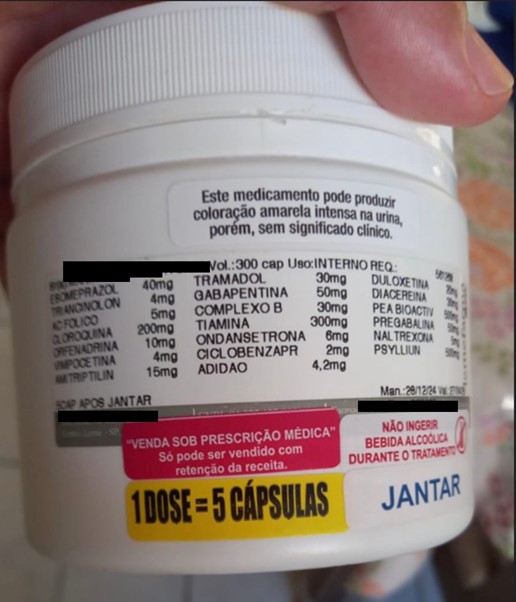
Figure 1: Label of a compounded preparation for chronic pain therapy containing 20 active ingredients administered as five capsules per dose. The formulation includes antidepressants, anticonvulsants, opioids, corticosteroid, and dietary supplements, highlighting the complexity and safety challenges associated with multi-drug compounded products.
Author Contribution: All authors contributed substantially to the conception, drafting, and critical revision of the manuscript. All authors approved the final version of the manuscript.
Conflict of Interest: The authors declare that there are no conflicts of interest related to this manuscript.
Funding Disclosure: No external funding was received for the preparation of this manuscript.
References
- Watson CJ, Whitledge JD, Siani AM, Burns MM. Pharmaceutical compounding: a history, regulatory overview, and systematic review of compounding errors. J Med Toxicol, 2020; 16(4): 361–379.
- Associação Nacional de Farmacêuticos Magistrais (Anfarmag). Panorama Setorial 2024. São Paulo: Anfarmag, 2024.
- Nova One Advisor. S. Compounding Pharmacies Market, 2025.
- Gudeman J, Jozwiakowski M, Chollet J, Randell M. Potential risks of pharmacy compounding. Drugs R D, 2013; 13(1): 1–8.
- Randell MD, Duffy PJ. Risk and liabilities of prescribing compounded medications. Postgrad Med, 2014; 126(4): 178–180.