
Email id: info@ijclinmedcasereports.com
Artificial Intelligence in Diagnosing Conjunctivitis – A Step towards Smarter Eye Care
Fabeha Tahir1, Omar Irfan2,3, Mohammad Aadil Qamar3,*, Neha Maqsood4 and Ahmed Burq Maqsood3
1Ziauddin Medical University, Karachi, Pakistan
2Independent Consultant, Milton, Ontario, Canada
3Department of Ophthalmology and Visual Science (DOVS), Aga Khan University Hospital, Karachi, Pakistan
4University of Bristol Medical School, Bristol, United Kingdom
Received Date: 23/04/2025; Published Date: 25/06/2025
*Corresponding author: Mohammad Aadil Qamar, Volunteer Researcher, Department of Ophthalmology and Visual Science (DOVS), Aga Khan University Hospital, Karachi, Pakistan
DOI: 10.46998/IJCMCR.2025.52.001300
Abbreviations: AI- Artificial Intelligence; VKC- Vernal keratoconjunctivitis; HL- Hamming Loss; CA- Classification accuracy; TEN- Toxic Epidermal Necrolysis; SJS- Stevens-Johnson Syndrome; GPC- Giant papillary conjunctivitis; AKC- Atopic keratoconjunctivitis; AC- Allergic conjunctivitis (AC); CNN- Convolutional Neural Network
To the Editor,
We are writing in reference to a recent article entitled, ‘Outbreak of Conjunctivitis in South Asia: A Landscape of Current Situation and Rapid Review of Literature’ [1]. We congratulate the authors on their unique narrative review on conjunctivitis, a highly contagious, self-limiting eye infection characterized by conjunctival hyperemia, watery discharge, and follicular reaction. Whilst the article briefly touches upon the clinical diagnostic approaches, we seek to highlight and further elaborate on this topic, particularly on the emerging use of Artificial Intelligence (AI) in the clinical diagnosis of infectious diseases. Given AI’s vast influence across different industries and its inevitable impact on the future of modern medicine, we would like to emphasize its potential to bolster the diagnostic accuracy in conjunctivitis.
Type of AI Tools Used for Conjunctivitis Diagnosis
Given the progress in AI technologies, researchers have adopted various techniques for building healthcare diagnostic systems that can correlate symptoms and diagnoses. Examples include automatic image processing-based techniques composed by Joydeep Tamuli et al., which distinguish conjunctivitis-tainted eyes from ordinary eyes and characterize them according to their type, which is either allergic, bacterial, or viral [2]. Additionally, recent breakthroughs in AI have resulted in the development of a highly complex AI-driven chatbot, Google Gemini Advanced, that assists in providing accurate and relevant responses to Vernal Keratoconjunctivitis (VKC)-related queries [3].
Moreover, an innovative automated diagnosing system of adenoviral conjunctivitis used the facial picture built by Melih Gunay et al. to measure the vascularization and intensity of redness in pink eyes after segmenting the sclera regions of eye images to diagnose conjunctivitis with only 30 images (18 healthy and 12 adenoviral conjunctivitis eye images). The average accuracy rate was found to be 96% [4].
In addition to the above-mentioned technologies, one study validates AI-based software named AllergoEye for objectively assessing conjunctival allergic reactions using smartphone imaging and computer analysis, demonstrating 98% sensitivity and 90% specificity. This further highlights its practical applicability in clinics for allergic conjunctivitis evaluation [5].
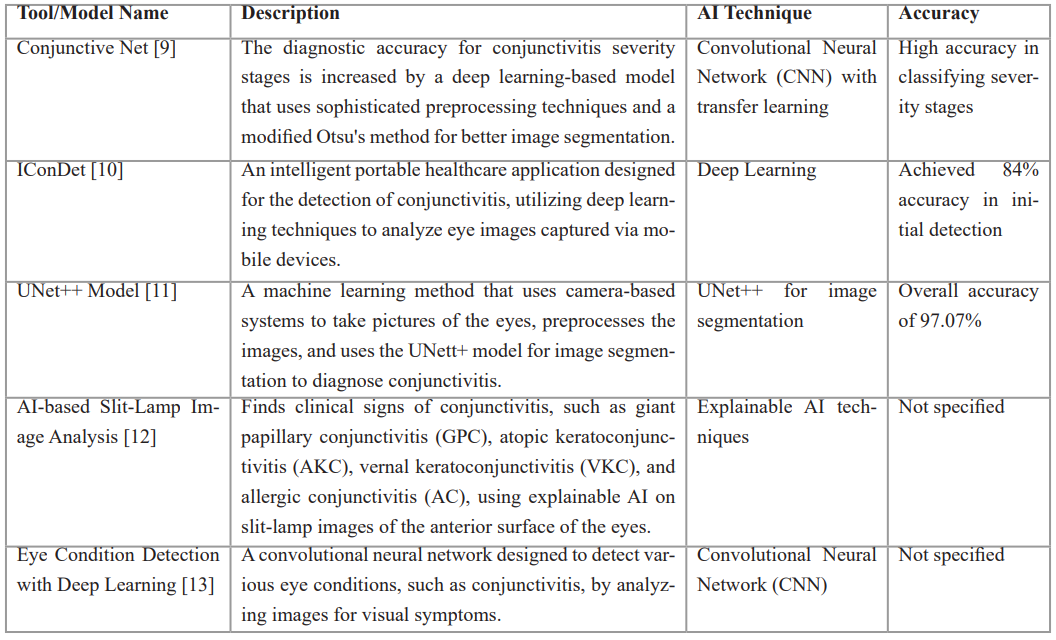
Table 1 provides insights into the latest AI devices designed for conjunctivitis detection and management.
Table 1: AI tools designed for conjunctivitis diagnoses and management.
AI Tools currently in use internationally
The use of AI in diagnosing conjunctivitis is no longer a theoretical concept but a growing reality. Several countries have already initiated AI-based studies and clinical applications, demonstrating AI’s potential for early detection, classification, and management of the disease. Some notable instances include the world's first conjunctivitis-related tear biomarker study, which was carried out by Dr. Rohit Shetty at the Narayana Nethralaya Institute in India and used AI to measure the severity of conjunctivitis [6]. Similarly, China developed the EE-Explorer – a multimodal AI system – that used metadata and ocular pictures to help with the initial diagnosis and triaging of eye crises. In the first diagnosis, the system showed a Hamming Loss (HL) of 0.011 and a classification accuracy (CA) of 0.860 (7). Furthermore, according to the original article, a study conducted in Japan using 4,942 slit-lamp images showed that Al could identify clinical signs of various types of conjunctivitis, including giant papillary conjunctivitis, vernal keratoconjunctivitis, atopic keratoconjunctivitis, and allergic conjunctivitis [8].
Clinical Implications and Challenges
AI-powered gadgets are becoming increasingly beneficial for the diagnosis and treatment of conjunctivitis.
AI can facilitate remote diagnosis and triage of conjunctivitis cases using teleophthalmology, especially in primary care or disadvantaged areas. However, because conjunctivitis presents differently in separate demographics and geographical areas, there is a lack of generality despite these encouraging developments. Al's incapacity to access subjective symptoms, which are crucial in distinguishing amongst conjunctivitis etiologies, is further reflected in the excessive dependence on picture analysis. Integration into actual clinical practice, lack of extensive clinical validation, and ethical issues continue to be major issues that require attention.
Notwithstanding these drawbacks, AI-driven technology has the potential to improve treatment effectiveness and close gaps in healthcare accessibility. Al can identify potentially fatal conjunctivitis associated with systemic conditions such as sepsis, Kawasaki disease, or Stevens-Johnson Syndrome (SJS)/Toxic Epidermal Necrolysis (TEN), and can ensure that high-risk patients are urgently evaluated by a specialist. Furthermore, risk stratification and predictive analytics in AI models can help prioritize serious illnesses by evaluating patient symptoms, history, and imaging data, which can shorten diagnostic turnaround times and enhance clinical results.
The integration of AI in the diagnosis of conjunctivitis emerges as a promising advancement in ophthalmology. By leveraging image recognition and ML algorithms, AI can assist clinicians in early diagnosis and differentiate between the types of conjunctivitis. Further validation of results through large-scale studies and diverse data sets can help AI to improve diagnostic prediction, streamline patient triage, and improve eye care.
Conflict of Interest: None
Funding statement: None
Acknowledgements: None
References
- Amjad SS, Memon H, Soomro SR, Qamar MA, Anjum MU, Hasanain M, et al. Outbreak of Conjunctivitis in South Asia: A Landscape of Current Situation and Rapid Review of Literature. IJCMCR, 2024; 39(2); 5.
- Tamuli J, Jain A, Dhan AV, Bhan A, Dutta MK. An image processing-based method to identify and grade conjunctivitis infected eye according to its types and intensity. In 2015 Eighth International Conference on Contemporary Computing (IC3), 2015; pp. 88-92.
- Saad M, Moqeet MA, Mansoor H, Khan S, Sharif R, Khan FU, et al. Evaluating the Efficacy of Artificial Intelligence-Driven Chatbots in Addressing Queries on Vernal Conjunctivitis. Cureus, 2025; 17(2).
- Gunay M, Goceri E, Danisman T. Automated detection of adenoviral conjunctivitis disease from facial images using machine learning. In 2015 IEEE 14th International Conference on Machine Learning and Applications (ICMLA), 2015; pp. 1204-1209.
- Yarin Y, Kalaitzidou A, Bodrova K, Mösges R, Kalaidzidis Y. Validation of AI-based software for objectification of conjunctival provocation test. Journal of Allergy and Clinical Immunology: Global, 2023; 2(3): 100121.
- HealthVision. Conjunctivitis Management using AI - Research by Narayana Nethralaya [Internet]. Health Vision, 2023.
- Chen J, Wu X, Li M, Liu L, Zhong L, Xiao J, et al. EE-explorer: a multimodal artificial intelligence system for eye emergency triage and primary diagnosis. American Journal of Ophthalmology, 2023; 252: 253-264.
- Yonehara M, Nakagawa Y, Ayatsuka Y, Hara Y, Shoji J, Ebihara N, et al. Use of explainable AI on slit-lamp images of anterior surface of eyes to diagnose allergic conjunctival diseases. Allergology International, 2025; 74(1): 86-96.
- Pahwa S, Kaur A, Dhiman P, Damaševičius R. ConjunctiveNet: an improved deep learning-based conjunctive-eyes segmentation and severity detection model. International Journal of Intelligent Computing and Cybernetics, 2024; 17(4): 783-804.
- Mukherjee P, Bhattacharyya I, Mullick M, Kumar R, Roy ND, Mahmud M. i condet: An intelligent portable healthcare app for the detection of conjunctivitis. InInternational Conference on Applied Intelligence and Informatics. Cham: Springer International Publishing, 2021; pp. 29-42.
- Umamaheswari E, Sruthakeerthi B, Bacanin N, Mathur T. System and method to diagnose conjunctivitis in the eye of a user. Heliyon, 2024; 10(17).
- Yonehara M, Nakagawa Y, Ayatsuka Y, Hara Y, Shoji J, Ebihara N, et al. Use of explainable AI on slit-lamp images of anterior surface of eyes to diagnose allergic conjunctival diseases. Allergology International, 2025; 74(1): 86-96.
- Vengurlekar MS, Nadaf MT, Fernandes NN, Kumar KC. Conjunctivitis Eye Detection using Deep Learning. In2024 5th International Conference on Electronics and Sustainable Communication Systems (ICESC), 2024; pp. 1591-1597.