
Email id: info@ijclinmedcasereports.com
Kidney Involvement in Pregnant Women Treated at a Regional Hospital in Northern Paraguay: A Series of Ten Cases
Raúl Desvars1,2,*, María José López Otaño2, Oscar Maciel2 and Elena Schupp2
¹Faculty of Medicine, Universidad Nacional de Concepción, Concepción, Paraguay
²Nephrology Service, Hospital Regional de Concepción, Concepción, Paraguay
Received Date: 05/11/2026; Published Date: 29/12/2026
*Corresponding author: Raúl Desvars; Faculty of Medicine, Universidad Nacional de Concepción, Concepción, Paraguay. Full postal address: Facultad de Medicina, Campus Universitario UNC, Concepcion, Paraguay
ORCID: 0000-0003-3372-6329
Abstract
Pregnancy-related acute kidney injury (PR-AKI) remains an important cause of maternal morbidity and mortality in low-resource settings. We describe ten women aged 17–37 years (median 27.5) treated between 2022 and 2026. Four had complications of the first half of pregnancy (missed miscarriage with status epilepticus, two septic abortions, and a complicated ectopic pregnancy), four had hypertensive disorders (eclampsia, pre-eclampsia with alveolar haemorrhage, HELLP syndrome, and pre-eclampsia superimposed on undiagnosed kidney disease), and two had pre-existing kidney disease or anaemia (one woman on haemodialysis and one with severe anaemia). Eight developed AKI or acute-on-chronic kidney disease; three started haemodialysis, and in a fourth it was indicated but precluded by haemodynamic instability. Two women aged 21 and 27 years remained on maintenance haemodialysis after pre-eclampsia; one had documented prior nephropathy and one had chronic hypertension. Several had improved kidney function and two died of multiple organ failure. Six pregnancies resulted in a live birth, including that of the woman on haemodialysis. Septic and haemorrhagic complications of early pregnancy and hypertensive disorders accounted for most cases. Measuring serum creatinine and performing urinalysis at antenatal care, particularly in women with hypertension, could identify those at risk of progression to kidney failure.
Keywords: Pregnancy; Acute kidney injury; Pre-eclampsia; Septic abortion; Renal dialysis; Paraguay
Introduction
In low- and middle-income countries, PR-AKI is caused mainly by pre-eclampsia, obstetric haemorrhage, and sepsis [1–3]. In Africa it is the second most common cause of AKI, with associated maternal mortality of up to 34% [1]; in India, sepsis is the most frequent cause, followed by haemorrhage and pregnancy-induced hypertension [2]. In an Ethiopian teaching hospital, 8.6% of patients required haemodialysis, 76.5% fully recovered kidney function, and pre-existing Chronic Kidney Disease (CKD) was the main determinant of poor outcome [3].
Pregnancy in women on dialysis is uncommon and high-risk; intensive dialysis is associated with more live births and longer gestation [4]. We report ten pregnant women with kidney involvement assessed by the nephrology service of a regional hospital in northern Paraguay, following the CARE guidelines [5,6].
Case Report
Design and data source. This retrospective case series is based on the progress notes and consultation records of the Nephrology Service, Hospital Regional de Concepción, a public referral hospital in northern Paraguay. All 1146 progress-note documents recorded between October 2021 and October 2026 were screened with the Spanish terms for pregnancy, pregnant, gestation, pre-eclampsia, eclampsia, HELLP, abortion, ectopic, caesarean section, puerperal, and maternity, followed by manual review. The included patients were treated between July 2022 and October 2026.
Selection criteria. We included women who were pregnant at the onset of the episode or whose kidney complication began during pregnancy or delivery, including those assessed in the immediate puerperium for pre-eclampsia, eclampsia, or HELLP syndrome. Four patients were excluded: one whose complication began in the puerperium, two with a single assessment and no recorded outcome, and one without impairment of kidney function.
Variables and definitions. We recorded age, gestational age, parity, comorbidities, obstetric complication, serial laboratory results, treatment, need for haemodialysis, maternal outcome, and perinatal outcome. AKI was defined according to the KDIGO criteria [7]. Recovery was defined as dialysis independence, and creatinine at last follow-up is reported. Laboratory values are given in the units used at our centre: to convert creatinine from mg/dL to µmol/L, multiply by 88.4; to convert urea from mg/dL to mmol/L, multiply by 0.166.
Ethical considerations: [Verify the institutional approval, reference number and scope against the original documentation; see Ethics and consent.]
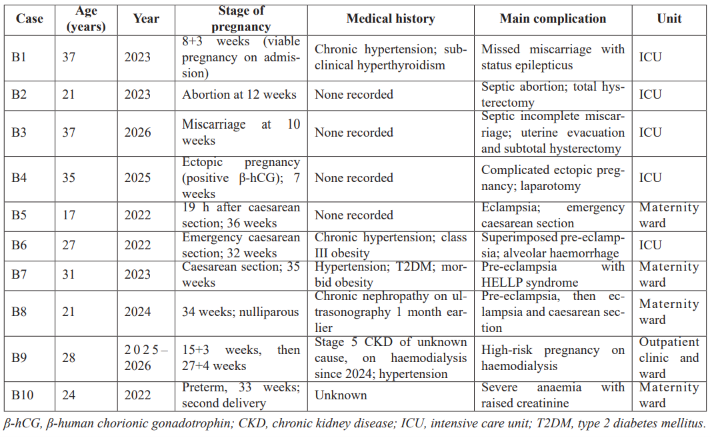
One patient was an adolescent, and four had pre-existing hypertension. Gestational age at the index event ranged from 7 to 36 weeks, and six pregnancies resulted in a live birth. Baseline characteristics are summarised in Table 1.
Table 1: Baseline characteristics of the ten patients.
Complications of the first half of pregnancy (B1–B4)
Case B1. A 37-year-old woman with chronic hypertension and subclinical hyperthyroidism was admitted to intensive care (August 2023) in status epilepticus, with a viable intrauterine pregnancy of 8+3 weeks confirmed by ultrasonography on day 0. Computed tomography showed occipital cortico-subcortical hypodensity (recorded as ‘posterior encephalitis’) and, on day 3, generalized cerebral oedema. That day she had vaginal bleeding, and ultrasonography showed that the pregnancy had failed (missed miscarriage); the intensive care and gynaecology teams deferred uterine evacuation because of her critical condition.
Creatinine rose from 1.0 mg/dL (day 0) to 4.6 mg/dL (day 3), urea from 19 to 121 mg/dL, and leucocytes from 6.7 to 30.2 × 10⁹/L, while platelets fell from 223 to 54 × 10⁹/L; on day 4, pH was 7.08 and bicarbonate 11.1 mmol/L. HbA1c was 5.7%, and serology was negative. At nephrology assessment (day 5) she was in shock on noradrenaline and anuric; although sedation had been withdrawn, she had been unresponsive for approximately 2 days, with absent corneal, pupillary light, cough, and gag reflexes. She was receiving ceftriaxone and metronidazole. Septic and hypovolaemic prerenal AKI was diagnosed, and optimization of haemoglobin, a neutral fluid balance, and pre-dialysis serology were recommended. She died on day 7; brain death and multiple organ failure were certified.
Case B2. A 21-year-old woman was admitted (October 2023) with a septic abortion at 12 weeks treated by total abdominal hysterectomy, with sepsis of gynaecological origin, disseminated intravascular coagulation (DIC), and a recorded diagnosis of Mondor syndrome. At assessment on day 5 she was sedated and mechanically ventilated, without inotropic support, with a urine output of 4280 mL/24 h; she was receiving colistin and tigecycline. Creatinine was 2.6 mg/dL, urea 165 mg/dL, sodium 156 mmol/L, potassium 2.3 mmol/L, leucocytes 29.1 × 10⁹/L, and platelets 40 × 10⁹/L; on day 7, total bilirubin was 1.27 mg/dL and AST/ALT 129/187 U/L. Free water, potassium replacement, and a slightly positive fluid balance were prescribed, without dialysis. Creatinine fell to 1.5 mg/dL on day 7 and 1.4 mg/dL on day 8, and platelets rose to 112 × 10⁹/L. On day 9 she remained intubated, with improving kidney function. She was extubated on day 14 and discharged on day 24 with creatinine 0.9 mg/dL.
Case B3. A 37-year-old woman was admitted (October 2026) with haemorrhage in the first half of pregnancy due to an incomplete miscarriage at 10 weeks and was transferred to intensive care after uterine evacuation. On day 1, creatinine was 4.6 mg/dL, urea 152 mg/dL, haemoglobin 75 g/L, leucocytes 15.8 × 10⁹/L, and platelets 112 × 10⁹/L; direct and indirect antiglobulin tests were negative. On day 3 she was in septic shock of obstetric origin, anuric, and on dopamine, with haemoglobin 62 g/L and creatinine 7.6 mg/dL; a femoral catheter was inserted and haemodialysis was started. She received ampicillin, gentamicin, and metronidazole, then ampicillin and tigecycline, together with blood transfusions.
A subtotal hysterectomy was performed between days 3 and 5, and on day 8 bacteraemia due to meticillin-resistant Staphylococcus haemolyticus was documented. She remained anuric with anasarca until day 11 (peak creatinine 10.3 mg/dL). On day 12 her urine output was 1200 mL/24 h, and on day 17 she entered a polyuric phase (5000 mL/24 h with diuretics). After 12 sessions, creatinine was 5.0 mg/dL on day 18, and the catheter was removed on day 19. She was discharged on day 21 with creatinine 3.8 mg/dL and referred to the nephrology clinic for follow-up.
Case B4. A 35-year-old woman with an ectopic pregnancy (ruptured tubal pregnancy at 7 weeks) and a positive β-hCG underwent laparotomy and was admitted to intensive care (June 2025) with mixed haemorrhagic and septic shock, DIC, thrombocytopenia, and multiple organ failure; she received multiple transfusions of red cells and platelets. Two days earlier, creatinine had been 0.7 mg/dL (haemoglobin 66 g/L). On day 0, creatinine was 3.5 mg/dL, urea 145 mg/dL, platelets 22 × 10⁹/L, bicarbonate 11.7 mmol/L, total bilirubin 8.42 mg/dL, and AST/ALT 140/88 U/L. She was sedated and intubated, on noradrenaline and dopamine, with acrocyanosis; urine output was maintained with furosemide (5425 mL/24 h on day 3). She received ciprofloxacin and metronidazole, then imipenem, metronidazole, and vancomycin.
Creatinine rose to 3.9 and 4.1 mg/dL on days 2 and 3, with platelets of 15–19 × 10⁹/L and fever of 40 °C. Haemodialysis was indicated but deferred because of haemodynamic instability and, on one day, a shortage of nursing staff. On day 4 she had a blood pressure of 48/34 mmHg, SpO₂ of 77%, and anasarca. She died on day 5 of refractory shock.
Hypertensive disorders of pregnancy (B5–B8)
Case B5. A 17-year-old adolescent was assessed on the maternity ward (September 2022) 19 h after an emergency caesarean section for eclampsia at 36 weeks, which resulted in a live-born infant weighing 2450 g. She was in good general condition, with blood pressure 110/60 mmHg, a spontaneous urine output of approximately 2000 mL/24 h, and mild lower-limb oedema. Creatinine was 0.7–0.8 mg/dL, urea 37–40 mg/dL, uric acid 5.6–6.9 mg/dL, AST/ALT 20/8 U/L, alkaline phosphatase 392 U/L, and triglycerides 416 mg/dL. Haemoglobin fell from 104 to 74 g/L within 48 h, and platelets ranged from 192 to 364 × 10⁹/L. Proteinuria was 2546 mg/24 h, and ultrasonography showed subtle diffuse changes in the right kidney (nephropathy vs pyelonephritis). In the absence of AKI, iron, folic acid, a low-sodium diet, and nephrology clinic follow-up to reassess proteinuria were prescribed. At 3 months, proteinuria was 180 mg/24 h, and blood pressure was normal without medication.
Case B6. A 27-year-old woman with chronic hypertension and class III obesity underwent emergency caesarean section for superimposed pre-eclampsia at 32 weeks (live-born infant weighing 1650 g, admitted to the neonatal unit) (July 2022) and was admitted to the ICU the same day. She was drowsy and receiving oxygen at 5 L/min; creatinine was 6.5 mg/dL, urea 182 mg/dL, potassium 5.6 mmol/L, haemoglobin 88 g/L, and platelets 125 × 10⁹/L; serology was negative. Haemodialysis was started on day 0. On day 4 she had anasarca, agitation, and respiratory distress (pH 7.32; bicarbonate 17.8 mmol/L).
Around day 6 she developed massive epistaxis after a heparin-free session, respiratory distress requiring intubation, and cotton-wool infiltrates on chest computed tomography; alveolar haemorrhage with a probable connective tissue disease was diagnosed. After discussion with rheumatology, she received intravenous immunoglobulin for 2 days, methylprednisolone 500 mg/day for 5 days, hydrocortisone, and broad-spectrum antibiotics. The immunological screen (ANA, anti-DNA antibodies, c-ANCA, and p-ANCA) was negative, with a normal C4; anti-glomerular basement membrane (anti-GBM) antibodies were not measured.
She subsequently developed hospital-acquired pneumonia, bilateral pleural effusions, pansinusitis, and a catheter exit-site infection (catheter replaced on day 19). Between sessions, creatinine fell to 4.4 mg/dL (day 7) and 2.7 mg/dL (day 15), with preserved urine output. On day 20, prednisone 1 mg/kg/day (maximum 60 mg), rheumatology review for maintenance therapy, and referral to the National Institute of Nephrology were arranged. In April 2024 she remained on haemodialysis with a diagnosis of stage 5 CKD of undetermined cause, and in June 2024 she was referred for vascular access while on thrice-weekly maintenance haemodialysis.
Case B7. A 31-year-old woman with morbid obesity, hypertension, and type 2 diabetes underwent caesarean section for pre-eclampsia at 35 weeks (live-born infant weighing 2300 g) (June 2023), complicated by HELLP syndrome. After delivery, haemoglobin was 80 g/L, platelets 62 × 10⁹/L, creatinine 1.1 mg/dL, and uric acid 8.9 mg/dL. On day 3, creatinine was 3.1 mg/dL (urea 95 mg/dL; uric acid 14.7 mg/dL), proteinuria 750 mg/24 h, and blood pressure up to 180/100 mmHg, with lower-limb oedema. Hepatitis B surface antigen (HBsAg) was reactive. Ultrasonography showed hepatosplenomegaly, a dilated inferior vena cava, an enlarged left kidney, and a minimal pleural effusion.
On day 4, creatinine was 3.6 mg/dL, lactate dehydrogenase (LDH) 848 U/L, AST/ALT 32/60 U/L, alkaline phosphatase 529 U/L, and platelets 149 × 10⁹/L. She was treated with furosemide, nifedipine 20 mg every 8 h, methyldopa 500 mg every 6 h, transfusion, and fluid-balance monitoring, and transfer to a tertiary centre was requested. On days 5 and 6 her urine output was 9000 mL/24 h, and creatinine fell to 2.4 mg/dL (estimated clearance 26 mL/min/1.73 m²) without dialysis. She was discharged on day 10 with creatinine 1.3 mg/dL; at 6 weeks, creatinine was 0.9 mg/dL.
Case B8. A 21-year-old nulliparous woman had undergone renal ultrasonography 1 month earlier, which showed chronic nephropathy and a simple cyst. She was admitted to the maternity ward (September 2024) at 34 weeks’ gestation with pre-eclampsia, severe anaemia requiring three units of red cells, and acute-on-chronic kidney disease of unknown cause: on day 2, creatinine was 4.6 mg/dL, urea 117 mg/dL, and haemoglobin 102 g/L after transfusion. Methyldopa and nifedipine were adjusted, and maternal–fetal Doppler ultrasonography was requested.
She was readmitted on day 17 after eclampsia and caesarean section (live-born infant weighing 1900 g), with creatinine 7.0–7.7 mg/dL, urea 163–178 mg/dL, haemoglobin 51 g/L, pH 7.16–7.19, and bicarbonate 8.4 mmol/L. She received transfusions, erythropoietin, sodium bicarbonate, and sodium correction; an immunological screen (ANA, anti-DNA antibodies, ANCA, C3, and C4) was negative. She declined urinary catheterization. Haemodialysis was started on day 27; after three sessions creatinine was 3.5–3.7 mg/dL, but it rose to 6.2 mg/dL by day 35.
She remained on maintenance haemodialysis at a contracted private unit, with poor adherence. Over the following 2 years she had hypertensive crises, pneumonia, hypertensive acute pulmonary oedema, suspected pulmonary tuberculosis with haemoptysis, and recurrent catheter infections; in April 2026 creatinine was 18.9 mg/dL. In October 2026 she remained on haemodialysis, with a further catheter exit-site infection.
Pregnant women with pre-existing kidney disease or anaemia (B9–B10)
Case B9. A 28-year-old woman with stage 5 CKD of unknown cause and hypertension had been on haemodialysis since November 2024 (arteriovenous fistula created in January 2025 and in use since August 2025). In October 2025, at 15+3 weeks’ gestation and with a blood pressure of 160/90 mmHg, she was switched to daily 3-h haemodialysis with enoxaparin 20 mg, erythropoietin 20,000 IU/week, methyldopa, iron, folic acid, and calcium. Referral to a tertiary centre for high-risk pregnancy was arranged, but she reported having no means to travel to the capital.
In January 2026, at 27+4 weeks, she was admitted with a complicated urinary tract infection and severe loin pain (8–20 leucocytes per high-power field, positive leucocyte esterase; haemoglobin 107 g/L; leucocytes 14.3 × 10⁹/L). Because of a reported allergy to ceftriaxone, she received cefotaxime, and daily haemodialysis continued under joint nephrology and obstetric follow-up. At 33 weeks a caesarean section was performed for superimposed pre-eclampsia; a live-born boy weighing 1780 g was discharged from the neonatal unit after 18 days. The mother continued on thrice-weekly haemodialysis.
Case B10. A 24-year-old woman (para 1) with a preterm pregnancy (33 weeks) and unknown medical history was admitted to the maternity ward (September 2022) with severe anaemia and no history of bleeding. She was alert and stable (blood pressure 100/60 mmHg), with marked pallor and preserved urine output. Haemoglobin was 58 g/L, platelets 532 × 10⁹/L, leucocytes 12.0 × 10⁹/L, creatinine 1.7 mg/dL, and uric acid 7.9 mg/dL. Two units of red cells were transfused, and electrolytes, urinalysis, faecal occult blood testing, and renal ultrasonography were requested. At 72 h, haemoglobin was 86 g/L, creatinine 1.2 mg/dL, urea 58 mg/dL, and potassium 3.10 mmol/L. Iron, folic acid, vitamin C, hydration, and nephrology clinic follow-up were prescribed. Faecal occult blood testing was negative, and ferritin was 6 ng/mL. She had a vaginal delivery at 37 weeks of a live-born infant weighing 2900 g, and postpartum creatinine was 0.9 mg/dL.
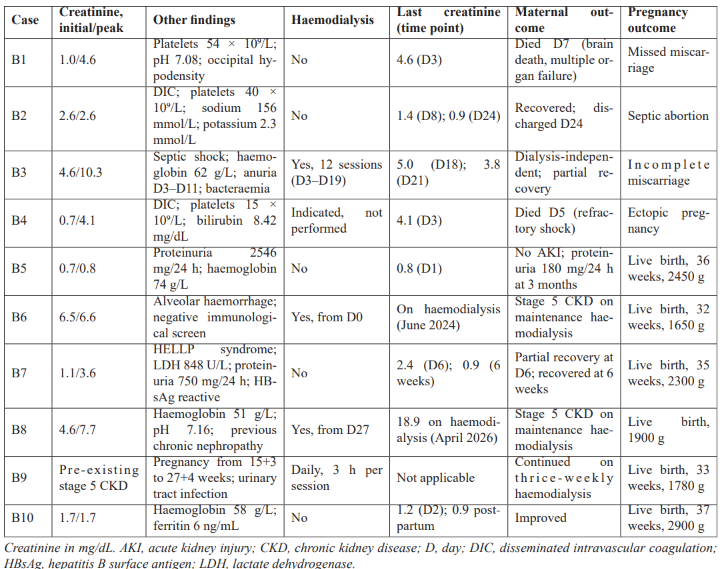
Three women started haemodialysis during the episode (B3, B6, and B8), and a fourth was already on maintenance haemodialysis (B9). Both women who progressed to maintenance haemodialysis (B6 and B8) had hypertensive disorders of pregnancy, whereas those with septic abortion (B2 and B3) and with HELLP syndrome (B7) improved kidney function. B1 and B4 died in intensive care. The chronology is shown in Table 2; diagnostic findings and outcomes are summarised in Table 3.
Table 2: Timeline of events (day 0 = admission to the relevant unit).
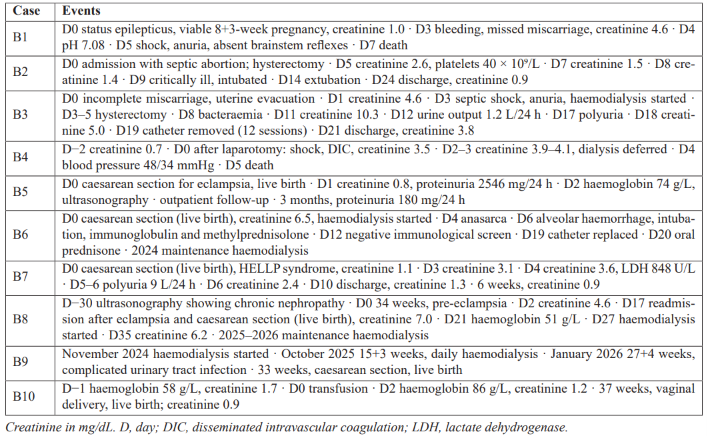
Table 3: Diagnostic assessment and maternal and pregnancy outcomes.
Discussion
The causes in this series match those described for PR-AKI in low-resource settings: sepsis and haemorrhage in the first half of pregnancy, and hypertensive disorders later in gestation [1–3]. Severity was greater than in general hospital series (three of ten women dialysed, compared with 8.6% [3]), reflecting the fact that the nephrology service assesses the most severely ill patients.
The most relevant finding is that both women who remained on maintenance haemodialysis (B6 and B8) were younger than 30 years. B8 had ultrasonographic findings described as chronic nephropathy before admission; B6 had chronic hypertension, but the available description does not establish pre-existing CKD. The contribution of previous kidney disease requires verification [3]. Measuring serum creatinine and performing urinalysis at antenatal care, particularly in women with hypertension, could identify these patients before pre-eclampsia develops.
In B6, alveolar haemorrhage after pre-eclampsia with a negative immunological screen raised a broad differential diagnosis (systemic lupus erythematosus, ANCA-associated vasculitis, anti-GBM disease, thrombotic microangiopathy, and pulmonary oedema); anti-GBM antibodies were not measured, and empirical immunosuppression was given without a definitive diagnosis. In B1, status epilepticus with occipital hypodensity in a hypertensive woman at 8 weeks’ gestation should prompt consideration of posterior reversible encephalopathy syndrome, which was not documented in the records.
The septic and haemorrhagic complications of the first half of pregnancy (B1–B4) were accompanied by shock and thrombocytopenia, with documented DIC in B2 and B4. B3 recovered diuresis after 12 sessions despite receiving gentamicin during established AKI. In B2, the recorded ‘Mondor syndrome’ (in Latin American usage, post-abortion clostridial sepsis with intravascular haemolysis and AKI) was not supported by cultures or laboratory evidence of haemolysis. In B7, HELLP syndrome caused AKI that did not require dialysis and resolved with a polyuric phase, and the reactive HBsAg had implications for the newborn.
B9 illustrates a rare situation: pregnancy on maintenance haemodialysis. Live-birth rates rise from 48% with 20 h or less of dialysis per week to 85% with more than 36 h [4]; the daily 3-h schedule (approximately 18–21 h per week) remained below that threshold, and lack of resources prevented referral. The pregnancy nevertheless ended in a live birth at 33 weeks. Social barriers were also evident in B8 (poor adherence) and in the age of B5 (17 years).
Strengths and limitations. The series documents the day-by-day renal course and, in two cases, follow-up of up to 2 years. However, it relies on nephrology notes, in which gestational age, parity, and perinatal outcome were often missing; the source states that these data were completed from obstetric and neonatal records, which requires verification. The retrospective, single-centre design and the small number of patients limit generalization.
Conclusion
In this preliminary series, septic and haemorrhagic complications and hypertensive disorders were prominent among the reported cases. The reported outcomes underline the importance of timely assessment of kidney function, multidisciplinary obstetric and nephrology care, and access to referral and follow-up. These observations and their implications require confirmation against the source records.
Ethics and consent: Ethics approval no. 046/2026 dated November 2026, consent from patients or relatives, and an ethics committee authorization for B10.
Authorship Criteria: Raúl Desvars: conceptualization, methodology, supervision, and review and editing. Elena Schupp, María José López Otaño and Oscar Maciel: investigation, data curation and patient care. Raúl Desvars: original draft. Guarantor: Raúl Desvars.
Conflicts of Interest / Competing Interests: The authors declare no conflict of interest.
Grant Information: The author(s) received no specific funding for this work.
Acknowledgements: The authors thank the nursing staff of the Nephrology Service, the intensive care units, and the maternity ward of Hospital Regional de Concepción.
Data Availability: The de-identified data underlying this article will be shared on reasonable request to the corresponding author, subject to approval by the ethics committee.
Use of Artificial Intelligence: An artificial intelligence assistant (Claude, Anthropic) was used to translate the manuscript; the authors verified all data and take full responsibility for the content.
References
- Shalaby AS, Shemies RS. Pregnancy-related acute kidney injury in the African continent: where do we stand? A systematic review. J Nephrol, 2022; 35(9): 2175–2189. doi: 10.1007/s40620-022-01349-2.
- Gautam M, Saxena S, Saran S, Ahmed A, Pandey A, Mishra P, et al. Etiology of pregnancy-related acute kidney injury among obstetric patients in India: a systematic review. Indian J Crit Care Med, 2022; 26(10): 1141–1151. doi: 10.5005/jp-journals-10071-24325.
- Berhe E, Teka H, Abraha HE, Abera BT, Gebru MA, Gebremariam T, et al. Characteristics and outcome of pregnancy-related acute kidney injury in a teaching hospital in a low-resource setting: a five-year retrospective review. BMC Nephrol, 2024; 25(1): 182. doi: 10.1186/s12882-024-03616-9.
- Hladunewich MA, Hou S, Odutayo A, Cornelis T, Pierratos A, Goldstein M, et al. Intensive hemodialysis associates with improved pregnancy outcomes: a Canadian and United States cohort comparison. J Am Soc Nephrol, 2014; 25(5): 1103–1109. doi: 10.1681/ASN.2013080825.
- Gagnier JJ, Kienle G, Altman DG, Moher D, Sox H, Riley D, et al. The CARE guidelines: consensus-based clinical case report guideline development. J Clin Epidemiol, 2014; 67(1): 46–51. doi: 10.1016/j.jclinepi.2013.08.003.
- Riley DS, Barber MS, Kienle GS, Aronson JK, von Schoen-Angerer T, Tugwell P, et al. CARE guidelines for case reports: explanation and elaboration document. J Clin Epidemiol, 2017; 89: 218–235. doi: 10.1016/j.jclinepi.2017.04.026.
- Kidney Disease: Improving Global Outcomes (KDIGO) Acute Kidney Injury Work Group. KDIGO clinical practice guideline for acute kidney injury. Kidney Int Suppl, 2012; 2(1): 1–138.