
Email id: info@ijclinmedcasereports.com
Acute Cortical Chorea as An Unusual Presentation of Ischemic Stroke: A Case Series Study
Aasmi H*, Khattab H, El Abboudi S, Sikkal A, Haddouali K, Bellakhdar S, El Moutawakil B, Rafai Ma and EL Otmani H
Department of Neurology and Clinical Neurophysiological Explorations, University Hospital Center IBN ROCHD – Casablanca, Morocco
Received Date: 25/05/2026; Published Date: 10/08/2026
*Corresponding author: Hajar Aasmi, Department of Neurology and Clinical Neurophysiological Explorations, University Hospital Center IBN ROCHD – Casablanca, Morocco
Abstract
Background: Hemichorea is an uncommon manifestation of ischemic stroke and is typically associated with lesions of the basal ganglia. However, cortical infarctions may also disrupt motor control networks and lead to hyperkinetic movement disorders.
Objective: To describe a series of patients presenting with hemichorea as the initial manifestation of cortical ischemic stroke and to discuss the underlying mechanisms and clinical implications.
Methods: We retrospectively analyzed a case series of five patients who presented with acute hemichorea as the initial clinical manifestation of cortical ischemic stroke. All patients underwent neurological evaluation including NIHSS scoring at admission and modified Rankin Scale (mRS) at follow-up, magnetic resonance imaging (MRI), and etiological workup, including vascular imaging, and cardiac assessment.
Results: All patients exhibited unilateral choreiform or choreoballistic movements without concurrent hemiparesis or sensory deficit. NIHSS scores at admission were low (0–2) despite confirmed acute cortical infarction. Lesions involved frontal, parietal, and insular cortical regions. Hemichorea represented the initial neurological manifestation in all cases. Brain MRI confirmed cortical ischemic infarction without basal ganglia lesions. Symptoms resolved within days to weeks under antiplatelet therapy combined with low-dose haloperidol or levetiracetam.
Conclusion: Cortical infarction should be considered in the differential diagnosis of acute hemichorea. Recognition of this atypical presentation is important because patients may present with minimal deficits on stroke severity scales yet still represent candidates for acute stroke management.
Keywords: Ischemic stroke; Chorea; Cortical infarction; Hyperdirect pathway; NIHSS; Movement disorder
Introduction
Hemichorea is a hyperkinetic movement disorder characterized by involuntary, random, and irregular movements on one side of the body. It is traditionally associated with lesions in the contralateral subthalamic nucleus or basal ganglia, particularly the putamen and caudate nucleus [1,2]. However, recent literature has described cases of hemichorea due to cortical ischemic lesions, primarily in the parietal, frontal, and insular cortices [3–6].
Despite the increasing number of such reports, the phenomenon remains poorly understood and underdiagnosed, as clinicians tend to attribute hemichorea exclusively to deep brain lesions. The recognition of cortical strokes as a cause of hemichorea is clinically important, especially in the hyperacute phase, where movement disorders may obscure or delay the diagnosis of stroke, potentially excluding patients from reperfusion therapy.
We present a series of five patients in whom acute hemichorea was the revealing symptom of cortical ischemic infarction, and we review the pathophysiological mechanisms and literature supporting this presentation.
Methods
Study design and setting: We conducted a retrospective observational case series of patients admitted to the Neurology Emergency Unit of the University Hospital Center IBN ROCHD, Casablanca, Morocco, between January 2022 and December 2024.
Inclusion criteria: (i) acute onset of unilateral choreic or choreoballistic movements; (ii) MRI-confirmed ischemic stroke involving exclusively cortical regions; (iii) absence of concurrent structural lesions in the basal ganglia, thalamus, or subthalamic nucleus on diffusion-weighted and FLAIR sequences.
Exclusion criteria: non-ketotic hyperglycemia, systemic lupus erythematosus, thyrotoxicosis, Huntington's disease, neuroleptic exposure, structural basal ganglia lesions, and encephalitis.
Clinical assessment: All patients underwent standardized neurological examination, NIH Stroke Scale (NIHSS) scoring at admission, and modified Rankin Scale (mRS) at admission and at three-month follow-up. Phenomenology of involuntary movements (chorea, ballism, dystonia, myoclonus) was characterized by a senior movement-disorder specialist and, when possible, video-recorded with written patient consent.
Neuroimaging: All patients underwent 1.5-T brain MRI including DWI, ADC, FLAIR, T2*/SWI, 3D-TOF MR angiography of intracranial vessels, and cervical vessel imaging (MR angiography). Lesion size was measured on DWI.
Etiological work-up: Standard laboratory tests (fasting glycemia, HbA1c, thyroid function, complete blood count, renal and hepatic function, lipid profile, inflammatory markers), 12-lead ECG, 24-hour Holter ECG, and transthoracic echocardiography were obtained.
Treatment and follow-up: Secondary stroke prevention (single or dual antiplatelet therapy, anticoagulation, statins, blood pressure control) was initiated according to current guidelines. Symptomatic treatment of chorea was left to the treating physician (haloperidol or levetiracetam). Follow-up was clinical, at 1 and 3 months.
Ethics: Written informed consent was obtained from all patients or their legal representatives for publication of clinical data and images.
Statistical analysis: Given the descriptive nature of the study, data are presented as medians (range) for continuous variables and counts (percentages) for categorical variables. No inferential statistics were applied.
Results
We describe five patients, two females and three males, with a mean age of 74.4 years old. All the patients presented hemichorea within a few hours of symptom onset, which was the primary presenting symptom. All of them had normal laboratory results, including glycemia, thyroid function, and blood cell count. All the patients underwent a magnetic resonance imaging (MRI) showing cortical frontal and parietal infarctions and sparing of the basal ganglia. Baseline demographic, clinical, and imaging characteristics are summarized in Table 1.
Table 1: Demographic, clinical, and imaging characteristics of the five patients.
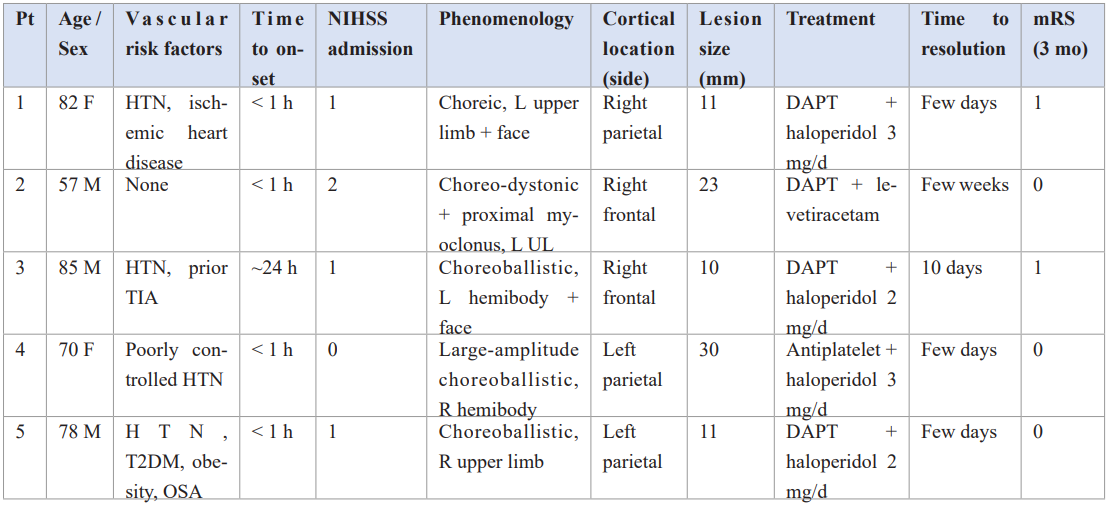
Abbreviations: DAPT = dual antiplatelet therapy; F = female; HTN = hypertension; L = left; mRS = modified Rankin Scale; NIHSS = National Institutes of Health Stroke Scale; OSA = obstructive sleep apnea; Pt = patient; R = right; T2DM = type 2 diabetes mellitus; TIA = transient ischemic attack; TOAST = Trial of ORG 10172 in Acute Stroke Treatment; UL = upper limb.
Case 1:
An 82-year-old woman with a history of hypertension and ischemic heart disease presented with sudden heaviness of the left upper limb accompanied by facial deviation. A few minutes later, she developed ipsilateral choreic movements. NIHSS at admission was 1. Brain MRI revealed a right parietal cortical ischemic lesion (Figure 1). The patient was treated with dual antiplatelet therapy and haloperidol 3 mg/day, resulting in improvement of the choreic movements within a few days.
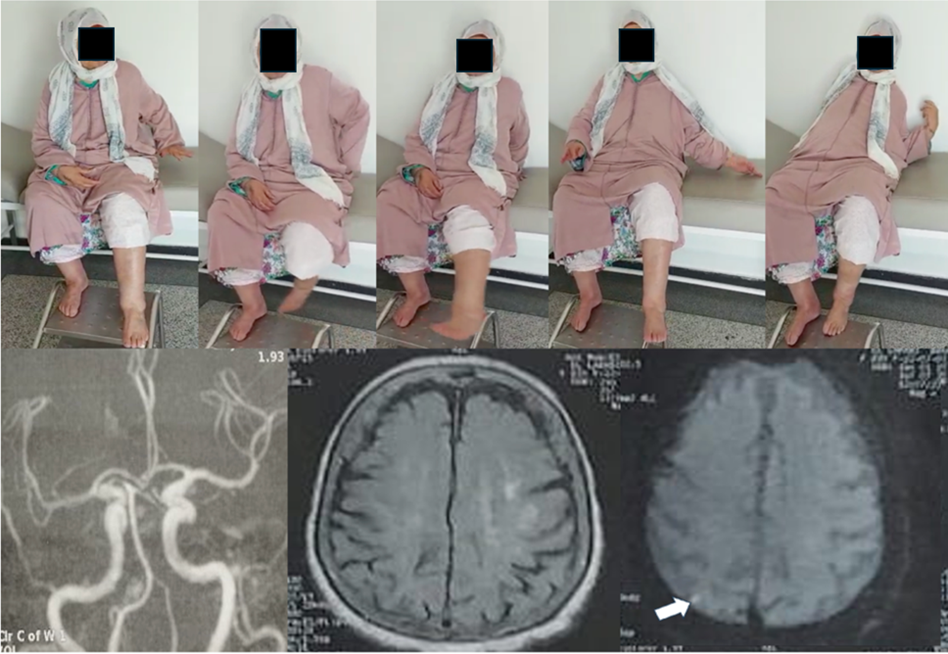
Figure 1: Clinical presentation of the patient with brain MRI showing a right parietal ischemic spot (arrow).
Case 2:
A 57-year-old man with no significant medical history presented to the emergency department following a transient loss of consciousness. Upon regaining awareness, he exhibited confusion, left-sided heaviness, and facial deviation. A few minutes later, choreo-dystonic movements appeared in the distal part of the left upper limb, characterized by wrist flexion posture, along with proximal myoclonic jerks. NIHSS at admission was 2. Brain MRI revealed a right frontal cortical ischemic stroke (Figure 2). The patient was started on secondary stroke prevention and levetiracetam with near-complete resolution within a few weeks.
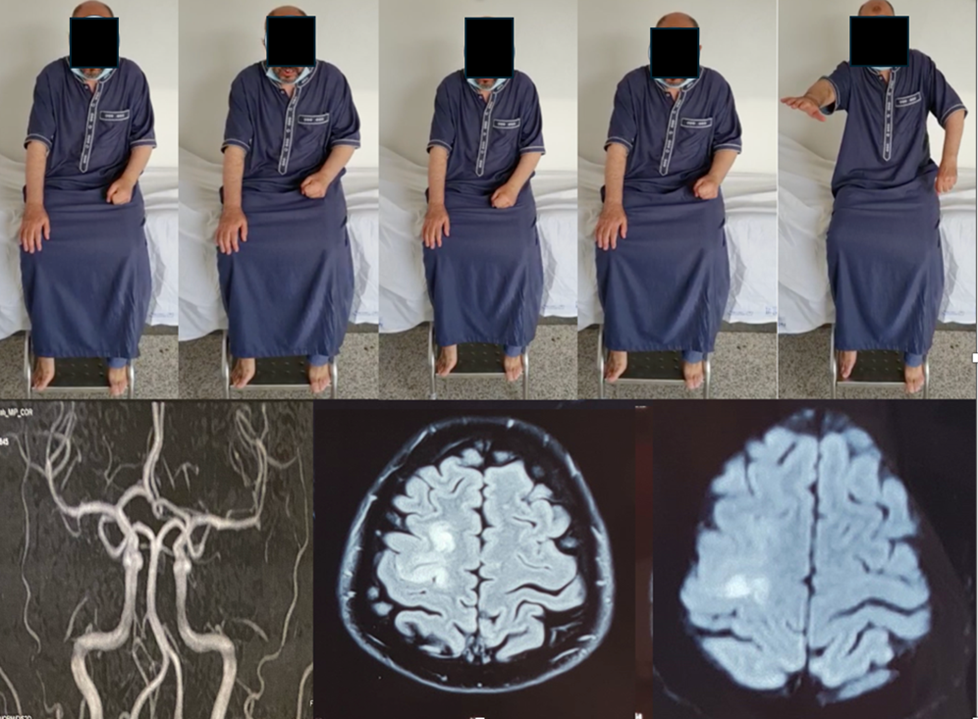
Figure 2: Clinical presentation of the patient with imaging showing a right frontal cortical ischemic stroke.
Case 3:
An 85-year-old male with a history of hypertension and a prior transient ischemic attack seven months earlier was admitted for sudden-onset involuntary movements. The symptoms began the day before admission with an abrupt onset of involuntary movements predominantly affecting the left upper limb and involving the face. Neurological examination revealed choreoballistic movements of the left hemibody, predominantly in the upper limb, with associated facial involvement. NIHSS at admission was 1. Brain MRI revealed a right frontal cortical ischemic stroke (Figure 3). The patient was treated with dual antiplatelet therapy and haloperidol 2 mg/day with complete resolution within 10 days.
Case 4:
A 70-year-old female presented with involuntary abnormal movements affecting the right hemibody. Her medical history was significant for poorly controlled hypertension under irregular treatment. The symptoms began with an acute onset of vertigo, rapidly complicated within minutes by the emergence of large-amplitude, random, involuntary movements of the right hemibody. Neurological examination revealed choreoballistic movements localized to the right hemibody. NIHSS at admission was 0. Brain MRI showed a left parietal cortical ischemic stroke (Figure 3). Symptomatic treatment with haloperidol 3 mg per day and antiplatelet therapy was initiated. The patient became asymptomatic after a few days.
Case 5:
A 78-year-old male, with a history of hypertension, type 2 diabetes, severe obesity, and sleep apnea syndrome, presented with a sudden onset of abnormal involuntary movement of the right upper limb. The neurological examination revealed choreoballistic movements localized to the right upper limb, with NIHSS at admission of 1. Brain MRI revealed a left parietal cortical infarct (Figure 3), leading to the initiation of haloperidol 2 mg per day with dual antiplatelet therapy as symptomatic and preventive treatments, resulting in disappearance of the right hemichorea within a few days.
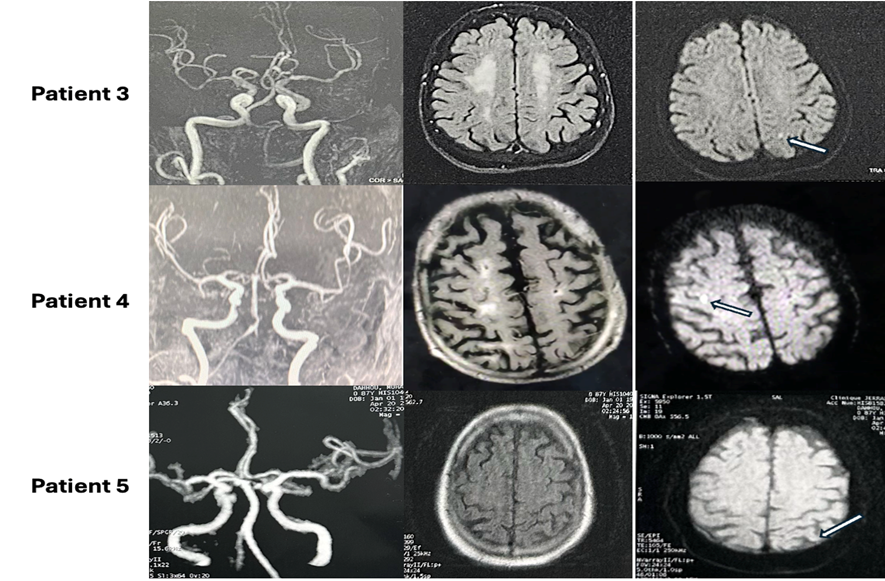
Figure 3: Brain MRI showing cortical infarcts in frontal and parietal lobes for Cases 3, 4 and 5 (arrows).
Discussion
Hemichorea is an uncommon manifestation of ischemic stroke and is classically associated with lesions involving the subthalamic nucleus or other components of the basal ganglia. However, accumulating evidence indicates that cortical infarctions alone may also lead to hyperkinetic movement disorders through disruption of motor network connectivity [1–3]. In our series of five patients, hemichorea represented the initial neurological manifestation of cortical ischemic stroke, emphasizing that cortical lesions may produce abnormal involuntary movements even in the absence of structural involvement of deep gray nuclei.
Post-stroke movement disorders are relatively uncommon, occurring in approximately 1–4% of patients with strokes, with hemichorea and hemiballismus representing among the most frequently reported hyperkinetic syndromes [1, 4]. These disorders may appear during the acute phase or with delayed onset after the vascular event, reflecting complex mechanisms involving dysfunction of distributed motor circuits rather than isolated focal lesions [2, 4]. Of note, three of our patients presented with choreoballistic rather than purely choreic movements, in line with the reported continuum between chorea and ballism when larger amplitude is involved.
Several cortical regions have been implicated in the pathogenesis of hemichorea, including the frontal, parietal, and supplementary motor areas [3, 5]. These cortical regions constitute essential components of the cortico–striato–thalamo–cortical motor circuits, which regulate voluntary movement and motor inhibition. Disruption of these pathways by cortical ischemia may lead to abnormal motor output and the emergence of involuntary hyperkinetic movements [1, 2].
In all our patients, hemichorea occurred without clinically significant hemiparesis. The most likely explanation is that the cortical infarcts were small and spared the primary motor cortex (M1) and the corticospinal tract, while selectively involving premotor, supplementary motor, and parietal association areas that modulate — rather than directly execute — voluntary movement. Dysfunction limited to these modulatory nodes may therefore disrupt motor inhibition without abolishing motor output, producing hyperkinetic phenomena in a patient who can otherwise move voluntarily.
From a pathophysiological perspective, one proposed mechanism involves impairment of the hyperdirect pathway, a cortico-subthalamic projection that provides rapid inhibitory control over motor activity [6]. Cortical lesions involving frontal or parietal areas may reduce excitatory input to the subthalamic nucleus, resulting in decreased inhibitory output from the basal ganglia to the thalamus. This functional disinhibition of thalamo-cortical motor circuits may ultimately lead to excessive motor activity and choreiform movements [4–9]. These findings support the concept that cortical lesions alone can disturb the functional balance of the basal ganglia network even without direct structural damage to these nuclei (Figure 4).
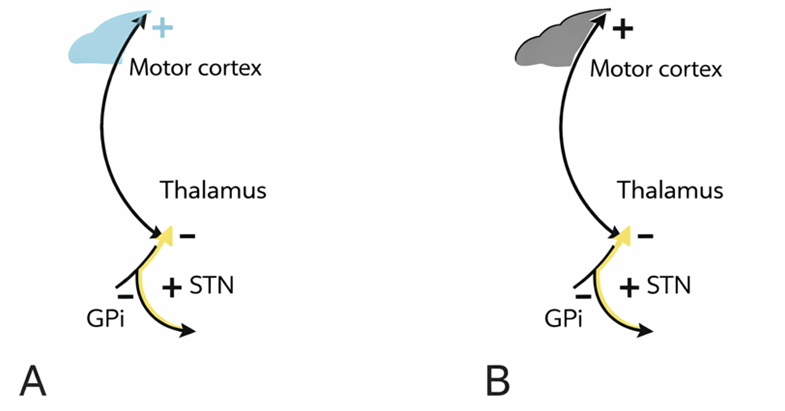
Figure 4: (A) The subthalamic nucleus (excitatory) is directly activated by cortical inputs, enhancing the inhibitory activity of the globus pallidus internus. This leads to increased inhibition of the thalamus and decreased motor output. (B) When the cortex is impaired, the inhibition of the thalamus decreases, and motor output increases.
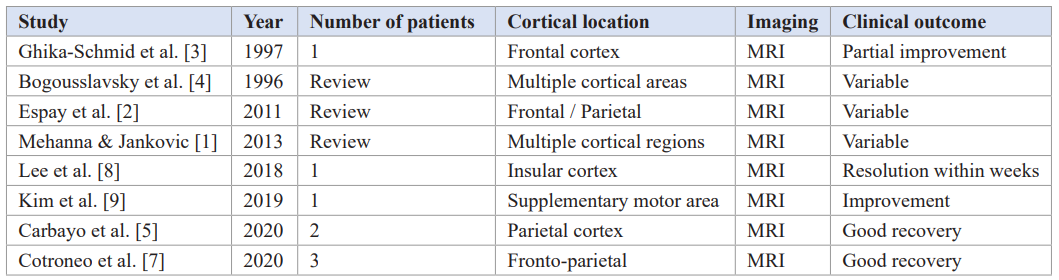
Multiple isolated cases of hemichorea secondary to cortical ischemic lesions have been reported in the literature, involving various cortical regions, including frontal, parietal, insular, and supplementary motor areas [3,5,8,9]. A summary of previously reported cases is presented in Table 2. An alternative mechanism that should be considered is regional hypoperfusion related to large- or medium-vessel disease. The small size of cortical infarcts observed in our patients suggests that abnormal movements may not be solely explained by structural lesions, but rather by dysfunction of distributed motor networks [10,11]. This mechanism may overlap with limb-shaking TIAs, further complicating the diagnostic approach.
This hypothesis is supported by previous reports describing hyperkinetic movement disorders in the setting of hemodynamic impairment, particularly in patients with carotid artery stenosis or occlusion [2,5]. In such cases, abnormal movements, including limb-shaking transient ischemic attacks, have been attributed to transient cerebral hypoperfusion and may improve following revascularization procedures [5].
Similarly, cortical hypoperfusion may disrupt cortico–basal ganglia circuits without direct structural damage to deep nuclei, leading to abnormal motor output [1,2]. These findings support the concept that both structural lesions and functional hemodynamic disturbances contribute to the pathophysiology of hemichorea in cortical stroke.
Although perfusion imaging was not systematically available in our series, the vascular findings and the small lesion size strongly suggest a potential hemodynamic contribution.
Low-dose haloperidol (2–3 mg/day) was effective and well tolerated in four of our patients, producing complete or near-complete resolution within days. One patient responded to levetiracetam, consistent with the overlap between cortical hyperexcitability and hyperkinetic phenomena. When haloperidol is undesirable because of extrapyramidal or cardiac risk in elderly stroke patients, tetrabenazine, atypical neuroleptics (olanzapine, risperidone) or valproic acid may be considered. However, in most post-stroke hemichoreas the movements are self-limited over days to weeks, and aggressive long-term symptomatic therapy is rarely required.
Another important consideration relates to the clinical recognition of hemichorea as a potential manifestation of acute ischemic stroke. In some cases, involuntary movements may represent the predominant or sole neurological sign, which may lead to diagnostic uncertainty and delay in appropriate neuroimaging. Awareness of this atypical presentation is therefore crucial, particularly in patients with vascular risk factors [3,5].
An additional clinical implication concerns the possibility that hemichorea may reveal an acute ischemic stroke occurring within the therapeutic window for reperfusion therapy. In such circumstances, the neurological deficit may appear minor according to conventional stroke severity scales such as the NIH Stroke Scale, which primarily evaluates motor weakness, language impairment, and level of consciousness but does not adequately capture hyperkinetic movement disorders [10, 12]. Consequently, patients presenting with isolated hemichorea may have a very low NIHSS score despite the presence of an acute cortical infarction.
This situation may create a therapeutic dilemma regarding eligibility for acute reperfusion strategies such as intravenous thrombolysis or mechanical thrombectomy. Current international guidelines indicate that reperfusion therapy may be considered in patients presenting with minor but potentially disabling symptoms [12]. Although hemichorea is rarely discussed in this context, severe involuntary movements may significantly interfere with voluntary motor control, gait, and daily activities, thereby representing a potentially disabling neurological deficit despite a low NIHSS score [2, 3]. Failure to recognize hemichorea as a manifestation of acute ischemic stroke may therefore lead to missed opportunities for timely reperfusion therapy, even though functional recovery is often favorable, as reported in previous cases in the literature (Table 2) and similarly observed in our series.
Our findings underscore the importance of considering vascular etiologies in patients presenting with sudden onset hemichorea. Early brain imaging, particularly diffusion-weighted MRI, remains essential to establish the diagnosis and guide management. Greater awareness of this atypical clinical presentation may improve early stroke recognition and facilitate appropriate therapeutic interventions.
Finally, several limitations should be acknowledged. The relatively small number of patients reflects the rarity of this clinical presentation. In addition, the retrospective design may introduce potential biases in case identification and clinical characterization. Perfusion imaging and intra-arterial vascular imaging were not systematically performed, precluding definitive correlation between hemodynamic status and clinical expression. Video documentation was not available for all patients. Nevertheless, our series contributes to the growing body of literature suggesting that cortical infarctions may represent an underrecognized cause of hemichorea and highlights the need for further studies to better understand the mechanisms and therapeutic implications of this phenomenon.
Key Clinical Messages
- Acute hemichorea may be the sole presenting manifestation of cortical ischemic stroke.
- Stroke severity may be underestimated using the NIH Stroke Scale in such cases.
- Brain MRI should be systematically performed in patients with acute-onset movement disorders of unclear origin.
- Hemichorea may represent a potentially disabling symptom despite low NIHSS scores and should not preclude consideration of reperfusion therapy.
- Differential diagnosis includes limb-shaking transient ischemic attacks and focal motor seizures.
- Vascular and hemodynamic mechanisms should be considered, particularly in patients with large-vessel disease.
- Small cortical infarcts sparing M1 and the corticospinal tract may produce disinhibition of the cortico-subthalamic hyperdirect pathway, explaining hyperkinetic movements without weakness.
Conclusion
Isolated hemichorea is an uncommon but clinically important presentation of cortical ischemic stroke. Recognition of this atypical presentation is essential, as it may lead to underestimation of stroke severity and missed opportunities for reperfusion therapy. Early neuroimaging, preferably diffusion-weighted MRI, should be systematically performed in patients presenting with acute-onset movement disorders. Cortical disinhibition of the hyperdirect pathway provides a plausible pathophysiological framework that deserves further investigation with functional and perfusion imaging.
Table 2: Reported cases of cortical stroke presenting with hemichorea in the literature.
Declarations
Consent for publication. Written consent was obtained from all patients for publication of anonymized clinical and imaging data.
Availability of data and materials. The datasets generated and analyzed during the current study are not publicly available due to patient privacy regulations but are available from the corresponding author on reasonable request.
Competing interests. The authors declare that they have no competing interests.
Funding. This research received no specific grant from any funding agency in the public, commercial, or not-for-profit sectors.
References
- Mehanna R, Jankovic J. Movement disorders in cerebrovascular disease. Lancet Neurol, 2013; 12(6): 597–608. doi:10.1016/S1474-4422(13)70057-7.
- Espay AJ, Chen R. Post-stroke movement disorders: clinical spectrum and pathophysiology. Lancet Neurol, 2011; 10(8): 751–762. doi:10.1016/S1474-4422(11)70112-6.
- Ghika-Schmid F, Ghika J, Regli F, Bogousslavsky J. Hyperkinetic movement disorders during and after stroke. J Neurol Sci, 1997; 146(2): 109–116. doi:10.1016/S0022-510X(96)00283-2.
- Bogousslavsky J, Regli F, Ghika J. Movement disorders after stroke. Neurology, 1996; 46(1): 132–138. doi:10.1212/WNL.46.1.132.
- Carbayo Á, Tiu C, Pérez-Sánchez JR, et al. Cortical stroke presenting with hemichorea. J Stroke Cerebrovasc Dis, 2020; 29(10): 105094. doi: 10.1016/j.jstrokecerebrovasdis.2020.105094.
- Nambu A, Tokuno H, Takada M. Functional significance of the cortico-subthalamo-pallidal “hyperdirect” pathway. Neurosci Res, 2002; 43(2): 111–117. doi:10.1016/S0168-0102(02)00027-5.
- Cotroneo M, Ciacciarelli A, Cosenza D, et al. Hemiballism: unusual clinical manifestation in three patients with frontoparietal infarct. Clin Neurol Neurosurg, 2020; 188: 105612. doi:10.1016/j.clineuro.2019.105612.
- Hwang KJ, Hong IK, Ahn TB, Yi SH, Lee D, Kim DY. Cortical hemichorea–hemiballism. J Neurol, 2013; 260(12): 2986–2992. doi:10.1007/s00415-013-7096-7.
- Kim JS. Involuntary movements after anterior cerebral artery territory infarction. Stroke, 2001; 32(1): 258–261. doi: 10.1161/01.STR.32.1.258.
- Baquis GD, Pessin MS, Scott RM. Limb-shaking transient ischemic attacks. Stroke, 1985; 16(3): 444-448. doi:10.1161/01.STR.16.3.444.
- Persoon S, Kappelle LJ, Klijn CJM. Limb-shaking transient ischaemic attacks in patients with internal carotid artery occlusion: a case-control study. Brain, 2010; 133(Pt 3): 915–922. doi:10.1093/brain/awq035.
- Powers WJ, Rabinstein AA, Ackerson T, et al. Guidelines for the early management of patients with acute ischemic stroke: 2019 update to the 2018 guidelines for the early management of acute ischemic stroke. Stroke, 2019; 50(12): e344–e418. doi: 10.1161/STR.0000000000000211.