
Email id: info@ijclinmedcasereports.com
Sensory Outcomes in the Mental Region After Segmental Mandibulotomy with Inferior Alveolar Nerve Anastomosis
Eiji Mitate*, Yasuhisa Sawai, Youta Yamauchi, Taichi Demura, Arina Nakamichi, Atsuko Tomoda, Hiroto Nanaumi, Shuto Itou, Takuya Munehira, Miho Hasumoto, Satoshi Wada and Hiroyuki Nakano
Department of Oral & Maxillofacial Surgery, Faculty of Medicine, Kanazawa Medical University, Japan
Received Date: 06/10/2025; Published Date: 15/10/2025
*Corresponding author: Eiji Mitate, DDS, PhD, Department of Oral & Maxillofacial Surgery, Faculty of Medicine, Kanazawa Medical University, 1-1 Daigaku, Uchinada-machi, Kahoku-gun, Ishikawa 920-0265, Japan
Abstract
In mandibular osteotomy, not only the restoration of favorable facial morphology and occlusion but also the prevention of sensory paralysis in the innervation area through Inferior Alveolar Nerve (IAN) reconstruction is desirable. Postoperative complications such as sialorrhea, accidental biting of the lip and buccal mucosa, and pressure ulcer formation can significantly affect the patient's quality of life. However, nerve reconstruction techniques are not always performed due to their complexity and, in some cases, the difficulty associated with the extent of resection. Management of the IAN includes three main approaches: resection, preservation (Becker’s method or the Ishikawa‘s Mehod; pull-through technique), and reconstruction via nerve grafting. Common donor nerves used for grafting include the great auricular nerve and cutaneous nerves.
We have performed Inferior Alveolar Nerve (IAN) anastomosis in 10 cases following segmental mandibulectomy (6 males and 4 females), employing the pull-through technique in 8 cases and great auricular nerve grafting in 2 cases. In cases where preoperative radiographic examination revealed a safe margin between the tumor and the IAN, the pull-through technique was utilized. Conversely, in cases where the resection area involved the IAN, reconstruction with a great auricular nerve graft was performed. No cases of local recurrence were observed.
Keywords: Sensory; Mental; Segmental mandibulotomy; Inferior alveolar nerve; Anastomosis
Introduction
In mandibular resection surgery, not only the restoration of a favorable facial profile and occlusion, but also the sensory paralysis in the area innervated by the inferior alveolar nerve due to nerve reconstruction can significantly affect postoperative Quality of Life (QOL). However, nerve reconstruction procedures are often complicated and, depending on the extent of the resection, reconstruction may be difficult to perform. As a result, such procedures are not always carried out.
Regarding nerve reconstruction, Becker et al. proposed a method of preserving the inferior alveolar nerve by shaving the mandible (Becker’s method) [1]. In addition, Ishikawa et al. proposed a technique in which the inferior alveolar nerve is pulled out after mandibular osteotomy and then anastomosed (Ishikawa’s method) [2].
In this report, we present a case involving an anastomosis of the inferior alveolar nerve and examine its clinical course and usefulness.
Subjects and Methods
The subjects consisted of six male and four female patients who underwent segmental mandibulectomy and anastomosis of the inferior alveolar nerve.
Regarding preservation of the inferior alveolar nerve, nerve pulling (Ishikawa’s Method: dissection and preservation of the nerve from the mandible) [2] was performed in eight cases, while great auricular nerve grafting was performed in two cases.
The choice of surgical method was based on radiographic evaluation: in cases where there was sufficient distance between the tumor safety margin and the inferior alveolar nerve, the nerve-pulling technique was employed. In cases where the resection area included the inferior alveolar nerve, great auricular nerve grafting was performed.
Results
The breakdown of all cases is shown in Table 1. Paresthesia was observed in two cases and a sense of discomfort in one case in the mental region; however, tactile sensation recovered to within the normal range in all cases.
Table 1: List of all cases.
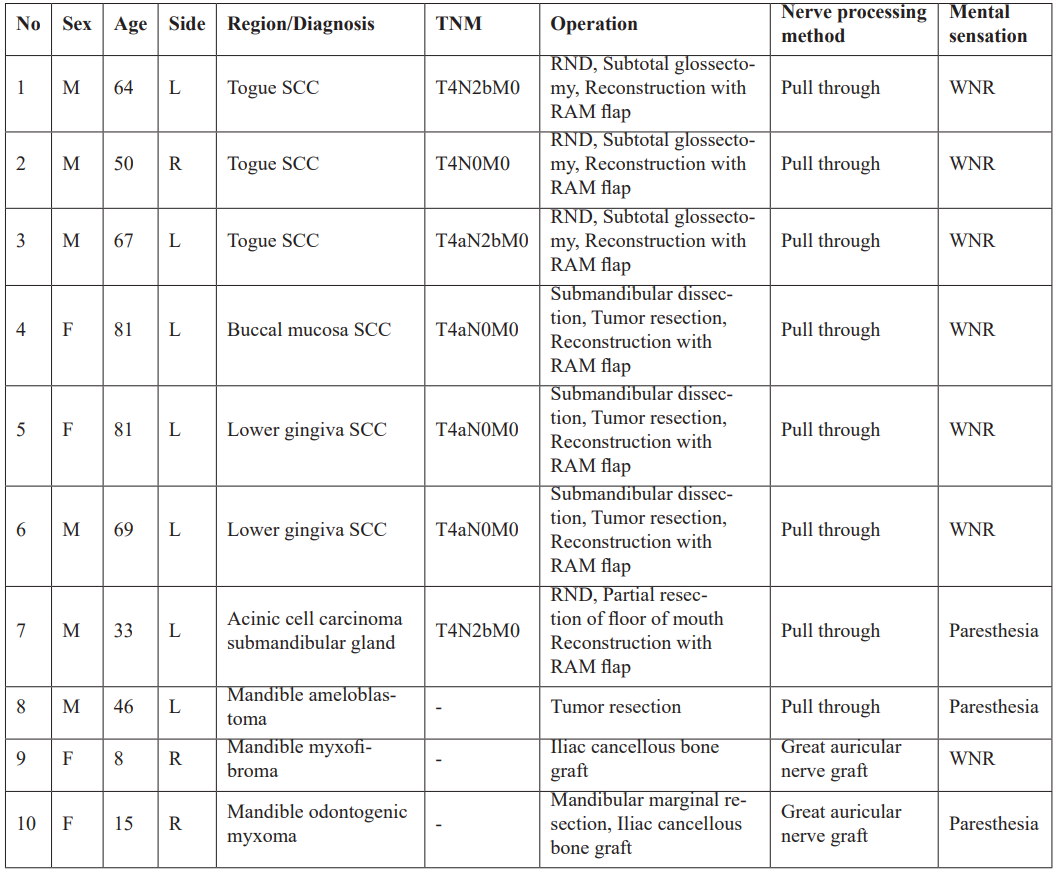
8 cases were performed with the pull-though method and sensory perception of the mental area was within normal limits. L: left side, R: right side, RAM: rectus abdominis myocutaneous, RND: radical neck dissection, SCC: squamous cell carcinoma, WNR: within normal range
Case 1: Pull-through technique case
An 81-year-old female patient underwent left supraomohyoid neck dissection, segmental mandibulectomy on the left side, and reconstruction with a rectus abdominis musculocutaneous flap and titanium plate for Squamous Cell Carcinoma (SCC) of the left mandibular gingiva (T3N0M0).
As sufficient distance between the tumor and the Inferior Alveolar Nerve (IAN) was confirmed, the pull-through technique was employed. One year postoperatively, tactile sensation had recovered to within the normal range.
Case 2: Nerve grafting case
A 9-year-old girl patient underwent right segmental mandibulectomy and iliac bone grafting for a myxofibroma of the right mandible. As the tumor extended to the inferior border of the mandible, reconstruction with a great auricular nerve graft was performed. Recovery of tactile sensation was observed beginning two weeks postoperatively, and by the time of plate removal eight months later, sensation had returned to within the normal range (Figure 2).
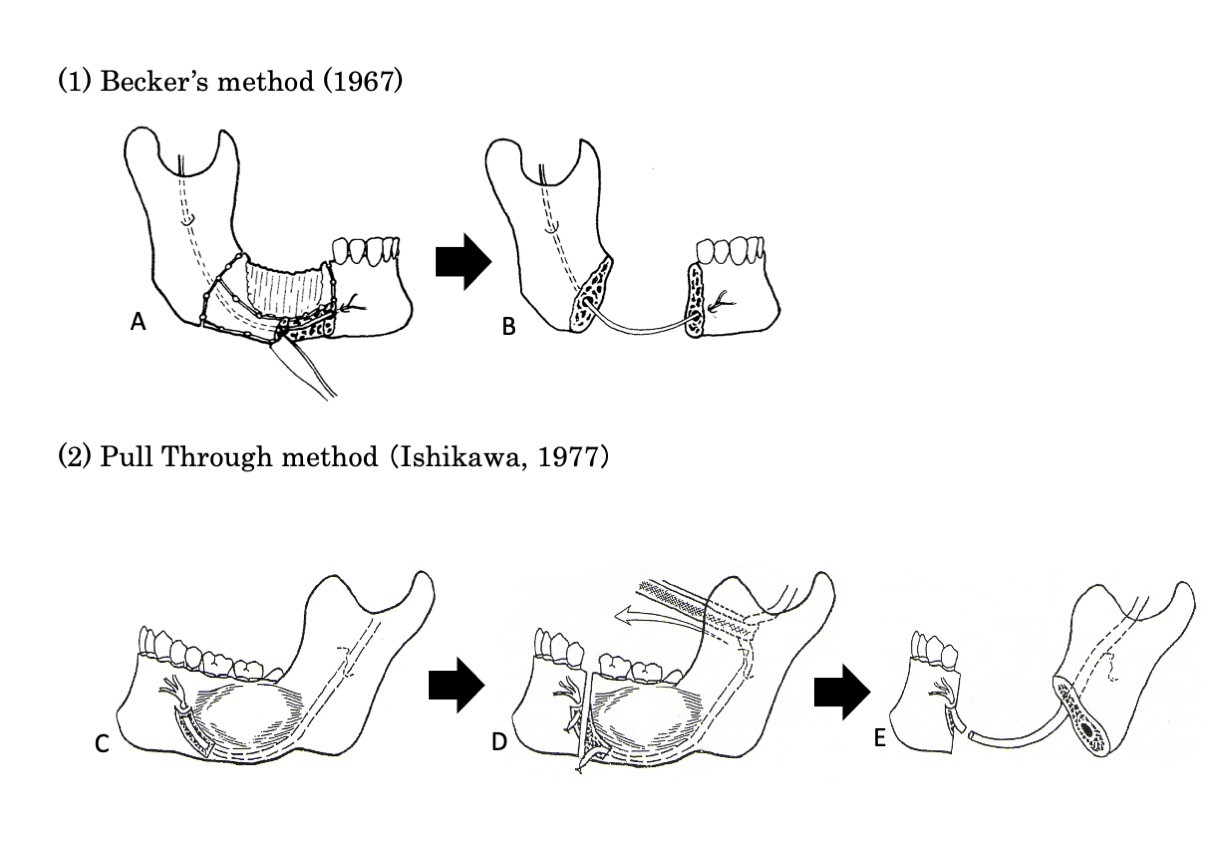
Figure 1: Becker method and pull through method.
(1) Becker method. First, the cortical bone is removed. Next, the nerve bundle is separated from the mandible and the mandible is dissected. The inferior alveolar nerve can be fully preserved, but the procedure is complicated. (2) Pull Through method. Demonstrating the neurovascular bundle near the mental foramen. After dissection of the mandible, the neurovascular bundle was pulled out. Finally, the nerve is anastomosed. The procedure is easier than the Becker's method. However, because the nerve is severed, there is concern about postoperative sensory disturbance.
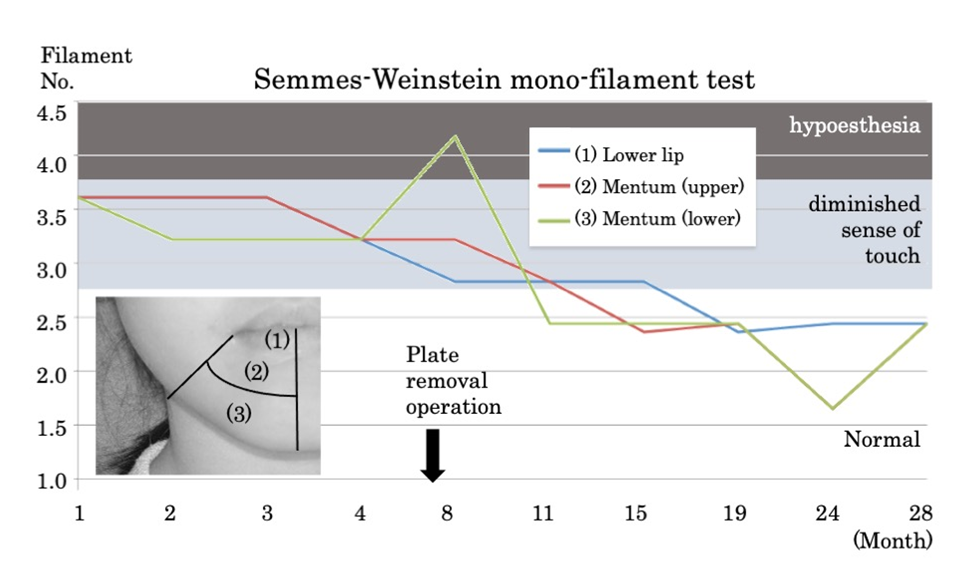
Figure 2. Postoperative course of case No.9.
Evaluation of perception using the Semmes-Weinstein mono-filament test. Eight months after surgery, the patient underwent plate removal. Perception was restored to within normal limits in (1) the lower lip, (2) the upper mussel area, and (3) the lower mussel area.
Discussion
On inferior alveolar nerve repair, several reports have been published regarding the repair of the inferior alveolar nerve. Susarla, et al reported that the majority of patients who underwent inferior alveolar nerve repair achieved functional sensory recovery within one year after surgery [3]. Le Donne, et al reported that 92.9% of cases showed functional sensory recovery following segmental mandibular resection [4]. Bagheri, et al examined 167 patients with inferior alveolar nerve injuries who underwent microsurgical repair, and found that 81.7% recovered to within acceptable limits [5]. The present report also showed comparable results in the majority of cases.
Regarding nerve grafting cases, Hausamen, et al reported that sensory function is almost completely restored within six months after nerve transplantation [6]. Almohammadi, et al reviewed that autologous nerve grafting and noted that sural nerve grafts remain a recommended approach [7]. However, in cases of segmental mandibular resection, the great auricular nerve can be harvested without creating a new surgical wound. That said, during secondary procedures such as reconstruction or plate removal following segmental resection, it is essential to carefully identify and preserve the course of the preserved or grafted nerve to avoid damage.
Based on these findings, nerve pulling techniques and nerve grafting are considered highly useful, as they contribute to improved quality of life (QOL) by restoring sensation in the lower lip and mental region. In recent years, the effectiveness of bioabsorbable collagen nerve cuffs has also been reported8), and their combined use is expected to further improve postoperative outcomes.
Acknowledgement: Artificial intelligence has not been used in the preparation of the manuscript.
Statement of Ethics: This study was approved by the Clinical Research Ethics Review Committee of Kanazawa Medical University (approval number; C055) and adhered to the 1964 Declaration of Helsinki and its later amendments or comparable ethical standards.
Conflict of Interest Statement: The authors have no conflicts of interest to declare.
Funding Sources: No financial support for this report.
References
- Becker R. Continuity resection of the mandible with preservation of the mandibular nerve. Br J Oral Surg. 1970; 8(1): 45-50.
- Ishikawa T, Nomura M, Nagahata H, Tani N, Yasui R, Shimosato T. A new method of conserving the inferior alveolar nerve during resection of the mandible. Br J Oral Maxillofac Surg, 1986; 24(2): 107-113.
- Susarla SM, Kaban LB, Donoff RB, Dodson TB. Functional sensory recovery after trigeminal nerve repair. J Oral Maxillofac Surg, 2007; 65(1): 60-65.
- Le Donne M, Jouan R, Bourlet J, Louvrier A, Ducret M, Sigaux N. Inferior alveolar nerve allogenic repair following mandibulectomy: A systematic review. J Stomatol Oral Maxillofac Surg.
- Bagheri SC, Meyer RA, Cho SH, Thoppay J, Khan HA, Steed MB. Microsurgical repair of the inferior alveolar nerve: success rate and factors that adversely affect outcome. J Oral Maxillofac Surg, 2012; 70(8): 1978-1990.
- Hausamen JE, Samii M, Schmidseder R. Repair of the mandibular nerve by means of autologous nerve grafting after resection of the lower jaw. J Maxillofac Surg, 1973; 1(2): 74-78.
- Almohammadi T, Yates J, Aljohani M, Alshehri S. Surgical outcomes of the surgical techniques following management of iatrogenic trigeminal nerve injuries: A systematic review. Saudi Dent J.
- Meyer RA, Bagheri SC. A bioabsorbable collagen nerve cuff (NeuraGen) for repair of lingual and inferior alveolar nerve injuries: a case series. J Oral Maxillofac Surg, 2009; 67(11): 2550-2551.