
Email id: info@ijclinmedcasereports.com
A Study on a Non-Invasive Therapy with No Side Effects for the Treatment of Stretch Marks
Alessandro Roberto1,*, Antonio Cataldo1 and Maurizio Busoni2
1Alla Violetta Medical Clinic, Napoli, Italia
2Aesthetic Medicine Master Camerino University, Camerino (MC), Italia
Received Date: 30/06/2025; Published Date: 04/08/2025
*Corresponding author: Alessandro Roberto, Alla Violetta Medical Clinic, Napoli, Italia
Abstract
Objective: The study aims to test the efficacy and safety of VEMFtherapy (also known as Biodermogenesi), synergy between electromagnetic fields, electron flux and vacuum, applied on striae albae (SA) found on the glutes of women of various ages and phototypes. The choice of the type of stretch marks that are examined, selected for their location and dating, allows the study to open a discussion on the possibility to successfully and safely intervene even against the striae generally more widespread in women.
Methods: 30 female patients aged 20-61 years, with phototype included between II to V, afflicted with white stretch marks that are 5 to 38 years old, were treated with a cycle of 9 or 12 sessions of VEMFtherapy® with one session per week. 9 sessions were performed for 16 patients with striae up to 20 years old and 12 sessions were performed for 14 patients with striae that that are older than 20 years. The treatment was performed with the medical device Bi-one® LifeTouchTherapy equipped with a generator of electric impulses, electromagnetic fields and vacuum simultaneously. Subjective evaluation is expected to be carried separately by patients and researchers who are asked to evaluate filling of the furrow, the feeling to the touch, the dyschromia and the eventual tanning of the stretch marks by adopting a Linkert scale. The evaluation is performed at T0 (before the sessions) and at T1 (at the end of the complete treatment).
Results: The result appears to be significative and uniform for all patients, as demonstrated by the filling of the striae, which is evident both to the touch and visually and thanks to the recovery of a colour compatible with the surrounding tissue, followed by the tanning of the stretch marks which is a consequence of exposure to the Sun. Simultaneously, it is possible to notice an increase in the elasticity and firmness of the treated glutes, with a substantial remodelling. The therapy has never caused side effects and has resulted extremely pleasant.
Conclusion: The synergy of VEMFtherapy has demonstrated to regenerate the SA of the glute by significantly reducing – and in some cases completely eliminating – their evidence to the touch and to the eye, also thanks to the found ability to tan the striae with ultraviolet exposure. The absence of side effects and the high level of stretch mark regeneration and of glute remodelling qualifies VEMFtherapy as designated therapy for white and dated striae.
Keywords: VEMFtherapy; Striae; Stretch Marks; Glutes; Toning; Cellulite; Electromagnetic Fields; Vacuum; Electroporation; Biodermogenesi
Introduction
Striae distensae (SD) are extremely widespread skin lesions considered permanent, aesthetically evident and undesirable, with an immense social and psychological effect [1]. SD form in the dermis, usually on the abdomen, breast, glute, and thigh [2,3]. They appear to be related to the period of puberty and pregnancy in which they involve up to 88% of the population [2,4,5].
Newly formed SD appear red-purple (also known as striae rubrae; SR), generally in relief [6], then, after 12/24 months, they appear depressed and hypopigmented (called striae albae; SA) [6]. The cause of their occurrence is yet to be precisely determined, although hormonal alterations [7] and mechanical skin traction [2,8] contribute to their formation of SD. The main offered therapies vary from topical treatments, Energy Based Devices to lasers.
Topical Products
The application of medication or cosmetics for the treatment of stretch marks has never highlighted significant results: there generally is a slight, newly emerging improvement which is limited to the SR [9,10]. Another matter is instead with peelings, where improvements have been found to be a little more evident, although small and temporary.
Microdermabrasion
Protocols indicate that monthly microdermabrasion needs to be repeated multiple times with a maximum of 11 sessions [11]. Dermabrasion has shown fairly moderate results in the face of significant discomforts, repeated and extended for each session. For the majority of the cases, it is necessary to perform local anaesthesia and then proceed to occlusive therapies that facilitate skin regeneration in the absence of infections [11].
To conclude, dermoabrasion has highlighted an acceptable improvement on SR, on the other hand, it is limited or even absent in SA therapy [12]. Histological analysis of biopsies documents an increase in protocollagen I [12].
Needling therapy
Needling therapy is characterized by a number of sessions between three and five on a monthly basis. Microneedling seems more effective in the treatment of SR [13], while patients with SA have shown extremely limited improvement [13]. The therapy is performed with a local anaesthetic, sometimes followed by a post-surgery analgesic. The edema that usually forms begins to subside from the second day after therapy, to be reabsorbed within a week.
Radiofrequency
In the treatment of striae, it has been adopted both with a non-invasive method, through a handpiece that is slid over the skin surface, and with an invasive method, called fractionated, through a series of small needles designed to cross the stratum corneum and pass the electrical impulse directly from one needle to the other, inside the skin. Non-invasive radiofrequency is characterized by limited outcomes, especially with respect to SA and exposes to the risk of hyperpigmentation, which generally regresses within three months [14]. Some authors have tried to combine non-invasive radiofrequency with fractional [15] with not particularly positive results; indeed, from the biopsies performed on 4 patients, it appears that the percentage of elastic fibres was reduced, especially after the combined treatment, while no improvement was observed in the deep reticular dermis.
Lasers
Lasers for striae therapy are essentially of two types: ablative or non-ablative, the former act because they are absorbed by the water in the skin, which tends to vaporize due to the thermal stimulus, consequently, the skin heats up and reshapes. Non-ablative lasers pass through the stratum corneum and stimulate a series of reactions in the deeper layers. Lasers also differ in the source (CO₂, Erbium, Neodymium, Thulium, Diode, etc.) and in the wavelength of the emitted signal, which ranges from 308 nanometers of the excimer laser up to 1,927 nanometers of the diode and Thulium for non-ablative models; from 2,940 nanometers of the Erbium YAG up to 10,600 nanometers of the CO₂ for ablative models.
Ablative lasers
1) 10,600-nm CO₂ (carbon dioxide) fractional laser
This type of laser has been the subject of several studies, often characterized by the sole subjective evaluation of doctors and patients. On one hand, there are researchers who report encouraging results [16,17] while in others, 45% of patients declare themselves dissatisfied and some have interrupted the therapies due to hyperpigmentation [18], or even cancelled the study due to the lack of improvements [19]. Histological analysis has highlighted the presence of type I protocollagen, a consequence of the damage caused by the laser. The CO₂ laser exposes the patient to some side effects; erythema, prolonged prohibition of sun exposure (from three to six months after each session) due to the risk of hyperpigmentation of the treated area. For the CO₂ laser, great attention is recommended in the treatment of phototypes IV, V, VI [18,19].
2) Er:YAG fractional laser
This form of laser does not appear to be suitable for the treatment of SA and for SR, it only offers modest improvements [20]. The researchers' opinion is supported by the total lack of improvements highlighted by the biopsies. This therapy requires between six and eight sessions with one session per month; the side effects can be skin inflammation and hyperpigmentation which in some cases persists even after six months [20]. Sun exposure is not recommended for a period that varies from three to six months from the last carried out session.
Non-ablative lasers
1) 585 nm. Pulsed Dye Laser (PDL)
Thanks to its specific action aimed at hemoglobin, the Pulsed Dye Laser is proposed as a candidate for the treatment of SR, against which it has however shown modest results, [12,19] and even more reduced results against SA. This technology is not recommended for therapy on phototypes IV, V and VI due to the high risk of pigmentary alterations after therapy [12,19]. Apart from this, the PDL exposes to prolonged erythema that can last up to three weeks. In this case too, sun exposure is prohibited for a period that varies from three to six months starting from the last performed session.
2) 1,064-nm Nd:YAG laser
This specific type of laser should allow significant results on SR as it has a strong affinity with water and melanin, which act as chromophores. Clinical improvements on striae are not significant [21] and the increase in collagen, generically defined, is balanced by a decrease in elastic fibres [21]. The side effects of this technology are however limited; the session is moderately painful and the risks of hyperpigmentation seem lower than with other laser models, while maintaining the prolonged ban on sun exposure.
3) Non-ablative fractional laser (1,450-nm/1,550-nm/1,565-nm)
Laser technologies, which work in this narrow range of frequencies that vary from 1,450 to 1,565 nanometers – generally use Erbium as a source – are those supported by the greatest number of published works and even in this case the findings are not entirely univocal. A study [22] conducted on 51 documented patients, with also biopsies on some of the sample patients, always gave positive results, with an attenuation of the striae generally greater than 50%. Another research [18] based on 24 Asian patients gave different results: 2 patients had to suspend the treatments due to strong hyperpigmentation, another 2 patients (9.08%) declared a good result, 6 patients (27.24%) an average result and the other 12 patients (54.48%) poor or no results. Probably in this case the lower results can be attributed to the different skin phototype of the people treated. These laser technologies are characterized by moderate pain during therapy [23] micro-crusting [23], recurrent edema and hyperpigmentation [18,23] that is generally reabsorbed within 5/10 days but can last up to 8 weeks and skin inflammation [18] which can last up to 8 weeks. Histological analysis has shown an increase in type I collagen [24]. Although the therapeutic proposals are extremely varied, in the state of the art there is still no solution that can be successfully replicated on all patients, especially those who expose themselves to the sun, where hypopigmentation of SD is even more evident.
Materials and Methods
Between April and December of the year 2024, a group of 30 patients whom were women between the 20 and 61 years of age was analised, with each patient afflicted by SA aged between 5 and 38 years on their glutes. Striae up to 20 years old were treated with weekly sessions for a total of 9 sessions of – Biodermogenesi, also known as VEMFtherapy – while striae older than 20 years were treated with a total of 12 sessions. During the preliminary visit, patients resulted healthy, did not qualify for exclusion from the trial and have signed the informed consent and release for the use of their data for the purpose of this clinical study.
The excluding criteria are the following: Pace-Maker holders; oncology therapy that is either ongoing or was performed during the last 5 years; epilepsy; vascular alterations such as varicose, phlebitis and thrombophlebitis; pregnancy or lactation; changes and hormone therapy manifested during the last 6 months; anticoagulant therapy; anorexia or bulimia phenomena during the last 2 years.
The therapy is performed with an electromedical device called Bi-one® LifeTouchTherapy (Expo Italia Srl – Florence – Italy). The device delivers three different energy forms at the same time: electromagnetic fields at low potential (with a mean delivered value of 4W and maximum of 6W) with frequency ranging from 0.5 to 2 MHz, negative pressure delivered between 9 and 15 hundredths of 1 Atm and square wave electrostimulation at 5 Hz with maximum intensity of 0.36 mA on a load of 500 Ohm.
The synergy induced between the electromagnetic field, which interacts on the activity of sodium and potassium through the cellular membranes [25,26], and vacuum which activates both the blood and lymphatic microcirculation [27], allows three specific results to be achieved. The increase in sodium and potassium activity through the hydroelectropores allows for the introduction of a greater number of elements such as amino acids and oxygen into the cell membranes [28] and the fibroblast and at the same time promotes the detoxification of these elements by moving the waste material of cellular metabolism towards the matrix [29]. At the same time, the gentle dilation and mechanical activation of the blood pump allow a greater quantity of blood to be drawn towards the skin, and therefore, the amount of nutrients and oxygen will augment proportionally, and a greater lymphatic flow through the activation of osmosis resulting from the reduced internal pressure in the vessels that is given by the dilation [30-32]. According to the second law of thermodynamics [33-35], the kinetic energy of the moving ions is transformed into thermal energy by friction, stabilized by the device within the temperature range of 39 to 40° C, thus allowing the implementation of Van t'Hoff's Law (J. Van't Hoff, Nobel Prize in Chemistry 1901) [36]. According to this postulate, there are three biological reactions necessary to increase cellular and molecular regeneration: cells rich in nutritional elements and oxygen, a particularly reactive blood and lymphatic circulatory system, and a stabilization of body temperature between 39 and 40° C. When implemented, the regenerative and repairing activity of biological tissues experiences a cellular proliferation that is up to four times higher than the normal mitosis of healthy patients [37,38]. The quality of the result is also facilitated by the fact that the electromagnetic field allows a greater hemoglobin saturation of the blood [39] with consequent greater supply of oxygen at the level of skin exchange. During the treatments, the device also delivers a square wave signal designed to promote electroporation [40], that is, the delivery of active ingredients through the stratum corneum.
The evaluation of the results is carried out - both by doctors and patients - with a VAS scale developed with the Linkert procedures which includes the following evaluations:
I Worsening of stretch marks/very dissatisfied patient;
II No improvement/dissatisfied patient;
III Moderate improvement – ranging from 1 to 25%/patient moderately satisfied;
IV Discreet improvement – ranging from 26 to 50%/patient satisfied;
V Good improvement – ranging from 51 to 75%/patient very satisfied;
VI Excellent improvement – ranging from 76 to 100%/patient extremely satisfied.
Evaluations will be carried out on three specific aspects of stretch marks:
- Parameter "A": improvement of the smear to the touch (depth and fibrosis);
- Parameter "B": improvement of the striation to the sight (colour and opacity);
- Parameter “C”: increase in the ability of stretch marks to tan (limited to patients who have regularly been exposed to sunlight).
We also checked the comfort level of the patients at the end of the cycle of sessions. We adopted a scale which ranges from 1 (maximum discomfort, intolerable pain) to 10 (maximum comfort).
All the results were evaluated using the Wilcoxon Signed Rank, by which the final data were compared with those obtained at the beginning of the current study; p-values less than 0.05 was considered significant.
The procedure
Before the treatment, the area to be treated is cleaned with a sodium hypochlorite solution. For the treatment, the Body Shaping program and the ACTIVE PLUS BODY LARGE handpiece need to be selected. Each session requires a total of 25 minutes, after which no limitations are expected to be placed on the patients' lifestyle. Many of the patients then exposed themselves to the sun starting from the sixth session, checking for any tanning of the stretch marks.
This study complies with the provisions of the Declaration of Helsinki and the MEDDEV guideline 2.7.1, fourth edition.
Results
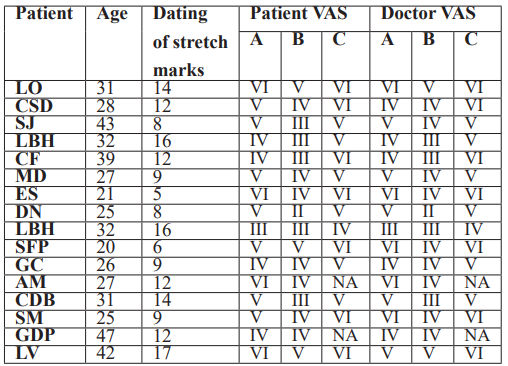
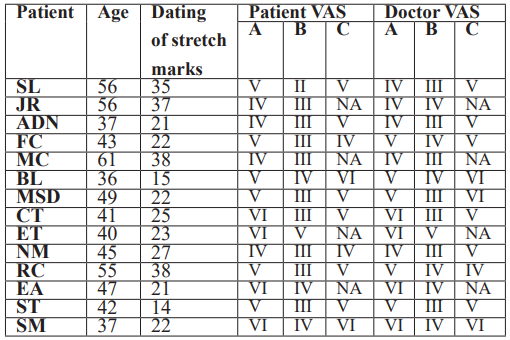
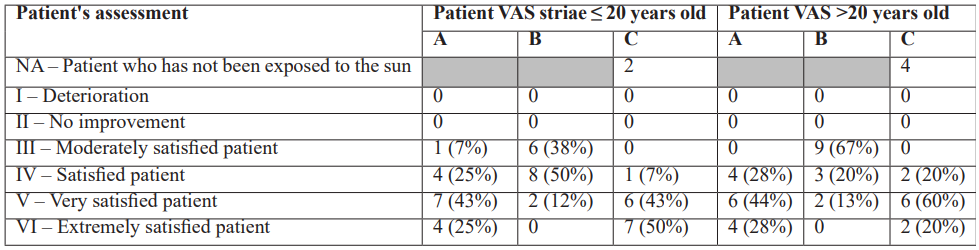
The results obtained are summarised in the following tables A and B:
- Table A: (VAS scale of the patient);
- Table B: (VAS scale of the doctor).
Scales measure the perceived improvement in treated streaks
VAS scale of the patient and doctor – Stretch marks on the glute that are up to 20 years old
Table 1: Patients with stretch marks less than 20 years old, subjected to 9 weekly sessions.
VAS scale of the patient and doctor – Stretch marks on the glute that are over 20 years old
Table 2: Patients with stretch marks older than 20 years, subjected to 12 weekly sessions.
Patient VAS table summary
Table 3
Doctor VAS table summary
Table 4
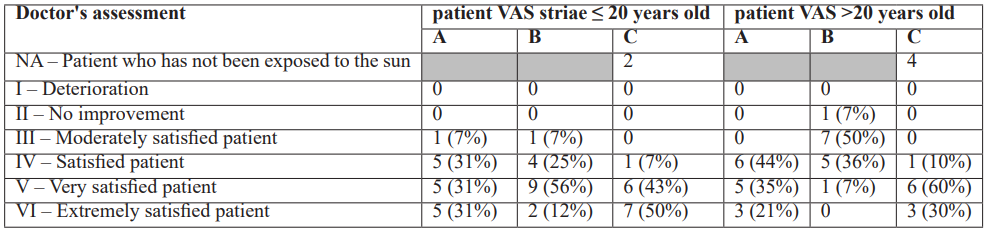
For stretch marks up to 20 years old, assessments A and B are performed on 16 patients, while assessment C is performed on 14, since 2 patients did not want to expose themselves to ultraviolet rays. Similarly, in patients with stretch marks older than 20 years, assessment C is performed on 10 patients since 4 did not want to expose themselves to the sun. Percentage values rounded to the nearest whole number.
The average level of comfort recorded at the end of the session cycle was 9.24 (from a minimum of 8 to a maximum of 10).
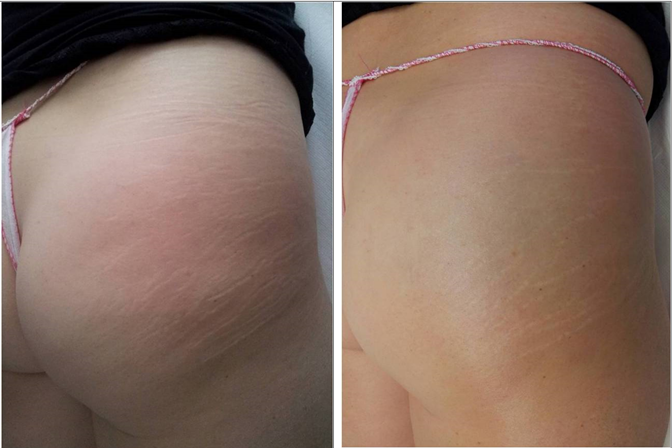
Figure 1: 40-year-old patient with 23-year-old stretch marks on the glute, dating back to the developmental period; the patient does not want to expose herself to the sun. In the image on the left, taken before the therapies, deep and evident striae and a skin ptosis involving the entire glute are noted, with some inhomogeneities attributable to mild cellulite. In the photo on the right, the same patient is seen after a cycle of 12 weekly Biodermogenesi® sessions: the stretch marks are filled and regenerated and have attenuated the chromatic difference with the surrounding tissue, even in the absence of sun exposure. The glute appears smooth and uniform, lifted, toned, and reshaped.
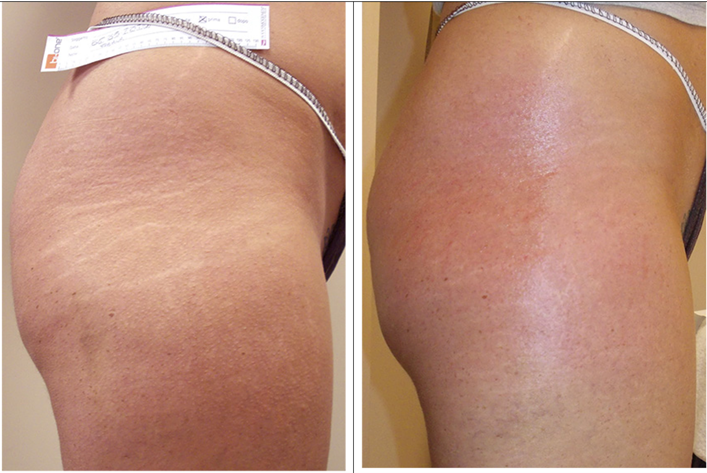
Figure 2: 31-year-old patient with 14-year-old stretch marks from her developmental period. In the photo on the left, taken before the cycle of 9 weekly treatments, you can see obvious white streaks. After the cycle of sessions, as you can see in the photo on the right, the stretch marks are regenerated and perfectly tanned with sun exposure. The shape of the glute has also improved, with greater relief compared to the profile of the thigh.
Analysis of Results
Thanks to the breadth of data collected with this study, we can see the actual level of satisfaction of doctors and patients and the patient's expectation before starting therapies. As indicated by Scarano et al. [41] the indicated technology is able to regenerate melanocytes generally lost with the evolution of stria; this factor therefore allows stretch marks to tan and make their color similar, and sometimes equal, to the surrounding healthy tissue. The recovered vascularization of the treated stretch marks [41] allows them to turn from pearly white to pink, approaching the color of the surrounding skin in the absence of sun exposure, and for this reason the visual satisfaction is significant, with all patients declaring themselves moderately to very satisfied. After sun exposure and the consequent tanning of the stretch marks, the level of satisfaction of the patients clearly increases, with only 3 patients satisfied and the others – about 90% – very or extremely satisfied. This aspect is also confirmed by the doctors who evaluated the results. It should be remembered that for this study, patients with stretch marks up to 38 years old, therefore complex and difficult to treat, were selected.
Another feature that we have observed is given by the overlapping of the results found in the two groups of patients, the first with striae up to 20 years old (16 patients) and the second with striae over 20 years old (14 patients). Similar results were also verified considering the phototype of the patients which varied from II (8 patients), III (16 patients), IV (3 patients) up to V (3 patients). To obtain similar improvements, it was necessary to perform 12 sessions for the streaks older than 20 years instead of 9, as required for the streaks of lesser age. The therapy was appreciated for the total absence of side effects and downtime; even sun exposure immediately after the therapies did not determine any negative outcome. The patients, specifically questioned in this sense, evaluated the therapy as extremely pleasant and relaxing. All the patients, without exception, expressed a high level of comfort during the cycle of sessions. Pleasant effects not expected at the time of starting this study we have observed are an evident remodeling of the glute, which appears more toned, lifted, and reshaped and at the same time a reduction of cellulite in patients also affected by this pathology. This was immediately noticed by the patients and then confirmed on all the patients also by the doctors. The lack of preliminary adoption of a specific scale to evaluate these unexpected results prevents us from assigning a numerical value to the improvement, but we can affirm that it is evident on all the patients and is relevant on at least 50% of them.
Discussion
Biodermogenesi® opens a new perspective in the treatment of SA by applying for the first time a non-invasive method that is not based on damage and subsequent repair. We know that collagen fibers change between 52° and 55° C [42], contract at 65° C [43] and denature between 60° and 70° C [44]. The thermal effect induced in the dermis by Biodermogenesi® stabilizes between 39° and 40° C and therefore the variation of collagen and elastic fibers documented bioptically by Scarano et al. [41], Bacci et al. [45], Artigiani et al. [46] raises interesting questions on the induced regenerative mechanism, presumably correlated to Van't Hoff's Law [37,38].
However, the improvement of the treated stretch marks appears objective in the total absence of side effects, normally connected to the excessive increase in skin temperature, which until now has been considered essential to obtain a reorganization of collagen. In the case of Biodermogenesi®, the thermal effect is not considered the cause of neocollagenogenesis but rather the consequence of the increased activity of Na+/K+ whose greater motility, favored by the applied electromagnetic field [25,26], determines this reaction by mere friction as a consequence of the second law of thermodynamics; the regenerative capacity of the tissues subject to greater activity by these carriers is widely demonstrated by the literature in sports medicine, in the context of the recovery of muscular injuries [47-49]. In the specific field of stretch mark therapy, the same results are found in the treatment of abdominal post-pregnancy striae, with the regeneration of the lesions and the consequent tanning [26]. Considering the unexpected improvement in the cellulite field, we intend to develop a further study aimed at carefully analyzing the levels of attenuation of stretch marks and cellulite on the glutes when the two pathologies were to manifest themselves together.
Conclusion
Biodermogenesi®, otherwise known as VEMFtherapy, has proven to be effective and safe in the treatment of glute stretch marks. The total restructuring of the stretch marks, which regain the ability to tan like the surrounding tissue and without the risk of hyperpigmentation, and the simultaneous remodeling of the glute and the total absence of side effects and downtime, as well as the high level of comfort expressed by patients, qualify Biodermogenesi® as an elective therapy for the treatment of glute stretch marks.
Division of tasks: A. Roberto performed the therapies, A. Cataldo developed the statistical analysis, M. Busoni developed the operating protocol and wrote the article.
Conflict of interest: M. Busoni is part of the Board of Directors of Expo Italia Srl, the other authors do not have any interest conflict.
References
- Yamaguchi K, Suganuma N, Ohashi K. Quality of life evaluation in Japanese pregnant women with striae gravidarum: a cross-sectional study. BMC Res Notes, 2012; 5: 450. doi: 10.1186/1756-0500-5-450.
- Cho S, Park ES, Lee DH, Li K, Chung JH. Clinical features and risk factors for striae distensae in Korean adolescents. J Eur Acad Dermatol Venereol, 2006; 20(9): 1108-1113. doi: 10.1111/j.1468-3083.2006.01747.x.
- Elsaie ML, Baumann LS, Elsaaiee LT. Striae distensae (stretch marks) and different modalities of therapy: an update. Dermatol Surg, 2009; 35(4): 563-573. doi: 10.1111/j.1524-4725.2009.01094.x.
- Ghasemi A, Gorouhi F, Rashighi-Firoozabadi M, Jafarian S, Firooz A. Striae gravidarum: associated factors. J Eur Acad Dermatol Venereol, 2007; 21(6): 743-746. doi: 10.1111/j.1468-3083.2007.02149.x.
- Thomas RG, Liston WA. Clinical associations of striae gravidarum. J Obstet Gynaecol, 2004; 24(3): 270-271. doi: 10.1080/014436104101001660779.
- Kim BJ, Lee DH, Kim MN, Song KY, Cho WI, Lee CK, et al. Fractional photothermolysis for the treatment of striae distensae in Asian skin. Am J Clin Dermatol, 2008; 9(1): 33-37. doi: 10.2165/00128071-200809010-00003.
- Cordeiro RC, Zecchin KG, de Moraes AM. Expression of estrogen, androgen, and glucocorticoid receptors in recent striae distensae. Int J Dermatol, 2010; 49(1): 30-32. doi: 10.1111/j.1365-4632.2008.04005.x.
- Shuster S. The cause of striae distensae. Acta Derm Venereol Suppl (Stockh), 1979; 59(85): 161-169.
- Ud-Din S, McAnelly SL, Bowring A, Whiteside S, Morris J, Chaudhry I, et al. A double-blind controlled clinical trial assessing the effect of topical gels on striae distensae (stretch marks): a non-invasive imaging, morphological and immunohistochemical study. Arch Dermatol Res, 2013; 305(7): 603-617. doi: 10.1007/s00403-013-1336-7.
- Ud-Din S, McGeorge D, Bayat A. Topical management of striae distensae (stretch marks): prevention and therapy of striae rubrae and albae. J Eur Acad Dermatol Venereol, 2016; 30(2): 211-222. doi: 10.1111/jdv.13223.
- Adatto MA, Deprez P. Striae treated by a novel combination treatment--sand abrasion and a patent mixture containing 15% trichloracetic acid followed by 6-24 hrs of a patent cream under plastic occlusion. J Cosmet Dermatol, 2003; 2(2): 61-67. doi: 10.1111/j.1473-2130.2004.00023.x.
- Sarnoff DS. Therapeutic update on the treatment of striae distensae. J Drugs Dermatol, 2015; 14(1): 11-12.
- Basma M Mohamed Ali, Rania A El-Tatawy, Nashwa N Elfar, Dareen A Mohammed Ali. A comparative clinical and histopathological study of microneedling versus microdermabrasion (aluminum oxide crystals) in the treatment of striae distensae Journal of the Egyptian Women’s Dermatologic Society, 2017; 14: 92–99. 10.1097/01.EWX.0000511156.50929.3b.
- Suh DH, Chang KY, Son HC, Ryu JH, Lee SJ, Song KY. Radiofrequency and 585-nm pulsed dye laser treatment of striae distensae: a report of 37 Asian patients. Dermatol Surg, 2007; 33(1): 29-34. doi: 10.1111/j.1524-4725.2007.33004.x.
- Harmelin Y, Boineau D, Cardot-Leccia N, Fontas E, Bahadoran P, Becker AL, et al. Fractionated bipolar radiofrequency and bipolar radiofrequency potentiated by infrared light for treating striae: A prospective randomized, comparative trial with objective evaluation. Lasers Surg Med, 2016; 48(3): 245-253. doi: 10.1002/lsm.22458.
- Lee SE, Kim JH, Lee SJ, Lee JE, Kang JM, Kim YK, et al. Treatment of striae distensae using an ablative 10,600-nm carbon dioxide fractional laser: a retrospective review of 27 participants. Dermatol Surg, 2010; 36(11): 1683-1690. doi: 10.1111/j.1524-4725.2010.01719.x.
- Khater MH, Khattab FM, Abdelhaleem MR. Treatment of striae distensae with needling therapy versus CO2 fractional laser. J Cosmet Laser Ther, 2016; 18(2): 75-79. doi: 10.3109/14764172.2015.1063665.
- Yang YJ, Lee GY. Treatment of Striae Distensae with Nonablative Fractional Laser versus Ablative CO2 Fractional Laser: A Randomized Controlled Trial. Ann Dermatol, 2011; 23(4): 481-489. doi: 10.5021/ad.2011.23.4.481.
- Nouri K, Romagosa R, Chartier T, Bowes L, Spencer JM. Comparison of the 585 nm pulse dye laser and the short pulsed CO2 laser in the treatment of striae distensae in skin types IV and VI. Dermatol Surg, 1999; 25(5): 368-370. doi: 10.1046/j.1524-4725.1999.07320.x.
- Sule Gungor, Tulay Sayilgan, Gonca Gokdemir, Deniz Ozcan. Evaluation of an ablative and nonablative laser procedure in the treatment of striae distensae. IJDVL, 2014; 80(5): 409-412. doi: 10.4103/0378-6323.140296.
- El-Ramly AZ, El-Hanafy GM, El Maadawi ZM, Bastawy NH. Histological and quantitative morphometric evaluation of striae distensae treated by long-pulsed 1064-nm Nd: Y AG laser. J Egypt Women Dermatol Soc, 2015; 12: 120–128. DOI: 1097/01.EWX.0000461925.84138.f3.
- De Angelis F, Kolesnikova L, Renato F, Liguori G. Fractional nonablative 1540-nm laser treatment of striae distensae in Fitzpatrick skin types II to IV: clinical and histological results. Aesthet Surg J, 2011; 31(4): 411-419. doi: 10.1177/1090820X11402493.
- Tretti Clementoni M, Lavagno R. A novel 1565 nm non-ablative fractional device for stretch marks: A preliminary report. J Cosmet Laser Ther, 2015; 17(3): 148-155. doi: 10.3109/14764172.2015.1007061.
- Bak H, Kim BJ, Lee WJ, Bang JS, Lee SY, Choi JH, et al. Treatment of striae distensae with fractional photothermolysis. Dermatol Surg, 2009; 35(8): 1215-1220. doi: 10.1111/j.1524-4725.2009.01221.x.
- Clayton EB, Scott PM. Electrotherapy and Actinotherapy. Baillière Tindal, London, 1975: 178-208.
- Bistolfi F. Campi magnetici in medicina. Ed. Minerva Medica, Torino, 1983.
- Robert N. Negative pressure wound therapy in orthopaedic surgery. Orthopaedics & Traumatology: Surgery & Research, 2017; 103: S99–S103. doi.org/10.1016/j.otsr.2016.04.018.
- The Nobel Prize in Chemistry 2003. NobelPrize.org. Nobel Prize Outreach AB 2024, 2024.
- Garth L Nicolson. Update of the 1972 Singer-Nicolson Fluid-Mosaic Model of Membrane Structure. Discoveries, 2013; 1(1): e3. DOI: 10.15190/d.2013.3.
- Gerald S Manning, Alan R Kay. The physical basis of osmosis. J. Gen. Physiol, 2023; 155(10): e202313332. https://doi.org/10.1085/jgp.202313332.
- Kiil F. Mechanism of osmosis. Kidney Int, 1982; 21(2): 303-308. doi: 10.1038/ki.1982.22.
- Peter Hugo Nelson. Osmosis and thermodynamics explained by solute blocking. Eur Biophys J, 2017; 46(1): 59–64. doi:10.1007/s00249-016-1137-y.
- Ben-Naim A. A Farewell to Entropy: Statistical Thermodynamics Based on Information, World Scientific, New Jersey, 2008. ISBN: 978-981-270-706-2.
- Pippard AB. Elements of Classical Thermodynamics for Advanced Students of Physics, original publication 1957, reprint 1966, Cambridge University Press, Cambridge, 1957/1966.
- Kittel C, Kroemer H. Thermal Physics, second edition, W.H. Freeman, San Francisco, 1980; ISBN: 0-7167-1088-9.
- Jacobus H. van 't Hoff – Facts. NobelPrize.org. Nobel Prize Outreach AB 2024, 2024.
- Vant t’Hoff JH. Studies in chemical Dynamics. Williams & Norgate, London, 1896.
- Denbigh KG. The priciples of chemical equilibrium. Cambridge University Press, 1955.
- Tashiro Y, Hasegawa S, Yokota Y, Nishiguchi S, Fukutani N, Shirooka H, et al. Effect of Capacitive and Resistive electric transfer on haemoglobin saturation and tissue temperature. Int J Hyperthermia, 2017; 33(6): 696-702. doi: 10.1080/02656736.2017.1289252.
- Pacini S, Punzi T, Gulisano M, Cecchi F, Vannucchi S, Ruggiero M. Transdermal delivery of heparin using pulsed current iontophoresis. Pharm Res, 2006; 23(1): 114-120. doi: 10.1007/s11095-005-8923-z.
- Scarano A, Sbarbati A, Amore R, Iorio EL, Ferraro G, Lorusso F, et al. A New Treatment for Stretch Marks and Skin Ptosis with Electromagnetic Fields and Negative Pressure: A Clinical and Histological Study. J Cutan Aesthet Surg, 2021; 14(2): 222-228. doi: 10.4103/JCAS.JCAS_122_20.
- Nicoletti G, Cornaglia AI, Faga A, Scevola S. The biological effects of quadripolar radiofrequency sequential application: a human experimental study. Photomed Laser Surg, 2014; 32(10): 561-573. doi: 10.1089/pho.2014.3749.
- Lin SJ, Hsiao CY, Sun Y, Lo W, Lin WC, Jan GJ, et al. Monitoring the thermally induced structural transitions of collagen by use of second-harmonic generation microscopy. Opt Lett, 2005; 30(6): 622-624. doi: 10.1364/ol.30.000622.
- Paul M, Blugerman G, Kreindel M, Mulholland RS. Three-dimensional radiofrequency tissue tightening: a proposed mechanism and applications for body contouring. Aesthetic Plast Surg, 2011; 35(1): 87-95. doi: 10.1007/s00266-010-9564-0.
- Bacci PA, Alberti G, Amuso D, Artigiani A, Benitez Roig V, Di Nardo V, et al. The synergy between vacuum and electromagnetic fields in the treatment of striae distensae: retrospective study on 917 patients with clinical and histological case records A possible treatment for striae distensae. Journal of Applied Cosmetology, 2021; 39(1): 43-54. ISSN: 0392-8543.
- Artigiani A, Cervadoro G, Loggini B, Paolicchi A. Biodermogenesi: la soluzione non invasiva nel trattamento delle smagliature. La Medicina Estetica, 2012 gennaio-marzo; 41-49.
- Whipple T, Villegas D. Thermal and electric energy fields by noninvasive monopolar capacitive-coupled radiofrequency: temperatures achieved and histological outcomes in tendons and ligaments. PM R, 2010; 2(7): 599-606. doi: 10.1016/j.pmrj.2010.02.012.
- Armitage DW, LeVeen HH, Pethig R. Radiofrequency-induced hyperthermia: computer simulation of specific absorption rate distributions using realistic anatomical models. Phys Med Biol, 1983; 28(1): 31-42. doi: 10.1088/0031-9155/28/1/003.
- Abraham MT, Mashkevich G. Monopolar radiofrequency skin tightening. Facial Plast Surg Clin North Am, 2007; 15(2): 169-177, v. doi: 10.1016/j.fsc.2007.01.005.
- Veronese S, Bacci PA, Garcia-Gimenez V, Canel Micheloud CC, Haro García NL, Sbarbati A. V-EMF therapy: A new painless and completely non-invasive treatment for striae gravidarum. J Cosmet Dermatol, 2024; 23(6): 2007-2014. doi: 10.1111/jocd.16220.