
Email id: info@ijclinmedcasereports.com
Fitness for Work in a Nurse with a Brainstem Cavernous Malformation: Occupational Decision-Making Under Prognostic Uncertainty
Mafalda Bica Tavares*, João Coutinho de Sousa, Renato Matos Barbosa, Amanda Dias, Rita Gil Duarte, Ana Beatriz Oliveira, Miguel Magalhães, Ana Catarina Carvoeiro, Filipe Araújo, Ana Sofia Duarte, Nuno Augusto Saldanha and Sara Alves Matos
Occupational Health Service, Unidade Local de Saúde de Santo António, Porto, Portugal
Received Date: 06/10/2026; Published Date: 02/12/2026
*Corresponding author: Mafalda Bica Tavares, Occupational Health Service, Unidade Local de Saúde de Santo António, Largo do Professor Abel Salazar, 4099-001 Porto, Portugal
Abstract
Brainstem cavernous malformations presenting with hemorrhage or a new focal neurological deficit carry an estimated five-year risk of symptomatic hemorrhage approaching one in three. We report a woman in her early forties, an anesthesia nurse in a tertiary hospital, who presented with a change in her migraine pattern followed by right upper limb paresthesia, dysphagia, and facial hypoesthesia. Magnetic resonance imaging showed a dorsal medullary cavernous malformation, which was managed conservatively. A specialist recommended avoidance of shift work, physical exertion, and stress. On return to work after approximately four months of sick leave, a conditional fitness certificate excluded night work, extended shifts, and emergency operating room duties. Approximately three months later, the neurological examination was normal, right-hand fatigability persisted, and transfer to outpatient clinic duties was proposed. We propose that each restriction be attributed explicitly to its ground and linked to a criterion for review.
Keywords: Cerebral cavernous malformation; Brainstem; Fitness for work; Return to work; Health personnel; Shift work
Introduction
Cerebral cavernous malformations are low-flow vascular malformations of the central nervous system composed of abnormally dilated, leaky, endothelium-lined caverns containing blood of different ages [1]. In an individual patient data meta-analysis of 1620 patients, the estimated five-year risk of symptomatic intracranial hemorrhage was 30.8% for brainstem lesions presenting with hemorrhage or a new focal neurological deficit, compared with 3.8% for non-brainstem lesions presenting without either feature [2].
The occupational physician must translate an uncertain neurological prognosis into a formal fitness-for-work decision, and fitness for work is commonly defined as the capacity to work without risk to one's own or others' health and safety [3]. The task is particularly challenging in healthcare workers who perform safety-critical duties, and the fitness-for-work literature offers little empirical evidence to guide such decisions [3]. We report a case in which specialist recommendations exceeded the available evidence and examine how a defensible fitness-for-work decision can be constructed under prognostic uncertainty.
Case Report
A woman in her early forties was employed as an anesthesia nurse in the main operating room of a tertiary hospital, where she performed safety-critical perioperative duties. Her medical history included migraine with approximately five episodes per month, polycystic ovary syndrome, hip osteoarthritis secondary to femoroacetabular impingement, and an L5-S1 disc herniation with left lower limb radicular symptoms. Before the neurological event, she already held a conditional fitness certificate attributable to these musculoskeletal conditions. It restricted prolonged standing, unassisted handling of heavy loads or patients, extended shifts, and exposure to ionizing radiation, because she could not tolerate the weight of lead protective equipment. She worked a daytime schedule under the parental right to flexible working hours of the Portuguese Labor Code, which is not an exemption from night work [4].
The neurological episode began with a change in her usual migraine pattern, followed by persistent right upper limb paresthesia, dysphagia, and facial hypoesthesia. Brain magnetic resonance imaging showed a cavernous malformation of the dorsal medulla oblongata, at the level of the obex, with a reticulated core and a peripheral hemosiderin rim (Figures 1 and 2). Neurosurgical evaluation favored conservative management with clinical and imaging surveillance. A subsequent specialist opinion recommended avoidance of shift work and limitation of physical exertion and psychological stress. She remained on sick leave for approximately four months.
In Portugal, an occasional occupational health examination is mandatory on return to work after an absence exceeding 30 days due to illness [5]. At this examination, she reported persistent upper limb paresthesia and difficulty handling loads. A conditional fitness certificate restricted prolonged standing and walking, manual handling of loads, night work, extended shifts, and allocation to unpredictable, time-critical settings, namely the emergency operating room. The record stated that these restrictions were based on the symptoms reported, on the potential consequences of a recurrent hemorrhage, and on the absence of complete specialist information, and that the decision was precautionary and provisional.
At re-examination approximately three months later, the neurological examination was normal and she no longer reported paresthesia. She described persistent fatigability of the right hand during sustained fine motor tasks, with a need to interrupt writing, continued intolerance of the lead apron, and a preference to avoid the emergency operating room. Conditional fitness was maintained, and transfer to outpatient clinic duties was proposed on clinical grounds because of their more predictable workload and lower time pressure. Neurosurgical re-evaluation was scheduled for the following year.
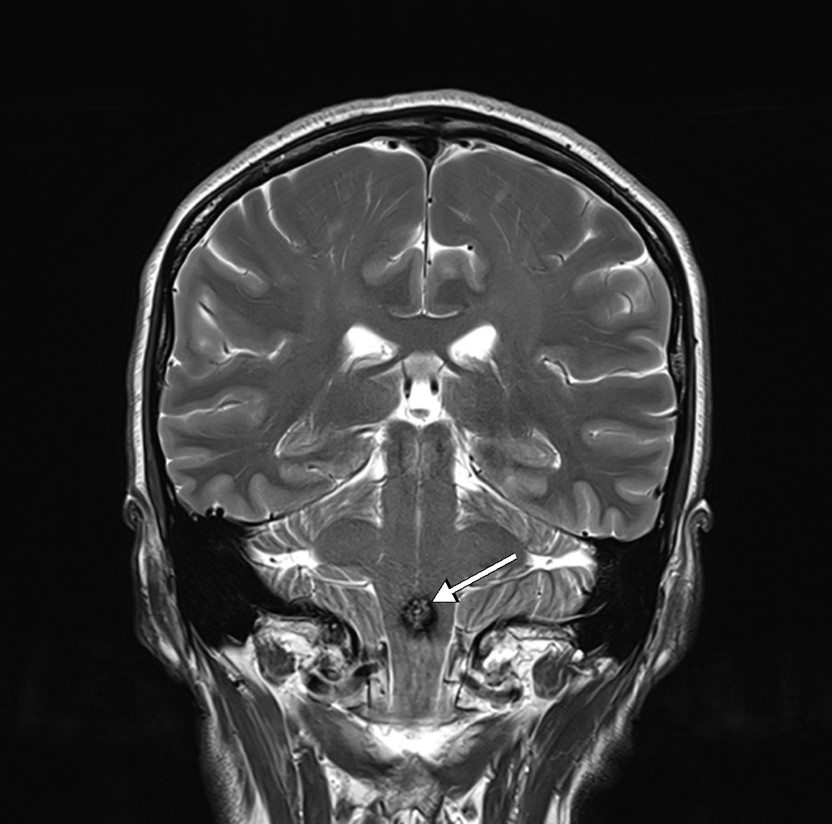
Figure 1: Coronal T2-weighted brain magnetic resonance image showing a cavernous malformation of the medulla oblongata (arrow), with a heterogeneous reticulated core and a hypointense hemosiderin rim.
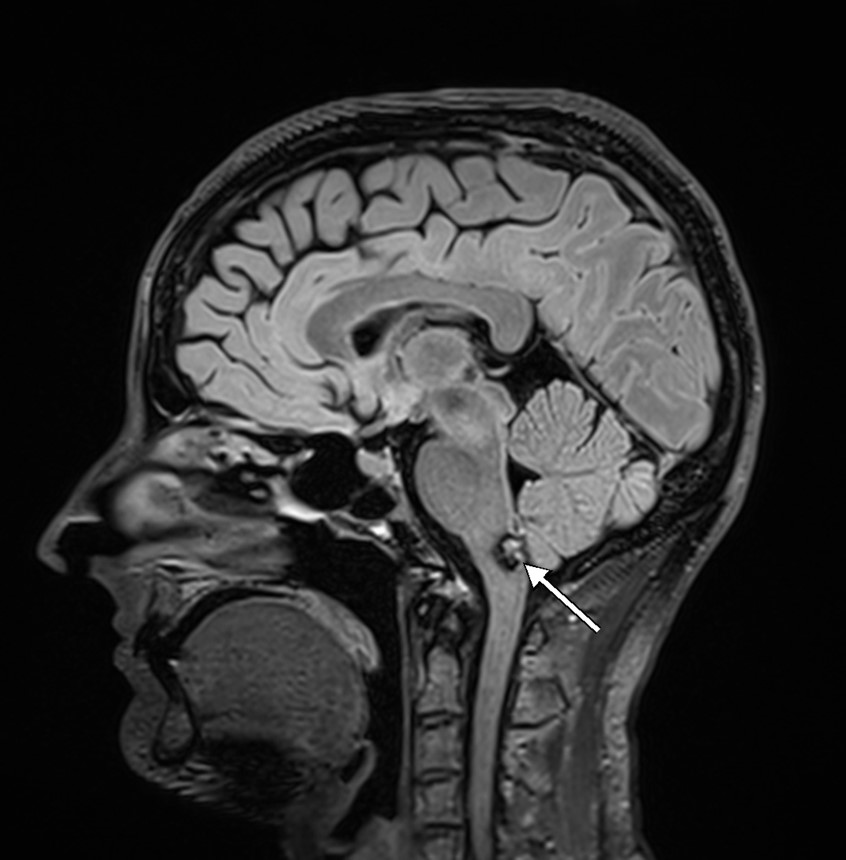
Figure 2: Sagittal T2-weighted fluid-attenuated inversion recovery (FLAIR) brain magnetic resonance image showing a cavernous malformation in the dorsal lower medulla oblongata, at the level of the obex (arrow).
Discussion
A hemosiderin rim alone does not meet the definition of hemorrhage used in the individual patient data meta-analysis, which requires acute or subacute symptoms with evidence of recent hemorrhage, but presentation with a new focal neurological deficit from a brainstem lesion placed this patient in its highest-risk category [2]. Risk is also front-loaded. In the whole cohort, the annual risk of hemorrhage fell from 6.2% in the first year after diagnosis to 2.0% in the fifth, a decline confined to patients presenting with hemorrhage or a focal deficit [2], and a population-based cohort showed a similar decline in the risk of recurrence [6]. Restrictions justified by the consequences of recurrence should therefore be time-limited and linked to reassessment. Conservative management was consistent with the current consensus guideline, which considers it reasonable after a first symptomatic hemorrhage from a brainstem lesion and suggests that resection be considered after a second symptomatic hemorrhage or, in selected cases, a single disabling hemorrhage [7].
Assuming a constant hazard, a five-year risk of 30.8% corresponds to an annual risk of approximately 7% and to roughly one symptomatic hemorrhage per 15,000 eight-hour periods. Because risk is front-loaded, the early risk exceeds this average, and not every hemorrhage would cause sudden incapacity during a task. Aviation medicine has traditionally accepted an annual risk of sudden incapacitation of 1% for multicrew airline pilots, and relaxation of this limit to 2% has been proposed [8]. By that standard, the risk in this case is not negligible, but the relevant question is whether the task is performed with immediate backup.
The specialist recommendation to limit shift work, physical exertion, and stress was incorporated into the decision, but following it does not imply accepting a causal mechanism that the literature has not established. The consensus guideline notes that no rigorous studies have examined the risks of physical activity [7], and occupational exposures are not among the established predictors of hemorrhage [2,7]. A restriction presented as hemorrhage prevention makes an empirical claim that is difficult to defend if challenged and difficult to revise rationally.
The restrictions rest instead on three defensible grounds, summarized with their review criteria in Table 1. The first is the risk to others, which is inherent in the definition of fitness for work [3]. A recurrent brainstem deficit, such as dysphagia or upper limb dysfunction, during emergency perioperative care, where substitution and task interruption are limited, could compromise both the worker's safety and patient care. This ground explains why elective perioperative work was not excluded and why the restriction should be relaxed as event-free time accumulates. The second is documented residual functional limitation. Right-hand fatigability is directly relevant to medication preparation and airway assistance, but it was self-reported and should be measured objectively at the next review. The third is an individualized rationale for avoiding night work, which is not hemorrhage prevention. Psychomotor vigilance is worse at the end of night shifts than during day shifts [9], and sleep disturbance is a recognized migraine trigger [10]. In shift-working nurses, migraine was associated with shift work disorder and insomnia but not with the work schedule or the number of night shifts [11]. Night work could therefore aggravate migraine in a worker who tolerates disrupted sleep poorly and obscure a change in headache pattern, which was the sentinel symptom in this case. Portuguese law provides that night workers with health problems related to night work should, whenever possible, be transferred to suitable day work [4]. Although she was not a night worker, this provision supports recording a health-based rationale for daytime work. Because she already worked days under a parental entitlement that ends when the child turns 12, the restriction gave a clinical basis to an existing arrangement rather than creating a new accommodation.
Table 1. Restrictions, the grounds on which they rest, and criteria for reviewa.
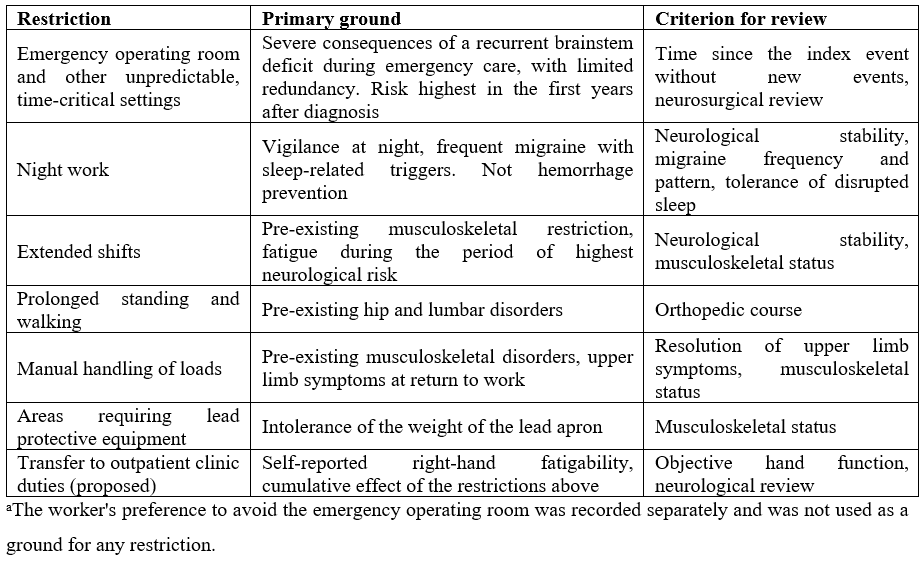
The worker's preference to avoid the emergency operating room is not a medical ground and was recorded separately. Several restrictions were attributable to the pre-existing musculoskeletal disorders. Attributing all limitations to the neurological diagnosis would overstate its functional impact and obscure the information required to relax each restriction. The confidential clinical record should therefore specify the ground and the review criterion of each restriction, whereas the certificate communicated to the employer states functional restrictions without diagnoses, as Portuguese law requires [5].
Contraceptive use was not recorded in the occupational health file. Female hormone therapy was associated with a higher risk of hemorrhage in a pooled analysis of two prospective cohorts [12], although a subsequent single-center cohort found no significant association [13]. Documenting current medication and raising this question with the treating team are therefore part of the return-to-work assessment.
This report has limitations. Follow-up is limited, hand function was not measured objectively, and the contribution of each coexisting condition to the observed limitations was not quantified. The per-shift risk estimate assumes a constant hazard and is illustrative only.
Conclusion
Occupational reasoning in brainstem cavernous malformations should rest on the individualized, time-dependent prognosis rather than on a generic hemorrhage rate. The available evidence does not support presenting shift work, physical exertion, or psychological stress as established precipitants of hemorrhage. Restrictions are better justified by the consequences of neurological deterioration during safety-critical care, by documented functional limitation, and by an individualized rationale for limiting night work. Each restriction should be attributed to its ground and linked to a criterion for review in the confidential clinical record, while the certificate states only functional restrictions.
Informed Consent: Written informed consent was obtained from the patient for publication of this case report and the accompanying images. All identifying information has been removed.
Author Contributions: Mafalda Bica Tavares contributed to the concept and design, acquired, analyzed, and interpreted the data, and drafted the manuscript. João Coutinho de Sousa, Amanda Dias, Renato Barbosa, Beatriz Oliveira, Miguel Magalhães, Catarina Carvoeiro and Filipe Araújo contributed to the concept and design. Nuno Augusto Saldanha and Sara Alves Matos supervised the work and critically reviewed the manuscript for important intellectual content. All authors approved the final version of the manuscript and agreed to be accountable for all aspects of the work. Mafalda Bica Tavares is the guarantor of the work. Rita Gil Duarte contributed to the concept and design. Ana Sofia Duarte supervised the work and critically reviewed the manuscript for important intellectual content.
Competing Interests: The authors declare that they have no competing interests.
Grant Information: The authors received no specific funding for this work.
References
- Flemming KD, Lanzino G. Cerebral cavernous malformation: what a practicing clinician should know. Mayo Clin Proc, 2020; 95(9): 2005-2020. doi: 10.1016/j.mayocp.2019.11.005.
- Horne MA, Flemming KD, Su IC, Stapf C, Jeon JP, Li D, et al. Clinical course of untreated cerebral cavernous malformations: a meta-analysis of individual patient data. Lancet Neurol, 2016; 15(2): 166-173. doi: 10.1016/S1474-4422(15)00303-8.
- Serra C, Rodriguez MC, Delclos GL, Plana M, Gómez López LI, Benavides FG. Criteria and methods used for the assessment of fitness for work: a systematic review. Occup Environ Med, 2007; 64(5): 304-312. doi: 10.1136/oem.2006.029397.
- Lei n.º 7/2009, de 12 de fevereiro. Aprova a revisão do Código do Trabalho, na redação atual, artigos 56.º e 225.º [Law No. 7/2009 of 12 February. Approves the revision of the Labor Code, as amended, articles 56 and 225] [Internet]. Diário da República, 1.ª série. 2009.
- Lei n.º 102/2009, de 10 de setembro. Regime jurídico da promoção da segurança e saúde no trabalho, na redação atual, artigos 108.º e 110.º [Law No. 102/2009 of 10 September. Legal framework for the promotion of safety and health at work, as amended, articles 108 and 110] [Internet]. Diário da República, 1.ª série. 2009.
- Al-Shahi Salman R, Hall JM, Horne MA, Moultrie F, Josephson CB, Bhattacharya JJ, et al. Untreated clinical course of cerebral cavernous malformations: a prospective, population-based cohort study. Lancet Neurol, 2012; 11(3): 217-224. doi:10.1016/S1474-4422(12)70004-2.
- Akers AL, Albanese J, Alcazar-Felix RJ, Al-Shahi Salman R, Awad IA, Connolly ES, et al. Guidelines for the diagnosis and clinical management of cavernous malformations of the brain and spinal cord: consensus recommendations based on a systematic literature review by the Alliance to Cure Cavernous Malformation Clinical Advisory Board Experts Panel. Neurosurgery, 2026; 98(1): 3-22. doi: 10.1227/neu.0000000000003459.
- Mitchell SJ, Evans AD. Flight safety and medical incapacitation risk of airline pilots. Aviat Space Environ Med, 2004; 75(3): 260-268.
- Ganesan S, Magee M, Stone JE, Mulhall MD, Collins A, Howard ME, et al. The impact of shift work on sleep, alertness and performance in healthcare workers. Sci Rep, 2019; 9(1): 4635. doi: 10.1038/s41598-019-40914-x
- Kelman L. The triggers or precipitants of the acute migraine attack. Cephalalgia, 2007; 27(5): 394-402. doi: 10.1111/j.1468-2982.2007.01303.x
- Bjorvatn B, Pallesen S, Moen BE, Waage S, Kristoffersen ES. Migraine, tension-type headache and medication-overuse headache in a large population of shift working nurses: a cross-sectional study in Norway. BMJ Open, 2018; 8(11): e022403. doi: 10.1136/bmjopen-2018-022403.
- Zuurbier SM, Santos AN, Flemming KD, Schmidt B, Jabbarli R, Lanzino G, et al. Female hormone therapy and risk of intracranial hemorrhage from cerebral cavernous malformations: a multicenter observational cohort study. Neurology, 2023; 100(16): e1673-e1679. doi: 10.1212/WNL.0000000000206888.
- Wildi S, Nager S, Staartjes V, Stumpo V, Özkaratufan S, Krayenbühl N, et al. Female hormone therapy and risk of intracranial hemorrhage and focal neurological deficits in patients with cavernous malformations of the central nervous system. Front Neurol, 2025; 16: 1658980. doi: 10.3389/fneur.2025.1658980.