
Email id: info@ijclinmedcasereports.com
Venomous Animal Exposure and Renal Risk in Remote Paraguay: A Spider-Bite Case Contextualised by Four Previously Reported Severe Cases
Raúl Desvars1,2,*, Elena Schupp1, Jorge Rojas Godoy2, Balbina Pereira2 and María Liz Diaz2
¹Service of Nephrology, Hospital Regional de Concepción, Primera Región Sanitaria, Ministry of Public Health and Social Welfare, Concepción, Paraguay
²Universidad Nacional de Concepción, Faculty of Medicine, Concepción, Paraguay
Received Date: 01/09/2026; Published Date: 30/10/2026
*Corresponding author: Raúl Desvars, MD, MSc. Universidad Nacional de Concepción, Faculty of Medicine, Ruta Py05, km 205, Campus Universitario, Concepción, Paraguay
Abstract
We report a 58-year-old man from Horqueta, northern Paraguay, who works periodically on cattle ranches in the remote Paraguayan Chaco and presented with a bite from a locally named 'ñandupé' spider (reportedly Selenops sp.) followed by limb oedema. He had pre-existing chronic kidney disease and microscopic haematuria: serum creatinine was 2.24 mg/dL before the bite and 1.65 mg/dL at later follow-up, with no oliguria, hyperkalaemia, acidosis or acute creatinine rise. We contrast this case with four previously published severe renal cases from the same regional centre — probable Loxosceles bite, multiple wasp stings, Bothrops snakebite and decompensated chronic kidney disease — all of which required haemodialysis and two of which were fatal. Together, these cases show that venomous animal exposure in rural workers warrants early renal surveillance, but temporal association alone should not be equated with nephrotoxicity, particularly when chronic kidney disease coexists.
Keywords: Acute kidney injury; Chronic kidney disease; Haemodialysis; Paraguay; Rural health; Spider bite
Introduction
Venomous animal injury is both a toxicological and a rural-health problem. In Paraguay, 1651 snakebite envenoming cases were notified between 2015 and 2021; men accounted for 68% of cases, and 47% of patients with occupational information were working in agricultural or livestock settings. Alto Paraguay, in the Chaco, had the highest cumulative rate reported nationally, and Concepción also contributed substantial case numbers [1]. Earlier Paraguayan work similarly described a concentration of clinically important ophidism among men in agricultural regions bordering Brazil [2].
Kidney complications can determine prognosis after envenomation. A 2026 systematic review estimated acute kidney injury (AKI) in approximately 23% of snakebite patients, with renal replacement therapy required in about 28% of those who developed AKI [3]. Multiple wasp stings can cause AKI through direct venom toxicity, haemolysis and rhabdomyolysis [4], and systemic loxoscelism can also involve the kidney, although less frequently than its characteristic local manifestations [5]. The rural pathway to severe disease is not explained by venom alone: staged care and limited local resources can shape outcomes after severe envenomation [6,7].
Our group previously published four severe venom-related renal cases from the Hospital Regional de Concepción [8]; those patients are not republished here. We report a previously unpublished fifth patient whose occupational exposure occurred in a remote cattle-ranch environment but whose renal course did not support venom-induced AKI, and use this contrast to examine how rural exposure should be documented and how causal over-attribution can be avoided when chronic kidney disease is already present.
Case Report
A 58-year-old man living in Horqueta, northern Paraguay, was under nephrology follow-up for chronic kidney disease. His work periodically required travel to cattle ranches in remote areas of the Chaco; this residence–workplace distinction was clinically relevant, since his home district did not describe the environmental setting of exposure.
At follow-up, he reported that approximately 10 days earlier he had been bitten by a spider locally called 'ñandupé', reportedly Selenops sp.; the specimen was unavailable for taxonomic confirmation. He described oedema of the affected lower limb. An ulcerated lesion was later seen in the area, which he attributed to a separate traumatic event rather than the bite; the ulcer is therefore not classified as venom-induced necrosis.
Renal impairment clearly pre-dated the exposure. On 30 January 2026, haemoglobin was 13.5 g/dL, urea 53 mg/dL and creatinine 2.24 mg/dL, with microscopic haematuria (8–10 red blood cells per high-power field). On 23 August 2026, haemoglobin was 11 g/dL, urea 50 mg/dL and creatinine 1.65 mg/dL, with persistent haematuria (6–8 red blood cells per high-power field). Using the 2021 CKD-EPI equation, these values correspond to an estimated glomerular filtration rate of approximately 33 and 48 mL/min/1.73 m², respectively.
There was no documented oliguria or anuria, severe hyperkalaemia, major metabolic acidosis, or acute creatinine rise temporally linked to the bite; renal replacement therapy was not indicated. The later creatinine was lower than the previously documented value, making clinically significant venom-induced AKI unlikely. Evidence on human Selenops bites is sparse, limited to an older case report, and insufficient to infer a characteristic nephrotoxic syndrome from the local name alone [9]. At later review, the patient also described a longstanding foot wound from a mechanical injury approximately 12 years earlier, with intermittent oedema and purulent secretion when irritated by footwear; this chronic wound was a separate problem, unrelated to the reported spider exposure.
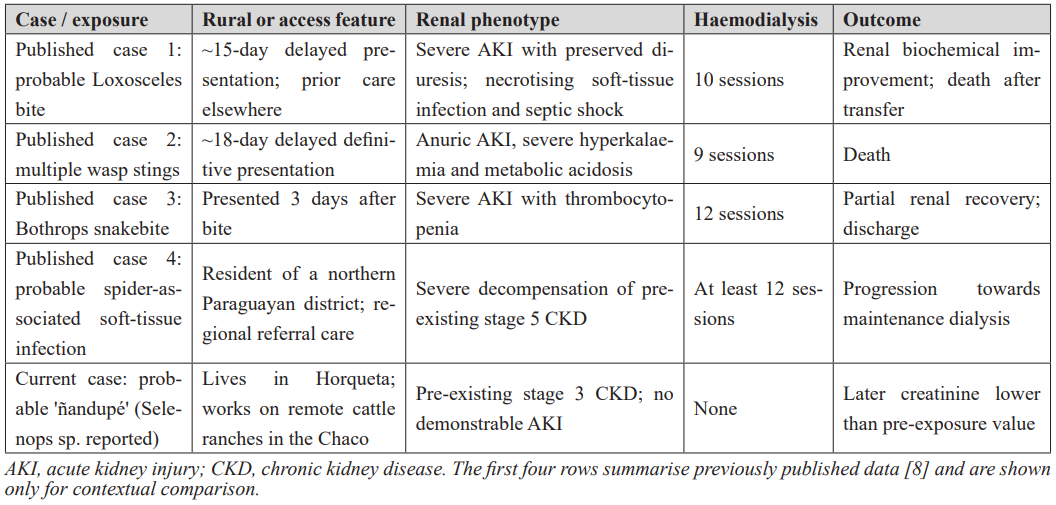
For contextual comparison, Table 1 summarises this case alongside four previously published regional cases [8]: three patients without advanced chronic kidney disease who developed dialysis-requiring AKI after probable Loxosceles bite, multiple wasp stings or Bothrops snakebite, and a fourth patient with advanced chronic kidney disease who developed severe uraemic and metabolic decompensation during a probable spider-associated soft-tissue infection. The two fatal AKI presentations occurred after delays of approximately 15 and 18 days before definitive regional care. The first four rows of Table 1 are not new data.
Table 1: Current case compared with four previously published regional cases [8].
Discussion
This case illustrates why rural exposure history and renal causality should be considered separately. Mobile rural work can be invisible if only residence is recorded: the patient lived in Horqueta but periodically worked on remote Chaco ranches, and national data confirm that agricultural and livestock occupations are central to snakebite risk in Paraguay [1]. Clinical history-taking and rural surveillance should therefore record the place and activity at the time of exposure, not only the municipality of residence.
Exposure does not equal renal causality. Chronic kidney disease and microscopic haematuria were present before the bite, and renal function subsequently improved rather than deteriorated; a plausible environmental exposure can coexist with chronic renal abnormalities without causing AKI. This distinction is particularly important when species identification depends on a local name or patient recollection rather than specimen confirmation.
By contrast, the previously published regional cases show that delayed definitive assessment can coincide with severe renal presentation: the two fatal cases followed approximately 15 and 18 days of delay before definitive care [8], consistent with reports emphasising coordinated multilevel care and timely transfer after snakebite [6]. These observations cannot prove that earlier treatment would have prevented death, but they support the principle that timely recognition, transfer and serial biochemical assessment matter in rural settings.
Regional dialysis capacity is part of emergency rural care: four of the previously published cases required repeated haemodialysis [8], within a service that already manages substantial acute and chronic illness. A previous study at the same centre reported 18 deaths among 101 haemodialysis patients over six months, with sepsis accounting for 77.8% of deaths and severe acute renal failure contributing importantly to mortality [10]. Emergency dialysis capacity should therefore be considered part of regional preparedness for severe envenomation, not a separate tertiary concern.
Preserved urine output is not sufficient reassurance, since severe renal dysfunction requiring haemodialysis occurred in previously reported patients who retained substantial diuresis [8]. When clinically significant envenomation is suspected, creatinine, urea, potassium and acid-base status should be checked early and repeated according to severity, even where laboratory capacity is limited. A pragmatic rural pathway should document the animal and certainty of identification, record the occupational and geographic exposure setting, establish time from exposure to care, screen for pre-existing kidney disease, obtain early renal and metabolic testing, and define transfer routes to centres with haemodialysis, preserving terms such as 'probable' or 'reported' when identification is uncertain.
Conclusion
This case shows why rural exposure history and renal causality should be separated conceptually. A worker may have genuine environmental exposure in a remote setting yet no venom-related kidney injury, while previously published patients from the same region developed catastrophic AKI or decompensated chronic kidney disease after venomous animal encounters. For rural and remote services, the priority is not to assume nephrotoxicity but to detect it early when it occurs, recognise limited renal reserve, and ensure timely access to regional haemodialysis.
Declarations
Ethics approval and consent to participate: The project was approved by the Research Ethics Committee of the National University of Concepción Faculty of Medicine, in accordance with minutes number 11, folio 31.
Consent for publication: The data were obtained from the medical record.
Competing interests: The authors declare no conflicts of interest.
Grant information: No specific funding was received for this work.
Author contributions: Raúl Desvars — conceptualisation, clinical interpretation, data curation, drafting, supervision and revision; Alessandra Ramírez — clinical review, validation and critical revision; Elena Schupp — nephrology review, validation and critical revision; Jorge Rojas Godoy — clinical review, validation and critical revision; Balbina Pereira and María Liz Diaz — Writing – Original Draft.
Prior publication: Four comparator cases were previously published in Jana Nexus: Journal of Health and Medicine [8]. They are cited and summarised only as published regional context. The current case has not been published previously.
Artificial intelligence-assisted writing disclosure: OpenAI ChatGPT (GPT-5.6 Sol), accessed 1 September 2026, was used to assist with English-language drafting, and reference-format checking. It was not used to generate clinical data or statistical results. The authors reviewed the output, verified the clinical content and references, and accept full responsibility for the manuscript.
References
- Ardiles-Ruesjas S, Sanabria E, Segovia Portillo VH, Jara Oroa L, de Egea V, Sequera G, et al. Epidemiological and sociodemographic description of snakebite envenoming cases in Paraguay reported between 2015 and 2021. BMJ Public Health, 2024; 2(1): e000359. doi: 10.1136/bmjph-2023-000359.
- Borges A. Ofidismo en el Paraguay: distribución geográfica, alteraciones fisiopatológicas y necesidad de la preparación de un veneno de referencia nacional. Rev Soc Cient Parag, 2019; 24(2): 249-261. doi: 10.32480/rscp.2019-24-2.249-261.
- Goumboundi IA, Taylor S, Ayerkain NL, Asum K, Oti MG, Afrifa J, et al. Snake envenomation and acute kidney injury: a systematic review and meta-analysis. BMC Nephrol, 2026; 27: 220. doi: 10.1186/s12882-026-04823-2.
- Yu F, Wang L, Yuan H, Gao Z, He L, Hu F. Wasp venom-induced acute kidney injury: current progress and prospects. Ren Fail, 2023; 45(2): 2259230. doi: 10.1080/0886022X.2023.2259230.
- Albuquerque PLMM, Tessarolo LD, Menezes FH, de Lima TB, Paiva JHHL, da Silva Junior GB, et al. Acute kidney injury due to systemic loxoscelism: a cross-sectional study in Northeast Brazil. Rev Soc Bras Med Trop, 2018; 51(5): 695-699. doi:10.1590/0037-8682-0465-2017.
- Mendez-Dominguez N, Gomez-Carro S, Diaz-Novelo R, Bobadilla-Rosado LO, Chi-Mendez C. Emergency treatment for a venomous snakebite accident in rural southern Mexico. Rural Remote Health, 2019; 19(2): 4701. doi: 10.22605/RRH4701.
- Bermingham D, De Vidal Chaves BS, Ganju A, Khan A, Ratsch A. The convergence of climate, recreation and health: La Niña, crab catching and necrotising fasciitis, a case series. Rural Remote Health, 2025; 25(2): 9705. doi: 10.22605/RRH9705.
- Desvars R, Ramirez A, Schupp E, Rojas Godoy J, Fernandez Coronel G. Renal consequences of venomous animal injuries: four clinical cases of acute kidney injury and severe chronic kidney disease decompensation. Jana Nexus J Health Med, 2026; 2(4): 7-12. doi: 10.21474/JNHM01/126.
- Andrews JR, Evans RJ. Selenops radiata bite. J Accid Emerg Med, 1995; 12(1): 67. doi: 10.1136/emj.12.1.67-a.
- Desvars RM, Shupp E, Alfonzo B. Caracterización de la mortalidad de pacientes hemodializados en el Hospital Regional de Concepción, Paraguay. Marzo-agosto 2023. Medicinae Signum, 2023; 2(1): 48-51.