
Email id: info@ijclinmedcasereports.com
Capgras Delusion Involving the Primary Caregiver: Management Challenges and a Practical Treatment Approach
Ana I Gonzalez1, Teresa Canova1, Eduardo Castro2, Amy Garcia2, Celia Canova3 and Patrick Pinchinat1
1Southern Winds Hospital, Hialeah, FL, USA
2Ross University School of Medicine, Barbados
3St. George’s School of Medicine, Grenada
Received Date: 01/06/2026; Published Date: 19/08/2026
*Corresponding author: Ana I Gonzalez, Southern Winds Hospital, Hialeah, FL, USA
Abstract
Introduction: Capgras delusion is a delusional misidentification syndrome in which a familiar individual is believed to have been replaced by an identical impostor. When the misidentified individual is the patient’s primary caregiver, management becomes uniquely complex, requiring simultaneous attention to psychosis, safety, treatment adherence, and preservation of the caregiver relationship.
Case Presentation: We present the case of a 25-year-old man with schizoaffective disorder, bipolar type, who developed Capgras delusion involving his mother and primary caregiver. The delusion contributed to behavioral disorganization, medication nonadherence, and unsafe wandering. Inpatient management focused on sequential priorities: safety assessment for both patient and caregiver, psychiatric stabilization, development of therapeutic alliance, simplification of treatment with a long-acting injectable antipsychotic, and structured caregiver involvement through psychoeducation and supervised reintegration.
Discussion: This case illustrates that the primary clinical challenge in Capgras delusion may extend beyond symptom control to include restoration of a disrupted caregiver relationship. Each management step was directed toward reducing risk, improving adherence, and rebuilding trust to enable a safe discharge.
Conclusion: A structured approach emphasizing safety, adherence, caregiver engagement, and transition planning may provide a practical framework for managing Capgras delusion when the misidentified individual is essential to the patient’s post-discharge care.
Introduction
Capgras delusions are part of a broader syndrome known as Delusional Misidentification Syndrome (DMS). This is an umbrella term that encompasses other syndromes, including Fregoli syndrome, intermetamorphosis, syndrome of subjective doubles, and reduplicative paramnesia [1,2]. Capgras delusions are most frequently associated with diagnoses of schizophreniform disorder and brief psychotic disorder, with lower rates for schizophrenia, and schizoaffective disorder involving only 8.2% of patients [1,3]. Other diseases where Capgras delusions have been documented include Lewy body dementia, Alzheimer's disease, frontotemporal dementia, ischemic stroke, epilepsy, traumatic brain injury, and intracranial tumors [4-8]. Reporting on Capgras delusions in schizoaffective disorder can enhance diagnostic awareness and provide valuable insight for future clinical management.
Due to the broad spectrum of diseases involved, it is essential to understand how Capgras delusions can manifest. Capgras delusions can lead to significant psychological distress, particularly when the misidentified individual is a close relative. The fixed false belief that a familiar person has been replaced may lead to severe anxiety, confusion, and paranoia. These symptoms can be exacerbated in the context of comorbid psychotic disorders such as schizophrenia, schizoaffective disorder, or brief psychotic episodes [1]. When accompanied by agitation and paranoia, there is increased risk for impulsive or violent behavior, raising safety concerns for both the patient and the “impostor.” While physical violence is not a core feature of Capgras syndrome [6], cases of aggression, homicide [9], and executive dysfunction have been reported [1]. Risk assessment is therefore essential, and management should include a comprehensive psychiatric evaluation and individualized treatment planning.
Case Presentation
We present the case of a 25-year-old male with a diagnosis of schizoaffective disorder and a presentation of Capgras delusion. Capgras delusion is hypothesized to result from a disconnection between the temporal cortex, which is responsible for face recognition, and the limbic system, responsible for emotional salience and familiarity. In this case, the patient recognizes the mother's identity or face but lacks the usual emotional response of familiarity, leading to the belief that the person is an “impostor.” In psychiatric disorders like schizoaffective disorder, this may be compounded by dopaminergic dysregulation, impaired reality testing, and affective instability. In this case, the combination of psychotic vulnerability and neurocognitive misprocessing likely contributed to the emergence of Capgras delusion. Because the delusion directly involved the patient’s primary caregiver and would impact discharge planning, management focused on a structured sequence of care: (1) safety assessment for both patient and caregiver, (2) inpatient psychiatric stabilization, (3) development of therapeutic alliance, (4) optimization of medication adherence including transition to a long-acting injectable, and (5) structured caregiver involvement and discharge planning (Figure 1).
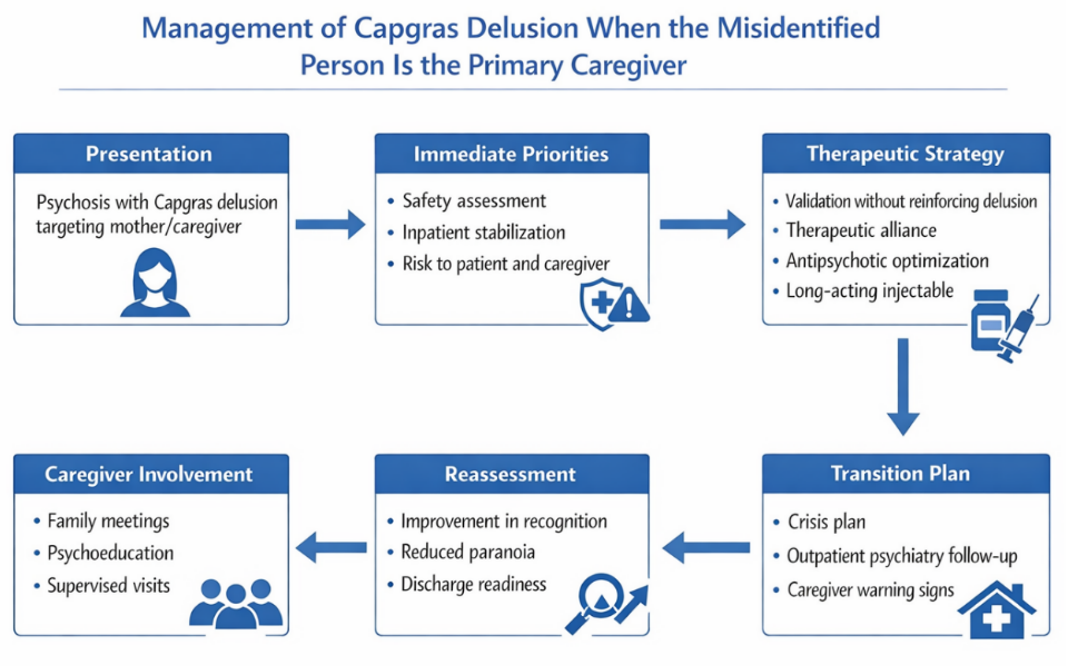
Figure 1: Structured management approach for Capgras delusion when the misidentified individual is the primary caregiver. The framework illustrates sequential treatment priorities including safety assessment, inpatient stabilization, therapeutic alliance development, antipsychotic optimization with long-acting injectable treatment, caregiver involvement, reassessment of symptom improvement, and discharge planning.
The patient was transferred to Southern Winds Hospital from Jackson Health, involuntarily under the Baker Act, initiated by law enforcement. As per the Baker Act, the patient “was observed sitting down on the road, wearing no shoes, and rocking his body back and forth. He seemed disoriented and stated vehicles were making him feel eerie.” Upon admission, the patient reported having a prior diagnosis of bipolar disorder and schizophrenia at the age of 21 and stated noncompliance with the medication regimen.
Upon evaluation, he appeared disheveled, exhibited disorganized behavior, and actively responded to internal stimuli. At this time, Capgras delusion was expressed; the patient stated, "I left home because my mother is not my mom. It was an imposter." This prompted the patient to leave home, raising concern for safety given impaired reality testing and caregiver misidentification. The patient's speech was soft and mumbled, and he exhibited poor insight and judgment. Lab results from Jackson Health included a negative urinalysis and urine toxicology screen. The initial treatment plan included: Risperidone 2 mg twice daily, Depakote 500 mg at bedtime, and Trazodone 100 mg for sleep.
On day 2 of hospitalization, the patient reiterated the Capgras delusion that the mother had been replaced by an impostor and mentioned it prompted him to leave home. His mood was anxious, and he remained disheveled, guarded, and suspicious. The patient endorsed command-type auditory hallucinations that “tell me the places I must visit. I must go play ball, go to Miami Beach, and scar my face”. Throughout the interview, the patient was seen actively responding to internal stimuli.
On day 3, the dose of Risperidone was increased to 3 mg twice daily to better target psychotic symptoms. Risperidone was initiated and later transitioned to a long-acting injectable to improve long-term adherence, given prior noncompliance. Invega Sustenna 234 mg was ordered for administration. These changes aimed to stabilize his condition more effectively and increase medication adherence in the outpatient setting. Capgras delusion persisted, and the patient expressed that the mother was a fish pretending to be his mother. Auditory hallucinations persisted.
Collateral information from his mother was obtained on day 5 of admission after multiple failed attempts to contact the mother during hospitalization. The mother indicated that the condition onset occurred during his high school years, and a prodromal period was noted in which the patient started to frequently use marijuana, social skills diminished, and academic decline was noted. The patient grew up in Miami, Florida, and during middle-school was academically very successful, which enabled his acceptance into a competitive STEM-focused high school. However, the patient was unable to complete high school and subsequently failed the GED exam, which he took in hopes of obtaining a high school diploma. The mother states that during her pregnancy with the patient, she went into labor at 7 months, but eventually labor was stopped, and the patient was delivered 3.5 weeks early. The patient has no history of accidents, seizures, or traumatic brain injury. However, the mother states that the patient once hit his head with a door while riding a bicycle as a teenager; no loss of consciousness occurred after the incident. As a child, the patient underwent 3 months of high fevers of unknown nature, and the mother reports that high carrot consumption as a toddler caused the patient’s skin to turn orange at one point. Two years ago, in 2023, the patient’s speech became disorganized at times following the passing of his stepfather. The mother states that the patient and the stepfather did not get along. The mother suggested that we ask the patient to write down his responses to our questions to achieve a more coherent response. As per the mother, the patient’s routine includes walking 5-7 miles a day, taking the bus to various places in South Florida, and attending swimming lessons. The mother mentions visiting the patient at the hospital during visiting hours and states that the patient does not talk much and appears suspicious of her. As per the mother, this is the first time the patient presents with Capgras delusion, and recalled an instance in which the patient was with friends and became unable to move his hands or feet, prompting a psychiatric hospitalization. The patient follows up with a psychiatrist in the outpatient setting and, according to the mother, has been compliant with medications.
By day 6, despite ongoing Capgras delusion, the patient showed signs of improvement, with a decrease in the intensity and frequency of the command-type auditory hallucinations. The patient said “Mom has a double, a nice lady that brings me clothes, but that is not my mother”.
On day 7, Invega Sustenna 156 mg was administered as per hospital protocol, and the patient became preoccupied with discharge. Auditory hallucinations were described as “grabby grabby” by the patient, and he reported interest in returning home with his mother, accurately noting his mother has been visiting the patient during visiting hours.
On day 8, command-type auditory hallucinations were reported by the patient, and speech became disorganized at times. The patient reported that his mother was visiting him at the unit and that "they need to get back home because they need to get under their own skin, as of right now, they are under the skin of a demented dinosaur". On day 9, command-type auditory hallucinations persisted, telling the patient to “stay awake” and “overcome fears”. The patient stated mother has been visiting the patient but reported “her face changes colors” sometimes.
On day 10, the patient expressed feeling unsure of the mother’s identity, saying, “Maybe she is my mom”. On day 11, the patient's Trazodone was increased to 200 mg at bedtime to further assist with sleep disturbances. By day 12, the patient reported no auditory or visual hallucinations. By discharge, the patient demonstrated improved recognition of his mother, allowing safe return to his primary support system. His mother was accurately identified, and the patient expressed interest in being discharged from the unit to attend a “massage appointment booked by mother.” He was deemed medically stable and was discharged on day 13 back to his home along with an appointment with an outpatient psychiatrist to follow up with information on his diagnoses, prescription of medications and instructions on who to call if in need of psychiatric help. The patient's case highlights the challenges of managing schizoaffective disorder with Capgras delusion and underscores the importance of comprehensive treatment and support. Throughout the course of hospitalization, multiple fluctuations were seen in this patient’s speech and thought process. It was essential to ensure that the patient could be discharged to a place where he felt safe, and that those around him could be safe.
Discussion
This case highlights a key clinical challenge in Capgras delusion: management becomes significantly more complex when the misidentified individual is the patient’s primary caregiver. In such cases, treatment must extend beyond symptom reduction to include restoration of a safe and functional caregiver relationship, which is essential for discharge and long-term stability. Capgras delusion, also known as a Delusional Misidentification Syndrome (DMS), is theorized to result from a disruption between the temporal cortex and the limbic system, allowing recognition without the expected emotional response, leading to the belief that a known individual has been replaced by an impostor [6]. In psychiatric illnesses such as schizoaffective disorder, the pathophysiology is further complicated by dopaminergic dysregulation, impaired reality testing, and affective instability [1]. Nonadherence to medication and psychosocial stress frequently contribute to symptom exacerbation. This structured management approach is summarized in Figure 1 and highlights key steps required to safely restore caregiver relationships in Capgras delusion
Capgras delusion is classified within DMS, a spectrum that also includes Fregoli syndrome, syndrome of subjective doubles, and reduplicative paramnesia [2]. Although uncommon, it is most often reported in schizophrenia, schizoaffective disorder, and other psychotic illnesses [3]. Neurological conditions such as Alzheimer’s disease, Lewy body dementia, frontotemporal dementia, and traumatic brain injury have also been implicated [4,5,7].
The exact prevalence of Capgras delusion remains unclear due to underrecognition and diagnostic challenges. Estimates suggest it affects approximately 2–8% of patients with schizophrenia or schizoaffective disorder [1,3]. Though relatively rare, the disorder’s clinical impact is disproportionate, as misidentification often targets close relatives or caregivers, thereby heightening emotional distress and risk.
Capgras delusion carries significant clinical risks, including paranoia, agitation, and potential violence toward the perceived impostor. Prior studies have documented associations with aggression, homicide, and impulsive behavior in severe cases [1,9]. In our patient, the delusion involved his mother, his primary caretaker, resulting in mistrust, disorganized thought processes, and exacerbation of hallucinations. The patient fled his home, triggered by the delusion and nonadherence to medications, further complicating stabilization. Risk assessment was central, as misidentification of a caregiver has been associated with increased risk of aggression and unsafe behavior. Studies have shown that emotional support significantly enhances therapeutic response in patients with schizoaffective disorder [10]. Our patient had a robust support system, which was jeopardized by the Capgras delusion. Validation without reinforcing the delusion allowed engagement while avoiding confrontation that could further erode trust. Prior to discharge, our goal was to ensure that our patient felt safe returning home and to their support system, while also highlighting the need for close inpatient monitoring and a multidisciplinary management approach.
The prognosis of Capgras delusion varies according to etiology, severity of comorbid psychiatric illness, and adherence to treatment. Improvement is more likely when treatment includes antipsychotics, mood stabilizers, and structured psychosocial support [6]. Our patient responded to risperidone titration and adjunctive use of long-acting injectable antipsychotics, though fluctuating delusions persisted throughout hospitalization. Transition to a long-acting injectable antipsychotic was prioritized to address known nonadherence and to support stability following discharge, particularly given the reliance on the caregiver. This underscores the chronic and relapsing course often seen in schizoaffective disorder and the importance of long-term follow-up to reduce relapse risk and improve functional outcomes.
The management of Capgras delusion presents unique ethical challenges. Patients may pose an imminent danger to caregivers they misidentify, raising questions about autonomy versus safety [9]. Involuntary hospitalization, under the Baker Act in this case, is often necessary to protect both patient and caregiver. Ethical responsibility also extends to caregiver support, as mistrust toward primary family members complicates discharge planning and continuity of care. The mother visited the patient throughout the stay in the inpatient unit, and the patient gradually recognized the caregiver, with the delusion dissipating by the time of discharge. In this case, we prioritized the safety of the patient and the caregiver by ensuring that risk assessment was done prior to discharge. Structured caregiver involvement served both diagnostic and therapeutic roles, allowing collateral clarification while gradually reintroducing the patient to the misidentified individual in a controlled setting. Discharge planning focused on ensuring the safety of both the patient and caregiver, including psychoeducation, identification of warning signs, and the establishment of outpatient follow-up. Rather than a purely multidisciplinary success, this case demonstrates that targeted, sequential management aimed at safety, adherence, and caregiver reintegration can restore both clinical stability and essential interpersonal functioning. Transparent communication, multidisciplinary collaboration, and provision of crisis resources are essential to uphold safety and dignity in management.
Conclusion
Capgras delusion results from a disruption between the temporal cortex and the limbic system, creating an incongruence between facial recognition and the emotional response of familiarity. This disconnect leads to the false belief that a known individual has been replaced by an impostor. In this case, a 25-year-old man diagnosed with a history of schizoaffective disorder, bipolar type, developed the fixed belief that his mother was replaced by an imposter, at one point describing her as a fish disguised in her form. His presentation was further complicated by auditory hallucinations, paranoia, and medication noncompliance. With inpatient stabilization and medication adjustments, his symptoms gradually improved, hallucinations resolved, and he was ultimately able to correctly recognize his mother. He was discharged home with outpatient psychiatric follow-up, written instructions, and crisis resources. This case highlights the fluctuating course of Capgras delusion, the distress it causes for both patients and caregivers, and the importance of timely recognition and treatment in improving outcomes.
References
- Pandis C, Agrawal N, Poole N. Capgras' Delusion: A Systematic Review of 255 Published Cases. Psychopathology, 2019; 52(3): 161–173. https://doi.org/10.1159/000500474.
- Ventriglio A, Bhugra D, De Berardis D, Torales J, Castaldelli-Maia JM, Fiorillo A. Capgras and Fregoli syndromes: delusion and misidentification. International review of psychiatry (Abingdon, England), 2020; 32(5-6): 391–395. https://doi.org/10.1080/09540261.2020.1756625.
- Grover S, Yadav N, Saini Y, Sharma N. Misidentification syndrome: A narrative review. Industrial Psychiatry Journal. Advance online publication, 2025. https://doi.org/10.4103/ipj.ipj_293_24.
- Cannas A, Meloni M, Mascia MM, Solla P, Cocco L, Muroni A, et al. Capgras syndrome in Parkinson's disease: two new cases and literature review. Neurological sciences: official journal of the Italian Neurological Society and of the Italian Society of Clinical Neurophysiology, 2017; 38(2): 225–231. https://doi.org/10.1007/s10072-016-2765-9.
- Cressot C, Vrillon A, Lilamand M, Francisque H, Méauzoone A, Hourregue C, et al. Psychosis in Neurodegenerative Dementias: A Systematic Comparative Review. Journal of Alzheimer's disease : JAD, 2024; 99(1): 85–99. https://doi.org/10.3233/JAD-231363.
- Currell EA, Werbeloff N, Hayes JF, Bell V. Cognitive neuropsychiatric analysis of an additional large Capgras delusion case series. Cognitive neuropsychiatry, 2019; 24(2): 123–134. https://doi.org/10.1080/13546805.2019.1584098
- Margariti C, Mircea MT. Capgras Syndrome in Dementia: A Systematic Review of Case Studies. Current Alzheimer research, 2024; 21(5): 312–323. https://doi.org/10.2174/0115672050335918240919073012.
- Naasan G, Shdo SM, Rodriguez EM, Spina S, Grinberg L, Lopez L, et al. Psychosis in neurodegenerative disease: differential patterns of hallucination and delusion symptoms. Brain: a journal of neurology, 2021; 144(3): 999–1012. https://doi.org/10.1093/brain/awaa413.
- Trotta S, Mandarelli G, Ferorelli D, Solarino B. Patricide and overkill: A review of the literature and case report of a murder with Capgras delusion. Forensic Science, Medicine and Pathology, 2021; 17: 271–278. https://doi.org/10.1007/s12024-020-00314-4.
- Jian C-R, Chang Y-P, Lin C-Y, Yen C-F. Assessing perceived emotional social support in individuals with schizophrenia or schizoaffective disorder: The Multisource Emotional Support Inventory. Taiwanese Journal of Psychiatry, 2023; 37(3): 127–134. https://doi.org/10.4103/TPSY.TPSY_24_23.