
Email id: info@ijclinmedcasereports.com
Hepatic Epithelioid Hemangioendothelioma: A Diagnostic Mimic on Liver Imaging
Asmae Guennouni*, Ihssane Laasri, Soukaina Bahha, Rachida Latib, Youssef Omor and Sanae Amalik
Radiology Resident, Department of Radiology, National Institute of Oncology, University Hospital Center Ibn Sina, Rabat, Morocco
Received Date: 30/05/2026; Published Date: 17/08/2026
*Corresponding author: Asmae Guennouni, Radiology Resident, Department of Radiology, National Institute of Oncology, University Hospital Center Ibn Sina, Rabat, Morocco
Abstract
Hepatic epithelioid hemangioendothelioma (HEHE) is a rare vascular tumor with low-grade malignant potential, characterized by non-specific clinical and radiological features that frequently lead to misdiagnosis. We report the case of a 77-year-old man presenting with epigastric pain, weight loss, and multifocal liver lesions on imaging, initially suggestive of hepatocellular carcinoma. Further investigations revealed chronic hepatitis C infection and elevated alpha-fetoprotein levels; however, portal trunk invasion rendered chemoembolization unsuitable. Histopathological and immunohistochemical analysis of a liver biopsy confirmed the diagnosis of HEHE. After multidisciplinary team discussion, the patient was referred for systemic chemotherapy as a therapeutic option. This case highlights the diagnostic challenges of HEHE and emphasizes the importance of integrating imaging findings, clinical context, and histopathological confirmation for accurate diagnosis and management.
Keywords: Liver tumor; Hepatic epithelioid hemangioendothelioma (HEHE); Vascular neoplasm; Imaging
Introduction
Epithelioid hemangioendothelioma accounts for less than 1% of vascular tumors and exhibits a broad spectrum of clinical presentations. Its hepatic form is a relatively rare low-grade malignant neoplasm, with an estimated incidence of approximately one case per million inhabitants. Hepatic epithelioid hemangioendothelioma (HEHE) typically evolves slowly and insidiously, and is often diagnosed at a stage when multiple lesions are already present. Because of its extreme rarity, HEHE is frequently misdiagnosed, as it may be mistaken for other benign or malignant vascular or epithelial tumors.
Case Report
We report the case of a 77-year-old man with a history of cholecystectomy in 2022, who presented three months earlier with epigastric pain and dyspeptic symptoms, along with general health deterioration and unquantified weight loss. Clinical examination revealed a soft abdomen with a subcostal laparotomy scar, no abdominal distension, and normal neurological and cardiovascular findings.
Initial imaging showed multifocal hepatic lesions suggestive of Hepatocellular Carcinoma (HCC). Laboratory tests confirmed hepatitis C virus infection and elevated alpha-fetoprotein levels.
Abdominal CT revealed a dysmorphic liver consistent with chronic liver disease and signs of portal hypertension, along with multiple hepatic masses: five in segment IV (the largest measuring 45 mm), two in the left lobe (14 mm), and two in segment VII, all in a cirrhotic liver. The lesions were hypervascularized with portal phase wash-out. No thoracic involvement was detected. Hepatitis B serology was negative, while hepatitis C serology and viral RNA were positive (viral load: 1,202,568.56 IU/mL).
Tumor markers showed elevated alpha-fetoprotein (16.16 ng/mL) and hypoalbuminemia (33 g/L). A diagnosis of multifocal HCC was initially suspected due to the imaging wash-out and the background of chronic liver disease.
MRI demonstrated hypervascular hepatic masses with lipiodol uptake and late wash-out, associated with invasion of the portal trunk (Figure 1, 2), precluding further chemoembolization.
The case was discussed at a multidisciplinary tumor board, and liver biopsy was recommended. Histopathological and immunohistochemical analysis confirmed features consistent with hepatic epithelioid hemangioendothelioma. The patient was referred for systemic chemotherapy, with MELD score calculation and further therapeutic planning.
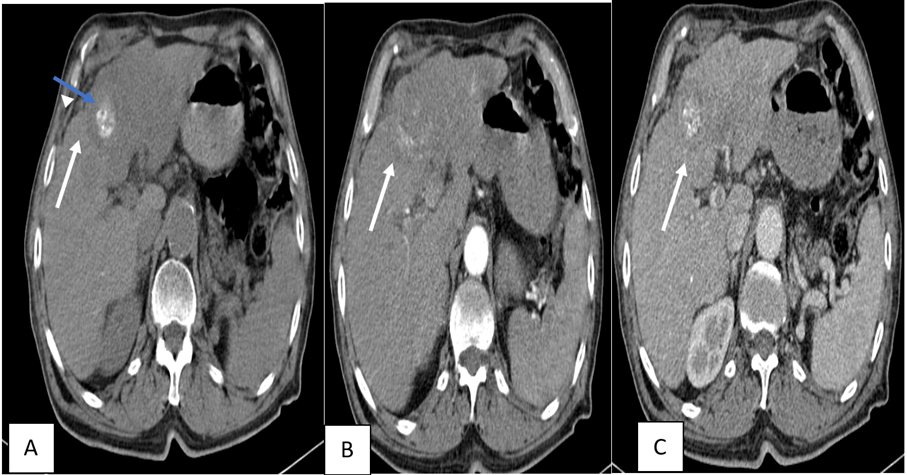
Figure 1: Axial abdominal CT scan without contrast injection (A) showing a hepatic mass containing spontaneously hyperdense Lipiodol (blue arrow), with mild enhancement in the arterial phase (B) and wash-out in the portal phase (C), in the context of chronic liver disease.
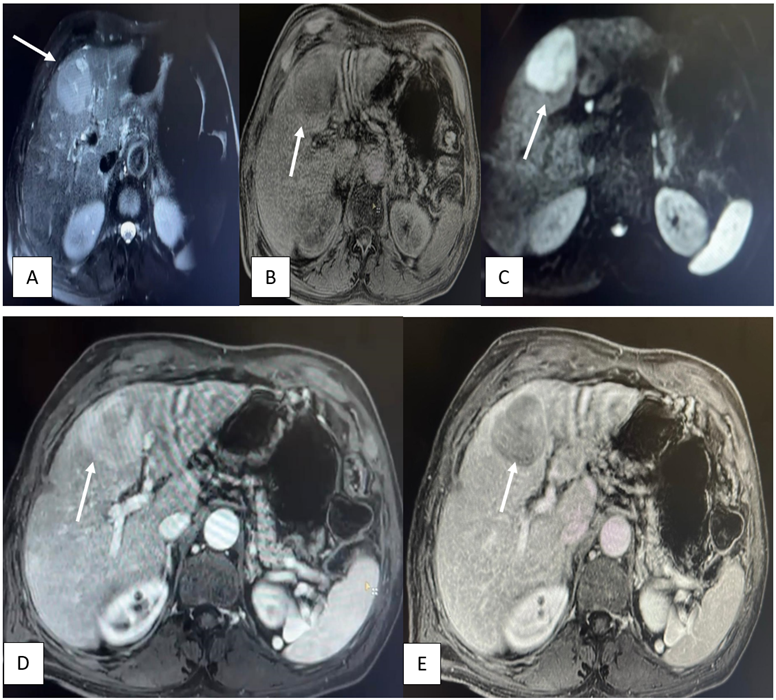
Figure 2: Liver MRI showing a mass in segment V appearing hyperintense on T2 STIR (A), hypointense on T1 (B), diffusion restricted (C), with arterial phase enhancement (D) and portal phase wash-out (E).
Discussion
Malignant epithelioid hemangioendothelioma is a rare vascular endothelial tumor with variable malignant potential, whose biological behavior lies between that of benign hemangiomas and highly aggressive angiosarcomas. This entity is exceptionally uncommon [1]. Its clinical course is unpredictable and may sometimes exhibit aggressive behavior. The tumor can originate from various organs including the liver, lungs, bones, breast, lymph nodes, skin, and head-and-neck regions. It most commonly occurs between the ages of 30 and 50 years [2].
Hepatic involvement is relatively rare, with approximately 200 cases reported in the literature. Because of its rarity, HEHE is frequently misdiagnosed on imaging as cholangiocarcinoma or metastatic disease, as in our patient, leading to diagnostic delay. According to the WHO 2002 classification, epithelioid hemangioendothelioma is considered a locally aggressive tumor with metastatic potential [3].
The exact cause of HEHE remains unknown. Suggested risk factors include exposure to vinyl chloride, polyurethane, and silica; oral contraceptive use; primary biliary cirrhosis; viral hepatitis; asbestos exposure; and alcohol consumption. A specific chromosomal translocation, t(1;3)(p36;q25), has been identified in HEHE, but the mechanism by which fusion transcripts contribute to tumorigenesis remains poorly understood [4].
Clinical presentation is usually non-specific, with weight loss and right upper quadrant discomfort being the most common symptoms. Less frequently, jaundice and hepatic failure may occur, typically related to massive tumor infiltration [3]. Liver function tests and tumor markers (AFP, CEA, CA 19-9) are often within normal ranges, limiting their diagnostic value [4].
On ultrasound, lesions are often hypoechoic. Contrast-Enhanced Ultrasound (CEUS) improves detection of multifocal lesions, typically demonstrating marked arterial phase enhancement followed by wash-out in the portal and delayed phases [5].
On CT, lesions are usually peripheral or subcapsular, hypodense compared with normal liver parenchyma. Capsular retraction and calcifications may be present. Post-contrast, three enhancement patterns are described:
- < 2 cm: homogeneous persistent enhancement,
- 2–3 cm: peripheral enhancement with progressive centripetal fill-in (“halo sign”),
- ≥ 3 cm: heterogeneous progressive enhancement.
Tumoral infiltration of hepatic or portal venous branches produces the characteristic “lollipop sign” [6].
MRI is more sensitive than CT for small lesions. Typically, lesions appear hypointense on T1, hyperintense on T2, and demonstrate the “target sign” in more than half of cases. Post-contrast, ring-like or target-like enhancement is observed. On hepatobiliary phase imaging, lesions appear hypointense or may show delayed central enhancement. Diffusion-weighted imaging (DWI) demonstrates peripheral hyperintensity with lower central signal, and ADC values are generally higher than those seen in hepatocellular carcinoma [1].
Definitive diagnosis relies on histopathology, which shows a mixture of epithelioid, dendritic, and intermediate cells with vacuolated cytoplasm sometimes containing erythrocytes, and hyperchromatic nuclei. Immunohistochemistry typically demonstrates positivity for CD31, CD34, and ERG, with Ki-67 useful for assessing proliferative activity. Keratin expression may also be present [8].
Lipiodol (Ethiodol) is an iodized oil known to localize selectively in hepatocellular carcinoma (HCC) cells and tumor vasculature for weeks to months following intra-arterial hepatic injection [9]. Its uptake in hepatic tumors is based on arterial vascularization and sinusoidal permeability. Being a lipophilic contrast medium, it preferentially accumulates in hypervascularized tumor tissues such as HCC, allowing precise visualization on CT or MRI after intra-arterial injection [10].
Lipiodol retention in tumors is more prolonged than in healthy liver parenchyma, making it useful for evaluating tumor necrosis after treatment, particularly following transarterial chemoembolization (TACE) [11]. Uptake varies by tumor type: it is usually intense and homogeneous in small HCCs, heterogeneous in larger lesions, minimal in hemangiomas, and variable in metastases depending on vascularization. For rare tumors such as hepatic epithelioid hemangioendothelioma, data on Lipiodol uptake are scarce, with no dedicated literature reviews, and its diagnostic or therapeutic role remains unclear [12].
In our case, the hepatic lesion was initially treated as HCC with Lipiodol-based chemoembolization. It was only after multidisciplinary tumor board review that a biopsy was recommended, which confirmed HEHE.
Between 60–80% of HEHE cases are initially misdiagnosed, with the most common differential diagnoses being metastases, angiosarcoma, sclerosing hepatocellular carcinoma, and cholangiocarcinoma [13].
First-line treatment is hepatic resection when technically feasible and when disease is localized [14]. In cases of diffuse, bilobar, or unresectable disease, liver transplantation is the treatment of choice, with reported 5-year survival ranging between 55–75%. For advanced or metastatic forms, systemic chemotherapy (doxorubicin, ifosfamide, gemcitabine, paclitaxel) has shown variable, mostly partial, responses [15]. Targeted anti-angiogenic therapies (sorafenib, pazopanib, bevacizumab) and immunotherapy with PD-1/PD-L1 inhibitors have provided encouraging results in small series and case reports. Transarterial embolization (TACE) may be used palliatively to slow disease progression or control symptoms [16]. Finally, in selected asymptomatic patients with indolent disease, close radiological surveillance may be considered.
In our case, the multiplicity and extent of the lesions led to a therapeutic approach combining capecitabine and bevacizumab chemotherapy, with liver transplantation planned as a subsequent option.
Conclusion
Hepatic epithelioid hemangioendothelioma is an extremely rare vascular tumor with highly variable biological behavior and nonspecific clinical and imaging features, often leading to misdiagnosis. In our case, the tumor initially mimicked multifocal hepatocellular carcinoma, resulting in delayed diagnosis. Definitive confirmation requires histopathology and immunohistochemistry, which remain the gold standard. Awareness of this entity is crucial for radiologists and clinicians, as early recognition may guide appropriate management and improve patient outcomes. Treatment should be tailored according to disease extent, ranging from surgical resection or transplantation in localized cases to systemic chemotherapy or targeted therapies in advanced stages.
References
- Malik M, Idrees RB, Mirza Z, Anwar S, Ahmad B, Chaudhary MH. Rare Encounter with Hepatic Epithelioid Hemangioendothelioma: A Case Report. Cureus, 2025. doi: 10.7759/cureus.80567.
- Sagar RD. Malignant Epithelioid Hemangioendothelioma: A Rare Case Report. no 10, 2021.
- Huda T, Parwez MM, Pandya B. Metastatic Hepatic Epitheloid Hemangioendothelioma in a Young Male: A Rare Presentation. Gastrointest Tumors, 2021; 8 (no 2): p. 58‑62. doi: 10.1159/000513963.
- Kou K, et al. Hepatic epithelioid hemangioendothelioma: Update on diagnosis and therapy. WJCC, 2020; 8 (no 18): p. 3978‑3987. doi: 10.12998/wjcc.v8.i18.3978.
- Dong Y, et al. Contrast-enhanced ultrasound of histologically proven hepatic epithelioid hemangioendothelioma. WJG, 2016; 22 (no 19): p. 4741. doi: 10.3748/wjg.v22.i19.4741.
- Alomari AI. The lollipop sign: A new cross-sectional sign of hepatic epithelioid hemangioendothelioma. European Journal of Radiology, 2006; 59 (no 3): p. 460‑464. doi: 10.1016/j.ejrad.2006.03.022.
- Paolantonio P, et al.MRI of Hepatic Epithelioid Hemangioendothelioma (HEH): MRI of (HEH). Magn. Reson. Imaging, 2014; 40 (no 3): p. 552‑558. doi: 10.1002/jmri.24391.
- Deng C, et al. Hepatic epithelioid hemangioendothelioma, a rare liver tumor: a case report and review of the literature. Oncol., 2025; 15: p. 1522002. doi: 10.3389/fonc.2025.1522002.
- Yumoto Y, Jinno K, Tokuyama K, et al. Hepatocellular carcinoma detected by iodized oil. Radiology, 1985; 154: 19-24.
- Llovet JM, Bruix J. "Systematic review of randomized trials for unresectable hepatocellular carcinoma: chemoembolization improves survival." The Lancet, 2003; 362: 1907–1917.
- Vogl TJ, Zangos S, Goehl J, et al. "Transcatheter oily chemoembolization of hepatocellular carcinoma." Radiology, 2002; 224(1): 115–125.
- Lau WY, Lai EC. Adjuvant intra-arterial iodine-131-labeled lipiodol for resectable hepatocellular carcinoma: a prospective randomized trial. Ann Surg, 2008; 247(1): 43–48.
- Studer LL, Selby DM. Hepatic Epithelioid Hemangioendothelioma. Archives of Pathology & Laboratory Medicine, 2018; 142 (no 2): p. 263‑267. doi: 10.5858/arpa.2016-0171-RS.
- Makhlouf HR, Ishak KG, Goodman ZD. Epithelioid hemangioendothelioma of the liver: a clinicopathologic study of 137 cases. Am J Surg Pathol, 1999; 23(1): 1–13.
- Lau WY, Leung TW, Ho SKW, et al. Epithelioid hemangioendothelioma of the liver: a rare hepatic tumor. World J Surg, 2007; 31(6): 1115–1121.
- Farges O, Bismuth H, et al. Treatment of hepatic epithelioid hemangioendothelioma: report of 12 cases and review of the literature. J Hepatol, 2001; 34(2): 225–235.