
Email id: info@ijclinmedcasereports.com
Hyperbilirubinemia and Hepatomegaly Secondary to Escitalopram Use: A Diagnosis of Exclusion
Navin Patil1, Samira Abdul Wajid2, Shanti Gurung3 Samith Ahmed4,*, Suraiya Abdul Wajid5, Aravind Pasupathi Ganesan6, Lina Kouam6, Fernandez Onyeuche6, Justin Singh6, Serra Taban6 and Patricio Gratuito Jr7
1Professor/Chair Department of Preclinical Sciences, Windsor University School of Medicine, St Kitts
2Professor Microbiology and Director of SASP, Windsor University School of Medicine, St Kitts
3Associate Professor, Department of Preclinical Sciences, Windsor University School of Medicine, St Kitts
4Professor /Chair Department of Pathophysiology, Windsor University School of Medicine, St Kitts
5Postgraduate student Pathology, Srinivas Institute of Medical Sciences and Research Centre, Mangalore, India
6Undergraduate student, Windsor University School of Medicine, St Kitts
7Undergraduate MD5 student
Received Date: 22/05/2026; Published Date: 03/08/2026
*Corresponding author: Dr. Samith Ahmed, Professor /Chair Department of Pathophysiology, Windsor University School of Medicine, St Kitts
Abstract
Background: Psychiatric medications are like a double-edged sword, and this is usually a challenge for psychiatrists, as most psychiatric drugs are known to cause various adverse effects. Escitalopram, a well-known SSRI is known to cause a wide range of side effects, some of which include; nausea, fatigue, constipation, dizziness, and diaphoresis. It is also known to cause sexual dysfunctions in the form of decreased libido and delayed ejaculation. There are only a few reports on escitalopram-induced alteration in liver function tests. Therefore, we report a case of escitalopram-induced hepatitis in a patient from a tertiary care hospital in southern India.
Case Presentation: We report the case of an eighteen-year-old male with a past medical history of Obsessive-Compulsive disorder who was diagnosed with Schizotypal Personality Disorder and treated with Nexito (Escitalopram), Sulpitac (Amisulpride), and Lonazep (Clonazepam). Three months later, the patient presented with hepatomegaly and abnormal Liver function test results. Other causes of liver injury such as tropical infections, alcoholic liver disease, fatty liver, a biliary obstruction that mimics DILD, and other concomitant drug-causing liver abnormalities were ruled out thereby, leaving a diagnosis of Escitalopram-induced hepatomegaly and liver injury.
Conclusion: SSRIs such as Escitalopram are a widely used class of medications used in the treatment of various psychiatric diseases. With this knowledge, thorough monitoring of the patient’s liver function should be kept in view as there are newly reported cases of SSRI-induced liver injury occurring in patients prescribed this class of medications.
Keywords: Antidepressants; Hepatotoxicity; Adverse drug reaction; Naranjo’s scale
Abbreviations: SPD - Schizotypal Personality Disorder; SSRI - Selective Serotonin Reuptake Inhibitor; LFT - Liver Function Test; DILD: Drug-Induced Liver Disease; SERT – Serotonin Reuptake Transporter
Introduction
Schizotypal personality disorder, characterized by a lack of social relatedness and communication, strange beliefs, odd behavior, eccentric appearances, extreme social anxiety, paranoia, and inappropriate affect is defined as “a pervasive pattern of social and interpersonal deficits distinguished by acute discomfort with, and decreased capacity for, close relationships alongside cognitive or perceptual distortions and eccentricities of behavior”. It usually begins in early adulthood and presents in diverse ways. SPD many times, co-occurs with major depressive disorder, obsessive obsessive-compulsive dysthymia, and generalized social phobia [1]. Schizotypal patients are therapeutically challenged with low doses of antipsychotics, like thiothixene or SSRIs, like escitalopram or sertraline. Individual drug therapy remains the preferred mode of treatment with recent literature evidence throwing light on group therapy and rehabilitation in form of support groups [2].
Escitalopram, a well-known SSRI is known to cause various side effects some of which include, fatigue, constipation, dizziness, and increased sweating. It is also known to cause sexual dysfunctions in the form of decreased libido and delayed ejaculation. [2] Available reports on escitalopram-induced alteration in Liver function tests are limited. Therefore, we report a case of escitalopram-induced hepatitis in a patient from a tertiary care hospital in southern India
Case History
An eighteen-year-old male patient, presented with complaints of blasphemous and distressing thoughts with difficulty in concentrating on his studies for one week. His complaints included of lack of focus, especially while writing which was associated with rolling his eyes, being preoccupied with trivial thoughts, auditory hallucinations which were derogatory in nature, aggressive behavior like spitting or slapping, sad mood, and suicidal thoughts. He also had a religious-themed preoccupation with Sai Baba which were obsessive in nature, and he found them distressing and distracting. His past medical history revealed a childhood onset of an obsessive-compulsive disorder comprising especially an obsession with contamination and cleaning compulsions. He was treated with olanzapine, quetiapine, amitriptyline, amisulpride, and topiramate two years prior. His social history reveals he is not a smoker, or alcoholic and has no history of substance abuse.
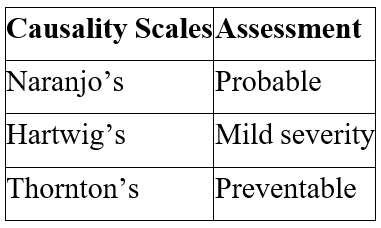
On general examination, the patient was found to be well-oriented to time, place, and person. There was no memory deficit and he had good insight regarding his condition and the content of thought-persecutory ideas and depressive cognitions. His vital signs were stable and the other system examinations were normal. He was diagnosed to be a case of SPD and was admitted for evaluation. Treatment was started with tab Nexito (20+10mg), tab Sulpitac (400mg), tab Lonazep (0.5mg). All baseline investigations were normal before the start of treatment and on subsequent laboratory investigations, total bilirubin was elevated on 2/8/2017 (Table 1). Complete blood count, electrolytes, and thyroid function tests were normal. In addition, an ultrasound was performed, and it reported Hepatomegaly with a liver span of 15.4 cm in the midclavicular line. A repeat Liver Function Test on 04/08/2017 was conducted (Table 1). As a result of this, Drug-Induced Liver Disease (DILD) caused by escitalopram was suspected. On the evaluation of hepatomegaly and altered liver parameters, all other causes such as tropical infections, alcoholic liver disease, fatty liver, a biliary obstruction that mimics DILD, and other concomitant drug-causing liver abnormalities were ruled out. Finally, a diagnosis of escitalopram-induced hepatotoxicity was made and causality, severity, and preventability assessment were made as per Naranjo’s, Hartwig’s, and Thornton’s scales respectively.
Table 1: Liver Functions Test.
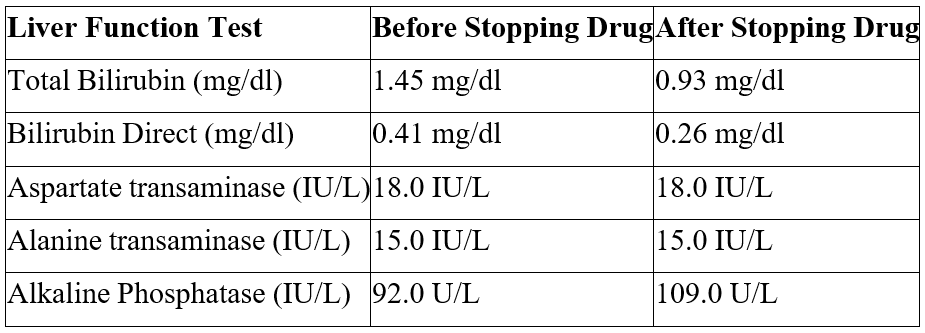
Table 2: Causality Assessment.
Discussion
SPD is a psychiatric disorder a with multidimensional construct and consists mainly of three-factor solutions among the well-established nine-factor diagnostic criteria, which include cognitive-perceptual, interpersonal and disorganized/oddness [3]. The prevalence of SPD in the United States of America is almost 4% with men having higher rates compared to women. SPD shows a strong association with bipolar disorder, narcissistic personality disorder, and with post-traumatic stress disorder [4]. Pathogenesis mainly revolves around environmental factors like self-inflicted trauma in patients with increased dopamine degradation, genetic causes like COMTVa1158Met polymorphisms, variations in the CACNAIC gene which encodes the protein pertinent for the function of the L-type calcium channel, and disruption of DISC 1 gene involved in the neuronal cell developed shares the dread [5,6]. Treatment of SPD consists of two arms namely pharmacotherapy and psychotherapy with the former consisting of antipsychotics, anxiolytics, antidepressants, and mood stabilizers whereas the latter comprising of supportive therapy, cognitive behavioral therapy, and family therapy respectively. Based on the current literature, there is no clear-cut guideline or definitive recommendation from the Food and Drug Administration regarding the use of a specific class of drugs as first-line therapy for treating SPD. Consequently, the prescribing pattern in patients with SPD largely depends on the physician’s clinical judgment and the patient’s presenting symptomatology.
Escitalopram is a selective serotonin reuptake inhibitor used in the treatment of major depression and anxiety. It is used in the treatment of SPD when depression is the major cause. It acts by binding to the Human Serotonin Reuptake Transporter (SERT) and inhibits the reuptake of serotonin thereby increasing the level of serotonin in the synaptic cleft. This action is responsible for the anti-depressive action of escitalopram. Adverse effects associated with this drug are usually mild and very less. Major adverse effects include insomnia, nausea, vomiting, electrolyte disturbances, somnolence, dry mouth, and decreased libido [2]. Alterations in liver parameters resulting in liver disorders are usually very rare and are underreported all around the world. There are only a few studies done to find the association of SSRI with liver function alteration and only a few case reports have been reported so far with escitalopram [7]. Cases of antidepressant-induced liver injury are known but the incidence, prevalence, and severity are not well known. SSRIs are known to have the least potential in causing liver injury when compared to other antidepressants that can cause liver failure leading to death. Antidepressant-induced liver injury is usually a diagnosis of exclusion as it resembles various disorders like nonalcoholic fatty liver, alcoholic liver disease, hepatitis C, and biliary tract obstruction. It usually presents with an increase in liver function test results along with a two-fold increase in bilirubin level. Patient age, choice of anti-depressant, chronicity of use is and some factors that should be considered before diagnosing DILD. The main type of liver injury is usually hepatocellular damage rather than cholestatic and the main mechanism attributed is metabolic and immune sensitivity. A three-fold increase in ALT with a two-fold increase in bilirubin is one of the well-known diagnostic criteria for diagnosing DILD and is highly reliable with increased sensitivity and specificity [8].
In our patient, elevated bilirubin with hepatomegaly was noted after 3 months of treatment with escitalopram. All other causes of liver abnormality were ruled out and DILD due to escitalopram was suspected. It was similar in comparison to reports previously published which claimed antidepressant-induced liver injury usually is not of the conjugated type and is usually related to immune sensitivity and hepatocellular type [8]. Other drugs causing DILD were ruled out. As shown in [Table 2] a probable causal relationship was ascribed as per Naranjo’s scale and the adverse reaction was found to be of mild severity and preventable as per Hartwig’s and Thornton’s scale respectively [9].
Conclusion
Anti-depressants are the mainstay of treatment for depression as well as personality disorders caused by depression. Keeping this in view, the chronicity of usage of this class of drugs, and evaluation of liver function should be of foremost importance in patients being treated with them as few grave instances leading to liver failure and death have been reported in published literature. Since the liver abnormalities induced by this class of drugs are under-reported, proper clinical studies can be undertaken to find out the incidence, prevalence, severity, and of liver abnormalities caused by different classes of anti-depressants.
References
- Rosell DR, Futterman SE, McMaster A, Siever LJ. Schizotypal personality disorder: a current review. Current psychiatry reports, 2014; 16(7): 452.
- Kirino E. Escitalopram for the management of major depressive disorder: a review of its efficacy, safety, and patient acceptability. Patient preference and adherence, 2012; 6: 853.
- Hummelen B, Pedersen G, Karterud S. Some suggestions for the DSM-5 schizotypal personality disorder construct. Compr Psychiatry, 2012; 53: 341–349.
- Pulay AJ, Stinson FS, Dawson DA, et al. Prevalence, correlates, disability, and comorbidity of DSM-IV schizotypal personality disorder: results from the wave 2 national epidemiologic survey on alcohol and related conditions. Prim Care Companion J Clin Psychiatry, 2009; 11: 53–67.
- Docherty AR, Sponheim SR. Anhedonia as a phenotype for the Val158Met COMT polymorphism in relatives of patients with schizophrenia. J Abnorm Psychol, 2008; 117: 788– 798.