
Email id: info@ijclinmedcasereports.com
Incidental Discovery of Pulmonary Artery Dissection in a 60-Year-Old Female Patient: A Rare Case Report
Soukaina Bahha*, Mariam Al Yandouzi, Salma El Aouadi, Asmae Guennouni, Ittimade Nassar and Kaoutar Imrani
Central Radiology Department, Ibn Sina Hospital Center, Rabat, Morocco
Received Date: 19/05/2026; Published Date: 24/07/2026
*Corresponding author: Soukaina Bahha, Central Radiology Department, Ibn Sina Hospital Center, Rabat, Morocco
Abstract
Pulmonary Artery Dissection (PAD) is a rare but potentially fatal condition, most commonly associated with Pulmonary Arterial Hypertension (PAH). Its diagnosis is often made post-mortem due to its nonspecific clinical presentation and rapid progression. However, with advances in imaging, incidental detection in asymptomatic individuals has become increasingly possible.
We report the case of a 60-year-old woman with no significant medical or surgical history who developed progressive exertional dyspnea following a flu-like illness. Concerned about her worsening symptoms, she underwent a transthoracic echocardiogram, which revealed signs of pulmonary arterial hypertension. She was referred for further evaluation, and a thoracic CT scan was performed. Imaging findings were consistent with a chronic pulmonary artery dissection, discovered incidentally in a hemodynamically stable and asymptomatic patient.
This case highlights the importance of comprehensive cardiovascular assessment in patients presenting with unexplained dyspnea, particularly in the context of suspected pulmonary hypertension. It also underscores the role of advanced imaging modalities such as CT scanning in diagnosing complex pulmonary vascular conditions like pulmonary artery dissection, which may not be fully appreciated on echocardiography alone. Early diagnosis is critical to optimizing patient outcomes in this potentially life-threatening condition.
Keywords: Pulmonary Artery Dissection; Incidental Discovery; Intimal flap; CT Angiography
Introduction
Pulmonary artery dissection is extremely rare and has been reported in less than 100 patients, most of them diagnosed postmortem [1]. Pulmonary Artery Dissection (PAD) should be considered among the potential diagnoses in patients who present with symptoms such as dyspnea and chest pain, with or without cyanosis. This is particularly important in men in their 30s and 40s and women in their 40s and 50s, where an age- and sex-related pattern has been observed. When Pulmonary Hypertension (PHT) is also present, the likelihood of PAD increases significantly. In such cases, rapid imaging—beginning with chest radiography and Transthoracic Echocardiography (TTE), followed by a Computed Tomography (CT) scan—is strongly recommended. The main pulmonary artery is the most frequent site of dissection. The preferred therapeutic approach involves emergency surgical intervention or an initial phase of medical stabilization followed by surgery, with reported success rates exceeding 90%. For patients who are not surgical candidates or decline the procedure, conservative medical treatment may still result in favorable outcomes, with success rates approaching 70% [2].
Case Report
We present the case of a 60-year-old female patient with no significant past medical or surgical history. Approximately one month prior to presentation, she experienced an episode of flu-like illness. Following this event, she developed persistent exertional dyspnea, which progressively worsened over the following weeks. Concerned about her symptoms, the patient sought evaluation from a cardiologist. During the cardiology consultation, a Transthoracic Echocardiogram (TTE) was performed. The echocardiographic assessment revealed signs consistent with Pulmonary Arterial Hypertension (PAH), including elevated pulmonary artery pressures and possible right ventricular strain. Given these findings, the patient was referred to our center for further diagnostic evaluation and management. At our facility, a thoracic Computed Tomography (CT) scan was ordered to provide more detailed imaging of the pulmonary vasculature and to investigate any potential structural abnormalities. The CT scan revealed an intimal flap in the intermediate and lower lobar branches of the right pulmonary artery (Figures 1, 2), with thrombosis of the false lumen (Figure 3), which appeared partially calcified. Additionally, the scan showed a reversed aorta-to-pulmonary artery ratio (>1), right atrial enlargement, and dilatation of the main pulmonary artery trunk measured at 34 mm of diameter (Figure 4). Given the patient's hemodynamic stability and lack of comorbidities, an initial conservative medical approach was adopted, including anticoagulation therapy as well as endothelin receptor antagonists and phosphodiesterase-5 inhibitors to manage pulmonary hypertension.
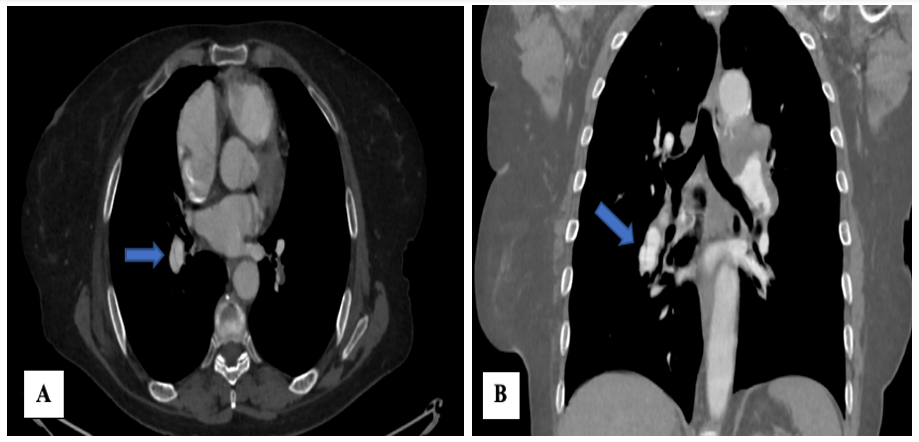
Figure 1: Axial (A) and coronal (B) slices of contrast-enhanced chest CT showing an intimal flap in the intermediate and lower lobar branches of the right pulmonary artery.
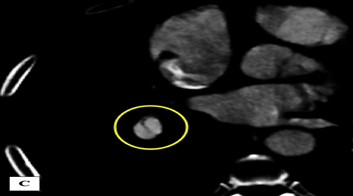
Figure 2: Image C shows an enlarged view of Image A, clearly displaying the intimal flap at the level of the intermediate lobar branches of the right pulmonary artery.
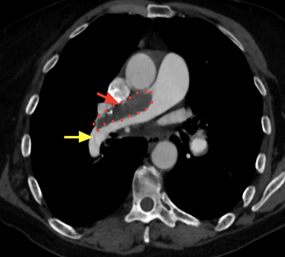
Figure 3: Axial slice of contrast-enhanced chest CT showing the thrombosis of the false lumen, which appeared partially calcified (red arrow and red dotted lines), and the intimal flap in the intermediate lobar branche of the right pulmonary artery (yellow arrow).
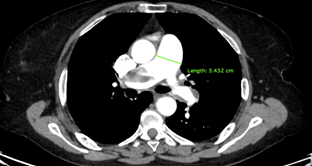
Figure 4: Axial slice of contrast-enhanced chest CT showing dilatation of the main pulmonary artery trunk (measured at 34 mm of diameter).
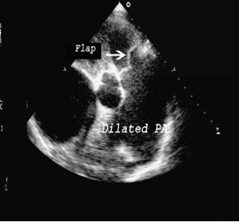
Figure 5: 2D transthoracic echocardiogram in a short axis oblique view showing a greatly dilated main pulmonary artery (PA) with an intimal flap (white arrow) [7].
Discussion
Dissection of the pulmonary artery is a rare condition with less than 100 reported cases in the literature. The vast majority of these are found in autopsies [1]. Pulmonary artery dissection can occur in both sexes, with a slight female predominance (male-to-female ratio of 1:1.2). The age of onset ranges from 26 days to 85 years, with incidence peaks observed in the third and sixth decades of life [3]. Inayama et al. [3] reported that in 72% of cases, dissections occur in the main pulmonary trunk. Less frequently affected sites include the intrapulmonary arteries (10%), the combination of the trunk and right main artery (6%), the left main artery (6%), the right main artery alone (4%), and both main arteries along with the trunk (2%). The initiating mechanism of arterial dissection is typically a rupture of the intima extending into the media, allowing blood to infiltrate the medial layer and form a false lumen. It is important to note that the media of the pulmonary artery is significantly thinner than that of the aorta, due to the lower resistance in the pulmonary circulation. As a result, in cases of pulmonary artery dissection, the false lumen is more likely to rupture rather than develop a re-entry site, which is more commonly seen in aortic dissections [4]. The leading cause is congenital heart disease, with persistent ductus arteriosus being the most frequent form. However, other contributing factors can include primary or secondary pulmonary hypertension, vascular inflammation, aorto-pulmonary fistulas, connective tissue disorders, and vessel wall damage resulting from catheterization [1]. Pulmonary artery dissection should be suspected in the presence of certain signs, particularly sudden-onset chest pain, the appearance of a new hilar mass, and the identification on imaging of an intimal flap or both true and false lumens, especially in patients with chronic pulmonary hypertension [3]. In the present case, the patient did not exhibit chest pain; the clinical presentation was limited to persistent dyspnea. Several non-invasive imaging techniques are utilized to identify pulmonary artery dissection in living patients, including transthoracic echocardiography, CT scans, MRI, and pulmonary arteriography [5]. Echocardiography is commonly the initial diagnostic tool due to its widespread availability and cost-effectiveness (Figure 5). However, if echocardiography does not reveal an intimal flap, CT imaging particularly multidetector CT can be employed. CT not only helps detect the dissection but also provides additional details about its extent. When pulmonary embolism is suspected, CT may be preferred as the first diagnostic method [6]. Multidetector CT offers distinct advantages compared to other imaging modalities, such as rapid volumetric coverage and isotropic resolution, enabling multiplanar reconstructions and 3D visualization. These capabilities allow for precise identification of the intimal flap, the dissection’s reach, and any intraluminal thrombi. Furthermore, CT can reveal haemopericardium caused by dissection extending into the pericardium, which may result in acute cardiac tamponade. It also facilitates accurate measurement of aneurysm size and extent, while excluding pulmonary embolism. Modern scanners enhance imaging quality with automated bolus timing [7]. Magnetic Resonance Imaging (MRI) is also considered a reliable option for diagnosing this condition, it typically shows a low-signal intensity image of the intimal flap and can also reveal a hematoma in the pulmonary artery wall, which in the late subacute stage (7 to 30 days) usually appears as high signal intensity on T1- and T2-weighted images, corresponding to an evolution of approximately two weeks [8]. In individuals experiencing chest pain, outcomes following conservative medical treatment have been inconsistent. There are also documented cases of successful surgical management involving graft placement. For patients without symptoms, clinicians face a challenging decision between a watchful waiting strategy—carrying an unpredictable risk of sudden cardiac death and surgical intervention, which, while carrying a known perioperative risk, may offer definitive treatment [9].
Conclusion
Although pulmonary artery dissection can be a rare and potentially fatal condition, a high level of clinical suspicion combined with appropriate diagnostic investigations enables early diagnosis and timely, effective treatment. Advances in diagnostic and therapeutic technologies have significantly improved survival rates.
Acknowledgements: The authors would like to thank the radiology team for its invaluable support in the diagnosis and management of this patient. We also extend our gratitude to the staff of the emergency department for their prompt and efficient care. Finally, we appreciate the patient’s consent and cooperation, which made this case report possible.
References
- Malm CJ, Ternström L, Jörgensen K, Dellgren G. Pulmonary artery dissection in a patient with undiagnosed pulmonary hypertension--A case report and review of literature. Heart Lung, 2015; 44(5): p. 453‑457. doi: 10.1016/j.hrtlng.2015.06.006.
- Fernando DMG, Thilakarathne SMNK, Wickramasinghe CU. Pulmonary artery dissection-A review of 150 cases. Heart Lung, 2019; 48(5): p. 428‑435. doi: 10.1016/j.hrtlng.2019.02.007.
- Inayama Y, Nakatani Y, Kitamura H. Pulmonary artery dissection in patients without underlying pulmonary hypertension. Histopathology, 2001; 38(5): p. 435‑442. doi: 10.1046/j.1365-2559.2001.01129.x.
- Senbaklavaci O, et al. Rupture and dissection in pulmonary artery aneurysms: incidence, cause, and treatment--review and case report. J Thorac Cardiovasc Surg, 2001; 121(5): p. 1006‑1008. doi: 10.1067/mtc.2001.112634.
- Steurer J, Jenni R, Medici TC, Vollrath T, Hess OM, Siegenthaler W. Dissecting aneurysm of the pulmonary artery with pulmonary hypertension. Am Rev Respir Dis, 1990; 142(5): p. 1219‑1221. doi: 10.1164/ajrccm/142.5.1219.
- Khattar RS, Fox DJ, Alty JE, Arora A. Pulmonary artery dissection: an emerging cardiovascular complication in surviving patients with chronic pulmonary hypertension. Heart, 2005; 91(2): p. 142‑145. doi: 10.1136/hrt.2004.045799.
- Neimatallah MA, Hassan W, Moursi M, Al Kadhi Y. CT findings of pulmonary artery dissection. BJR, 2007; 80(951): p. e61‑e63. doi: 10.1259/bjr/94062779.
- Park JH, Shin HW, Sohn KR, Lee YG. Differential Imaging Features of Pulmonary Artery Dissection from Other Intraluminal Diseases of Pulmonary Artery: Two Cases Report. Journal of the Korean Society of Radiology, 2015; 72(3): p. 193‑197. doi: 10.3348/jksr.2015.72.3.193.
- Nuche J, Montero Cabezas JM, Alonso Charterina S, Escribano Subías P. Management of incidentally diagnosed pulmonary artery dissection in patients with pulmonary arterial hypertension. European Journal of Cardio-Thoracic Surgery, 2019; 56(1): p. 210‑212. doi: 10.1093/ejcts/ezy387.