
Email id: info@ijclinmedcasereports.com
Unusual Case of Lichen Planopilaris in Body Hair
Turki Alkahtani1, Sarah Alamer2,*, Salha Alhakami3, Asker Bin Asker4 and Mohammed Munshi5
1General Practitioner, Riyadh Second Health Cluster, Riyadh, KSA
2General Practitioner, Riyadh First Health Cluster, Riyadh, KSA
3Consultant Dermatologist, Department of Dermatology, King Salman Hospital, Riyadh, KSA
4Consultant pathologist, DES. Pathologie anatomique, France
5Dermatology Specialist, Department of Dermatology, King Salman Hospital, Riyadh, KSA
Received Date: 12/05/2026; Published Date: 15/07/2026
*Corresponding author: Sarah Alamer, General Practitioner, Riyadh First Health Cluster, Riyadh, KSA
Abstract
Introduction: Lichen Planopilaris (LPP) is a primary lymphocytic-mediated cicatricial alopecia. It is a rare disease, which primarily affects the scalp. The disease presents as patchy or diffuse scalp hair loss with perifollicular erythema and scaling with atrophy. The cause and pathogenesis of this disorder are poorly understood. The most widely accepted theory states that it is a hair-specific autoimmune disorder in which T-lymphocytes target follicular antigens. A diagnosis of LPP is made based on a clinical exam and microscopic examination of a punch biopsy of tissue from the affected area. In this case report, we aimed to discuss the clinical, histopathological findings, and discuss the treatment regimens of a 29-year-old female patient who developed itchy skin lesions and hair loss.
Case Presentation: We describe the case of female who presented with a one year and nine-month history of pruritic scaly plaques over the scalp with hair loss and pruritic erythematous scaly papules over the abdomen, back, and genitalia. Histopathology showed lichen planopilaris, mild parakeratosis, mild acanthosis, and spongiosis along with marked vascular changes at the dermo-epidermal junction.
Conclusion: To make the correct diagnosis, patients with scarring alopecia should be evaluated histologically. Follow-up should be conducted to assess whether lichen planus develops elsewhere. Early diagnosis and treatment are the key to preventing active disease progression and irreversible hair loss, since the cause and pathogenesis of this disorder are poorly understood.
Keywords: Lichen pilanopilaris; Scarring alopecia; Cicatrix; Scalp; Clinical evaluation
Introduction
Lichen Planopilaris (LPP) is a rare disease of the scalp and hair, described as a primary lymphocytic-mediated cicatricial alopecia. It is the cause of alopecia in about 1.25% of patients and the cause of scarring alopecia in up to 25% [3]. LPP is usually seen between the ages of 40 and 60 and is most common in Caucasian women [4]. The disease presents as pruritic or painful multifocal patches of alopecia with perifollicular erythema and follicular hyperkeratosis. LPP patches are typically distributed over the central scalp, but the disease may also affect non-scalp areas, including eyebrows, eyelashes and axillae [3]. The disease may develop alone or in association with cutaneous or mucosal lichen planus [4,7]. Distribution of the lesions on the scalp characterize the main clinical forms. Its variable clinical features postpone the diagnosis hindering the dermatologist’s daily practice [2]. In LPP, hair follicles are selectively destroyed by a chronic lymphocytic inflammatory process that often results in irreversible scarring alopecia if not treated [3]. The cause and pathogenesis of this disorder are poorly understood. The most widely accepted theory states that it is a hair-specific autoimmune disorder in which T-lymphocytes target follicular antigens [4]. A diagnosis of LPP is made based on a clinical exam and microscopic examination of a punch biopsy from the affected area [6]. Three clinical variants of lichen planopilaris can be classically observed: the classic form (LPP), frontal fibrosing alopecia (FFA), and Graham-Little-Piccardi-Lassueur syndrome (GLPLS). The classic form is the most common and usually involves the vertex and the parietal part of the scalp, manifesting with alopecia plaques preferably at the vertex, but the scalp may be affected anywhere. These are all clinical syndromes of lichen planus that involve the scalp and appear as keratotic follicular papules with an evolving, often scarring alopecia, which in the end stage cannot be differentiated from other inflammatory disorders that cause destruction of follicular scalp appendages and fibrosis [1,8].
Case Presentation
A 28-year-old Saudi female, medically free, presented to our dermatology clinic with a one year and nine-month history of pruritic scaly plaques over the scalp, abdomen, back, and genitalia (Figure 1). She denied using any topical or oral medication before the onset of hair loss. Her family history was positive for alopecia areata but with unremarkable family history of other hair or autoimmune disease. Upon examination, her scalp showed symmetrical bitemporal irregular patches of scarring alopecia with remarkable perifollicular erythema and scaling (Figure 2), and pruritic erythematous papules over the abdomen, back and genitalia. There was no hair loss of the eyebrow, axilla, or groin area. Mucocutaneous and nail changes associated with lichen planus were not present. Her laboratory studies, including complete blood count, serum ferritin level, thyroid function test, and liver and renal function tests were all within normal ranges. The erythrocyte sedimentation rate was not elevated. A biopsy specimen of the scalp and back showed mild parakeratosis, mild acanthosis, spongiosis, along with marked vascular changes at the dermo-epidermal junction. The upper dermis showed mild perivascular lympho-histiocytic infiltrate (Figure 3). Pigment incontinence and peri-follicular fibrosis clinical pathological findings correlate with LPP.
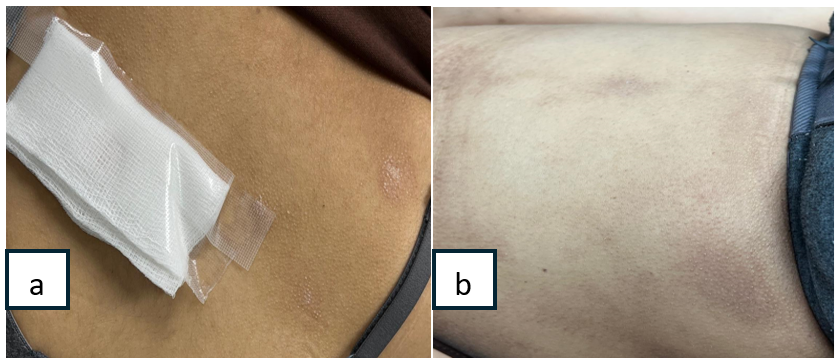
Figure 1 (a,b): Shows pruritic patchy follicular scaly plaques over the back and abdomen.
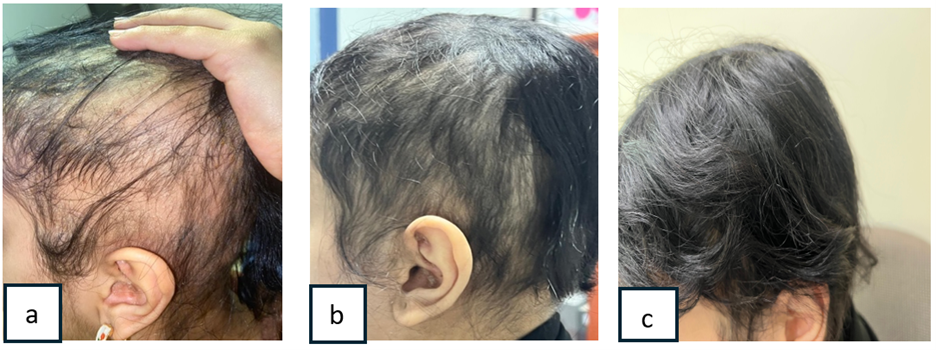
Figure 2: (a) Before management shows symmetrical bitemporal irregular patches of scarring alopecia with remarkable perifollicular erythema and scaling; (b) After management noticeable hair regrowth and cessation of further hair loss; (c) Shows marked improvement in hair growth.
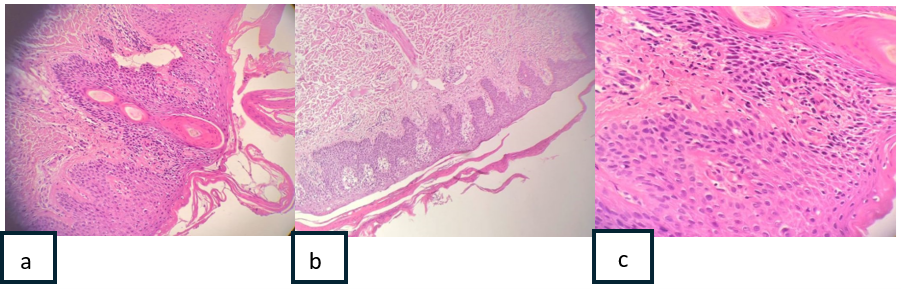
Figure 3 (a-c): Shows mild parakeratosis, mild acanthosis, spongiosis along with marked vascular changes at the dermo-epidermal junction. The upper dermis shows mild perivascular lympho-histiocytic infiltrate, pigment incontinence and peri-follicular fibrosis.
Discussion
The primary aim in treating Lichen Planopilaris (LPP) is to reduce chronic inflammation, and, thus, prevent the development of additional alopecic areas [10]. Understanding the nature of autoimmune diseases and the role of inflammatory processes is crucial in guiding treatment decisions. Recent evidence-based approaches advocate for the use of corticosteroids, topical tacrolimus, antimalarial drugs, and emerging treatments such as JAK inhibitors. In addition, patient education, interdisciplinary collaboration, and long-term management strategies are critical for improving functionality, considering the significant impact on lifestyle and appearance [5].
There are limited reports about available effective treatment regimens for LPP. The generally used therapeutic options include mid- to high-potency topical corticosteroids, intralesional corticosteroids, hydroxychloroquine, tetracycline family antibiotics, systemic retinoids (etretinate), topical calcineurin inhibitors (tacrolimus and pimecrolimus), topical cyclosporine, and orally administered immunosuppressive drugs (short courses of corticosteroids, cyclosporine, and mycophenolate mofetil) [4,9]. One study revealed that the topical treatment that caused the highest rate of symptomatic improvement was intralesional injection of corticosteroids. The treatment that led to the highest rate of remission was hydroxychloroquine combined with topical corticosteroid application. The remission rate was 6.5% after 3 months and 33% after 18 months. Of patients who achieved remission, 50% needed continuous treatment to maintain remission. No patient had any visible hair regrowth on any treatment [4].
In our study, the patient was initially managed with a combination of intralesional triamcinolone acetonide 10 mg/ml in the first session. For the remaining sessions, the patient was given 5mg/ml at the site of hair loss and topical Minoxidil 5%, which works by stimulating hair follicles and improving hair density. This resulted in the greatest symptomatic improvement. The systemic therapy that achieved the highest rate of remission was hydroxychloroquine (Plaquenil) 200 mg once daily. The effect was produced by suppressing the T-cell-mediated autoimmune attack on hair follicles, which can reduce both inflammation and scarring. The patient experienced noticeable symptom relief, including body itching that was reduced following hydroxychloroquine (Plaquenil) 200 mg once daily with no need to further increase the dose to twice daily, and regrowth of the hair with cessation of further hair loss (Figure 2). LPP is a chronic condition with periods of exacerbation and remission. Even with treatment, some patients may experience relapses. The goal of treatment is to maintain long-term remission and minimize the risk of irreversible scarring and hair loss.
Conflict of Interest Statement: All authors declare that they have no conflicts of interest relevant to this manuscript.
Funding Sources: No funding was received for conducting this study.
Statement of Ethics and Consent: A study approval statement was not required for this study in accordance with local/ national guidelines. Written informed consent was obtained from the patients for publication of the details of their medical case and any accompanying images. The CARE Checklist was completed by the authors for this case report, and it is attached in the online supplementary materials.
References
- Mehregan DA, Van Hale HM, Muller SA. Lichen planopilaris: Clinical and pathologic study of forty-five patients. Journal of the American Academy of Dermatology, 1992; 27(6). doi: 10.1016/0190-9622(92)70290-v
- Soares VC, Mulinari-Brenner F, Souza TE. Lichen planopilaris epidemiology: A retrospective study of 80 cases. Anais Brasileiros de Dermatologia,2015; 90(5): 666-670. doi: 10.1590/abd1806-4841.20153923.
- Migunov V. Lichen planopilaris: A case report. Medical Sciences, 2021; 10(1): 157-165. doi: 10.53453/ms.2022.03.18.
- Lyakhovitsky A, Amichai B, Sizopoulou C, and Barzilai A. A case series of 46 patients with lichen planopilaris: Demographics, clinical evaluation, and treatment experience. Journal of Dermatological Treatment, 2014; 26(3): 275–279. doi:10.3109/09546634.2014.933165.
- Lepe K, Nassereddin A, Syed HA, Salazar FJ. Lichen planopilaris. National Library of Medicine, 2024.
- National Institutes of Health. (n.d.). Lichen planopilaris. Genetic and Rare Diseases Information Center (GARD).
- Kerkemeyer KLS, Green J. Lichen planopilaris: A retrospective study of 32 cases in an Australian tertiary referral hair clinic. Australasian Journal of Dermatology, 2018. doi: 10.1111/ajd.12772.
- Waldorf DS. Lichen planopilaris. Histopathologic study of disease. Progression to scarring alopecia. Archives of Dermatology, 1966; 93(6): 684-691. doi: 10.1001/archderm.93.6.684.
- Assouly P, Reygagne P. Lichen planopilaris: Update on diagnosis and treatment. Seminars in Cutaneous Medicine and Surgery, 2009; 28(1): 3-10. doi: 10.1016/j.sder.2008.12.006.
- Stege H, Haist M, Schultheis M, Pawlowski J, Wittmann M, Grabbe S, et al. Treatment of lichen planopilaris and frontal fibrosing alopecia: A retrospective, real-life analysis in a tertiary center in Germany. Journal of Clinical Medicine, 2024; 13(16): 4947. doi: 10.3390/jcm13164947.