
Email id: info@ijclinmedcasereports.com
Beyond the Boundaries: Acute Leukemia Emerging from CALR-Driven Myelofibrosis with BCR::ABL1 Positivity
Kiran Ghodke1,*, Shruthi Kareddy2, Sneha Ann Oommen3, Akshita Rane4 and Prathamesh Kulkarni5
1Consultant Hematopathologist, Department of Hematology, Kokilaben Dhirubhai Ambani Hospital and Research Center, Rao Saheb Achutrao Patwardhan Marg, India
2Fellow, Department of Hematopathology, Kokilaben Dhirubhai Ambani Hospital and Research Center, Rao Saheb Achutrao Patwardhan Marg, India
3Associate consultant Hematopathologist, Kokilaben Dhirubhai Ambani Hospital and Research Center, Rao Saheb Achutrao Patwardhan Marg, India
4Research Scientist, Kokilaben Dhirubhai Ambani Hospital and Research Centre, Rao Saheb Achutrao Patwardhan Marg, India
5Consultant, Hematology-Oncology and BMT unit, Kokilaben Dhirubhai Ambani Hospital, India
Received Date: 21/04/2026; Published Date: 29/06/2026
*Corresponding author: Kiran Ghodke, MD (Pathology), Consultant Hematopathologist, Department of Hematology, Kokilaben Dhirubhai Ambani Hospital and Research Center, Rao Saheb Achutrao Patwardhan Marg, Four Bungalows, Andheri (W),Mumbai, Maharashtra 400053, India
Abstract
This report details the challenging diagnosis of an elderly male patient presenting with acute leukemia, characterized by marked peripheral blood blasts (88%), an acute myeloid leukemia (AML) immunophenotype, and complex molecular findings including Philadelphia chromosome positivity (BCR::ABL1 p210 transcript) and a co-occurring CALR mutation. Crucially, the patient had a prior diagnosis of myelofibrosis in 2013, for which he received thalidomide and steroids, and was JAK2 negative at that time. The co-existence of BCR::ABL1 (p210), typically associated with chronic myeloid leukemia (CML), and a CALR mutation, characteristic of Philadelphia chromosome-negative (Ph-negative) myeloproliferative neoplasms (MPNs), along with clinically relevant pathogenic/likely pathogenic mutations in SF3B1 and STAG2 genes, in the context of a pre-existing MPN, presents an exceedingly rare diagnostic dilemma. The primary challenge lies in distinguishing CML in myeloid blast crisis (CML-BC) from AML arising from a prior MPN. Accurate classification is paramount for guiding appropriate, targeted therapy and predicting prognosis, especially given the distinct therapeutic implications of each genetic alteration. This case highlights an exceptionally rare "hybrid" myeloid neoplasm, necessitating a comprehensive, multi-parameter diagnostic approach integrating clinical history, morphology, immunophenotype, and advanced molecular analysis to understand the clonal evolution.
Keywords: Acute myeloid leukemia; Philadelphia chromosome; CALR mutation; SF3B1 and STAG2
Introduction
Chronic Myeloid Leukemia (CML) is a clonal myeloproliferative neoplasm fundamentally defined by the presence of the Philadelphia chromosome (Ph), which results from a reciprocal translocation between chromosomes 9 and 22, generating the BCR::ABL1 fusion gene [1]. The most common transcript of this oncogene is p210, found in over 98% of CML cases, and it drives uncontrolled myeloid cell proliferation [2]. The advent of tyrosine kinase inhibitors (TKIs) targeting the BCR::ABL1 oncoprotein has revolutionized CML management, making it a highly treatable disease [3]. CML typically progresses through distinct phases: chronic, chronic phase progression, and eventually, blast crisis [1].
In contrast, Acute Myeloid Leukemia (AML) represents a heterogeneous group of hematological malignancies characterized by the rapid, uncontrolled proliferation of immature myeloid blasts in the bone marrow and peripheral blood, leading to significant impairment of normal hematopoiesis [1]. A diagnosis of AML typically requires the presence of ≥20% blasts in the peripheral blood or bone marrow [1]. AML can also arise from a pre-existing myeloproliferative neoplasm (MPN), such as myelofibrosis, a process often termed blast-phase MPN (MPN-BP) or secondary AML. Myelofibrosis is the most common type of MPN to progress to AML, with approximately 20% of patients developing AML within a 10-year period [1].
The presence of the Ph chromosome in an acute leukemia presentation introduces significant diagnostic complexities. It can indicate either CML in myeloid blast crisis (CML-BC), representing the terminal, aggressive phase of CML, or, albeit rarely, de novo AML with a BCR::ABL1 fusion[1]. Differentiating these two entities is critical due to their differing natural histories, prognostic implications, and distinct treatment strategies [1].
Further complicating the diagnostic landscape is the presence of co-mutations. Myeloproliferative neoplasms (MPNs) are broadly categorized into Ph-positive CML and Ph-negative MPNs. The latter are typically driven by mutations in JAK2, CALR, or MPL, which are generally considered mutually exclusive with each other and with BCR::ABL1 translocation [3,4]. The co-occurrence of BCR::ABL1 translocation and a CALR mutation is exceedingly rare, even more so than the co-occurrence of BCR::ABL1 and JAK2 mutations[4]. This "hybrid" genetic profile, especially in a patient with a documented history of myelofibrosis, presents a profound challenge to standard diagnostic algorithms and our understanding of disease pathogenesis, suggesting a complex clonal evolution.
This case report aims to illuminate a complex diagnostic scenario involving an elderly male patient presenting with acute leukemia, BCR::ABL1 (p210) positivity, and an unexpected CALR mutation, all in the context of a prior myelofibrosis diagnosis and the subsequent detection of SF3B1 and STAG2 mutations. The report will delve into the intricate differential diagnosis between CML-BC and AML arising from a prior MPN, analyze the implications of the CALR co-mutation and clonal evolution, and advocate for a multi-faceted approach to arrive at a definitive diagnosis and guide optimal management in such rare and challenging presentations.
Case Presentation
An elderly male patient presented with a 15-day history of rapidly worsening leukocytosis. He had a significant past medical history of myelofibrosis, diagnosed in 2013. At the time of his myelofibrosis diagnosis, he was tested negative for JAK2 mutation, and there were no details available regarding CALR or MPL mutation status. He was subsequently treated with thalidomide and steroids for his myelofibrosis.
A recent Complete Blood Count (CBC) dated revealed: Hemoglobin (HB): 3.6 g/dL, White Blood Cell (WBC) count: 16,920/µL, and Platelet Count: 72000/µL. Peripheral blood smear (PS) analysis revealed a strikingly high blast count of 88%. Cytochemical myeloperoxidase (MPO) was weakly positive.
Bone marrow aspiration performed showed a dilute marrow with 60% blasts and suppression of trilineage haematopoiesis. Bone marrow trephine biopsy revealed extensive fibrosis with scattered interstitial blastoid cells along with marked megakaryocytic proliferation and dysplasia with clustering. Myeloid and erythroid series were markedly suppressed. Immunohistochemistry (IHC) staining demonstrated CD34+ and CD117+ highlighting scattered blastoid cells, while CD41+ highlighted increased megakaryocytes. Reticulin and Masson trichrome staining confirmed grade-3 myelofibrosis.
Flow cytometry performed on the patient's sample confirmed an AML immunophenotype. The abnormal blasts were positive for myeloid markers CD13, CD33, CD117 and Cytoplasmic MPO with aberrant expression of CD7. They also express HLA DR and CD34 and were negative for B-lymphoid (CD10, CD19, CD20, Cyto CD79a), T-lymphoid (CD3, CD4, CD5, CD8, Cyto CD3), and monocytic markers (CD11b, CD14, CD36).
Next-Generation Sequencing (NGS) analysis yielded critical molecular findings. Philadelphia chromosome positivity (Ph+) was detected, specifically identifying the BCR::ABL1 p210 transcript. The p210 transcript (M-bcr genotype) is the characteristic fusion product in over 98% of CML cases, including those in blast crisis. However, it is important to note that while rare, the p210 transcript can also be found in cases of de novo AML [5-7]. In addition to the BCR::ABL1 fusion, CALR (Type-2) mutation with a Variant Allele Frequency (VAF) of 59% was also detected. Furthermore, NGS identified clinically relevant pathogenic/likely pathogenic mutations in the SF3B1 gene with a VAF of 34% and the STAG2 gene with a VAF of 65%. CALR mutations are typically found in Ph-negative MPNs such as essential thrombocythemia (ET) and Primary Myelofibrosis (PMF), and are generally considered mutually exclusive with BCR::ABL1 and JAK2 mutations [1,5]. The co-occurrence of BCR::ABL1 and CALR mutations is exceedingly rare, even more so than BCR::ABL1 and JAK2 co-mutations [1,6].
Discussion
Differential Diagnosis: CML Myeloid Blast Crisis vs. AML Arising from Prior MPN with BCR::ABL1
The presented case, with 88% peripheral blasts, an AML immunophenotype, BCR::ABL1 p210 positivity, and a history of myelofibrosis, necessitates a careful differential diagnosis between CML in myeloid blast crisis (CML-BC) and AML arising from a prior myeloproliferative neoplasm (MPN). Both the World Health Organization (WHO) 2022 and International Consensus Classification (ICC) criteria require a blast percentage of ≥20% in the peripheral blood and/or bone marrow for the diagnosis of acute leukemia [1,6]. The patient's 88% blasts clearly fulfill this criterion for both potential diagnoses.
CML-BC is defined as the transformation of CML from its chronic or accelerated phase to a blast phase, characterized by ≥20% blasts or the presence of an extramedullary accumulation of blasts [1]. This transformation invariably occurs in the context of an underlying Philadelphia chromosome-positive CML [2]. Conversely, AML arising from a prior MPN (also known as secondary AML or MPN-BP) is a recognized entity where acute leukemia develops in a patient with a pre-existing MPN. Myelofibrosis is the most common MPN to progress to AML [1].
De novo AML with BCR::ABL1 is also recognized as a distinct, albeit rare, entity within both the WHO 2022 and ICC classifications. Its estimated prevalence ranges from 0.1% to 3% of all AML cases [1,6,7].
Comparative Analysis of Differentiating Features
Several key features aid in distinguishing CML-BC from AML arising from a prior MPN, particularly in the context of BCR::ABL1 positivity:
Clinical History: CML-BC typically arises from a pre-existing chronic or accelerated phase of CML, which may have been present for months or years, often with symptoms such as persistent leukocytosis, splenomegaly, fatigue, weight loss, or abnormal platelet counts. In contrast, AML arising from a prior MPN occurs in patients with a documented history of another MPN, such as myelofibrosis. The patient's documented history of myelofibrosis since 2013, treated with thalidomide and steroids, provides a clear antecedent MPN. The 15-day history of worsening leukocytosis suggests a rapid transformation from this chronic state to an acute phase. While CML can present de novo in blast crisis, the very short history of acute worsening leukocytosis in a patient with a known chronic MPN makes the scenario of AML arising from prior myelofibrosis more plausible in terms of disease evolution.
BCR::ABL1 Transcript Type: The detection of the p210 BCR::ABL1 transcript in this patient is highly characteristic of CML, as it is present in over 98% of CML cases. However, the presence of the p210 transcript is not exclusively diagnostic for CML-BC in the context of an acute leukemia presentation. While less common, p210 can also be identified in de novo AML [5,7]. Some reports indicate that the p190 transcript is more typically associated with BCR::ABL1-driven component, it does not definitively rule out AML arising from another MPN, emphasizing the necessity of integrating all available clinical, morphological, and additional molecular data for accurate classification [4,5].
Additional Chromosomal Abnormalities (ACA): CML-BC is frequently accompanied by additional cytogenetic abnormalities beyond the Ph chromosome, such as a second Ph, trisomy 8, isochromosome 17q, trisomy 19, or complex karyotypes. These ACAs often signify clonal evolution and disease progression. AML arising from a prior MPN can also have complex karyotypes or specific abnormalities associated with myelodysplasia [4,6]. The current NGS results specify Ph positivity, CALR, SF3B1 and STAG2 mutations with no any other ACAs. However SF3B1 and STAG2 mutations are recurrently found in myelodysplastic syndromes (MDS) and acute myeloid leukemia (AML), particularly in high-risk MDS and secondary AML [8]. Favouring AML arising from a prior MPN, particularly in the context of BCR::ABL1 positivity over CML-BC.
ABL1 Mutations: Acquired ABL1 kinase domain mutations are a common mechanism of secondary resistance to TKIs in CML and are detectable in approximately 60% of cases of CML blast transformation. In contrast, no ABL1 mutations have been described to date in de novo AML with BCR::ABL1 [3,5]. The NGS results for this patient did not show any presence of ABL1 mutations; their absence would further support a diagnosis of de novo AML or AML arising from a prior MPN where BCR::ABL1 was a later acquisition.
NPM1 Mutations: NPM1 mutations can be associated with de novo AML with BCR::ABL1. These mutations are not typically found in CML-BC. The presence of an NPM1 mutation would have strongly favored a diagnosis of de novo AML or AML arising from a prior MPN [5]. However absence of NPM1 mutation cannot exclude the possibility of de novo AML or AML arising from a prior MPN.
Immunophenotype (Flow Cytometry): Flow cytometry confirmed an AML immunophenotype in the patient. Both CML-BC and AML blasts generally express common myeloid markers such as CD13, CD33, CD117, CD38, and often CD34[1]. Some studies suggest that de novo AML with BCR::ABL1 may exhibit lower CD36 or CD7 expression compared to CML-BP, and potentially different expression patterns of CD25 and ID4 mRNA[5]. Basophilic differentiation, indicated by positivity for CD123 and CD9 and dim/negative HLADR, can be observed in both acute basophilic leukemia and CML-BC, making differentiation challenging based solely on these markers [9].
Bone Marrow Morphology: In CML-BC, the bone marrow is characteristically hypercellular with an expansion of myeloid cell lines, prominent megakaryocytes, and often mild fibrosis [1]. A distinguishing feature of CML is the absence of a "leukemic gap," meaning that a full spectrum of mature and immature myeloid cells is present. In contrast, de novo AML is typically characterized by a "leukemic gap," signifying an absence of intermediate myeloid maturation forms between blasts and mature neutrophils [1].
The patient's bone marrow aspiration showed 60% blasts and myeloid and erythroid series were markedly suppressed, with megakaryocytes not seen. The trephine biopsy showed marked megakaryocytic proliferation with dysplasia and extensive fibrosis (grade-3 myelofibrosis). The presence of a CALR mutation, as seen in this patient, can significantly influence bone marrow morphology, typically leading to large and clustered megakaryocytes and fibrosis, which are characteristic features of Ph-negative MPNs [1].
In cases of co-occurrence of BCR::ABL1 and CALR, bone marrow histology may even show "hybrid megakaryocytes" (displaying features of both small, non-clustering CML-like megakaryocytes and large, clustered MPN-like megakaryocytes) or fibrosis at the time of CML diagnosis [10,11]. This atypical morphology can serve as a crucial clue for pathologists to suspect co-mutations [10].
The additional presence of SF3B1 mutations can be associated with myelodysplastic features, including ring sideroblasts, while STAG2 mutations are often found in very immature myeloid-committed stem cells and can define a chromatin-spliceosome AML group, further complicating the morphological picture [1,6,8]. Therefore, morphology alone is insufficient for a definitive diagnosis in such a complex case.
Table 1: Comparative Features of CML Myeloid Blast Crisis vs. De Novo AML with BCR::ABL1
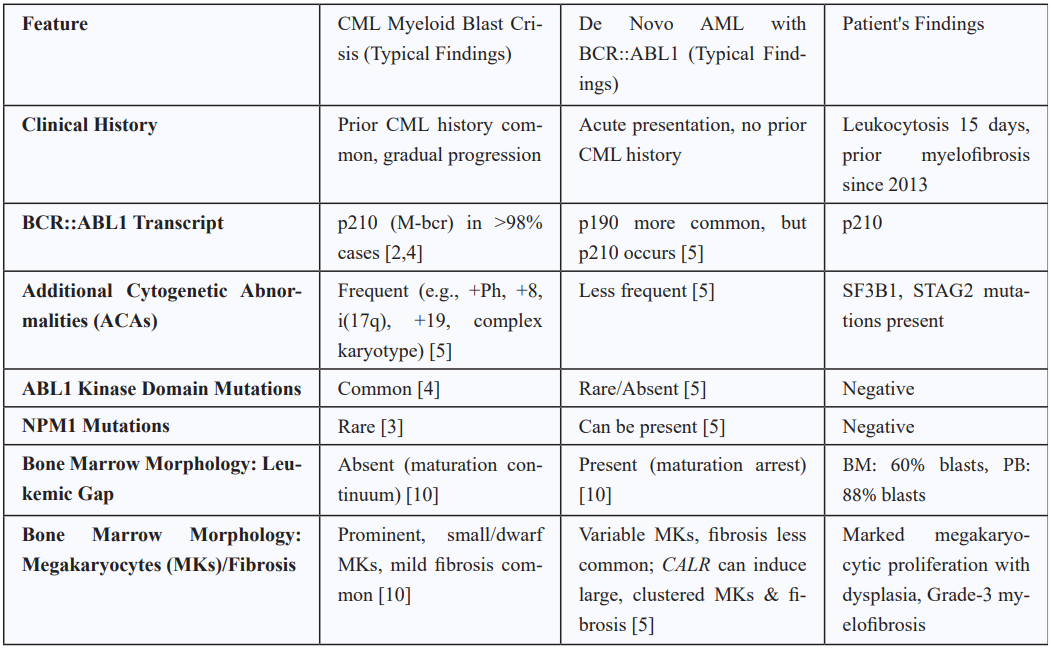
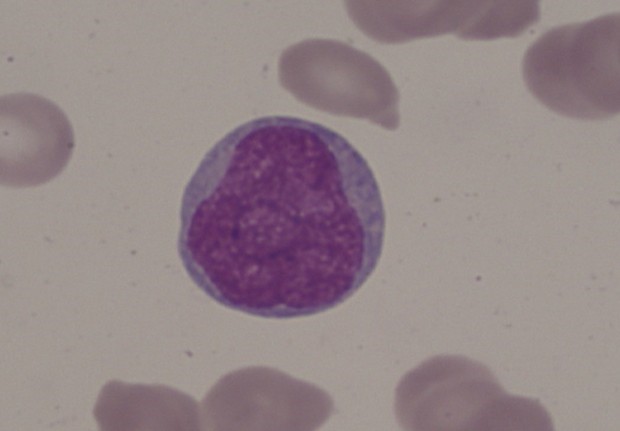
Figure 1: Peripheral blood smear showing a blasts with high nuclear-to-cytoplasmic ratio and prominent nucleoli.
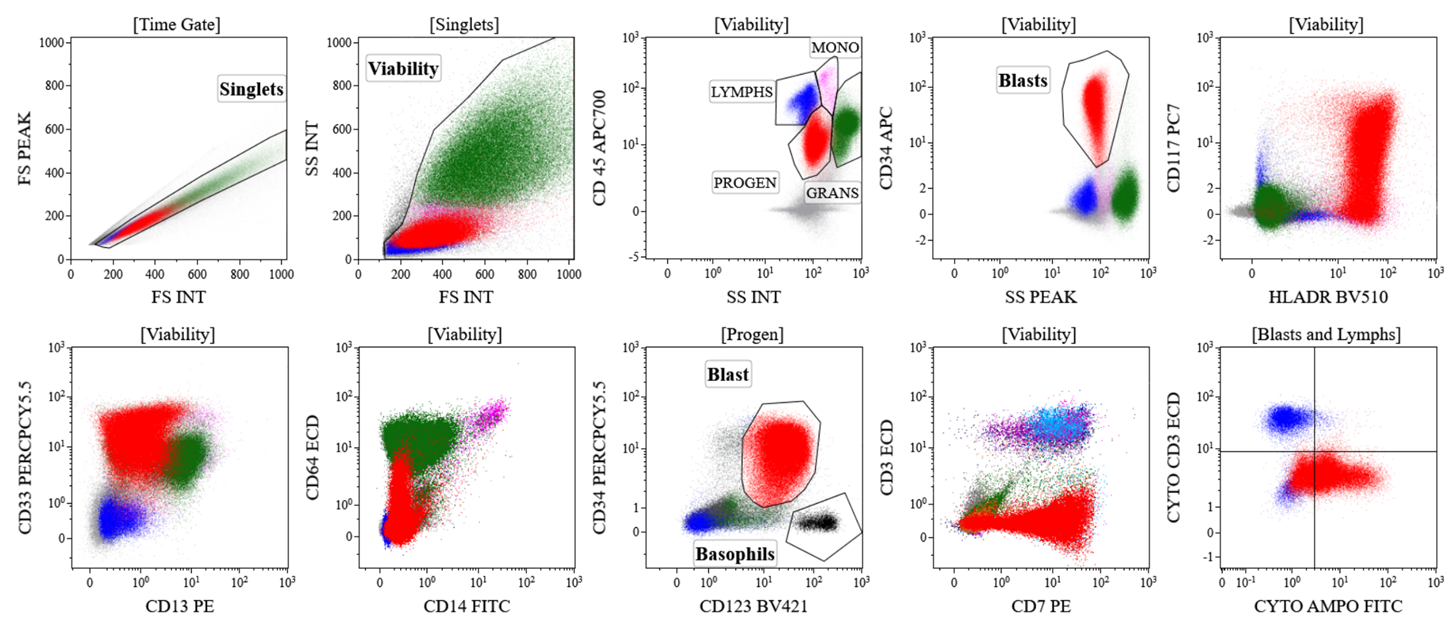
Figure 2: Immunophenotypic findings with sequential gating showed blasts (bright red colour) expressing dim CD45, moderate CD34, heterogeneous CD117, moderate HLADR, dim to negative CD13 and CD64, moderate CD33, dim CD123, heterogeneous CD7 and cytoplasmic MPO, and negative for rest other markers tested (not shown in figure).
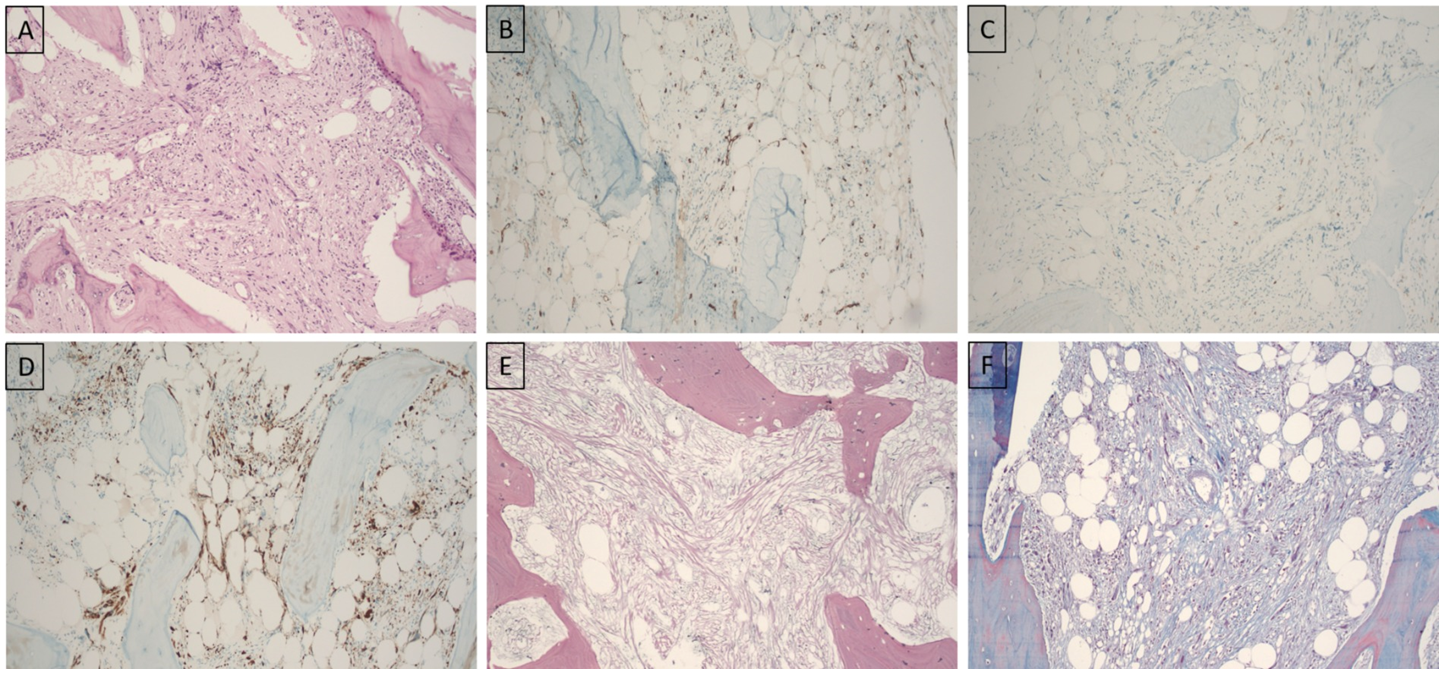
Figure 3: A - Hematoxylin and Eosin (H&E, 400x) stain showing markedly fibrotic marrow with scattered and loose clusters of megakaryocytes, B. CD34 immunostaining highlights scattered endothelial cells and occasional blasts, C - CD117 immunostaining shows minimal staining, indicating a paucity of immature myeloid precursors, D - CD41 immunostaining highlights increased and dysplastic megakaryocytes, E - Reticulin stain demonstrates a dense reticulin network (MF-3); consistent with marrow fibrosis, F - Masson’s trichrome stain confirms collagen deposition, indicative of advanced fibrosis.
The Confounding Presence of CALR, SF3B1, and STAG2 Mutations in the Context of Prior Myelofibrosis
The presence of a CALR mutation, now understood in the context of a prior myelofibrosis diagnosis, introduces an extraordinary layer of complexity to this case. CALR mutations are typically found in Ph-negative MPNs, such as essential thrombocythemia (ET) and primary myelofibrosis (PMF), and are generally considered mutually exclusive with JAK2 and MPL mutations [10]. By extension, they are also typically mutually exclusive with BCR::ABL1 translocation, which defines CML. The co-occurrence of BCR::ABL1 and CALR mutations is remarkably rare, even rarer than BCR::ABL1 and JAK2 co-mutations [10].
The patient's history of myelofibrosis diagnosed in 2013, with a negative JAK2 status at that time, strongly suggests that his myelofibrosis was driven by a CALR mutation - Type-2, even though it was not tested for initially. CALR mutations are a common driver in primary myelofibrosis, particularly in JAK2-negative cases with Type-2 mutations often associated with a more favorable prognosis compared to JAK2 mutations, but still indicative of an underlying MPN [1].
The subsequent detection of the BCR::ABL1 p210 transcript, the CALR (Type-2) mutation (VAF 59%), and now the SF3B1 mutation (VAF 34%) and STAG2 mutation (VAF 65%) in the current acute presentation, suggests an even more complex clonal evolution.
The co-occurrence of these mutations with BCR::ABL1 and CALR indicates a highly intricate, branched clonal evolution rather than a single clone acquiring all mutations. This challenges the traditional understanding of myeloid neoplasm initiation and progression, suggesting a more intricate genetic landscape than a single dominant driver. It raises fundamental questions about the order of mutation acquisition, clonal competition, and how these distinct oncogenic pathways interact to culminate in acute leukemia, pushing the boundaries of current classification systems.
Impact on Disease Phenotype and Bone Marrow Morphology
The CALR mutation typically drives phenotypes like essential thrombocythemia (ET) or primary myelofibrosis (PMF), which are characterized by distinct megakaryocyte morphology (large, hyperlobulated, clustered megakaryocytes) and often bone marrow fibrosis [10]. In cases where BCR::ABL1 and CALR co-occur, bone marrow histology may exhibit "hybrid megakaryocytes" (displaying features of both small, non-clustering CML-like megakaryocytes and large, clustered MPN-like megakaryocytes) or fibrosis, even at the initial diagnosis of CML [1]. This atypical morphology can serve as a crucial clue for pathologists to suspect the presence of co-mutations.
Response to Therapy and Prognosis
The prognosis for this patient is particularly complex due to the rare co-occurrence of multiple genetic abnormalities. While CALR (Type-2) mutations are generally associated with a more favorable prognosis in PMF compared to JAK2 mutations, the presence of BCR::ABL1 p210, SF3B1, and STAG2 mutations significantly worsens the outlook[1,11]. AML arising from a prior myelodysplastic syndrome or myeloproliferative neoplasm (secondary AML) is generally associated with a worse prognosis compared to de novo AML [1].
SF3B1 and STAG2 mutations are considered adverse prognostic factors in AML and MDS, often associated with advanced disease and reduced survival, especially in secondary AML [7]. The co-occurrence of these mutations with BCR::ABL1 and CALR implies a highly aggressive and complex disease biology, necessitating a multi-pronged therapeutic approach.
The patient's leukemia is driven by multiple distinct oncogenes, each potentially requiring different targeted therapies: TKIs for BCR::ABL1, JAK inhibitors for CALR-driven disease, and potentially novel agents for SF3B1 and STAG2 mutated AML. A single-agent approach is unlikely to be fully effective against all components of the disease. This creates a complex therapeutic challenge, as the optimal combination, sequence, and dosing of agents targeting both pathways are not established due to the rarity of such cases.
Tyrosine kinase inhibitors (TKIs) remain the cornerstone of treatment for BCR::ABL1-positive leukemias [1,12,13]. Given the acute presentation with a high blast count, intensive chemotherapy combined with a TKI (e.g., imatinib, dasatinib, nilotinib, or ponatinib) would be indicated [2]. Newer generation TKIs may offer deeper and faster molecular responses [3]. However, TKIs are generally ineffective against the CALR-mutated clone. If the CALR-mutated clone is significant, treatment for the MPN component may be required, potentially with agents like ruxolitinib (a JAK inhibitor, relevant as CALR activates the JAK/STAT pathway) or hydroxyurea [1,12]. The patient's prior treatment for myelofibrosis with thalidomide and steroids is notable. While these agents can improve symptoms like anemia in some patients with primary myelofibrosis, their responses are typically incomplete and not sustained, and they are not curative [13]. Thalidomide's activity in PMF is attributed to its anti-angiogenic, cytokine regulatory, and immune-modulating properties, while steroids can help reverse anemia. This historical treatment context further underscores the chronic nature of the underlying MPN before acute transformation [12,13]. The optimal sequence and combination of these therapies, especially with the added SF3B1 and STAG2 mutations, are not well-defined for this rare co-occurrence.
Crucially, quantitative monitoring of both BCR::ABL1 transcript levels (using International Scale, IS%) and CALR allele burden (e.g., by NGS variant allele frequency or ddPCR) is essential to assess the individual response of each clonal population and guide treatment modifications. This highlights the need for ongoing research and collaborative efforts to establish evidence-based guidelines for managing these extremely rare and genetically complex myeloid neoplasms, moving beyond broad diagnostic categories to highly individualized treatment plans.
Allogeneic hematopoietic stem cell transplantation (allo-HSCT) remains a crucial curative option for patients who do not respond adequately to TKIs or for those experiencing accelerated or blast crisis phase progression [1,12]. For this complex, high-risk presentation with co-occurring mutations, allo-HSCT should be considered early in eligible patients, as it has shown promising results in some reported cases with dual positivity, leading to complete remission of both clones [10,11]. This is especially pertinent given the elderly patient age, which impacts transplant eligibility and the intensity of conditioning regimens.
Conclusion
This case of an elderly male presenting with acute leukemia, BCR::ABL1 (p210) positivity, and co-occurring CALR (Type-2), SF3B1, and STAG2 mutations, in the context of a prior myelofibrosis diagnosis, exemplifies an exceptionally rare and diagnostically challenging scenario in myeloid neoplasms. The acute presentation with a very high blast count, alongside the presence of multiple typically mutually exclusive driver mutations, creates a complex diagnostic dilemma between CML in myeloid blast crisis and BCR::ABL1 positive AML arising from a prior myelofibrosis.
Accurate classification and optimal management of such complex cases require a meticulous integration of comprehensive clinical history, detailed peripheral blood and bone marrow morphology, thorough flow cytometric immunophenotyping, and advanced molecular genetic analysis. This includes NGS for a broad panel of mutations, quantitative PCR for BCR::ABL1 transcript levels, and allele burden assessment for CALR, SF3B1, and STAG2. Further advanced molecular investigations into clonal architecture (e.g., single-cell sequencing) are crucial to definitively determine if this represents a biclonal process or a rare hybrid transformation.
The extreme rarity of BCR::ABL1, CALR, SF3B1, and STAG2 co-mutations highlights a significant knowledge gap regarding their precise pathogenetic mechanisms, clonal evolution, optimal therapeutic strategies, and long-term prognosis. Further collection of such rare cases and advanced molecular studies are crucial to better understand these "hybrid" diseases and improve patient outcomes. This case serves as a powerful reminder that even with advanced diagnostic tools, complex and atypical presentations continue to challenge conventional classifications, emphasizing the critical role of expert hematopathologic interpretation and collaborative clinical-molecular correlation in providing the best possible care.
References
- "WHO Classification of Tumours Editorial Board. WHO Classification of Haematolymphoid Tumours. 5th ed. Lyon, France: International Agency for Research on Cancer, 2022
- Zenebe B, Nigussie H, Belay G, Seboka N. A review on characterization of BCR - ABL transcript variants for molecular monitoring of chronic myeloid leukemia phenotypes. Hematology, 2023; 28(1): 2284038. doi: 10.1080/16078454.2023.2284038.
- Adnan-Awad S, Kankainen M, Mustjoki S. Mutational landscape of chronic myeloid leukemia: more than a single oncogene leukemia. Leuk Lymphoma, 2021; 62(9): 2064-2078. doi: 10.1080/10428194.2021.1894652.
- Jajosky AN, Lichtman MA. Uncommon phenotypes of BCR::ABL1-positive chronic myelogenous leukemia: a review. Haematologica, 2025. doi: 10.3324/haematol.2025.287792.
- Gondran C, Dumas PY, Bérard E, Bidet A, Delabesse E, Tavitian S, et al. Imatinib with intensive chemotherapy in AML with t(9;22)(q34.1;q11.2)/BCR::ABL1. A DATAML registry study. Blood Cancer J, 2024; 14(1): 91. doi: 10.1038/s41408-024-01069-9.
- Arber DA, Orazi A, Hasserjian RP, Borowitz MJ, Calvo KR, Kvasnicka HM, et al. International Consensus Classification of Myeloid Neoplasms and Acute Leukemias: integrating morphologic, clinical, and genomic data. Blood, 2022; 140(11): 1200-1228. doi: 10.1182/blood.2022015850.
- Neuendorff NR, Burmeister T, Dörken B, Westermann J. BCR-ABL-positive acute myeloid leukemia: a new entity? Analysis of clinical and molecular features. Ann Hematol, 2016; 95(8): 1211-21. doi: 10.1007/s00277-016-2721-z.
- Park HS. What is new in acute myeloid leukemia classification? Blood Res, 2024; 59(1): 15. doi: 10.1007/s44313-024-00016-8.
- Han X, Jorgensen JL, Brahmandam A, Schlette E, Huh YO, Shi Y, et al. Immunophenotypic study of basophils by multiparameter flow cytometry. Arch Pathol Lab Med, 2008; 132: 813-819.
- Zanelli M, Fragliasso V, Loscocco GG, Sanguedolce F, Broggi G, Zizzo M, et al. Chronic myeloproliferative neoplasms with concomitant CALRmutation and BCR::ABL1 translocation: diagnostic and therapeutic implications of a rare hybrid disease. Front Cell Dev Biol, 2024; 12: 1391078. doi: 10.3389/fcell.2024.1391078.
- Vadeikienė R, Jakštys B, Laukaitienė D, Šatkauskas S, Juozaitytė E, Ugenskienė R. The Role of Mutated Calreticulin in the Pathogenesis of BCR-ABL1-Negative Myeloproliferative Neoplasms. International Journal of Molecular Sciences, 2024; 25(18): 9873. https://doi.org/10.3390/ijms25189873
- Smith G, Apperley J, Milojkovic D, Cross NCP, Foroni L, Byrne J, et al. British Society for Haematology. A British Society for Haematology Guideline on the diagnosis and management of chronic myeloid leukaemia. Br J Haematol, 2020; 191(2): 171-193. doi: 10.1111/bjh.16971.
- Wang L, Li J, Arbitman L, Zhang H, Shao H, Martin M, et al. Current Advances in the Diagnosis and Treatment of Major Myeloproliferative Neoplasms. Cancers (Basel), 2025; 17(11): 1834. doi: 10.3390/cancers17111834.