
Email id: info@ijclinmedcasereports.com
Radiologic Assessment of Scheuermann’s Disease: A Case Report
Salma Chenouni*, Fatima Chait, Najwa Ech-cherif Kettani, Meryem Fikri and Firdouas Touarsa
Department of Neuroradiology, Specialties Hospital, Mohammed V University, Rabat, Morocco
Received Date: 14/04/2026; Published Date: 17/06/2026
*Corresponding author: Salma Chenouni MD, Radiology, Specialties Hospital, Av. Abderrahim Bouabid, Rabat, Morocco
Abstract
Scheuermann’s disease is a structural kyphosis characterized by abnormalities of the vertebral growth plates, resulting in anterior wedging of the vertebral bodies. The diagnosis relies primarily on imaging, including conventional radiography and magnetic resonance imaging (MRI), based on Sörensen’s criteria. Management is typically conservative in mild to moderate cases and includes physical therapy and bracing, while surgical treatment is reserved for severe deformities.
We report the case of a 22-year-old patient presenting with chronic dorsal pain and kyphosis. MRI revealed characteristic features of Scheuermann’s disease, including vertebral wedging, endplate irregularities, and Schmorl’s nodes. The patient was managed conservatively with rehabilitation and bracing.
Keywords: Scheuermann disease; Kyphosis; Spine MRI; Vertebral wedging; Schmorl’s nodes
Introduction
Scheuermann’s disease, first described in 1920, is a structural kyphosis characterized by anterior wedging of the vertebral bodies and irregularities of the vertebral endplates [1]. It represents the most common cause of thoracic hyperkyphosis in adolescents and typically occurs during periods of rapid growth [2].
Its prevalence ranges from 0.4% to 10%, with a predominance in males; however, recent data suggest a more balanced sex distribution [3]. Its etiology is multifactorial, involving mechanical factors, genetic predisposition, and abnormalities in vertebral endplate growth [4].
The diagnosis relies primarily on imaging, particularly conventional radiography, based on Sörensen’s criteria, which include vertebral wedging, endplate irregularities, and the presence of Schmorl’s nodes (5). Magnetic Resonance Imaging (MRI) plays a complementary role by enabling detailed evaluation of intervertebral discs and detection of inflammatory changes [6].
We report a case of Scheuermann’s disease in a young adult, highlighting its radiological features and emphasizing the role of MRI in diagnosis.
Case Presentation
A 22-year-old patient presented with chronic dorsal pain associated with low back pain and heel pain, evolving over several months. The pain was mechanical in nature, progressively worsening throughout the day and exacerbated by prolonged sitting and physical activity. There was no history of trauma, inflammatory disease, or similar conditions in the family.
On physical examination, a painful dorsal kyphosis was observed, with reduced spinal mobility, particularly in the thoracic region. The deformity appeared relatively rigid on extension. No clinical signs of sacroiliitis were identified. Neurological examination was unremarkable, with no motor or sensory deficits.
Laboratory investigations, including inflammatory markers and HLA-B27 testing, were within normal limits, effectively ruling out inflammatory spondyloarthropathy.
Initial spinal radiographs demonstrated vertebral endplate irregularities and degenerative disc changes, raising suspicion of a structural spinal disorder. To further characterize these findings, a dorsolumbar magnetic resonance imaging (MRI) study was performed (Figure 1).
MRI revealed abnormalities extending from D5 to S2, including anterior wedging of multiple vertebral bodies, irregular and flattened vertebral endplates, intervertebral disc space narrowing, and multiple Schmorl’s nodes. In addition, areas of central fatty degeneration within the vertebral bodies were identified. These findings were consistent with Scheuermann’s disease based on Sörensen’s criteria.
Based on the clinical and radiological findings, a diagnosis of Scheuermann’s disease was established. The patient was managed conservatively with a structured rehabilitation program focusing on postural correction, stretching, and strengthening exercises. Orthopedic management with bracing was also initiated.
During follow-up, the patient showed partial improvement in pain, with stabilization of the kyphotic deformity and no evidence of progression or complications.
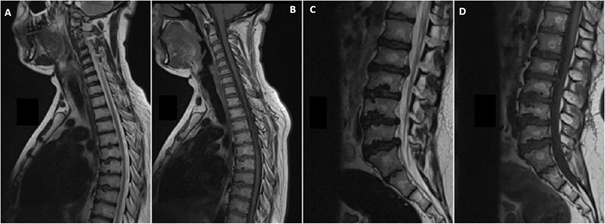
Figure 1: Sagittal T1- and T2-weighted MRI of the cervico-thoraco-lumbo-sacral spine demonstrating multilevel abnormalities from D5 to S2, including central fatty degeneration of the vertebral bodies, anterior wedging, disc space narrowing, and intravertebral herniations (Schmorl’s nodes). A: upper T2-weighted image; B: upper T1-weighted image; C: lower T2-weighted image; D: lower T1-weighted image.
Discussion
Scheuermann’s disease is defined as a structural and often painful hyperkyphosis, more or less reducible, associated with irregularities of the vertebral endplates and deformities of the vertebral bodies [1]. It most commonly affects the thoracic spine, although thoracolumbar and lumbar involvement may also occur [2]. The condition affects approximately 0.4% to 10% of adolescents, typically between 10 and 14 years of age, with a predominance in males [1,3]. However, recent studies suggest a more balanced sex distribution and a potentially underestimated prevalence due to pauci-symptomatic forms [7,8].
The exact etiology remains unclear [2]. Several pathophysiological mechanisms have been proposed, likely reflecting the combined effects of mechanical, metabolic, muscular, and genetic factors [2–4]. Recent studies have highlighted abnormalities in endochondral ossification of the vertebral endplates, leading to impaired vertebral growth and the characteristic anterior wedging [7]. Furthermore, morphologic studies have demonstrated structural alterations of the vertebral endplates and intervertebral discs, supporting the hypothesis of an early degenerative process [8].
The most common presenting features are thoracic kyphosis and back pain [5]. The pain is typically mechanical in nature, progressively worsening throughout the day and exacerbated by prolonged sitting and physical activity [6]. Some studies suggest that pain may be more pronounced in patients with more severe deformities, with variable functional impact [8].
Clinical examination should focus on two key features: segmental spinal stiffness, often painful, and sagittal imbalance. Stiffening of the hyperkyphotic segment leads to compensatory hyperlordosis of the lumbar and cervical spine [6]. Sagittal imbalance may also be observed depending on the severity of the deformity [7].
Imaging plays a central role in diagnosis, allowing confirmation of the disease, assessment of lesion extent and severity, evaluation of sagittal alignment, and exclusion of differential diagnoses [1]. Standard spinal radiographs, ideally obtained in anteroposterior and lateral views of the entire spine, constitute the first-line imaging modality [6].
Measurement of the Cobb angle is essential to quantify the degree of kyphosis, with normal values ranging from 25° to 45° [4]. The radiological diagnosis of Scheuermann’s kyphosis is based on Sörensen’s criteria, which include anterior vertebral wedging greater than 5° in at least three consecutive vertebrae at the apex of the deformity, irregular and flattened vertebral endplates, narrowing of intervertebral disc spaces, and the presence of Schmorl’s nodes [5]. These findings reflect structural alterations of the vertebral bodies and intervertebral discs, as described in recent radiological morphology studies [8]. Less commonly, additional findings such as a beveled appearance, notching, or marginal avulsion (limbus vertebra) may be observed [1].
Magnetic Resonance Imaging (MRI) is a complementary modality that is particularly valuable in atypical thoracolumbar or lumbar forms. Based on the same Sörensen criteria, MRI allows confirmation of the diagnosis, evaluation of intervertebral disc hydration, and detection of inflammatory changes such as vertebral endplate bone marrow edema [6]. It also provides a more detailed assessment of disc structures and bone marrow changes, reinforcing its role in complex or atypical cases [7,8].
In addition to spinal stiffness and progression of deformity into adulthood, rare but potentially severe complications may occur, particularly neurological complications secondary to spinal cord compression, which may present as spastic paraparesis or lumbar spinal canal stenosis [6]. In severe cases, restrictive respiratory impairment may also develop due to thoracic deformity [8]. In such situations, MRI, including diffusion-weighted imaging and apparent diffusion coefficient analysis, plays a crucial role in diagnostic evaluation [4].
Management of Scheuermann’s disease is primarily conservative, with surgery reserved for severe cases. Mild forms are managed with clinical monitoring and lifestyle modifications [1]. Functional treatment is indicated in both postural and structural kyphosis and includes physiotherapy focusing on postural correction, muscle stretching, and strengthening of the abdominal and paravertebral musculature [6]. Orthopedic management, mainly based on bracing, is indicated in painful or progressive forms or in cases of failure of rehabilitation [1,6]. Surgical treatment is reserved for severe kyphosis, particularly in patients at risk of progression beyond skeletal maturity, or in those presenting with significant aesthetic deformity, chronic pain, or, more rarely, neurological complications [6].
Conclusion
Scheuermann’s disease represents a major cause of structural kyphosis in young individuals and should be systematically considered in patients presenting with chronic back pain associated with spinal deformity. Imaging plays a fundamental role, not only in confirming the diagnosis but also in assessing disease severity and functional impact. Magnetic resonance imaging (MRI) constitutes an essential complementary tool, particularly in atypical forms, by providing a detailed evaluation of disco-vertebral structures and associated abnormalities.
Early recognition of the disease is crucial to initiate appropriate conservative management, primarily aimed at stabilizing progression and improving patients’ quality of life. Conversely, delayed diagnosis may lead to advanced forms associated with chronic pain, significant functional impairment, and, in rare cases, severe complications. Therefore, a rigorous and multidisciplinary diagnostic approach is essential to optimize prognosis and limit long-term sequelae.
Author Contributions
SALMA CHENOUNI: Conceptualization, Data curation, Methodology, Investigation, Writing – review & editing.
FATIMA CHAIT: Supervision, Validation, Project administration.
NAJWA ECH-CHERIF KETTANI: Supervision, Validation, Project administration.
MERYEM FIKRI: Supervision, Validation, Project administration.
FIRDOUAS TOUARSA: Supervision, Validation, Project administration.
All authors approved the final manuscript.
Declaration of Conflicting Interests: The authors declared no potential conflicts of interest with respect to the research, authorship, and/or publication of this article.
Funding:The authors declare that they have no known competing financial interests or personal relationships that could have appeared to influence the work reported in this paper.
References
- Palazzo C, Sailhan F, Revel M. Scheuermann’s disease. Revue du Rhumatisme Monographies, 2014; 81: 7–15.
- Mansfield JT, Bennett M. Scheuermann Disease. In: StatPearls. Treasure Island (FL): StatPearls Publishing; 2025.
- Lepeule V. La maladie de Scheuermann à l’adolescence: prise en charge en centre de rééducation. Besançon; Thèse de diplôme d’État de masseur-kinésithérapeute, 2009.
- Sebaaly A, Farjallah S, Kharrat K, Kreichati G, Daher M. Scheuermann's kyphosis: update on pathophysiology and surgical treatment. EFORT Open Reviews, 2022; 7(11): 782–791.
- Wicart P. Cyphose de Scheuermann: étiologie et diagnostic.
- Abelin-Genevois K. Maladie de Scheuermann ou dystrophie rachidienne de croissance. DOI: 10.34814/sofop-2024-09.
- Gokce E. Radiological imaging findings of Scheuermann disease. Cureus / PMC, 2016.
- Sinn C, et al. Scheuermann’s disease. PM&R KnowledgeNow.