
Email id: info@ijclinmedcasereports.com
Giant Irreducible Rectosigmoid Prolapse with Necrosis Treated by Altemeier Procedure
El Wassi Anas, Zarhouni Baallal Malik*, Othmane Berrada, Abdelilah El Bakouri, Mounir Bouali, Khadija Kamal, Abdelhak Ettaouissi and Elhattabi Khalid
Department of Visceral Surgery, Ibn Rochd University Hospital, Hassan II University, Faculty of Medicine and Pharmacy (FMPC), Morocco
Received Date: 17/06/2025; Published Date: 17/07/2025
*Corresponding author: Zarhouni Baallal Malik, Department of Visceral Surgery, Ibn Rochd University Hospital, Hassan II University, Faculty of Medicine and Pharmacy, Casablanca, Morocco
Abstract
Introduction: Rectal prolapse is a rare but challenging condition, especially when complicated by irreducibility and necrosis.
Case presentation: We report the case of a 48-year-old man with a complete rectosigmoid prolapse measuring 15 cm, presenting with edema and focal necrosis. A CT scan confirmed a full-thickness intussusception of the rectum through the anal canal. Surgical management was performed via perineal rectosigmoidectomy (Altemeier procedure) with coloanal anastomosis.
Conclusion: This case highlights the urgency of managing complicated rectal prolapse and confirms the relevance of the Altemeier approach in emergency settings with ischemic complications.
Background
Rectal prolapse is a rare and often progressive condition involving the protrusion of the rectal wall through the anal canal. In advanced cases, especially with strangulation or necrosis, emergency surgery is required. The perineal approach, particularly the Altemeier technique, offers a valuable alternative in elderly or frail patients and in emergency contexts.
Case Presentation
Patient Information:
- Male, 48 years old
- Past medical history: No known comorbidities
- History of present illness: A 1-year history of intermittent mucosal prolapse became complicated 5 days prior to admission by a painful, irreducible mass with signs of ischemia.
Clinical Findings:
- Vital signs: T 37.2°C, HR 80 bpm, BP 136/80 mmHg
- Conscious, hemodynamically and respiratorily stable
- Abdominal exam: soft, non-tender
- Rectal exam: Irreducible rectal prolapse, 15 cm in length, edematous and necrotic in places
Laboratory Tests:
- Hemoglobin: 15.5 g/dL
- White blood cell count: 14,030/mm³
- C-reactive protein (CRP): 150 mg/L
Radiologic Assessment (CT abdominopelvic):
- Full-thickness rectal intussusception through the anal canal (118 mm from the anal verge)
- Associated mesorectal infiltration and small pelvic effusion
- No evidence of bowel obstruction or other visceral abnormalities
Treatment
Procedure:
- Altemeier perineal rectosigmoidectomy under general anesthesia
- Findings: Complete irreducible and necrotic rectosigmoid prolapse
Surgical steps:
- Circumferential incision 15 mm above the pectinate line
- Dissection and exteriorization of the entire prolapsed rectum and sigmoid
- Vascular control and resection of the diseased segment
- Myorrhaphy of the levator ani and sphincter repair with separate sutures
- Coloanal anastomosis using interrupted absorbable sutures
Post-operative course: Uneventful; early return of bowel function; no anastomotic leak.
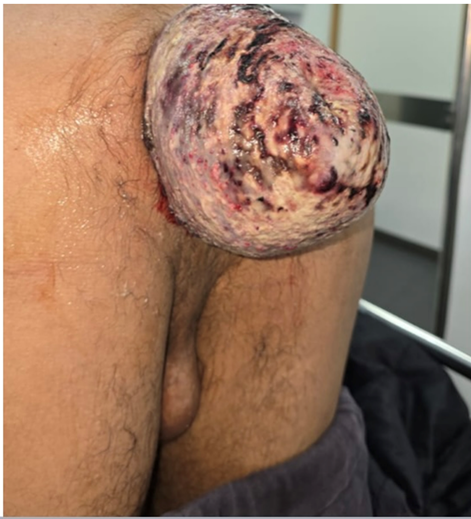
Figure 1: Clinical presentation: irreducible rectal prolapse with signs of edema and necrosis.
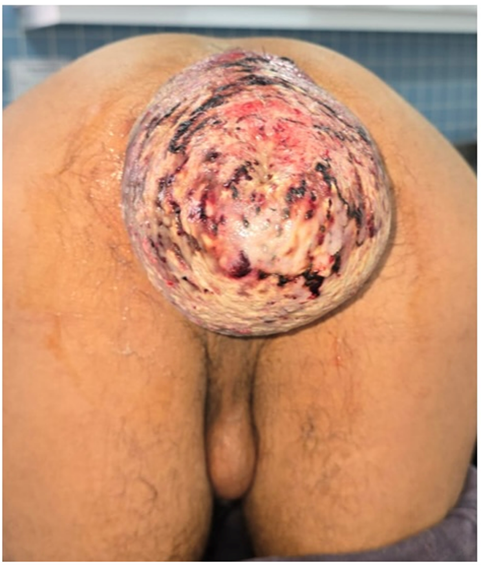
Figure 2: Posterior view of the prolapsed segment showing ischemic changes.
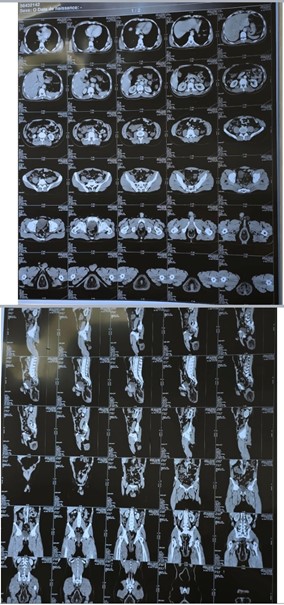
Figure 3: Abdominopelvic CT showing complete intussusception of the rectum.
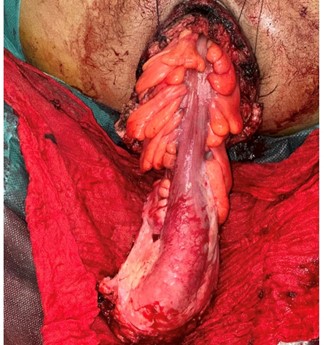
Figure 4: Intraoperative view of the prolapsed rectosigmoid exteriorized through the anal canal.
Discussion
Complicated rectal prolapse, particularly with irreducibility and signs of necrosis, is a surgical emergency. CT scan plays a crucial role in ruling out internal complications and planning surgery. The Altemeier procedure remains an effective and safe technique in this context. Although abdominal approaches (e.g. rectopexy) are common, perineal techniques are favored in acute, ischemic cases to minimize morbidity.
Literature review:
- Perineal procedures such as the Altemeier are associated with lower morbidity in emergency and elderly patients (Watts et al., Ann R Coll Surg Engl, 2019).
- Recurrence rate ranges from 10% to 30%, but acceptable considering patient selection and operative context.
Patient’s perspective
The patient expressed relief after the operation and was satisfied with the overall outcome.
Learning points
- Complicated rectal prolapse with necrosis requires urgent surgical management.
- The Altemeier procedure is effective for perineal rectosigmoidectomy in emergency settings.
- Radiological assessment is crucial to rule out intra-abdominal complications before surgery.
Declarations
Patient consent: Obtained.
Ethical approval: Not required for single-patient case report.
Conflict of interest: None.
Funding: None.
Authors' contributions: All authors contributed equally to the surgical management and manuscript writing.
References
- Deen KI, Grant E, Billingham C, Keighley MR. Abdominal rectopexy with sigmoid resection is superior to rectopexy alone in the management of full-thickness rectal prolapse. Br J Surg, 1994; 81(6): 906–910.
- Tou S, Brown SR, Nelson RL. Surgical repair of rectal prolapse in adults. Cochrane Database Syst Rev, 2015.
- Altemeier WA, et al. The surgical treatment of complete rectal prolapse by resection of the rectum and sigmoid. Surg Gynecol Obstet, 1971.