
Email id: info@ijclinmedcasereports.com
Kidney Failure of Unknown Aetiology in A Public Haemodialysis Programme in Northern Paraguay: A Clinical Profile
Raúl Desvars1,2,*, Jorge Rojas Godoy1, Elena Schupp2 and Gabriela Fernandez Coronel2
1Facultad de Medicina, Universidad Nacional de Concepción, Concepción, Paraguay
2Hospital Regional de Concepción, Ministerio de Salud Pública y Bienestar Social, Concepción, Paraguay
Received Date: 05/11/2026; Published Date: 31/12/2026
*Corresponding author: Raúl Desvars; Faculty of Medicine, Universidad Nacional de Concepción, Concepción, Paraguay. Full postal address: Facultad de Medicina, Campus Universitario UNC, Concepcion, Paraguay
ORCID: 0000-0003-3372-6329
Abstract
Aim: Chronic kidney disease of unknown aetiology has emerged in agricultural regions of Central America and South Asia, but it has not been described in Paraguay. We characterised patients with kidney failure of unknown aetiology in a public haemodialysis programme in northern Paraguay.
Methods: Cross-sectional study of the national dialysis registry at Hospital Regional de Concepción. Patients with unknown aetiology were compared with those with a known cause, using registry data, dialysis-unit laboratory values and, for a subset, linked hospital laboratory records.
Results: Of 149 patients, 32 (21.5%; 95% CI 15.6–28.7) had unknown aetiology. Their median age was 43.5 years versus 63.0 years with a known cause; 56.2% were younger than 45 years. Men made up 68.8%, similar to the known-cause group, and 84.4% relied on the Ministry of Health (57.3% with a known cause). They more often had an arteriovenous fistula (60.0% vs 32.7%; adjusted OR 3.02, 95% CI 1.20–7.57), lower serum calcium and higher alkaline phosphatase (adjusted ratio 1.36, 1.00–1.86). In linked hospital records, uric acid was 9 mg/dL or more in 8 of 9 patients with unknown aetiology and potassium below 3.5 mmol/L in 3 of 8.
Conclusion: One in five patients, mostly young adults relying on the public system, started dialysis without a diagnosed cause. Signs of advanced mineral bone disease suggest long-standing silent kidney disease, and the hyperuricaemia and hypokalaemia seen in a few patients resemble descriptions from Mesoamerica and Sri Lanka. A prospective study with standardised work-up is needed in northern Paraguay.
Keywords: Chronic kidney disease of unknown aetiology; Mesoamerican nephropathy; Renal dialysis; hyperuricaemia; Health inequities; Paraguay
Introduction
In the past two decades, Chronic Kidney Disease (CKD) unrelated to diabetes, hypertension or glomerular disease has emerged as an epidemic in agricultural communities of Central America, Sri Lanka, India and Egypt [1–4]. It mainly affects young and middle-aged adults, often male farmworkers, and progresses silently to kidney failure [2,4]. Biopsies show chronic tubulointerstitial damage with little proteinuria [3,5]. Hyperuricaemia and electrolyte disturbances, including hypokalaemia, are frequent clinical features [2,5]. Agrochemicals, heavy metals, heat stress with dehydration and infections have all been proposed as causes, but none has been confirmed [1–3]. In Sri Lanka, tubulointerstitial nephropathy is now the most common biopsy diagnosis in men, while lupus nephritis predominates in women [6].
Outside these hotspots, CKD of unknown aetiology is harder to see. In the Latin American Dialysis and Renal Transplantation Registry, five countries reported CKD of non-traditional causes in 2019 [7]. In Argentina, 17% of patients starting dialysis between 2004 and 2021 had no known cause; they were younger, more often female and of more precarious socioeconomic status, and showed signs of late or absent kidney care [8]. Only 9.4% of all patients starting dialysis there had a biopsy-confirmed diagnosis [8]. An unknown aetiology may therefore reflect a distinct disease, a known disease that was never diagnosed because referral came too late [9], or both.
The department of Concepción, in northern Paraguay, is largely rural and agricultural, with hot summers. Its regional hospital is the referral centre for kidney care. In our earlier work there, most critically ill patients who needed haemodialysis required it within 48 hours of admission, a sign of late presentation [10]. We have also described acute kidney injury and severe decompensation of CKD after venomous animal injuries in remote areas, an environmental route to kidney damage [11,12]. Paraguay's segmented health system separates the non-contributory Ministry of Public Health and Social Welfare (MSPBS) from the contributory Social Security Institute (IPS), with little coordination between them [13].
No study has described patients with kidney failure of unknown aetiology in Paraguay. We aimed to characterise these patients in a public regional haemodialysis programme, compare them with patients with a known cause, and look for features that might point to a CKD of unknown aetiology phenotype or to undiagnosed known diseases.
Methods
Design and setting: This was a cross-sectional study of routinely collected data, reported according to the STROBE statement [14]. The haemodialysis unit of the Hospital Regional de Concepción is an MSPBS facility serving the department of Concepción and neighbouring areas. It treats MSPBS patients and [describe the arrangement under which IPS beneficiaries are dialysed at the unit], and reports to the national dialysis registry.
Participants and case definition: We included every patient with a record in the unit's registry export covering [study period]. Cases were patients whose primary cause of kidney failure was recorded by the treating nephrologist as "unknown". The comparison group comprised all other patients, subdivided into diabetic kidney disease (DKD) and other known causes (hypertensive nephropathy, lupus nephritis, polycystic kidney disease, obstructive uropathy and other). [Describe the usual work-up before a cause is recorded: ultrasound, urinalysis, proteinuria, serology, biopsy availability.]
Variables and data sources: From the registry we obtained health coverage, vascular access, weekly epoetin dose, serology for hepatitis B and C, HIV and Chagas disease, and registry exit (death or transfer). Age and sex, together with the most recent haemoglobin, albumin, single-pool Kt/V, ferritin, transferrin saturation, phosphorus, calcium, alkaline phosphatase and dialysis vintage, came from the unit's clinical spreadsheet. For patients who also had hospital laboratory reports, we extracted the first recorded uric acid, potassium, sodium, glucose, glycated haemoglobin, creatinine, urea and haemoglobin. Sources were linked by national identity number and then de-identified. CKD definitions followed KDIGO [15].
Statistical analysis: Continuous variables are summarised as medians with interquartile ranges (IQR) and compared with the Mann–Whitney U test; categorical variables were compared with Fisher's exact test. Proportions are reported with Wilson 95% confidence intervals (CI). The main comparison was unknown versus all known causes. Because the unknown group was much younger, we adjusted key comparisons for age (per 10 years), sex and coverage: logistic regression for fistula use, and linear regression for calcium, haemoglobin and log-transformed alkaline phosphatase, reported as a ratio of geometric means. The hospital laboratory comparison was exploratory, given its small size. Analyses used Python 3 with SciPy and statsmodels.
Bias, study size and missing data: All patients in the registry were included, so the study size was fixed by the registry and no sample size was calculated. To limit information bias, sources were linked by identity number and checked against source documents; to limit confounding by age, key comparisons were adjusted as described above. Each comparison used all patients with data for that variable, and the number with data is shown in the tables. Age groups (<45, <50 and <60 years) and laboratory thresholds (calcium <8.4 mg/dL, uric acid ≥9 mg/dL, potassium <3.5 mmol/L) follow common clinical cut-offs and earlier descriptions of CKD of unknown aetiology. As a subgroup analysis, we compared the frequency of unknown aetiology between women and men younger than 45 years.
Ethics: The study was approved by [ethics committee, approval number and date], which waived individual consent for the use of de-identified routine data [confirm]. Names, identity numbers and exact dates were removed before analysis.
Results
Who the patients were: Of 149 registered patients, 32 (21.5%, 95% CI 15.6–28.7) had kidney failure of unknown aetiology, 65 had DKD and 52 had other known causes. Patients with unknown aetiology were much younger than those with a known cause (median 43.5 vs 63.0 years; p < 0.001; Table 1). Their ages ranged from 25 to 80 years, and 20 of 32 (62.5%) were younger than 50 (Figure 1). More than half (56.2%) were younger than 45 years, compared with 12.0% of patients with a known cause. Under 45 years, unknown aetiology was recorded in 7 of 10 women and 11 of 22 men (p = 0.45).
Men made up 68.8% of the unknown group, similar to the 65.8% of the known-cause group (p = 0.83). Most patients with unknown aetiology relied on MSPBS (84.4% vs 57.3%; p = 0.007), including 15 of the 18 younger than 45 years. All 27 patients with recorded serology tested negative for hepatitis B surface antigen, hepatitis C, HIV and Chagas disease.
Vascular access and treatment: Patients with unknown aetiology more often had an arteriovenous fistula (18/30, 60.0%) than those with a known cause (34/104, 32.7%; p = 0.010). The difference persisted after adjustment for age, sex and coverage (OR 3.02, 95% CI 1.20–7.57). Seven of the 30 (23.3%), however, were still dialysed through a non-tunnelled catheter. A weekly epoetin dose of 12,000 IU was prescribed to 22.2% of the unknown group and 11.5% of the known-cause group, a difference that was not significant across dose levels (p = 0.29).
Laboratory profile on dialysis: Patients with unknown aetiology had lower serum calcium (median 7.9 vs 8.8 mg/dL; p = 0.040) and higher alkaline phosphatase (241.5 vs 187.0 U/L; p = 0.038) (Table 2). Calcium was below 8.4 mg/dL in 63.0% of them, compared with 34.1% of known-cause patients (p = 0.013). After adjustment, alkaline phosphatase remained 36% higher (ratio 1.36, 1.00–1.86; p = 0.048), whereas the calcium difference narrowed (−0.41 mg/dL, −1.08 to 0.26), partly explained by coverage. Haemoglobin tended to be lower (10.1 vs 10.5 g/dL; adjusted difference −0.61, −1.34 to 0.11). Phosphorus, albumin, Kt/V, ferritin and transferrin saturation did not differ. Parathyroid hormone was not available. Dialysis vintage, recorded for 21 patients with unknown aetiology, was longer than in the known-cause group (median 7.7 vs 3.6 months; p = 0.19).
Hospital laboratory records: Eighteen patients with unknown aetiology (56%) and 39 with a known cause had linked hospital laboratory reports. At the first recorded test, uric acid was 9 mg/dL or more in 8 of 9 patients with unknown aetiology and 5 of 15 with a known cause (p = 0.013; medians 10.5 vs 8.3 mg/dL). Potassium was below 3.5 mmol/L in 3 of 8 and 0 of 23 (p = 0.012). First recorded creatinine was high in both groups (median 10.4 vs 8.8 mg/dL; p = 0.21). Two of the 18 patients with unknown aetiology had values compatible with diabetes: glycated haemoglobin 7.1% in one and random glucose 213 mg/dL in another.
Outcomes: Four patients with unknown aetiology (12.5%) died during the study period, two from cardiac and two from infectious causes, compared with 17.1% of the known-cause group (p = 0.79). One was transferred.
Table 1: Characteristics of patients by cause of kidney failure, n (%) or median (IQR).
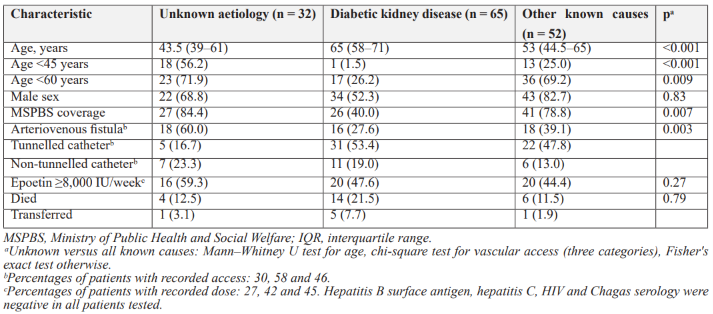
Table 2: Laboratory profile of patients with unknown versus known aetiology, median (IQR) or n/N.
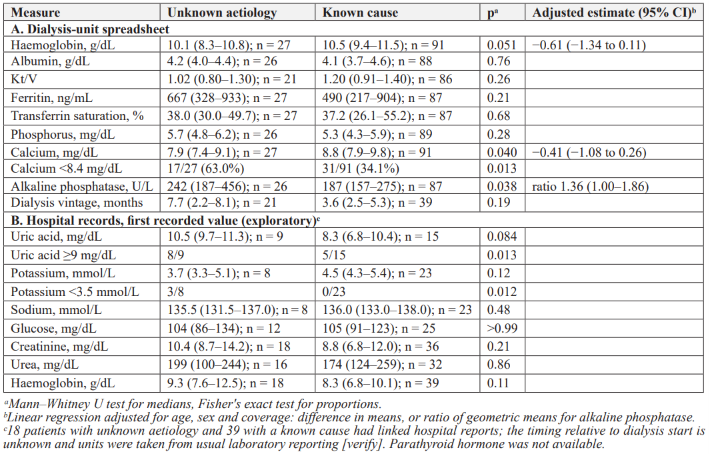
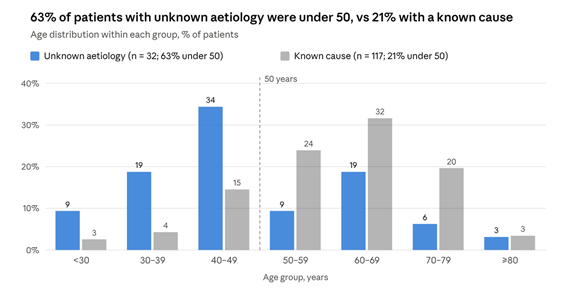
Figure 1: Age distribution of patients with kidney failure of unknown aetiology (n = 32) and with a known cause (n = 117).
Discussion
One in five patients in this public haemodialysis programme reached dialysis without a diagnosed cause. They were mostly young adults who relied on the Ministry of Health, and women were affected as often as men. Their laboratory profile suggested long-standing kidney disease that had gone unnoticed, and a few showed the hyperuricaemia and hypokalaemia described in CKD of unknown aetiology elsewhere. These findings do not establish a regional nephropathy, but they justify looking for one.
Comparison with other settings: The share of unknown aetiology (21.5%) was close to Argentina's 17%, where these patients were also younger and more socioeconomically vulnerable [8]. The age profile, concentrated between 25 and 50 years, resembles that of agricultural CKD in Central America and South Asia [2,4]. The sex pattern does not. Classical descriptions emphasise young men in heavy outdoor work [2,4], while our unknown group was no more male than the known-cause group, and under 45 years women had unknown aetiology as often as men. This mixture suggests more than one process. Some patients may have an environmental or occupational nephropathy; others probably have glomerular diseases, congenital anomalies or reflux that were never diagnosed. In Sri Lanka, biopsies revealed tubulointerstitial disease in men but lupus nephritis as the leading diagnosis in women [6].
What the laboratory profile suggests: Lower calcium and higher alkaline phosphatase point to more advanced CKD–mineral and bone disorder, which develops over years of reduced kidney function. Together with the young age and the high creatinine at first hospital contact, this pattern fits a disease that progressed silently until patients arrived with kidney failure, the same late presentation we observed in critically ill patients at this hospital [10]. Late referral is associated with worse outcomes on dialysis [9], and it also removes the chance to identify a cause, because small, scarred kidneys rarely allow a specific diagnosis. The higher use of fistulas in this group is harder to interpret. Younger patients have better vessels, and a longer time on dialysis gives more time to create a fistula; both may play a part.
The hyperuricaemia and hypokalaemia in our hospital records are signals, not findings. In Nicaraguan families affected by Mesoamerican nephropathy, uric acid was higher than in CKD patients from the United States (mean 9.6 vs 7.4 mg/dL in men), but hypokalaemia was uncommon [16]. Other series report frequent hypokalaemia, hyponatraemia and hypomagnesaemia [2,5]. Our numbers were very small, we did not know when the tests were taken relative to dialysis, and diuretics or dialysis itself can lower potassium. Two patients had values compatible with diabetes, a reminder that the label "unknown" includes misclassified known causes.
Public health and research implications: The first need is a standard work-up for every patient who starts dialysis without a cause. At minimum it should include kidney ultrasound, urinalysis and protein quantification, uric acid, potassium and magnesium, glycated haemoglobin and autoimmune serology, recorded in the registry [15]. The second is an occupational and environmental history: agricultural work, pesticide use, drinking water source, heat exposure and venomous animal injuries [3,11,12]. The third is earlier detection. Community screening with creatinine and urine dipstick among young adults in agricultural districts of Concepción would show whether reduced kidney function clusters there, as in other regions [4,17]. Finally, access to kidney biopsy for young patients with moderate CKD and normal-sized kidneys would allow tubulointerstitial disease to be distinguished from glomerular disease. Because most of these patients rely on the public system, the cost of inaction falls on MSPBS and on the families least able to bear it [13,18]. Sri Lanka and India face the same challenge, and shared case definitions would let northern Paraguay contribute to that international effort [3–5].
Strengths and limitations: This is, to our knowledge, the first description of kidney failure of unknown aetiology in Paraguay, and it combines registry, dialysis-unit and hospital data. Its limitations are important. The unknown group had only 32 patients, so comparisons are imprecise. The label was assigned clinically, without a standard work-up, and may include undiagnosed known diseases. We had no data on proteinuria, kidney size, biopsy, occupation, residence or water source. Laboratory values were cross-sectional, and the hospital records covered fewer than half of the patients, with unknown timing. Finally, the data came from routine records whose linkage was checked [complete after validation], and some error remains possible.
Conclusion
In a public haemodialysis programme in northern Paraguay, 21.5% of patients had kidney failure of unknown aetiology. Most were adults younger than 50 who relied on the Ministry of Health, and women were affected as often as men. Signs of advanced mineral bone disease point to long-standing silent kidney disease, and the hyperuricaemia and hypokalaemia found in a few patients echo descriptions from Mesoamerica and Sri Lanka. A standard diagnostic work-up at dialysis start, an occupational and environmental history in the registry, and community screening of young adults in agricultural districts are the next steps.
Practice points
- One in five patients in a public haemodialysis unit in northern Paraguay had kidney failure of unknown aetiology.
- These patients were mostly younger than 50, relied on the Ministry of Health, and included as many women as men under 45.
- Lower calcium and higher alkaline phosphatase suggest kidney disease that progressed silently for years before dialysis.
- Every patient starting dialysis without a cause should receive a standard work-up and an occupational and environmental history.
- Community screening of young adults in agricultural districts would show whether a regional nephropathy exists.
Declarations
Author contributions: RD conceived the study, collected the data and drafted the manuscript. JRG contributed to the public health interpretation. ES and GFC designed and ran the statistical analysis. All authors revised and approved the final version.
Funding: None
Competing interests: The authors declare no conflicts of interest.
Data availability: De-identified data are available from the corresponding author on reasonable request, subject to approval by the ethics committee.
References
- Johnson RJ, Wesseling C, Newman LS. Chronic kidney disease of unknown cause in agricultural communities. N Engl J Med, 2019; 380(19): 1843–1852. doi: 10.1056/NEJMra1813869.
- Correa-Rotter R, García-Trabanino R. Mesoamerican nephropathy. Semin Nephrol, 2019; 39(3): 263–271. doi: 10.1016/j.semnephrol.2019.02.004.
- Jayasumana C, Orantes C, Herrera R, Almaguer M, Lopez L, Silva LC, et al. Chronic interstitial nephritis in agricultural communities: a worldwide epidemic with social, occupational and environmental determinants. Nephrol Dial Transplant, 2017; 32(2): 234–241. doi: 10.1093/ndt/gfw346.
- Almaguer M, Herrera R, Orantes CM. Chronic kidney disease of unknown etiology in agricultural communities. MEDICC Rev, 2014; 16(2): 9–15. doi: 10.37757/MR2014.V16.N2.3.
- Wijkström J, Jayasumana C, Dassanayake R, Priyawardane N, Godakanda N, Siribaddana S, et al. Morphological and clinical findings in Sri Lankan patients with chronic kidney disease of unknown cause (CKDu): similarities and differences with Mesoamerican Nephropathy. PLoS One, 2018; 13(3): e0193056. doi: 10.1371/journal.pone.0193056.
- Pett J, Linhart C, Osborne N, Morrell S, Fahim M, Knight J, et al. Tubulointerstitial nephropathy is the predominant finding in men in a review of more than 3000 renal biopsies over a 10-year period from Sri Lanka. BMC Nephrol, 2024; 25(1): 295. doi: 10.1186/s12882-024-03731-7.
- Luxardo R, Ceretta L, González-Bedat M, Ferreiro A, Rosa-Diez G. The Latin American Dialysis and Renal Transplantation Registry: report 2019. Clin Kidney J, 2021; 15(3): 425–431. doi: 10.1093/ckj/sfab188.
- Rosa-Diez G. Special situations in Argentina: addressing the challenges faced by individuals on dialysis without a diagnosis. Semin Nephrol, 2025; 45(1–2): 151603. doi: 10.1016/j.semnephrol.2025.151603.
- Smart NA, Titus TT. Outcomes of early versus late nephrology referral in chronic kidney disease: a systematic review. Am J Med, 2011; 124(11): 1073–1080.e2. doi: 10.1016/j.amjmed.2011.04.026.
- Desvars R, Rojas J, Schupp E. Early prediction of urgent hemodialysis in critically ill patients with acute kidney injury or acute-on-chronic kidney failure: a multivariable clinical–laboratory model. South Florida J Health, 2026; 7(1): e6271. doi: 10.46981/sfjhv7n1-009.
- Desvars R, Ramirez A, Schupp E, Rojas Godoy J, Fernandez Coronel G. Renal consequences of venomous animal injuries: four clinical cases of acute kidney injury and severe chronic kidney disease decompensation. Jana Nexus J Health Med, 2026; 2(4): 7–12. doi: 10.21474/jnhm01/126.
- Desvars R, Schupp E, Ramirez A, Rojas J. WCN24-2319 Impact of venomous animal bites on renal function: an analysis of three clinical cases. Kidney Int Rep, 2024; 9(4 Suppl): S651–652. doi: 10.1016/j.ekir.2024.02.1368.
- Dullak R, Rodriguez-Riveros MI, Bursztyn I, Cabral-Bejarano MS, Ruoti M, Paredes ME, et al. Atención primaria en salud en Paraguay: panorámica y perspectivas. Cienc Saude Colet, 2011; 16(6): 2865–2875. doi: 10.1590/S1413-81232011000600024.
- von Elm E, Altman DG, Egger M, Pocock SJ, Gøtzsche PC, Vandenbroucke JP, et al. The Strengthening the Reporting of Observational Studies in Epidemiology (STROBE) statement: guidelines for reporting observational studies. Lancet, 2007; 370(9596): 1453–1457. doi: 10.1016/S0140-6736(07)61602-X.
- Kidney Disease: Improving Global Outcomes (KDIGO) CKD Work Group. KDIGO 2024 clinical practice guideline for the evaluation and management of chronic kidney disease. Kidney Int, 2024; 105(4S): S117–314. doi: 10.1016/j.kint.2023.10.018.
- Kupferman J, Amador JJ, Lynch KE, Laws RL, López-Pilarte D, Ramírez-Rubio O, et al. Characterization of Mesoamerican nephropathy in a kidney failure hotspot in Nicaragua. Am J Kidney Dis, 2016; 68(5): 716–725. doi: 10.1053/j.ajkd.2016.06.012.
- Correa-Rotter R, Méndez Durán A, Vallejos A, Rico-Fontalvo J, Cusumano AM, Rosa-Diez GJ, et al. Unmet needs of CKD in Latin America: a review from expert virtual working group. Kidney Int Rep, 2023; 8(5): 954–967. doi: 10.1016/j.ekir.2023.02.1082.
- Garcia-Garcia G, Jha V. CKD in disadvantaged populations. Kidney Int, 2015; 87(2): 251–253. doi: 10.1038/ki.2014.369.