
Email id: info@ijclinmedcasereports.com
Occupational Contact Dermatitis: Translating Diagnosis into Causation, Prevention, and Fitness-for-Work Decisions
Mafalda Bica Tavares1,*, Martim Luz2, João Coutinho de Sousa1, Renato Matos Barbosa1, Amanda Dias1, Rita Gil Duarte1, Ana Beatriz Oliveira1, Miguel Magalhães1, Ana Catarina Carvoeiro1, Filipe Araújo1, Ana Sofia Duarte1, Nuno Augusto Saldanha1 and Sara Alves Matos1
1Occupational Health Service, Unidade Local de Saúde de Santo António, Porto, Portugal
2Dermatology Service, Unidade Local de Saúde de Santo António, Porto, Portugal
Received Date: 06/10/2026; Published Date: 07/12/2026
*Corresponding author: Mafalda Bica Tavares, Occupational Health Service, Unidade Local de Saúde de Santo António, Largo do Professor Abel Salazar, 4099-001 Porto, Portugal
Abstract
Contact dermatitis accounts for approximately 90% of occupational skin disorders, and occupational contact dermatitis constitutes up to 30% of reported occupational diseases. Irritant contact dermatitis, the most common form, results from direct injury to the epidermal barrier, whereas allergic contact dermatitis is a delayed T cell-mediated reaction that requires prior sensitization. The two frequently coexist and are difficult to distinguish clinically, particularly in chronic hand eczema. This mini review approaches occupational contact dermatitis from the perspective of occupational medicine. It summarizes the mechanisms and the diagnostic work-up, including patch testing with workplace materials and the assessment of clinical relevance, and then examines five responsibilities of the occupational physician. These are the attribution of occupational causation or aggravation with the Mathias criteria and the operational definition of Ale and Maibach, exposure assessment against the current definition of wet work, prevention structured as a hierarchy in which elimination, substitution, and technical and organizational controls precede personal protection, a fitness-for-work decision with a graded return to work, and statutory notification of suspected occupational disease. The Portuguese medicolegal framework is used as a worked example of how these steps connect. Identification of the causal agent is only the first stage of management. The decisive task is to translate it into a documented causation judgment, a feasible workplace adaptation, and the appropriate notification.
Keywords: Occupational dermatitis; Allergic contact dermatitis; Irritant contact dermatitis; Patch tests; Wet work; Fitness for work
Introduction
Contact dermatitis is an inflammatory skin condition caused by exposure to exogenous substances and is classified as irritant or allergic [1]. Its prevalence is estimated at 1.7% to 9.8%, it accounts for 4% to 7% of dermatology consultations, and it is more common in women [1]. Approximately 90% of occupational skin disorders in industrialized countries are contact dermatitis, mostly irritant [1], and occupational contact dermatitis constitutes up to 30% of reported occupational diseases [2].
Risk is concentrated in occupations involving wet work and exposure to detergents, disinfectants, metalworking fluids, cement, metals, rubber, and resins, and healthcare workers, hairdressers, food handlers, and construction and metal workers are consistently over-represented [1-3]. Irritant, allergic, and endogenous factors often coexist in the same worker [2].
The dermatological diagnosis of contact dermatitis is well established, but its translation into occupational decisions is less often presented as an integrated sequence. A positive patch test does not by itself establish occupational disease [4], determine work restrictions, or satisfy statutory notification requirements. The occupational physician must link the finding to a documented exposure and translate it into decisions on causation, prevention, fitness for work, and notification. This mini review examines occupational contact dermatitis from the point at which the dermatological diagnosis meets occupational decision-making and uses the Portuguese medicolegal framework as a worked example.
Methods
This narrative mini review is based on a targeted, non-systematic search of MEDLINE through PubMed, using combinations of the terms occupational contact dermatitis, irritant contact dermatitis, allergic contact dermatitis, hand eczema, wet work, patch testing, clinical relevance, occupational causation, fitness for work, return to work, skin protection, and occupational disease notification. The search was last updated in 2026. Current European and German guidelines on patch testing, hand eczema, and occupational skin products [4-7], the German technical rules on skin exposure [8], and the Portuguese legal instruments on fitness for work and occupational disease were also consulted. Priority was given to guidelines, systematic reviews, and reviews published in the past five years. Older publications were retained only when they introduced an instrument that remains in use, namely the Mathias criteria and the operational definition of Ale and Maibach, or when no more recent systematic review was available. Legal instruments and official national guidance were cited in their current versions irrespective of date. Selection and synthesis were performed by the authors without a formal screening protocol or risk-of-bias assessment.
Mechanisms and Clinical Features
Irritant contact dermatitis results from disruption of the epidermal barrier combined with activation of innate immunity, and it requires no prior sensitization [9]. Acute irritant dermatitis follows a single exposure to a potent irritant and causes burning, stinging, and soreness, whereas irritants such as benzalkonium chloride may produce a delayed reaction 8 to 24 hours after exposure that can be mistaken for allergy [9]. The most common occupational form results from repeated exposure to weak irritants or wet work over a long period [2], when the interval between exposures is too short for recovery of barrier function [9]. In a systematic review, the evidence for an association with irritant contact dermatitis was strong for wet work, moderate for detergents and non-alcoholic disinfectants, and strong for their combination [3]. Occlusion, heat, sweating, and friction increase irritation, and frictional damage enhances the penetration of allergens [9].
Allergic contact dermatitis is a type IV delayed hypersensitivity reaction that develops in two phases [1]. In the sensitization phase, haptens bind skin proteins and are presented by Langerhans cells and dermal dendritic cells to naive T cells in regional lymph nodes. On re-exposure, the elicitation phase produces dermatitis, usually within 24 to 48 hours [1]. In a North American analysis of occupational allergic contact dermatitis, the most common clinically relevant allergens were rubber accelerators, methylisothiazolinone, epoxy resin, formaldehyde, nickel, potassium dichromate, 2-hydroxyethyl methacrylate, and cobalt [2].
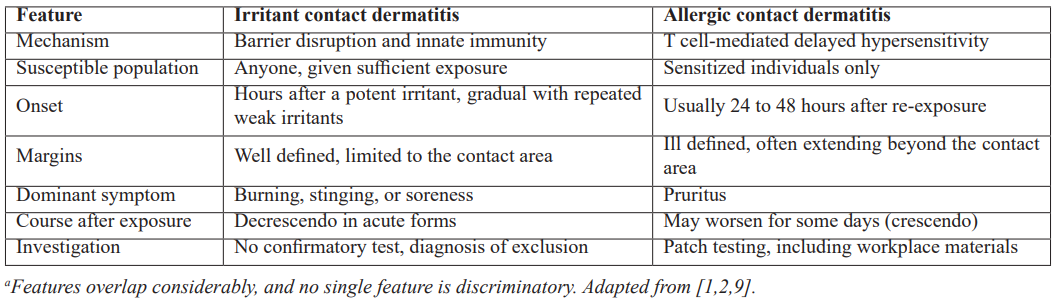
The two forms often cannot be distinguished on clinical grounds alone, particularly in chronic hand dermatitis (Table 1) [2,9]. Irritant contact dermatitis is therefore a diagnosis of exclusion, established from the exposure history, the distribution of lesions, and negative patch test results [9]. A positive patch test confirms sensitization but does not exclude a concurrent irritant component [2]. Allergen avoidance alone may therefore fail to resolve the dermatitis if wet work and other irritant exposures are not reduced at the same time.
Table 1: Distinguishing features of irritant and allergic contact dermatitisa.
Diagnosis and Clinical Relevance
The occupational history distinguishes an occupational assessment from a dermatological one and should be documented in detail, because it may later be required for medicolegal purposes [4]. It should record current and previous jobs, the tasks performed, the materials handled with reference to safety data sheets, the personal protective equipment used, similar complaints among co-workers, and the course of symptoms during holidays and rest days [2,4]. Safety data sheets are often incomplete but guide the selection of workplace materials for testing [2]. Non-occupational exposures must be recorded with equal care, and topical treatments may themselves cause secondary contact dermatitis [2].
Patch testing is the reference standard for the diagnosis of allergic contact dermatitis [1,4]. The baseline series detects most, but not all, occupational contact allergies. In a North American analysis, 18% of patients with occupational allergic contact dermatitis reacted to supplemental allergens, including 5% who reacted only to them [2]. The European baseline series should therefore be supplemented by occupation-specific series and by the worker's own products at appropriate non-irritant concentrations, and testing with workplace materials has been reported to yield almost 20% additional diagnoses of occupational allergic contact dermatitis [4]. Unidentified substances should not be tested [2,4]. Allergens are removed on day 2, a second reading on day 3 or day 4 is required, and a later reading around day 7 is recommended because late reactions occur [1,4]. Distinguishing a weak allergic reaction from an irritant or doubtful one is a major interpretive challenge, and substantial intra- and inter-observer variation among experts led to a modified International Contact Dermatitis Research Group classification [10,11]. The temporal pattern across readings is often decisive, because allergic reactions persist or increase, whereas irritant reactions fade [4]. When suspicion persists despite negative testing, the repeated open application test assesses the product under conditions closer to actual use, and a negative test after two weeks may need to be extended to three or four weeks [1].
A positive reaction is relevant when sufficient exposure can be documented and the dermatitis can reasonably be explained by that exposure [4]. The dose required may be lowered by repeated or combined exposures, damaged skin, occlusion, friction, and sweating [4]. Relevance may be current, past, or unknown, and each diagnosis should state whether work is the sole, the predominant, or a contributory cause, or not a cause at all [4]. When relevance remains unknown, further exposure assessment and, where feasible, a workplace visit should precede the exclusion of an occupational cause, because the visit often provides information that is not obvious to the worker or the employer [4].
Establishing Occupational Causation
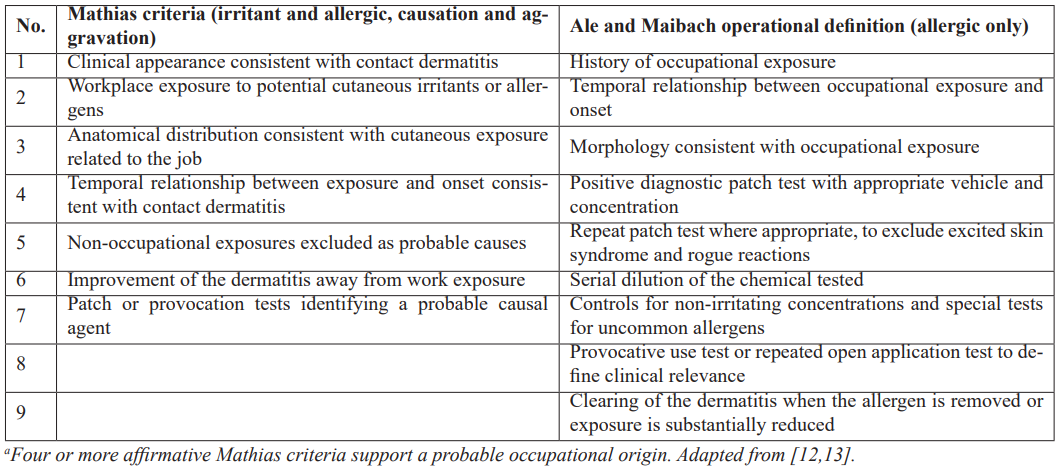
Two formal frameworks support the attribution of occupational causation and are best applied as complements (Table 2). The seven Mathias criteria address both causation and aggravation of irritant or allergic contact dermatitis, and four or more affirmative answers support a probable occupational origin [2,12]. This threshold has been reported to correspond to a probability of occupational causation of 50% or more, which supports its medicolegal use, although clear answers are not always possible in complex cases [2]. The nine-step operational definition of Ale and Maibach is restricted to allergic contact dermatitis and relies on patch and use testing [13]. We consider its greater evidentiary detail useful when an allergic causal conclusion is likely to be contested, although several of its steps are rarely feasible outside specialized centers.
Table 2: Frameworks for establishing occupational causation of contact dermatitisa.
Two interpretive points matter in practice. First, occupational dermatitis typically improves away from work, but acute irritant dermatitis may take weeks to heal, allergic reactions may worsen for some days after exposure stops, and chronic irritant dermatitis has a poor prognosis for complete healing [3,9]. The absence of improvement after a brief absence from work therefore does not exclude occupational causation. Second, persistent non-occupational exposure does not in itself exclude an occupational contribution, because the relative contributions of occupational and non-occupational exposure must be weighed [4].
Irritant contact dermatitis, although it represents most occupational cases, requires a different evidentiary route, because no confirmatory test exists. The causal argument rests on a documented irritant exposure of sufficient frequency, intensity, and duration, on the course of the dermatitis in relation to exposure, and on the exclusion of relevant contact allergy [3,9]. Aggravation deserves equal attention. Workers with a history of atopic dermatitis are at increased risk of irritant hand dermatitis [9], the Mathias criteria explicitly address aggravation [12], and in Portugal the notification of suspected occupational disease also covers the aggravation of a pre-existing condition [14]. The diagnostic statement should therefore specify any pre-existing disease and the exogenous co-factors involved, in addition to the causative exposure [4].
These frameworks construct the causal argument, but recognition and compensation in Portugal are determined against the national list of occupational diseases, whose chapter on skin diseases was revised in 2007 [15]. We recommend that the clinical formulation correspond as closely as possible to the nomenclature of that chapter. For a listed disease, compensation requires that the worker has the disease and was exposed to the corresponding risk through the nature of the work. A disease not included in the list may still be compensated when it is shown to be a necessary and direct consequence of the work performed and not normal wear of the organism [16].
Exposure Assessment
Causation assessment requires exposure to be characterized rather than merely asserted [4]. The parameters to be documented include the potency and physicochemical properties of the substance, its concentration, and the duration, frequency, skin site, and area of exposure, together with workplace factors that enhance penetration, such as wet work, occlusion, and mechanical trauma [4,9]. The amount of allergen deposited on the skin can be assessed in practice for only a few allergens, such as nickel with the dimethylglyoxime spot test [4].
Wet work should be quantified against an operational definition rather than described qualitatively. The classic definition, introduced in 1996 by the German Technical Rules for Hazardous Substances (TRGS) 401, comprises regular skin contact with liquids for more than two hours per working day, regular use of occlusive gloves for a comparable duration, or frequent hand washing, which has been quantified as about 20 times per day [3]. The current version of TRGS 401 emphasizes skin contact with water or aqueous liquids and frequent hand washing, alone or alternating with the wearing of liquid-tight gloves, and no longer considers the wearing of liquid-tight gloves alone to be wet work [8]. This change is consistent with systematic evidence that is limited for occlusive glove use without other exposures and moderate when glove use is combined with other wet work [3]. Quantification against a recognized threshold turns a vague description into a documented exposure.
Prevention
Prevention should follow a hierarchy of controls rather than an undifferentiated list of recommendations [6,9]. The German hand eczema guideline applies the STOP principle, which gives priority to substitution or elimination of the causative agent, followed by technical, organizational, and finally personal protective measures [6]. Gloves are therefore the last layer of protection. Their material should be selected according to the specific hazard, the task, and the permeation time [9], and occlusion under gloves may itself impair barrier function [9]. Gloves should be worn when required but not longer than necessary, with cotton undergloves beneath liquid-tight gloves when wearing times exceed about 10 minutes, depending on individual sweating [6]. Skin care products complement but do not replace exposure reduction, and where hygienically acceptable, alcohol-based hand disinfection is preferable to washing with detergents [2,7].
Skin protection education is widely recommended, and work-related programs have been effective in some occupational groups [9]. A Cochrane review, however, rated the evidence for its effect on the primary prevention of occupational irritant hand dermatitis as very low certainty and the evidence for moisturizers as low certainty [17]. Educational measures should therefore support rather than replace higher-level controls. Secondary prevention depends on early detection, because workers often delay seeking care for months, partly for fear of job loss, and a longer delay is associated with a poorer prognosis [2]. For severe occupational hand eczema refractory to outpatient treatment, multidisciplinary tertiary prevention programs combining three weeks of inpatient treatment, a further period without occupational exposure, intensive education, and vocational counseling have reduced eczema severity and days of absence from work [6,9].
Treatment and Return to Work
Treatment is based on identification and avoidance of the causative agent and on restoration of the epidermal barrier with regular use of emollients [1,9]. Topical corticosteroids are the first-line anti-inflammatory treatment for allergic contact dermatitis [1] and are commonly used in chronic hand eczema [18], whereas their role in irritant dermatitis is controversial, because prolonged use may impair barrier function [9]. Topical calcineurin inhibitors are a steroid-sparing option, and severe or relapsing disease may require phototherapy or systemic immunosuppressive agents [1]. The topical pan-Janus kinase inhibitor delgocitinib was superior to vehicle in two phase 3 trials in patients with moderate to severe chronic hand eczema [19].
Return to work should be planned as a graded process. The prognosis for complete healing of irritant dermatitis is poor when exposure continues unchanged [3], and a graduated return with ongoing skin monitoring to detect early recurrence has been used successfully [2]. Effective communication between the physician, the worker, the workplace, and the insurer, together with clear written recommendations, supports successful return to work [2]. The occupational physician should translate the diagnosis into specific exposures to be avoided and tasks to be modified rather than describe it only in clinical terms. Skin-specific workplace prescriptions that combine work restrictions, choice of protective equipment, hand hygiene, and treatment advice have been developed for this purpose [2].
In Portugal, these restrictions acquire operational force through the fitness-for-work form that the occupational physician completes after each health examination [20,21]. The form classifies the worker as fit, conditionally fit, temporarily unfit, or permanently unfit. It must be signed by the worker, and a copy is sent to the employer [20,21]. It cannot contain information covered by medical confidentiality [20], which provides a legal as well as a practical reason to word restrictions as exposures to be avoided rather than as a diagnosis. We recommend conditional fitness with a defined review date as the usual outcome, with unfitness reserved for cases in which exposure cannot be adequately controlled, because unfitness may cost the worker the job without resolving the dermatitis if the same exposure recurs in the next post. Persistent disease despite optimized controls may nevertheless justify redeployment, because a systematic review found moderate evidence that the prognosis of irritant contact dermatitis improves after a change of work tasks or occupation [3]. A history of atopic dermatitis should be recorded at the pre-placement examination so that skin protection and surveillance can be intensified from the outset [6], but in our view it should not in itself justify exclusion from employment.
Notification
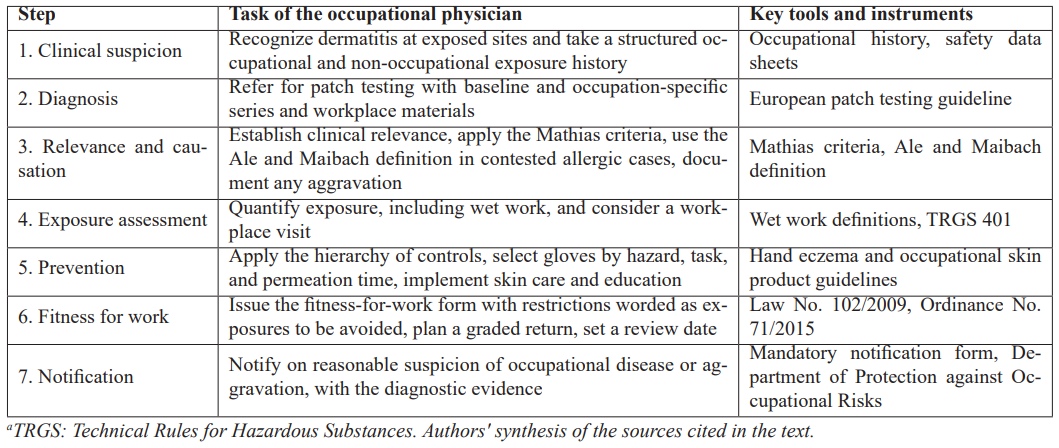
In Portugal, any physician who suspects an occupational disease or its aggravation, including general practitioners and hospital specialists, is legally required to notify it [14,22]. The physician's notification form is sent together with the complementary diagnostic examinations, including patch test results, to the Department of Protection against Occupational Risks of the Social Security Institute, which assesses and certifies the occupational disease [14]. The formal determination of occupational causation is therefore made by this administrative body, not by the notifying physician. Because the duty is triggered by reasonable suspicion rather than by diagnostic or legal certainty, diagnostic uncertainty should not delay notification. The complete sequence, from clinical suspicion to notification, is summarized in Table 3.
Table 3: Stepwise pathway from clinical suspicion to notification of occupational contact dermatitis in Portugala.
Discussion
The central argument of this review is that each step after the dermatological diagnosis, from relevance and causation to exposure quantification, prevention, fitness for work, and notification, has its own evidentiary standard and legal instrument, and none follows automatically from a positive patch test.
This mini review has limitations. It is a narrative rather than a systematic review, the selection of sources was not protocol-based, and the synthesis reflects the interpretive judgment of the authors. The Mathias criteria provide a probabilistic rather than a definitive attribution [2], and the Ale and Maibach definition applies only to allergic disease. Because repeated low-dose exposure, damaged skin, friction, and sweating lower the dose needed to elicit dermatitis [4], a single patch test application to intact skin may not reflect workplace exposure, so a negative result should be interpreted with caution when occupational suspicion remains high. The evidence for barrier creams, moisturizers, and skin protection education in primary prevention is of low or very low certainty [17]. The medicolegal sections describe the Portuguese framework, and notification procedures and recognition criteria differ between countries.
Conclusion
Occupational contact dermatitis is the most common occupational skin disease and frequently reflects overlapping irritant and allergic mechanisms. Its diagnosis requires a detailed occupational history and patch testing with an occupation-appropriate series supplemented by the materials handled at work. The distinctive task of occupational medicine is to translate that diagnosis into a documented causation assessment, a quantified exposure assessment, a hierarchy of preventive measures, a fitness-for-work decision worded as exposures to be avoided with a graded return to work, and statutory notification whenever occupational disease is reasonably suspected. These steps turn a dermatological diagnosis into an occupational health decision.
Author Contributions:
Mafalda Bica Tavares and Martim Luz contributed to the concept and design, acquired, analyzed, and interpreted the data, and drafted the manuscript. João Coutinho de Sousa, Renato Matos, Amanda Dias, Beatriz Oliveira, Miguel Magalhães, Catarina Carvoeiro and Filipe Araújo contributed to the concept and design. Martim Luz critically reviewed the manuscript for important intellectual content. Nuno Augusto Saldanha and Sara Alves Matos supervised the work and critically reviewed the manuscript for important intellectual content. All authors approved the final version of the manuscript and agreed to be accountable for all aspects of the work. Mafalda Bica Tavares is the guarantor of the work. Rita Gil Duarte contributed to the concept and design. Ana Sofia Duarte supervised the work and critically reviewed the manuscript for important intellectual content.
Competing Interests: The authors declare that they have no competing interests.
Grant Information: The authors received no specific funding for this work.
References
- Tramontana M, Hansel K, Bianchi L, Sensini C, Malatesta N, Stingeni L. Advancing the understanding of allergic contact dermatitis: from pathophysiology to novel therapeutic approaches. Front Med (Lausanne), 2023; 10: 1184289. doi: 10.3389/fmed.2023.1184289.
- Houle MC, Holness DL, DeKoven J. Occupational contact dermatitis: an individualized approach to the worker with dermatitis. Curr Dermatol Rep, 2021; 10(4): 182-191. doi: 10.1007/s13671-021-00339-0.
- Jacobsen G, Rasmussen K, Bregnhøj A, Isaksson M, Diepgen TL, Carstensen O. Causes of irritant contact dermatitis after occupational skin exposure: a systematic review. Int Arch Occup Environ Health, 2022; 95(1): 35-65. doi: 10.1007/s00420-021-01781-0.
- Uter W, Aerts O, Agner T, Brans R, Bruze M, Cannavó A, et al. European Society of Contact Dermatitis guideline for diagnostic patch testing: recommendations on best practice (update 2026). Contact Dermatitis, 2026; 95(3): 237-275. doi: 10.1111/cod.70195.
- Thyssen JP, Schuttelaar MLA, Alfonso JH, Andersen KE, Angelova-Fischer I, Arents BWM, et al. Guidelines for diagnosis, prevention, and treatment of hand eczema. Contact Dermatitis, 2022; 86(5): 357-378. doi: 10.1111/cod.14035.
- Bauer A, Brans R, Brehler R, Büttner M, Dickel H, Elsner P, et al. S2k guideline diagnosis, prevention, and therapy of hand eczema. J Dtsch Dermatol Ges, 2023; 21(9): 1054-1074. doi: 10.1111/ddg.15179.
- Arbeitsgemeinschaft der Wissenschaftlichen Medizinischen Fachgesellschaften. S2k-Leitlinie Berufliche Hautmittel: Hautschutz, Hautpflege und Hautreinigung [S2k guideline on occupational skin products: skin protection, skin care, and skin cleansing]. AWMF-Register-Nr. 013-056 [Internet]. Berlin: AWMF; 2025.
- Ausschuss für Gefahrstoffe. Technische Regeln für Gefahrstoffe TRGS 401: Gefährdung durch Hautkontakt. Ermittlung, Beurteilung, Maßnahmen [Technical Rules for Hazardous Substances TRGS 401: Risks resulting from skin contact. Determination, evaluation, measures] [Internet]. Dortmund: Bundesanstalt für Arbeitsschutz und Arbeitsmedizin, 2022.
- Patel K, Nixon R. Irritant contact dermatitis—a review. Curr Dermatol Rep, 2022; 11(2): 41-51. doi: 10.1007/s13671-021-00351-4.
- Bruze M, Ale I, Andersen KE, Elsner P, Goh CL, Goossens A, et al. Are we reading patch test reactions in a uniform way? An International Contact Dermatitis Research Group study. Dermatitis, 2025; 36(4): 352-357. doi: 10.1089/derm.2024.0364.
- Bruze M, Svedman C. Clarification and modification of the International Contact Dermatitis Research Group classification of patch test reactions on behalf of the International Contact Dermatitis Research Group. Dermatitis, 2025; 36(5): 440-446. doi: 10.1089/derm.2024.0365.
- Mathias CG. Contact dermatitis and workers' compensation: criteria for establishing occupational causation and aggravation. J Am Acad Dermatol, 1989; 20(5 Pt 1): 842-848. doi: 10.1016/s0190-9622(89)70096-7.
- Ale SI, Maibach HI. Operational definition of occupational allergic contact dermatitis. In: Kanerva L, Elsner P, Wahlberg JE, Maibach HI, editors. Handbook of occupational dermatology. Berlin, Heidelberg: Springer, 2000; p. 344-350. doi: 10.1007/978-3-662-07677-4_41.
- Direção-Geral da Saúde. Informação Técnica n.º 09/2014: Diagnóstico, conhecimento, prevenção e reparação da doença profissional [Technical Information No. 09/2014: Diagnosis, knowledge, prevention, and compensation of occupational disease] [Internet]. Lisboa: Direção-Geral da Saúde; 2014.
- Decreto Regulamentar n.º 6/2001, de 5 de maio, republicado pelo Decreto Regulamentar n.º 76/2007, de 17 de julho. Lista das doenças profissionais e respetivo índice codificado [Regulatory Decree No. 6/2001 of 5 May, republished by Regulatory Decree No. 76/2007 of 17 July. List of occupational diseases and its coded index] [Internet]. Diário da República, 1.ª série. 2007.
- Lei n.º 98/2009, de 4 de setembro. Regime de reparação de acidentes de trabalho e de doenças profissionais [Law No. 98/2009 of 4 September. Compensation scheme for occupational accidents and diseases] [Internet]. Diário da República, 1.ª série. 2009.
- Bauer A, Rönsch H, Elsner P, Dittmar D, Bennett C, Schuttelaar MLA, et al. Interventions for preventing occupational irritant hand dermatitis. Cochrane Database Syst Rev, 2018; 4(4): CD004414. doi: 10.1002/14651858.CD004414.pub3.
- Balato A, Tancredi V, Aerts O, Crépy MN, Dugonik A, Gonçalo M, et al. Chronic hand eczema: common questions and practical recommendations from the EADV Contact Dermatitis Task Force. J Eur Acad Dermatol Venereol, 2026; 40(4): 583-596. doi: 10.1111/jdv.70068.
- Bissonnette R, Warren RB, Pinter A, Agner T, Gooderham M, Schuttelaar MLA, et al. Efficacy and safety of delgocitinib cream in adults with moderate to severe chronic hand eczema (DELTA 1 and DELTA 2): results from multicentre, randomised, controlled, double-blind, phase 3 trials. Lancet, 2024; 404(10451): 461-473. doi: 10.1016/S0140-6736(24)01027-4.
- Lei n.º 102/2009, de 10 de setembro. Regime jurídico da promoção da segurança e saúde no trabalho, na redação atual [Law No. 102/2009 of 10 September. Legal framework for the promotion of safety and health at work, as amended] [Internet]. Diário da República, 1.ª série, 2009.
- Portaria n.º 71/2015, de 10 de março. Aprova o modelo da ficha de aptidão para o trabalho [Ordinance No. 71/2015 of 10 March. Approves the fitness-for-work form] [Internet]. Diário da República, 1.ª série. 2015.
- Decreto-Lei n.º 2/82, de 5 de janeiro. Torna obrigatória a participação de todos os casos de doença profissional [Decree-Law No. 2/82 of 5 January. Mandatory notification of all cases of occupational disease] [Internet]. Diário da República, 1.ª série. 1982.