
Email id: info@ijclinmedcasereports.com
Occupational Allergic Contact Dermatitis to p-Phenylenediamine in a Hairdresser: Patch Test Interpretation and Occupational Management
Mafalda Bica Tavares1,*, Margarida Contente2, João Coutinho de Sousa1, Renato Matos Barbosa1, Amanda Dias1, Rita Gil Duarte1, Ana Beatriz Oliveira1, Miguel Magalhães1, Ana Catarina Carvoeiro1, Filipe Araújo1, Ana Sofia Duarte1, Nuno Augusto Saldanha1 and Sara Alves Matos1
1Occupational Health Service, Unidade Local de Saúde de Santo António, Porto, Portugal
2Dermatology Service, Unidade Local de Saúde de Santo António, Porto, Portugal
Received Date: 06/10/2026; Published Date: 04/12/2026
*Corresponding author: Mafalda Bica Tavares, Occupational Health Service, Unidade Local de Saúde de Santo António, Largo do Professor Abel Salazar, 4099-001 Porto, Portugal
Abstract
Hairdressers have the highest incidence of occupational contact dermatitis, driven by wet work and potent allergens in hair products. We report a 41-year-old hairdresser with 18 years of exposure and a two-year history of fissured, scaling plaques on the dorsa of both hands that improved partially during holidays. Patch testing with the European baseline series, a hairdressers' series, and workplace products, read once on day 3, showed strong reactions to p-phenylenediamine and to an undiluted bleaching product, weak reactions to toluene-2,5-diamine and nickel, and a doubtful reaction to a hand cream. Ammonium persulfate was negative. Occupational allergic contact dermatitis to p-phenylenediamine was diagnosed, six of seven Mathias criteria were fulfilled, the case was notified, and she was declared fit for work with restrictions. The reliability of patch testing depends on a standardized protocol and explicit relevance assessment, and the diagnosis must be translated into notification and workplace controls.
Keywords: Allergic contact dermatitis; P-phenylenediamine; Patch tests; Hairdressers; Occupational diseases; Fitness for work
Introduction
Occupational contact dermatitis presents almost exclusively as hand eczema, and hairdressers rank highest in its incidence [1]. Hairdressing combines prolonged wet work with repeated exposure to reactive substances in dyeing, bleaching, and waving products, and irritant and allergic mechanisms frequently coexist [1]. A systematic review reported a pooled lifetime prevalence of hand eczema of 38.2% among hairdressers, with onset most often during apprenticeship [2].
Compared with other patch-tested patients, hairdressers have an up to fivefold higher risk of sensitization to p-phenylenediamine (PPD), ammonium persulfate, and glyceryl thioglycolate [1]. In a European surveillance study of 920 female hairdressers, PPD and toluene-2,5-diamine (PTD) each affected about one fifth of patients, often with coupled reactivity, and sensitization to ammonium persulfate was more frequent than in consumers (14.4% vs. 2.3%) [3]. PPD and PTD are primary intermediates of oxidative hair dyes, and ammonium persulfate is the main hapten of bleaching products [1].
This report describes the diagnostic pathway and the occupational management of a hairdresser with allergic contact dermatitis to PPD and discusses how a single patch test reading limited the interpretation of some reactions.
Case Report
A 41-year-old female hairdresser was referred to the dermatology department of a tertiary hospital for suspected occupational hand dermatitis. She reported a two-year history of a symmetrical, pruritic, and intermittently painful eruption on both hands that worsened during working periods and improved partially during holidays. She had worked as a hairdresser for 18 years, had no personal or family history of atopy or other relevant medical history, and took no regular medication. Examination revealed erythematous, scaling plaques with multiple fissures on the dorsa of both hands and fingers, extending to the wrists (Figure 1).
Her daily tasks comprised shampooing and rinsing, permanent hair coloring, bleaching, and cutting and styling. Wet work was estimated at approximately four hours per working day, twice the two-hour daily threshold used to define wet work [4]. She had never used gloves before the diagnosis and had received no formal training in skin protection. According to the patient, no co-worker had reported similar complaints, and no non-occupational source of the relevant allergens was identified on clinical history.
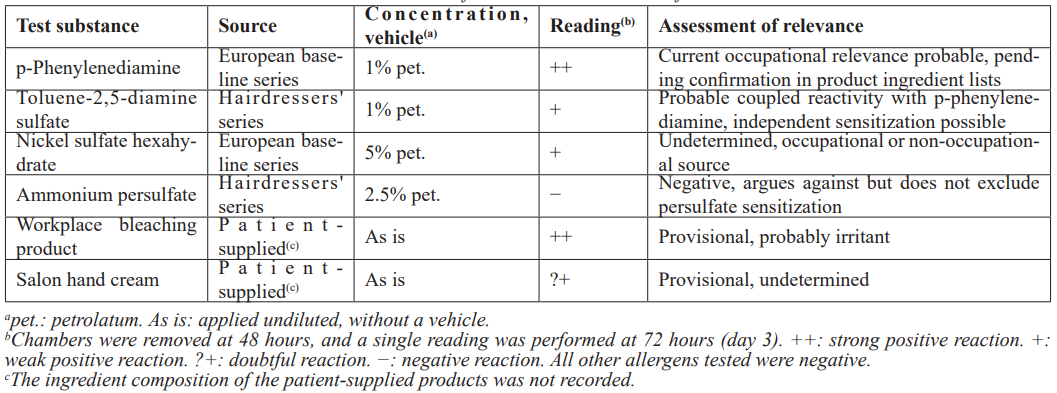
Patch testing was performed with the European baseline series [5], a hairdressers' series (Chemotechnique Diagnostics, Vellinge, Sweden), and the products used at her workplace. The workplace products were tested as is, undiluted and without a vehicle, and their ingredient composition was not recorded. Chambers were applied to the upper back and removed after 48 hours. A single reading was performed at 72 hours (day 3), and reactions were graded according to the International Contact Dermatitis Research Group criteria as adopted in the current European guideline [6] (Figure 2, Table 1). Strong positive reactions were observed to PPD and to the workplace bleaching product, weak positive reactions to nickel sulfate and PTD, and a doubtful reaction to the salon hand cream. Ammonium persulfate and all other allergens tested were negative.
Table 1: Patch test results of interest and assessment of their relevance.
Occupational allergic contact dermatitis to PPD was diagnosed, with probable concomitant irritant contact dermatitis related to wet work. Statutory notification of suspected occupational disease was submitted to the Department of Protection against Occupational Risks of the Portuguese Social Security Institute [7,8]. The occupational physician of her employer, who was responsible for her health surveillance, declared her fit for work with restrictions. These comprised removal of permanent coloring and bleaching tasks, consistent use of nitrile gloves compatible with the products handled, task reorganization within the salon, reduction of unnecessary wet work, regular use of emollients, and structured education on skin protection. Topical corticosteroids were prescribed. A follow-up appointment was scheduled six months after implementation of these measures and had not taken place at the time of writing.
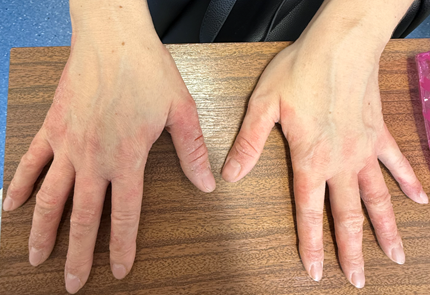
Figure 1: Erythematous, scaling plaques with fissures on the dorsa of both hands and fingers at the initial assessment.
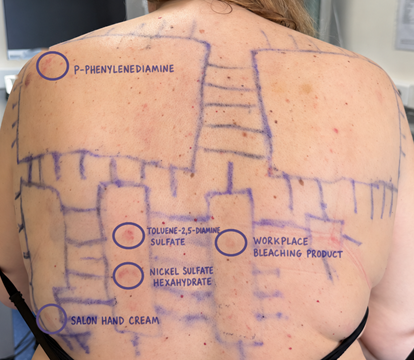
Figure 2: Patch test sites on the upper back at the day 3 reading.
Discussion
Worsening during working periods and improvement during holidays fulfill the criterion of improvement away from work proposed by Mathias [9] and should prompt patch testing, because a specific diagnosis of allergic contact dermatitis generally requires identification of the causative hapten [1]. The diagnostic value of patch testing then depends on an assessment of the current relevance of each reaction rather than on the enumeration of positive findings [6].
The reaction to PPD is probably of current occupational relevance, because PPD is a primary intermediate of oxidative hair dyes, which she handled daily, although definite relevance requires confirmation of PPD in the ingredient lists of her products [1]. The reaction to PTD may reflect coupled reactivity with PPD, but PTD is itself one of the most frequent sensitizers in hairdressers, so independent sensitization cannot be excluded [3]. The strong reaction to the bleaching product is probably irritant. The product was tested undiluted, its composition was not recorded, and irritant reactions occur mostly with patient-supplied materials that are not appropriately diluted or pH-adjusted [6]. The negative reaction to ammonium persulfate supports this interpretation but does not exclude sensitization to another ingredient. Removal from bleaching tasks remains justified by the irritancy of these products and by the increased risk of persulfate sensitization in hairdressers [1,3]. The weak reaction to nickel requires an exposure assessment before occupational relevance is attributed, because the prevalence of nickel allergy in hairdressers largely mirrors that of women of similar age, although scissors and other tools may release nickel [1]. The doubtful reaction to the hand cream warrants review of its ingredients and a repeated open application test [6].
A positive patch test does not exclude a concurrent irritant component, which is frequent in hairdressers [1], so allergen avoidance alone is unlikely to resolve the dermatitis unless wet work is also reduced. Counseling should also address personal use of oxidative hair dyes and possible reactions to structurally related compounds, such as benzocaine and the black rubber antioxidant N-isopropyl-N'-phenyl-p-phenylenediamine [10].
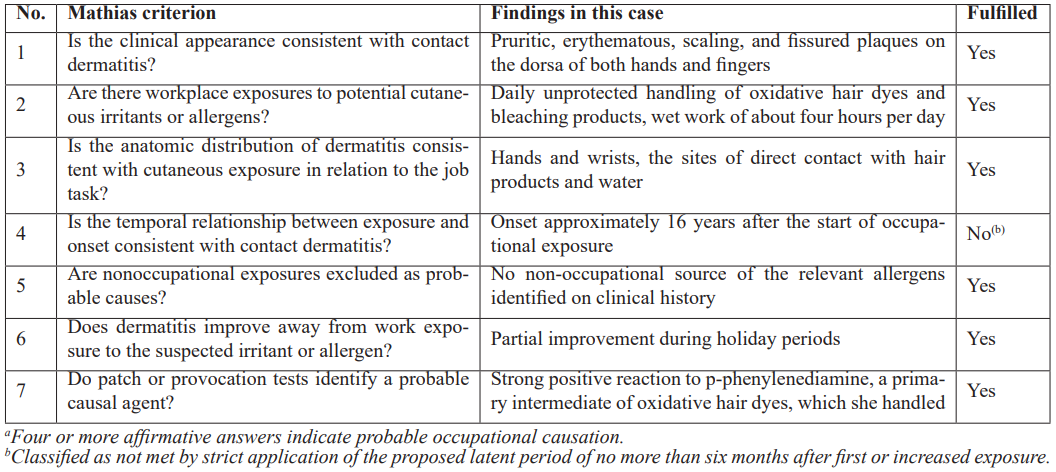
Occupational causation was assessed with the seven Mathias criteria, of which at least four must be fulfilled to conclude that dermatitis is probably occupational [9] (Table 2). Six criteria were met. The temporal criterion was classified as not met, because symptoms began about 16 years after first exposure, beyond the latent period of no more than six months proposed as a rule of thumb [9] and later than the onset during apprenticeship that is typical of hairdressers [2].
Table 2: Application of the seven Mathias criteria for occupational causation to this case(a).
In Portugal, any physician who suspects an occupational disease must notify it [7], although occupational contact dermatitis is seldom reported to the national authorities [11]. The fitness-for-work decision is a distinct act, reserved for the occupational physician who conducts the health surveillance of the worker [12]. Notification can therefore be initiated by the hospital physician who establishes the diagnosis, whereas hospital recommendations reach the workplace only through the occupational physician who follows the worker. In this case, the employer's occupational physician issued the fitness-for-work decision on the basis of the hospital findings. Preventive measures should follow the hierarchy of prevention, which gives priority to substitution and to collective over individual protection [1,12]. Removal of a sensitized worker from coloring and bleaching is an organizational measure and ranks above personal protection, and nitrile gloves offer the best protection against hairdressing chemicals [1]. Skin protection education is widely recommended [1], but the evidence that it prevents occupational irritant hand dermatitis in unaffected workers is of very low certainty [13]. Structured follow-up is needed, because in a Portuguese series of occupational allergic contact dermatitis, 27.3% of patients abandoned their work after diagnosis and the dermatitis resolved in only 39% [11].
This report has limitations. Only a single reading was performed, on day 3, whereas the European guideline combines early readings with a late reading around day 7 [6]. A day 7 reading identified new positive reactions in 13.6% of patients in a large series [14], and a single early reading cannot distinguish a decrescendo irritant reaction from a persistent allergic one [6]. The reaction to PPD is robust, but the weak and doubtful reactions are provisional, and negative results under this protocol are not conclusive. The workplace products were tested undiluted, their composition was not recorded, and no control testing was performed. Non-occupational exposures were assessed by clinical history only, and follow-up data are not yet available.
Conclusion
The reliability of patch testing in hairdressers depends on adherence to the standardized protocol, including a late reading, and on an explicit assessment of the relevance of each reaction, particularly for patient-supplied products with irritant properties. Identification of sensitization to PPD is not the endpoint of management. Its value is realized through statutory notification, a fitness-for-work decision by the responsible occupational physician, and workplace controls that follow the hierarchy of prevention, with structured follow-up to establish whether the worker can remain in her occupation.
Informed Consent: Written informed consent was obtained from the patient for publication of this case report and the accompanying images. All identifying information has been removed. Ethics committee approval was not sought for this single-patient case report.
Author Contributions: Mafalda Bica Tavares and Margarida Contente contributed to the concept and design, acquired, analyzed, and interpreted the data, and drafted the manuscript. João Coutinho de Sousa, Renato Matos, Amanda Dias, Beatriz Oliveira, Miguel Magalhães, Catarina Carvoeiro and Filipe Araújo contributed to the concept and design. Margarida Contente critically reviewed the manuscript for important intellectual content. Nuno Augusto Saldanha and Sara Alves Matos supervised the work and critically reviewed the manuscript for important intellectual content. All authors approved the final version of the manuscript and agreed to be accountable for all aspects of the work. Mafalda Bica Tavares is the guarantor of the work. Rita Gil Duarte contributed to the concept and design. Ana Sofia Duarte supervised the work and critically reviewed the manuscript for important intellectual content.
Competing Interests: The authors declare that they have no competing interests.
Grant Information: The authors received no specific funding for this work.
References
- Uter W, Johansen JD, Macan J, Symanzik C, John SM. Diagnostics and prevention of occupational allergy in hairdressers. Curr Allergy Asthma Rep, 2023; 23(5): 267-275. doi: 10.1007/s11882-023-01076-z.
- Havmose MS, Kezic S, Uter W, Symanzik C, Hallmann S, Strahwald J, et al. Prevalence and incidence of hand eczema in hairdressers: a systematic review and meta-analysis of the published literature from 2000-2021. Contact Dermatitis, 2022; 86(4): 254-265. doi:10.1111/cod.14048.
- Uter W, Hallmann S, Gefeller O, Brans R, Symanzik C, Oppel E, et al. Contact allergy to ingredients of hair cosmetics in female hairdressers and female consumers: an update based on IVDK data 2013-2020. Contact Dermatitis, 2023; 89(3): 161-170. doi: 10.1111/cod.14363.
- Jacobsen G, Rasmussen K, Bregnhøj A, Isaksson M, Diepgen TL, Carstensen O. Causes of irritant contact dermatitis after occupational skin exposure: a systematic review. Int Arch Occup Environ Health, 2022; 95(1): 35-65. doi: 10.1007/s00420-021-01781-0.
- Wilkinson SM, Gonçalo M, Aerts O, Badulici S, Dickel H, Gallo R, et al. The European baseline series and recommended additions: 2023. Contact Dermatitis, 2023; 88(2): 87-92. doi: 10.1111/cod.14255.
- Uter W, Aerts O, Agner T, Brans R, Bruze M, Cannavó A, et al. European Society of Contact Dermatitis guideline for diagnostic patch testing: recommendations on best practice (update 2026). Contact Dermatitis, 2026; 95(3): 237-275. doi: 10.1111/cod.70195.
- Decreto-Lei n.º 2/82, de 5 de janeiro. Torna obrigatória a participação de todos os casos de doença profissional [Decree-Law No. 2/82 of 5 January. Mandatory notification of all cases of occupational disease] [Internet]. Diário da República, 1.ª série. 1982.
- Lei n.º 98/2009, de 4 de setembro. Regime de reparação de acidentes de trabalho e de doenças profissionais [Law No. 98/2009 of 4 September. Compensation scheme for occupational accidents and diseases] [Internet]. Diário da República, 1.ª série. 2009.
- Mathias CG. Contact dermatitis and workers' compensation: criteria for establishing occupational causation and aggravation. J Am Acad Dermatol, 1989; 20(5 Pt 1): 842-848. doi: 10.1016/s0190-9622(89)70096-7.
- Warshaw EM, Peterson MY, Atwater AR, DeKoven JG, Pratt MD, Taylor JS, et al. Patch testing to paraphenylenediamine: the North American Contact Dermatitis Group experience (1994-2018). Dermatitis, 2023; 34(6): 536-546. doi: 10.1089/derm.2023.0140.
- Pestana C, Gomes R, Pinheiro V, Gouveia M, Antunes I, Gonçalo M. Main causes of occupational allergic contact dermatitis: a three year study in the center of Portugal. Acta Med Port, 2016; 29(7-8): 449-455. Portuguese. doi: 10.20344/amp.6605.
- Lei n.º 102/2009, de 10 de setembro. Regime jurídico da promoção da segurança e saúde no trabalho, na redação atual, artigos 15.º e 110.º [Law No. 102/2009 of 10 September. Legal framework for the promotion of safety and health at work, as amended, articles 15 and 110] [Internet]. Diário da República, 1.ª série. 2009.
- Bauer A, Rönsch H, Elsner P, Dittmar D, Bennett C, Schuttelaar MLA, et al. Interventions for preventing occupational irritant hand dermatitis. Cochrane Database Syst Rev, 2018; 4(4): CD004414. doi: 10.1002/14651858.CD004414.pub3.
- van Amerongen CCA, Ofenloch R, Dittmar D, Schuttelaar MLA. New positive patch test reactions on day 7—the additional value of the day 7 patch test reading. Contact Dermatitis, 2019; 81(4): 280-287. doi: 10.1111/cod.13322.