
Email id: info@ijclinmedcasereports.com
Upper Limb Functional Impairment Among Oral Healthcare Professionals: A Cross-Sectional Study Using QuickDASH
João Coutinho de Sousa1,* and Teresa Pinto2
¹Occupational Health Department, Unidade Local de Saúde de Santo António, Porto, Portugal
²Direção-Geral da Saúde (DGS), Lisboa, Portugal
Received Date: 18/07/2026; Published Date: 02/10/2026
*Corresponding author: João Coutinho de Sousa, MD, Occupational Health Department, Unidade Local de Saúde de Santo António, Rua de Dom Manuel II 57, 4050-342 Porto, Portugal
Abstract
Work-related musculoskeletal symptoms are a significant occupational health concern in dentistry, where static postures, repetitive movements, and prolonged manual activity may lead to upper limb strain and functional impairment. This study aimed to evaluate upper limb functional impairment related to work-related musculoskeletal symptoms among oral healthcare professionals using the QuickDASH questionnaire. A cross-sectional observational study was conducted among 92 oral healthcare professionals from a primary healthcare institution, including 45 dentists and 47 dental assistants. Participants completed the QuickDASH questionnaire before occupational health examinations, and sociodemographic variables and functional scores were descriptively analyzed. The study was reported according to the STROBE guidelines. The mean age was 39 years among dentists and 43 years among dental assistants. Mean QuickDASH scores were low in both groups, with average scores of 1.07 among dentists and 2.02 among dental assistants. Most participants (67%) reported no functional limitations (QuickDASH score = 0), and the highest recorded scores were 7 among dentists and 9 among dental assistants. The assessed oral healthcare professionals therefore demonstrated minimal upper limb functional impairment. Ergonomic awareness and preventive occupational health measures may have contributed to the low symptom burden observed in this cohort. Further multicenter studies with larger samples are needed to better characterize work-related musculoskeletal symptoms in oral healthcare settings.
Keywords: Work-related musculoskeletal symptoms; QuickDASH; Oral healthcare professionals; Occupational health; Ergonomics
Introduction
Work-related musculoskeletal symptoms are a significant occupational health issue among healthcare professionals, particularly in dentistry. Oral healthcare professionals are frequently exposed to static postures, repetitive movements, sustained neck and upper limb positioning, and prolonged manual activity, all of which may contribute to musculoskeletal strain and functional impairment [1-3].
Musculoskeletal disorders among dental professionals may affect quality of life, work performance, productivity, and long-term professional sustainability. Previous systematic reviews have reported high frequencies of musculoskeletal pain among dentists and dental assistants, particularly involving the neck, shoulders, back, and upper limbs [1-3].
The Quick Disabilities of the Arm, Shoulder and Hand questionnaire (QuickDASH) is a validated short-form instrument used to evaluate upper limb disability and symptoms. It provides a standardized functional score ranging from 0 to 100, where higher values indicate greater disability [8]. Although musculoskeletal symptoms in dentistry have been widely described, fewer studies have specifically assessed upper limb functional impairment using QuickDASH in occupational health surveillance settings.
This study aimed to evaluate upper limb functional impairment among dentists and dental assistants working in a primary healthcare institution using the QuickDASH questionnaire.
Methods
Study design and setting. A cross-sectional observational study was conducted in a primary healthcare institution. The manuscript was prepared according to the STROBE reporting guidelines for observational studies.
Participants. The study included 92 oral healthcare professionals, comprising 45 dentists and 47 dental assistants. Participants were selected from professionals undergoing occupational health assessment during the study period. Eligible participants were actively working in oral healthcare roles and agreed to participate voluntarily. No intervention or treatment allocation was performed because this was an observational study.
Data collection and instrument. Participants completed the QuickDASH questionnaire before routine occupational health examinations. The questionnaire evaluates symptoms and functional limitations involving the arm, shoulder, and hand. Scores range from 0, indicating no disability, to 100, indicating maximum disability. Sociodemographic variables, including professional group and age, were collected. QuickDASH scores were summarized separately for dentists and dental assistants.
Ethical considerations. This study was based on data collected during routine occupational health surveillance activities. As this was a non-interventional, descriptive study, with no procedures performed beyond standard occupational health practice and all data anonymized prior to analysis, formal ethics committee approval was not required under the applicable national regulations. The study was conducted in accordance with the principles of the Declaration of Helsinki, and all participants provided informed consent before participation.
Statistical analysis. Descriptive statistics were used to summarize the study population and QuickDASH results. Continuous variables are presented as means, minimum values, and maximum values where available. Categorical variables are presented as absolute and relative frequencies. Because this was an exploratory descriptive study, no inferential statistical testing was performed.
Results
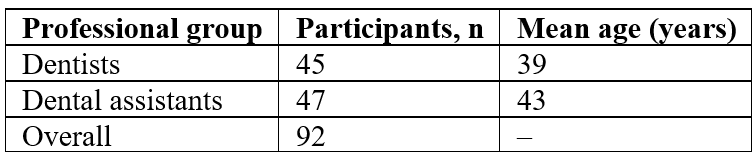
The study included 92 oral healthcare professionals: 45 dentists and 47 dental assistants. The mean age was 39 years among dentists and 43 years among dental assistants. The sociodemographic characteristics of the sample are presented in Table 1.
Table 1: Sociodemographic characteristics of the sample.
Mean QuickDASH scores were low in both professional groups. Dentists had an average QuickDASH score of 1.07, with values ranging from 0 to 7. Dental assistants had an average QuickDASH score of 2.02, with values ranging from 0 to 9. Overall, 67% of participants had a QuickDASH score of 0, indicating no reported functional limitation. QuickDASH results are summarized in Table 2 and Figure 1.
Table 2: QuickDASH results by professional group.

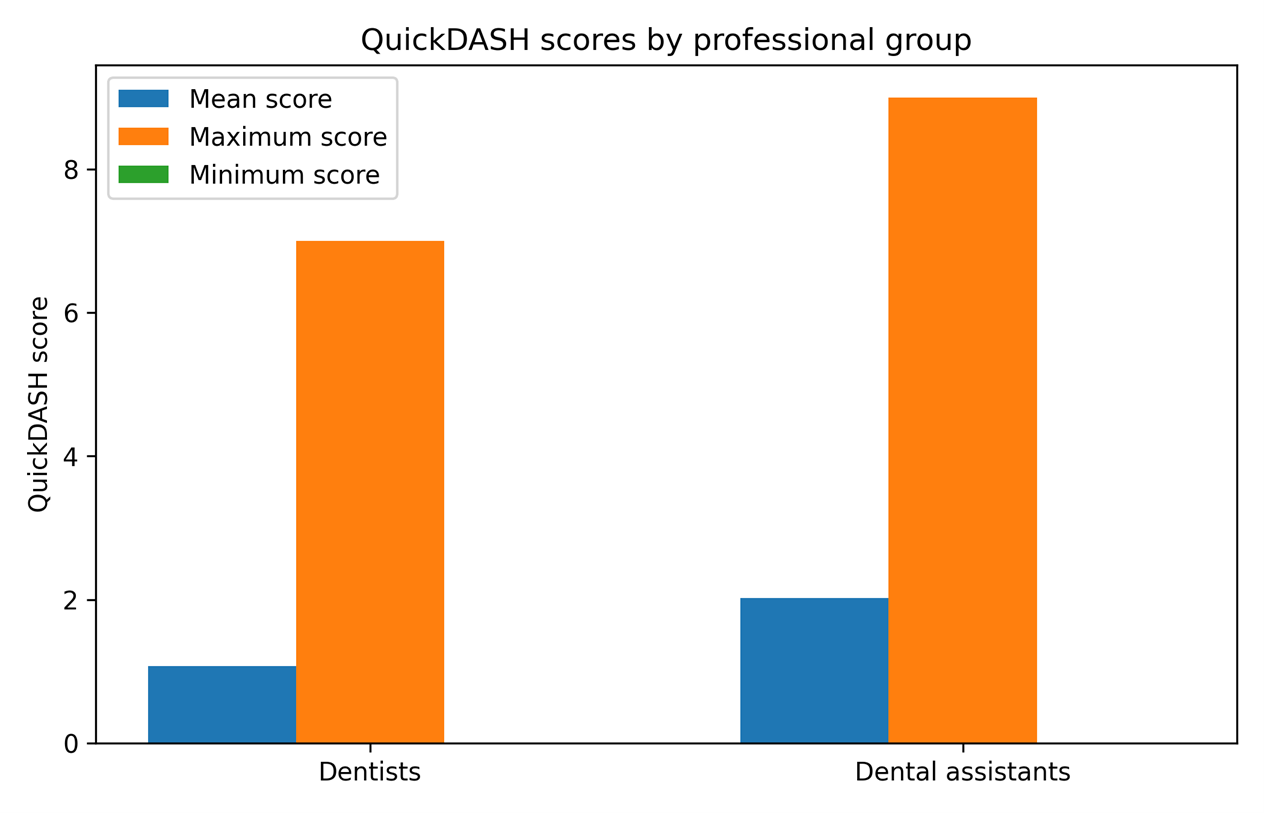
Figure 1: QuickDASH mean, minimum, and maximum scores by professional group. Bars represent mean scores; whiskers indicate minimum and maximum recorded values for each professional group.
Discussion
This study found minimal upper limb functional impairment among oral healthcare professionals assessed using the QuickDASH questionnaire. Mean scores were low in both dentists and dental assistants, and most participants reported no functional limitations. These findings suggest a low functional burden of upper limb symptoms in the assessed cohort.
The results contrast with previous literature reporting a high prevalence of musculoskeletal symptoms among dental professionals [1-3]. Hayes et al. reported that musculoskeletal disorders are frequent among dental professionals, while Lietz et al. identified a substantial burden of musculoskeletal diseases and pain in Western dental populations [1,3]. More recent evidence also emphasizes the importance of occupational ergonomics in the prevention of musculoskeletal disorders among dentists [2].
Several factors may explain the low QuickDASH scores observed in this sample. First, the participants may represent a relatively younger and active workforce, with lower cumulative exposure to occupational risk factors. Second, the occupational health setting may reflect increased awareness of ergonomics, posture, workplace organization, and preventive measures. Third, the use of the QuickDASH specifically captures functional impairment of the upper limb and may not fully reflect symptoms affecting other anatomical regions, such as the neck or lower back, which are frequently affected in dental practice.
The findings have indirect clinical relevance. Early identification of functional symptoms using a validated instrument such as QuickDASH may support occupational health surveillance and guide preventive strategies. Ergonomic education, workplace adjustment, adequate rest breaks, posture training, and early referral for rehabilitation may help reduce musculoskeletal burden and preserve work ability among oral healthcare professionals.
This study has limitations. It was conducted in a single primary healthcare institution and included a relatively small sample, limiting generalizability. The cross-sectional design does not allow causal inference. Data were self-reported, which may introduce reporting bias. The assessment focused on upper limb function using QuickDASH and did not comprehensively evaluate other anatomical regions frequently affected in dental practice. Finally, the study was descriptive and did not include inferential statistical analyses.
Conclusion
Oral healthcare professionals in this cohort demonstrated minimal upper limb functional impairment as assessed by QuickDASH. These findings support the potential value of ergonomic awareness and occupational health surveillance in maintaining functional capacity among dental professionals. Larger multicenter studies with longitudinal follow-up are needed to better characterize work-related musculoskeletal symptoms and identify modifiable occupational risk factors in oral healthcare settings.
Author Contributions: JCS and TP: concept and design of the study, acquisition of data, analysis and interpretation of data, drafting of the manuscript and revising it critically for important intellectual content, and final approval of the version to be published. JCS acts as guarantor and takes responsibility for the integrity of the work.
Competing Interests: The authors declare that there is no conflict of interest.
Grant Information: The author(s) received no specific funding for this work.
Acknowledgments: The authors thank the participating healthcare professionals and the occupational health department for their collaboration.
Data Availability Statement: The datasets generated and/or analyzed during the current study are available from the corresponding author upon reasonable request.
References
- Hayes MJ, Cockrell D, Smith DR. A systematic review of musculoskeletal disorders among dental professionals. Int J Dent Hyg, 2009; 7(3): 159-165.
- Soo SY, Ang WS, Chong CH, Tew IM, Yahya NA. Occupational ergonomics and related musculoskeletal disorders among dentists: A systematic review. Work, 2023; 74(2): 573-584.
- Lietz J, Kozak A, Nienhaus A. Prevalence and occupational risk factors of musculoskeletal diseases and pain among dental professionals in Western countries: A systematic literature review and meta-analysis. PLoS One, 2018; 13(12): e0208628
- Alghadir A, Zafar H, Iqbal ZA. Work-related musculoskeletal disorders among dental professionals in Saudi Arabia. J Phys Ther Sci, 2015; 27(4): 1107-1112.
- Sakzewski L, Naser-ud-Din S. Work-related musculoskeletal disorders in dentists and orthodontists: A review of the literature. Work, 2014; 48(1): 37-45.
- Halkai KR, Halkai RS, Sulgante S, et al. Work-related musculoskeletal disorders among dentists and their prevention through ergonomic interventions - A systematic review. Int J Occup Saf Health, 2022; 12(2): 125-139.
- Descatha A, Roquelaure Y, Chastang JF, Evanoff B, Cyr D, Leclerc A. Work, a prognosis factor for upper extremity musculoskeletal disorders? Occup Environ Med, 2009; 66(5): 351-352.
- Beaton DE, Wright JG, Katz JN. Development of the QuickDASH: Comparison of three item-reduction approaches. J Bone Joint Surg Am, 2005; 87(5): 1038-1046.