
Email id: info@ijclinmedcasereports.com
‘A Female in Fetal Positioning’ Aortic Dissection DeBakey Type 1: A Clinical Case
Chris Livadiotis, Laoura Pari and Ekaterini Lambrinou*
School of Health Sciences, Cyprus University of Technology, Cyprus
Received Date: 19/05/2026; Published Date: 21/08/2026
*Corresponding author: Ekaterini Lambrinou, School of Health Sciences, Cyprus University of Technology, Cyprus
Abstract
Acute Aortic Dissection (AAD) is a highly fatal Cardiovascular Emergency Disease (CVDs). Unfortunately, there is a lack of recognition, assessment, and intervention by health professionals (HPs). A 57-year-old female, was presented to the Emergency Department (ED) with chief complaints of sudden and acute sensation of drowning, numbness in lower limbs, and abdominal, chest, and back pain that started earlier the same day. The second hospital she visited after the exit of the first hospital without diagnosis suggested a CT. The CT Angiography showed Aortic Dissection (AD) DeBakey Type I with an intimal flap extending from the common carotid artery and the left subclavian artery and peripherally to the common and external iliac left artery The woman’s clinical case is an example of underrecognized AD in women.
Keywords: Acute Aortic Dissection; Sex differences; Gender differences
Introduction
Acute Aortic Dissection (AAD) is a highly fatal Cardiovascular Emergency Disease (CVDs) [1]. In Europe, CVDs remain the most common cause of morbidity and mortality, with 49% of deaths in women and 40% of deaths in men [2]. According to the literature, women have a higher risk of CVD mortality, worse prognosis, and major cardiovascular (CV) events, they are undertreated, have a lower rate of diagnostic angiograms and interventional procedures, and have worse clinical outcomes compared to men [2,3]. Whereas, gender differences stem from sociocultural processes, including varying behaviors, environmental influences, nutrition, lifestyle, stress, and attitudes toward treatment and prevention [3].
According to the guidelines set by the European Society of Cardiology (ESC), Aortic Dissection (AD) is characterized by the disruption of the medial layer due to intramural bleeding, leading to the separation of the aortic wall layers and the formation of both a true lumen and a false lumen, with or without communication between them [4].
AAD type 1 involves the ascending aorta, and is associated with a high fatality rate [5]. More than 80% of patients presenting with AAD type A have been treated by emergency surgery [5]. Unfortunately, there is a lack of recognition, assessment, and intervention by health professionals (HPs) [2].
Clinical Report
Clinical presentation
A Caucasian 57-year-old female, presented to the Emergency Department (ED) with chief complaints of sudden and acute sensation of drowning, numbness in lower limbs, and abdominal, chest, and back pain that started earlier the same day. Upon triage, the vital signs were: high Systolic Blood Pressure (SBP) 155/89mmHg, low Heart Rate (HR) 40bpm, high Respiratory Rate (RR) 23/min, normal Blood Oxygen Saturation (SPO2) 98% on room air, afebrile.
The patient had a clear medical and surgical history and took no prescribed medication. She reported a history of smoking a pack of cigarettes per day for the last 35 years, alcohol consumption socially, and normal BMI without regular exercise. Further, she was in menopause. The patient reported that it was the first time she had visited the hospital, and she had no cardiovascular assessment in the past. Her family history was clear.
Initial work-up
During the initial physical examination, by the ABCDE's approach, the patient had signs of respiratory distress, and sensations of dyspnea, however, the lungs were clear to auscultation. The peripheral pulses differed between the upper hands (absence of pulse in the right upper hand), the rate was 35-40 bpm, and the rhythm was regular. No upper or lower extremity edema. Upon neurological examination, the patient was alert and oriented with a Glasgow Coma Scale of 15/15. The pain was described as sharp and located in the epigastric, upper back, and left hemithorax. The patient was in a fetal position and could not sit on the bed, and an abdominal pulse was observed. Also, numbness in her lower extremities was reported. The abdomen was soft and flat.
The 12-lead electrocardiogram (ECG) verified the bradycardia and the rhythm was sinus bradycardia with interval T waves (Figure 1). The chest x-ray showed an expanded mediastinum and aorta, shadowing the aortic shape and shadowing of the aortic arch (Figure 2). The initial laboratory results didn’t reveal any abnormality; however, the D-dimer level was not checked. The patient was treated initially with intravenous atropine for heart rate control without any result, and morphine was given for pain management. Despite the high systolic blood pressure, no medication was administrated at the beginning and there was a delay of 2 hours in recognizing the symptoms and signs of the disease.
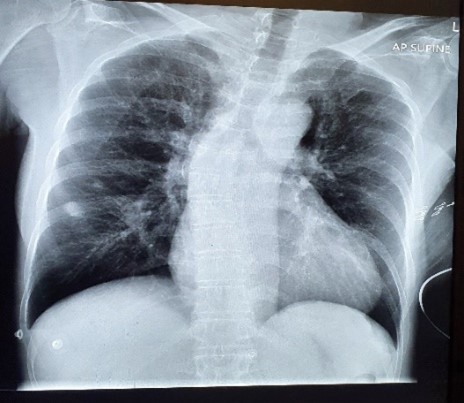
Figure 1: Chest Xray.
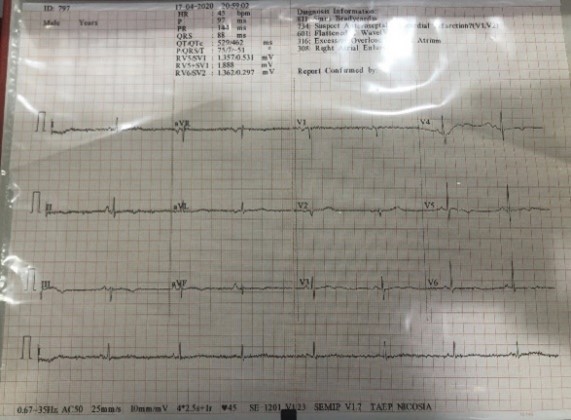
Figure 2: ECG.
Diagnosis
The CT Angiography showed Aortic Dissection (AD) DeBakey Type I with an intimal flap extending from the common carotid artery and the left subclavian artery and peripherally to the common and external iliac left artery (Figure 3, 4). There were not any measurements written on the CTA report. After the diagnosis was confirmed, the cardiothoracic surgeon assessed the patient immediately.
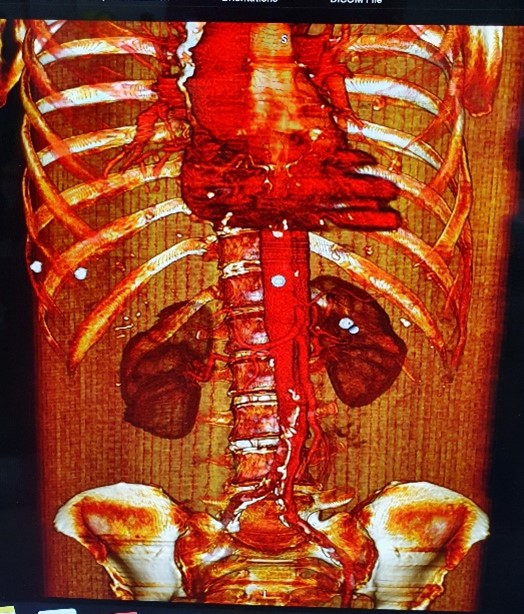
Figure 3: CTA 3D.
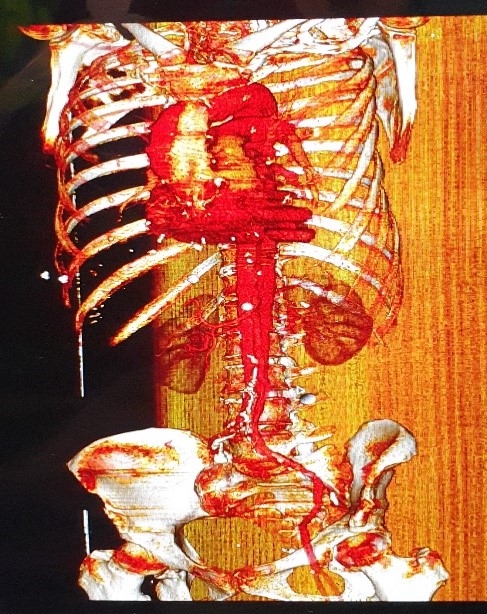
Figure 4: CTA 3D.
Classification
Classification of aortic dissection is defined by the anatomical location of the lesion and duration of onset [6]. The DeBakey system, proposed by DeBakey and colleagues in 1965, is divided into three subtypes [7]. Type I dissection originates in the ascending aorta propagates at least to the aortic arch, and may involve the descending thoracic aorta. Type II dissections originate in and are confined to the ascending aorta, while Type III dissections involve only the descending aorta [7].
Management
An intravenous bolus of hydralazine was given for SBP control, with a target of systolic BP <120 mmHg, according to the last guidelines [4]. Also, morphine was given again to manage the pain, and the patient was transferred to the operating theater for surgery. An arterial line was placed for close monitoring of the SBP and the patient after 4 to 5 hours in the operation theater was admitted to the Intensive Care Unit (ICU) for close hemodynamic monitoring and medical therapy. The patient was monitored for 10 days at the ICU.
During the second day, some complications could not wake up the patient. The health professional tried to wake her up but unfortunately, her SBP was very high 189/99, high respiratory rate RR=35 and she was very anxious, so they sedated her immediately again. The patient was awake finally on the 4th day and stayed in the ICU to monitor the SBP and level of consciousness which was reduced after the operation and control the pain with the appropriate medication. During her time in the ICU, all the HPs were next to her, providing her with physiotherapy, communicating, and making her feel safe and all the necessities. A significant role was the communication between HPs and patient. The woman was relieved and felt calm which helped her rehabilitation. Above all, she quit smoking to reduce any further disease progression.
Follow up
The patient was transferred to the angiothoracic ward for another 10 days before discharge. During her stay, all HPs were constantly monitored and assessed. Two months later a telephone conversation was made with the patient for a follow-up. During the time of two months, she was following her appointments with her doctor without any complications. After all this situation she started exercising, quit smoking, and followed her pharmacological therapy with lifestyle modifications. Nonetheless, she was thankful and authorized the nurses to express her experience hoping that no one would be in her position again.
Discussion
Acute Aortic Dissection (AAD) is a rare yet potentially fatal emergency condition, where timely diagnosis and appropriate treatment are crucial for the patient's survival [1]. The presented clinical case was a 57-year-old female, without any medical history, family history, or cardiology evaluation in the past, but with a smoking habit for over 35 years. All the symptoms, the acute sensation of drowning, numbness in lower limbs, abdominal, chest, and back pain, which brought her to the ED, were increased suddenly. The patient’s initial approach changed immediately during the triage assessment, because of her fatal position and the absence of pulse on the upper right hand. Also, the vital signs revealed high SBP and low pulse which added to the case of the emergency call for urgent management of symptoms and further investigation.
Furthermore, the low heart rate was somewhat confusing at the beginning of the assessment. This was due to the dissection interrupting blood flow to the coronary arteries, affecting the sinus node, which resulted in persistent bradycardia. The delayed diagnosis of AD Type 1, a life-threatening emergency, confirms the initial assessment and underscores the significance of early prevention, prompt medical care, recognition of clinical features, and management of cardiovascular disease (CVD). to medical care, recognition of clinical features, and management of CVD. The fact that she was in menopause settles the patient in a high-risk situation.
The woman’s clinical case is an example of inadequate recognition and assessment by HPs prevention and delay of presentation to medical care by the patient. The incidence of aortic dissection is estimated at 5 to 30 cases per million people annually, predominantly affecting individuals between the ages of 50 and 70, with a higher prevalence in males [2].
Conclusion
AD is a critical care disease that must be recognized and treated as soon as possible for the patient's survival. Education and training of HPs may help them to recognize and manage the disease as soon as possible to reduce mortality and morbidity. Initial treatment should be aimed at controlling pain and the hemodynamic state [8].
References
- Sayed A, Munir M, Bahbah EI. Aortic Dissection: A Review of the Pathophysiology, Management and Prospective Advances. Curr Cardiol Rev, 2020; 17(4): 1-15. doi: 10.2174/1573403x16666201014142930.
- B ST, Pari L, Soteriou M, Mitselos L, Lambrinou E. Medical and Clinical Case Reports " A backbone pain ": 61-year-old Female with Acute Aortic Dissection, 2024; 4(1): 1-4.
- Lee CY, Ting KL, Lu HT, Ali RM, Fong AYY, Wan Ahmad WA. Sex and gender differences in presentation, treatment and outcomes in acute coronary syndrome, a 10 year study from a multi-ethnic Asian population: The Malaysian National Cardiovascular Disease Database-Acute Coronary Syndrome (NCVD-ACS) registry. PLoS One, 2021; 16(2 February): 1-23. doi: 10.1371/journal.pone.0246474
- Working SEC, Committee SECG. Comments on the 2024 ESC guidelines for the management of peripheral arterial and aortic diseases ´a ESC 2024 para el tratamiento de la enfermedad arterial perife´ rica y SEC Working Group for the 2024 ESC guidelines for the management of peripheral art, 2025; 78(3): 164-169.
- Lin Y, Liang T, Zhang X, et al. Early goal-directed mobilization in patients with acute type A aortic dissection: A randomized controlled trial. Clin Rehabil, 2023; 37(10): 1311-1321. doi:10.1177/02692155231169822.
- Erbel R, Aboyans V, Boileau C, et al. ESC guidelines on the diagnosis and treatment of aortic diseases. Eur Heart J, 2014; 35(41): 2873-2926. doi: 10.1093/eurheartj/ehu281
- Patel PD, Arora RR. Pathophysiology, diagnosis, and management of aortic dissection. Ther Adv Cardiovasc Dis, 2008; 2(6): 439-468. doi: 10.1177/1753944708090830
- Fukui T. Management of acute aortic dissection and thoracic aortic rupture. J Intensive Care, 2018; 6(1): 1-8. doi: 10.1186/s40560-018-0287-7.