
Email id: info@ijclinmedcasereports.com
Unilateral Verrucous Plaque of Porokeratotic Eccrine Ostial and Dermal Duct Nevus: Case Report
Safoura Shakoei1, Alireza Ghanadan2, Zeinab Gholibeigian3 and Marwa Akhdar4,*
1Department of Dermatology, imam Khomeini Hospital, Tehran University of Medical Sciences (TUMS), Tehran, Iran
2Department of Pathology, Razi Hospital, Tehran University of Medical Sciences, (TUMS), Tehran, Iran
3Department of Dermatology, Lebanese University, Nabih Berri Governmental University Hospital, Nabatieh, Lebanon
Received Date: 27/05/2026; Published Date: 14/08/2026
*Corresponding author: Marwa Akhdar, MD, Department of Dermatology, Lebanese University, Nabih Berri Governmental University Hospital, Nabatieh, Lebanon
Abstract
Porokeratotic Eccrine Ostial and Dermal Duct Naevus (PEODDN) is a rare porokeratotic dermatosis which is a disorder of keratinization and clinically presents as asymptomatic localized area of plugged pits in a linear distribution on palms and soles.
A 9-year-old female patient presented with asymptomatic hyperkeratotic plaques on her fingers of right foot and hand. The lesion on her lateral of fifth finger of the right foot present since childhood and this lesion slowly enlarged and now has a verrucae appearance. The lesions on her right hand begun only about one year ago.
The histopathological examination revealed mild to moderate acanthosis with focal hypogranulosis, low papillomatosis broad columns of parakeratosis (parakeratotic cornoid lamella). The patient was referred for surgical excision.
PEODDN is a very rare condition and till date only a very limited number of cases have been reported. Hereby, we present a case of early onset of small unilateral variant of disease on the fingers of the right palm and sole.
Keywords: Porokeratosis Eccrine Ostial and Dermal duct Nevus; Porokeratosis; Early onset; Benign Eccrine Hamartoma
Abbreviations: PEODDN - Porokeratotic Eccrine Ostial and Dermal Duct Nevus; KID Syndrome - Keratitis-Ichthyosis-Deafness Syndrome; SCC - Squamous Cell Carcinoma
Introduction
Porokeratotic eccrine ostial and dermal duct nevus (PEODDN) is an uncommon hamartomatous growth with disordered keratinization [1]. It is a benign skin condition characterized by multiple keratotic papules and plaques with plugged pits having a comedo-like appearance, predominantly occurring on the acral extremities. It usually described unilateral involvement but bilateral and extensive variation of disease have been reported [2].
PEODDN is very rare and till date only a very limited number of cases have been reported. Hereby, we present a unique case of early-onset and small unilateral PEODDN on the fingers of the right palm and sole.
Case Report
A 9-year-old female patient presented with asymptomatic hyperkeratotic plaques on her fingers of right foot and hand. The patient mentions that the lesion on her foot was present since childhood. This lesion slowly enlarged and now has a verrucous appearance. The lesion on her right hand begun only about one year ago.
Physical examination showed a verrucous plaque on her lateral of fifth finger of the right foot approximately 20*5 mm, and on her ventral side of fourth finger of the right hand approximately 15*3 mm and adjacent to her nail on the second finger of the right hand with a 1 mm thickness (Figure 1a, 1b). All the lesions were in a linear configuration. Other skin examination findings were unremarkable. The patient was otherwise healthy with no past medical or drug history.
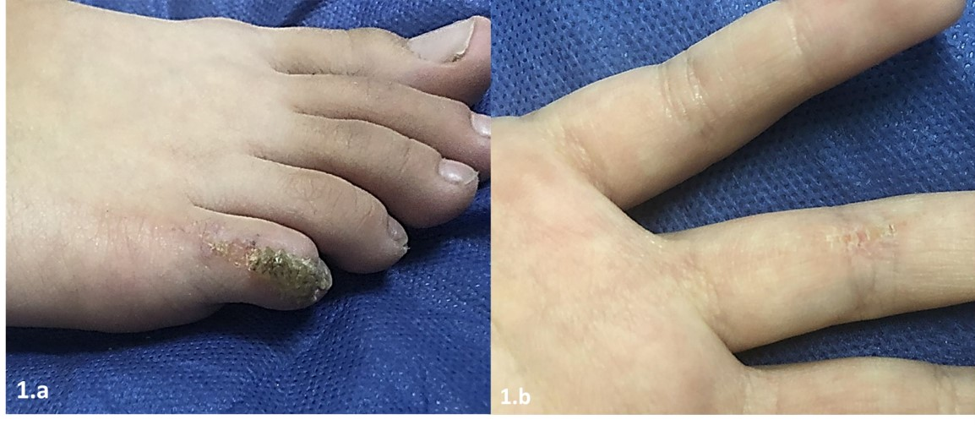
Figure 1(a): A verrucous plaque on her lateral of fifth finger of the right foot approximately 20*5 mm.
Figure 1(b): Hyperkeratotic linear plaque and on her ventral side of fourth finger of the right hand approximately 15*3 mm.
The punch biopsy of foot lesion was taken with differential diagnosis of inflammatory linear verrucous epidermal nevus, epidermal nevus, lichen striatus and Porokeratotic eccrine ostial and dermal duct nevus. The histopathological examination revealed mild to moderate acanthosis with focal hypogranulosis, low papillomatosis broad columns of parakeratosis (parakeratotic cornoid lamella), thickened blood vessels and fibroplasia of collagen bundles (Figure 2a, 2b). The findings were more consistent with porokeratotic eccrine ostial and dermal duct nevus. The patient was referred for surgical excision.
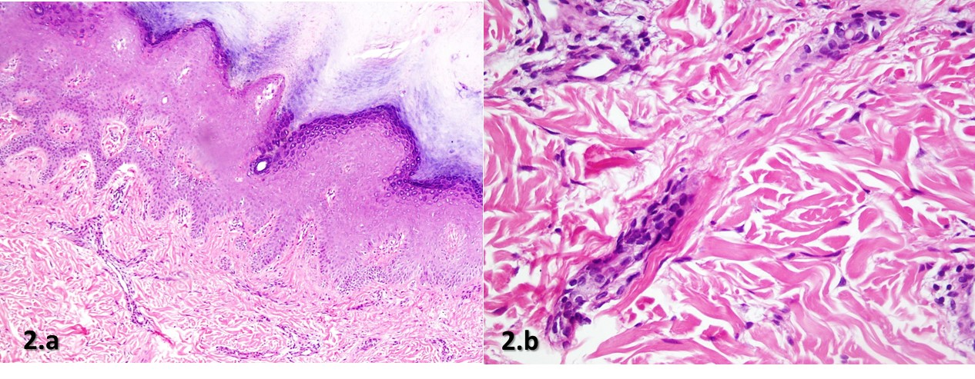
Figure 2(a): Cornoid lamella in hyperkeratotic layer overlying acrosyringeal duct in epidermis (H&E × 10 magnification).
Figure 2(b): Continuous with them are eccrine duct in dermis alongside of overlying cornoid lamella. (H&E × 40 magnification).
Discussion
PEODDN is a rare eccrine hamartoma of eccrine ducts. It usually presents as multiple keratotic papules and plaques with comedo-like appearance, appeared on distal extremities [3]. However, involvement of other areas such as trunk, buttock have been described [4,5]. The majority of this lesions were present in congenital or early childhood but later onset of disease has also been reported [5].
Linear or disseminated variations of disorder following the Blasckho’s lines have also been described [6]. A verrucous component explained when lesions spread extra palmar or plantar surfaces [7]. But our case presented with verrucous lesion on her foot.
On histologic examination, porokeratotic lesions are defined coronoid lamellae. There is a prominent parakeratotic column within an epidermal invagination and loss of the stratum granulosum. Dyskeratotic cells are usually present. The parakeratotic column is found overlying a dilated acrosyringium [7].
Some abnormalities have been reported in association with PEODDN like neurological disorders (hemiparesis, deafness, epilepsy, sensory polyneuropathy, developmental delay), musculo-skeletal abnormalities(scoliosis), breast hypoplasia, palmoplantar keratoderma, psoriasis, hyperthyroidism, onychodystrophy, Bowen, squamous cell carcinoma [2,4].
It is commonly asymptomatic but can be associated with pain, pruritus, hyperhidrosis or anhidrotic [5]. In our case, the patient had an early onset with her lesions starting since childhood, and the lesions involved both her hand and foot and were asymptomatic.
Many hypotheses have been suggested for it, but recently PEODDN has been considered as a mosaic form of Keratitis Ichthyosis-Deafness syndrome (KID) as it may present mutations in the gene GJB2, encoding a gap junction protein, connexin-26 [8].
Some lesions may undergo spontaneous regression [9]. Small lesions may be appropriate candidates for surgery and Carbon dioxide laser. Another treatment options include topical corticosteroids, topical calcipotriol, cryotherapy, photodynamic therapy and retinoid have not shown any promising results [10]. Our patient was referred to a surgeon for excision.
Conclusion
PEODDN is an uncommon disorder, and recent data suggest that it is due to a mutation in the GJB2 gene. Treatment is still challenging because many modalities have shown to be non-effective. Further studies are required to reinforce the postulated pathophysiology and to achieve the best and most effective treatment modality.
Conflict of interest: None
Disclosures: None declared
References
- Petkiewicz S, Baltz J, Cornejo K, Deng A, Wiss K. Widespread presentation and spontaneous regression of porokeratotic eccrine ostial and dermal duct nevus. JAAD case reports, 2018; 4(10): 972-975.
- Llamas-Velasco M, Hilty N, Kempf W. Porokeratotic adnexal ostial naevus: review on the entity and therapeutic approach. Journal of the European Academy of Dermatology and Venereology: JEADV, 2015; 29(10): 2032-2037.
- Masferrer E, Vicente MA, Bassas-Vila J, Rovira C, Gonzalez-Ensenat MA. Porokeratotic eccrine ostial and dermal duct naevus: report of 10 cases. Journal of the European Academy of Dermatology and Venereology: JEADV, 2010; 24(7): 847-851.
- Pathak D, Kubba R, Kubba A. Porokeratotic eccrine ostial and dermal duct nevus. Indian journal of dermatology, venereology and leprology, 2011; 77(2): 174-176.
- Arbogast M, Bax D, Paragh G, Bogner PN. Late-onset solitary porokeratotic eccrine ostial and dermal duct nevus. JAAD case reports, 2018; 4(5): 434-436.
- Cambiaghi S, Gianotti R, Caputo R. Widespread porokeratotic eccrine ostial and dermal duct nevus along Blaschko lines. Pediatric dermatology, 2007; 24(2): 162-167.
- Sassmannshausen J, Bogomilsky J, Chaffins M. Porokeratotic eccrine ostial and dermal duct nevus: a case report and review of the literature. Journal of the American Academy of Dermatology, 2000; 43(2 Pt 2): 364-367.
- Levinsohn JL, McNiff JM, Antaya RJ, Choate KA. A Somatic p.G45E GJB2 Mutation Causing Porokeratotic Eccrine Ostial and Dermal Duct Nevus. JAMA dermatology, 2015; 151(6): 638-641.
- Mazuecos J, Ortega M, Rios JJ, Camacho F. Long-term involution of unilateral porokeratotic eccrine ostial and dermal duct naevus. Acta dermato-venereologica, 2003; 83(2): 147-149.
- Aounallah A, Ghariani N, Kahla MB. Porokeratotic Eccrine Ostial and Dermal Duct Nevus. Indian pediatrics, 2017; 54(8): 698.