
Email id: info@ijclinmedcasereports.com
Left-Sided Acute Appendicitis Revealing Situs Inversus Totalis: A Case Report
Salma Chenouni*, Asmae Fariyou and Omar El Aoufir
Service de Radiologie des Urgences, Mohammed V University, CHU Ibn Sina, Rabat, Morocco
Received Date: 21/05/2026; Published Date: 12/08/2026
*Corresponding author: Salma Chenouni, Service de Radiologie des Urgences, Mohammed V University, CHU Ibn Sina, Rabat, Morocco
Abstract
Situs inversus totalis is a rare congenital anomaly characterized by a mirror-image transposition of the thoracic and abdominal viscera. We report the case of a 38-year-old woman with no significant medical history, admitted for left iliac fossa pain evolving over 24 hours and associated with biological inflammatory syndrome. Abdominal computed tomography revealed situs inversus totalis associated with uncomplicated left-sided acute appendicitis. The patient underwent appendectomy with a favorable outcome. This case highlights the importance of cross-sectional imaging in the diagnosis of abdominal emergencies presenting atypically due to laterality anomalies.
Keywords: Situs inversus; Acute appendicitis; Abdominal emergency
Introduction
Acute appendicitis is one of the most frequent causes of abdominal surgical emergencies and typically presents with right iliac fossa pain. However, atypical clinical presentations may occur in the presence of congenital laterality anomalies, particularly situs inversus totalis. Situs inversus totalis is a rare congenital condition characterized by a complete mirror-image transposition of the thoracic and abdominal organs, with an estimated prevalence of approximately 1 in 10,000 live births [1]. It results from an embryological defect affecting normal visceral rotation and lateralization during development [2].
Although generally asymptomatic and often discovered incidentally, situs inversus totalis may represent a diagnostic challenge in emergency settings because the localization of symptoms does not correspond to the usual anatomical landmarks. In this context, left-sided acute appendicitis remains an uncommon but well-recognized entity that may mimic more frequent left-sided abdominal conditions, such as sigmoid diverticulitis or gynecological disorders, potentially leading to diagnostic delay and an increased risk of complications [3,4].
Computed tomography currently represents the imaging modality of choice for evaluating atypical abdominal pain, as it allows both accurate diagnosis of acute appendicitis and identification of the associated laterality anomaly [5]. We report a rare case of left-sided acute appendicitis revealing situs inversus totalis in a 38-year-old woman presenting with atypical left iliac fossa pain.
Case Presentation
A 38-year-old woman with no significant past medical history was admitted to the emergency department for left iliac fossa pain evolving over 24 hours, without associated bowel disturbances or urinary symptoms.
Clinical examination revealed localized tenderness in the left iliac fossa, without guarding or rigidity. Body temperature was 37.8 °C.
Laboratory investigations demonstrated an inflammatory syndrome with leukocytosis of 13,000/mm³ and a C-reactive protein level of 50 mg/L.
Given this atypical clinical presentation, abdominal computed tomography was performed. It revealed situs inversus totalis with complete mirror-image transposition of the thoracoabdominal organs, associated with a left laterocecal appendix measuring 8 mm in diameter, with wall thickening and periappendiceal fat stranding, without signs of complication (Figure 1).
A diagnosis of left-sided acute appendicitis was established. The patient underwent appendectomy, which confirmed the diagnosis, with an uneventful postoperative course.
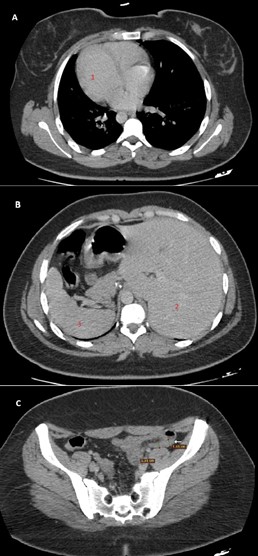
Figure 1: Axial computed tomography images illustrating situs inversus totalis associated with left-sided acute appendicitis.
(A) Thoracic CT image showing dextrocardia [1].
(B) Abdominal CT image demonstrating mirror-image transposition of the abdominal organs, with the liver located on the left [2] and the spleen on the right [3].
(C) Pelvic CT image showing a thickened left-sided appendix measuring approximately 10 mm [4], associated with periappendiceal fat stranding.
Discussion
Situs inversus totalis is a rare congenital anomaly characterized by a mirror-image arrangement of the thoracic and abdominal organs, with an estimated prevalence of approximately 1 in 10,000 live births [1]. It results from an early embryologic defect in laterality determination, particularly involving visceral rotation and positioning mechanisms [2].
In most cases, situs inversus totalis remains asymptomatic and is incidentally discovered during imaging studies performed for unrelated indications. However, its presence may represent a significant diagnostic challenge in emergency settings because of the discrepancy between the actual anatomical location of the organs and the usual clinical presentation.
Left-sided acute appendicitis in this context is an uncommon but well-documented entity [3]. It may lead to diagnostic delay, particularly in patients presenting with left iliac fossa pain, initially suggesting more common conditions such as sigmoid diverticulitis, colitis, or gynecological disorders. Several studies have shown that this atypical presentation is associated with delayed diagnosis, potentially increasing the risk of complications, especially appendiceal perforation [4].
In our case, the clinical presentation was relatively nonspecific and without signs of severity, highlighting the importance of maintaining a broad differential diagnosis in patients presenting with atypical abdominal pain. The absence of obvious clinical signs and the unusual location of pain strongly support the early use of imaging.
Abdominal computed tomography is currently considered the imaging modality of choice in this setting. It not only confirms the diagnosis of acute appendicitis by demonstrating an enlarged appendix with periappendiceal fat stranding, but also identifies the laterality anomaly, which is a key element in establishing the diagnosis [5]. Furthermore, CT allows exclusion of the main differential diagnoses, particularly left-sided colonic pathologies.
From a therapeutic perspective, management does not fundamentally differ from that of conventional appendicitis. Nevertheless, preoperative recognition of situs inversus totalis is essential for adapting the surgical approach, especially during laparoscopy, where the reversed anatomical orientation may require modification of operative maneuvers.
In addition, it should be emphasized that situs inversus totalis may be associated with other congenital anomalies, particularly cardiovascular abnormalities, thereby warranting further evaluation, especially when incidentally discovered.
Finally, our case highlights the importance of considering “mirror-image” abdominal pathology in the presence of atypical symptoms. Early imaging plays a crucial role in reducing diagnostic errors, avoiding delays in management, and improving patient outcomes.
Conclusion
Left-sided acute appendicitis associated with situs inversus totalis is a rare clinical entity that may represent a significant diagnostic challenge because of its atypical presentation. The unusual localization of pain may mimic other more common left-sided abdominal conditions, potentially leading to diagnostic delay and an increased risk of complications. Awareness of this congenital laterality anomaly is therefore essential for both clinicians and radiologists when evaluating atypical abdominal pain. Computed tomography plays a central role by accurately demonstrating the inflammatory appendiceal process, identifying the associated mirror-image anatomy, and excluding the main differential diagnoses. Early recognition of this condition is crucial to ensure prompt and appropriate surgical management, optimize therapeutic planning, and improve patient outcomes in emergency settings.
Additional Information
Human subjects: Consent was obtained or waived by all participants in this study.
Conflicts of interest: The authors declare no competing interests.
Funding: The authors have declared that no financial support was received for this study.
References
- Eitler K, Bibok A, Telkes G. Situs inversus totalis: a clinical review. Int J Gen Med, 2022; 15: 2437-2449. doi: 10.2147/IJGM.S295444.
- Maldjian PD, Saric M. Approach to dextrocardia in adults. AJR Am J Roentgenol, 2007; 187(6 Suppl): S39-S49. doi: 10.2214/AJR.06.1179.
- Akbulut S, Ulku A, Senol A, Tas M, Yagmur Y. Left-sided appendicitis: review of 95 published cases and a case report. World J Gastroenterol, 2010; 16(44): 5598-5602. doi: 10.3748/wjg.v16.i44.5598.
- Yang CY, Liu HY, Lin HL, Lin JN. Left-sided acute appendicitis: a pitfall in the emergency department. J Emerg Med, 2012; 43(6): 980-982. doi: 10.1016/j.jemermed.2010.11.056.
- Birnbaum BA, Wilson SR. Appendicitis at the millennium. Radiology. 2000;215(2):337-348. doi: 10.1148/radiology.215.2.r00ma24337.