
Email id: info@ijclinmedcasereports.com
Between Infarction and Rupture: The Diagnostic and Therapeutic Dilemma of an Unstable Vertebrobasilar Fusiform Aneurysm
Khattab H*, Ould Chhaiba M*, Mouddane M, El Otmani H, El Moutawakil B and Rafai MA
Department of Neurology, University Hassan II Casablanca, Morocco
Received Date: 21/05/2026; Published Date: 07/08/2026
*Corresponding author: Mouad Ould Chhaiba, Department of Neurology, University Hassan II Casablanca, Morocco
Abstract
Background: Fusiform aneurysms of the vertebrobasilar system are pathologically heterogeneous lesions whose clinical behavior depends primarily on the underlying arterial wall pathology rather than on their angiographic morphology. The Mizutani classification, derived from histopathological–radiological correlation, differentiates four wall-based subtypes of non-atherosclerotic fusiform/dissecting aneurysms, each carrying distinct natural histories and therapeutic implications. We report a clinically illustrative case in which the differential between chronic dissecting aneurysm and atherosclerotic dolichoectasia carried major management consequences.
Case description: A 72-year-old man, an active smoker, presented forty-eight hours after the abrupt onset of severe rotational vertigo and gait instability, followed within hours by left-sided weakness, peripheral facial palsy, and dysarthria. Neurological examination showed left hemiparesis (4/5), paralytic dysarthria, and a National Institutes of Health Stroke Scale (NIHSS) score of 2. CT angiography of the supra-aortic vessels revealed a fusiform aneurysm of the vertebrobasilar system with an adjacent acute ischemic lesion in the brainstem and an intramural thrombus organized in layers. The morphological pattern, the presence of laminated mural thrombus, and the absence of diffuse atheromatous burden suggested a chronic dissecting aneurysm (Mizutani type III–IV) rather than purely atheromatous dolichoectasia.
Conclusion: Fusiform vertebrobasilar aneurysms are not a single entity. Distinguishing chronic dissecting aneurysms from atherosclerotic dolichoectasia is clinically critical because the haemorrhagic risk, the rate of progression and the appropriate use of antithrombotic or endovascular therapy differ substantially. We argue that imaging in such cases should not merely describe shape but should attempt to characterize the arterial wall, and that the integration of the Mizutani (wall-based) and Park (behaviour-based) classifications offers the most coherent framework for individualized management.
Keywords: Fusiform aneurysm; Vertebrobasilar dolichoectasia; Intracranial dissection; Mizutani classification; Intramural thrombus; Ischaemic stroke
Introduction
Intracranial fusiform aneurysms account for less than 10% of intracranial aneurysms but carry disproportionate morbidity, particularly when located in the vertebrobasilar circulation [1,2]. Long considered a single morphological entity, these lesions are now recognized as a heterogeneous group of arterial wall diseases ranging from acute dissection to chronic dolichoectatic degeneration [3]. The clinical implications of this distinction are substantial: an acute dissecting aneurysm carries a high short-term risk of haemorrhage and warrants urgent intervention, whereas a slowly progressive dolichoectasia may behave indolently for years.
In 1999, Mizutani and colleagues proposed a pathology-based classification of non-atherosclerotic fusiform and dissecting aneurysms based on the integrity of the Internal Elastic Lamina (IEL), the intimal layer and the media [3,4]. Almost a decade later, Park et al. complemented this anatomical framework by stratifying these aneurysms according to their clinical behaviour — haemorrhagic, ischaemic, compressive or asymptomatic — and by linking each pattern to the natural history and to therapeutic options [5]. Taken together, these two complementary classifications form the conceptual backbone of contemporary practice when facing a vertebrobasilar fusiform aneurysm.
Despite this conceptual maturation, in everyday clinical practice the equation "dilated basilar artery = atherosclerosis" remains widespread. This simplification overlooks the fact that a substantial proportion of fusiform vertebrobasilar lesions reflect a primary mural pathology — chronic dissection, IEL fragmentation, medial degeneration — rather than atherosclerotic plaque [3,6]. Misclassification has therapeutic consequences, including inappropriate antiplatelet or anticoagulant therapy in lesions with haemorrhagic potential, and underestimation of risk in lesions interpreted as benign.
We describe a 72-year-old man who presented with a posterior circulation ischaemic stroke in the setting of a fusiform vertebrobasilar aneurysm harbouring a laminated intramural thrombus, and we use this case to revisit the diagnostic and therapeutic implications of the Mizutani–Park framework.
Case Presentation
History
A 72-year-old right-handed man, an active smoker (40 pack-years), with no prior history of hypertension, diabetes or known atherosclerotic vascular disease, presented to the emergency department forty-eight hours after the onset of severe rotational vertigo and gait instability. Within a few hours of vertigo onset, he developed left-sided motor weakness, dysarthria and a peripheral facial palsy. There was no history of headache, head or neck trauma, recent infection, or chiropractic manipulation. The patient denied prior transient ischaemic events.
Clinical examination
On admission, vital signs were as follows: blood pressure 140/100 mmHg, heart rate 64 beats per minute, glycaemia 1.55 g/L, and oxygen saturation 98% in room air. Neurological examination disclosed a left hemiparesis graded 4/5 on the Medical Research Council scale (predominantly proximal), paralytic dysarthria and a peripheral left facial palsy. There was no aphasia, no neglect, no cranial nerve deficit beyond the facial palsy, and no sensory level. Cerebellar testing was limited by hemiparesis but no overt ataxia of the right limbs was elicited. The patient's NIHSS score was 2/42.
Imaging
Non-contrast cerebral CT performed within an hour of admission excluded haemorrhage. CT angiography of the supra-aortic and intracranial arteries revealed an irregular fusiform dilatation involving the distal right vertebral artery and the proximal basilar artery, with luminal narrowing in the immediately adjacent segment ("pearl-and-string" pattern), as well as a small ischaemic lesion in the corresponding brainstem territory. The diameter of the aneurysmal segment exceeded 10 mm. A heterogeneous intramural thrombus was identified, arranged in concentric layers — a finding characteristic of chronic dissection with repeated mural haematoma episodes (Figure 1). The contralateral vertebral artery and the carotid system were free of significant atheromatous disease. Magnetic resonance imaging using black-blood T1-weighted sequences confirmed a hyperintense crescentic signal within the wall, compatible with intramural hematoma, and demonstrated the laminated thrombus organization. There were no concomitant aneurysms in the anterior circulation.
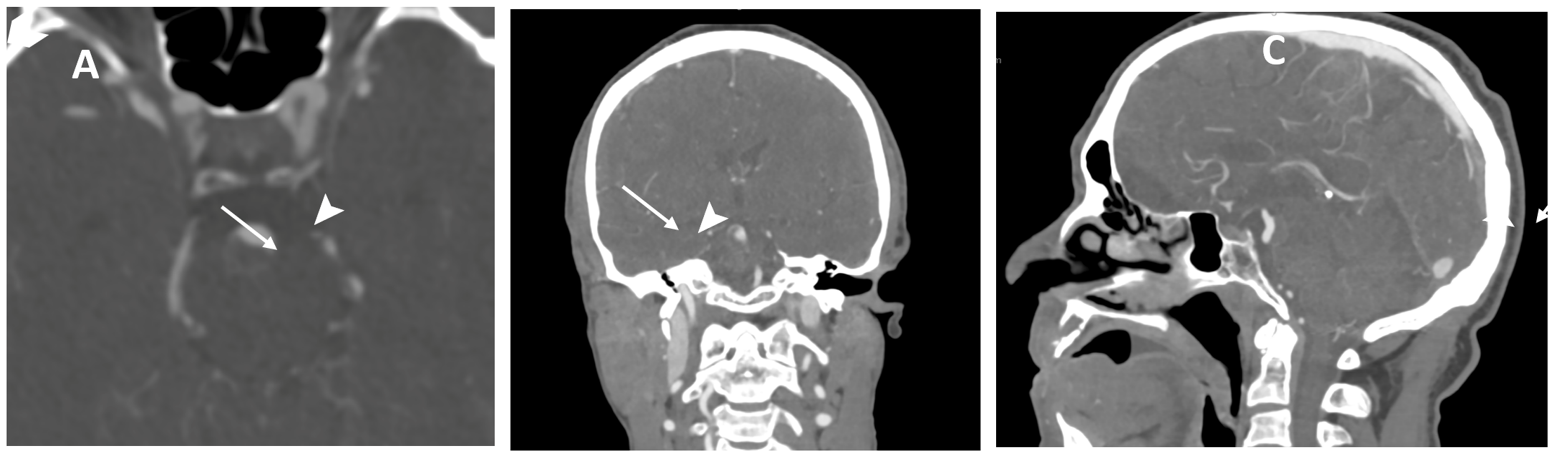
Figure 1: CT angiography of the patient demonstrating the basilar artery aneurysm in the axial (A), coronal (B) and sagittal (C) planes. The intramural thrombus (arrows) is responsible for luminal narrowing (asterisk).
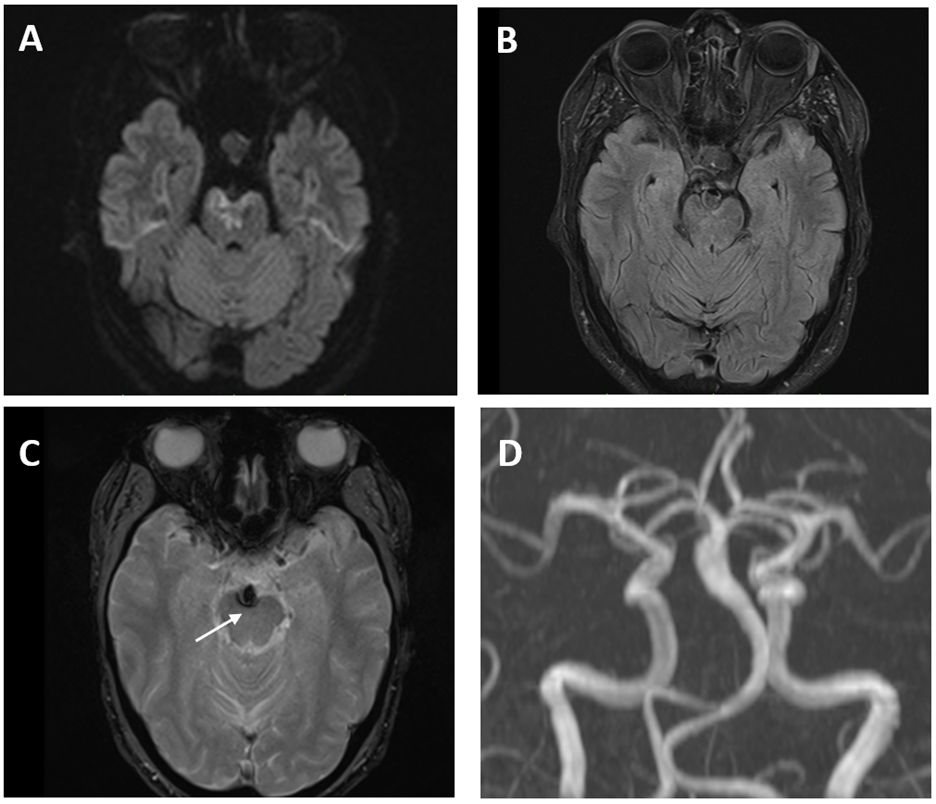
Figure 2: Brain MRI of the patient demonstrating a median pontine ischemic lesion on Diffusion Weighted Imaging (DWI) (A), a mural thrombus of the basilar artery with luminal narrowing on Fluid Attenuated Inversion Recovery (FLAIR) imaging (B). The T2* sequence (C) shows a layered thrombus (arrow). The aneurysm appears to have a fusiform shape on Magnetic Resonance Angiography (MRA) (D).
Initial management
After multidisciplinary discussion involving neurology, neurovascular interventional radiology and neurosurgery, intravenous thrombolysis and mechanical thrombectomy were not pursued given the suspected wall pathology and the small infarct volume with low NIHSS. The patient was admitted to the stroke unit for blood pressure control, surveillance and reassessment. Single antiplatelet therapy was withheld until further wall imaging characterization, given the haemorrhagic risk associated with a possible chronic dissecting aneurysm.
Discussion
The Mizutani classification: a wall-based framework
Mizutani and colleagues introduced their classification of intracranial non-atherosclerotic fusiform and dissecting aneurysms on the basis of histopathological analysis of resected specimens combined with clinical and radiological data [3,4]. The strength of the classification lies in its anchoring in the pathological state of the three layers of the arterial wall — the intima, the media and especially the internal elastic lamina. Four types are recognized (Table 1).
Table 1: The Mizutani classification of non-atherosclerotic intracranial fusiform and dissecting aneurysms. Adapted from Mizutani T et al.
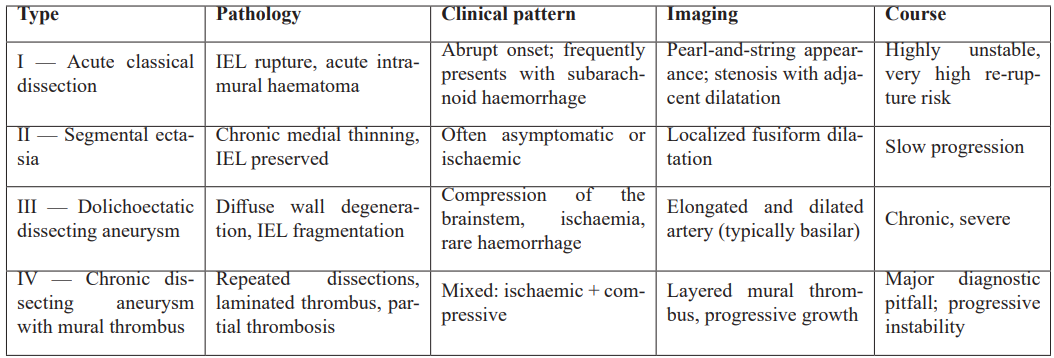
It is essential to underscore that this classification does not encompass purely atherosclerotic fusiform aneurysms. Atheromatous fusiform aneurysms - typically slowly growing, with concentric homogeneous wall thickening and diffuse plaque burden in a patient with classical cardiovascular risk factors — are biologically and prognostically distinct, and they were deliberately excluded from Mizutani's series [3,7]. Failing to make this distinction in practice results in conflating dissection with atherosclerosis, with potentially serious therapeutic consequences.
Atherosclerotic versus chronic dissecting fusiform aneurysms: a critical distinction
In a fusiform aneurysm of the vertebrobasilar system, the differential diagnosis between an atheromatous dolichoectasia and a chronic dissecting aneurysm of Mizutani type III or IV cannot be made on the basis of luminal angiography alone. Vessel wall imaging (VWI) with high-resolution black-blood T1-weighted sequences is now the cornerstone of the differentiation (Table 2) [8,9].
Table 2: Imaging and clinical features differentiating chronic dissecting fusiform aneurysms from atheromatous fusiform aneurysms.
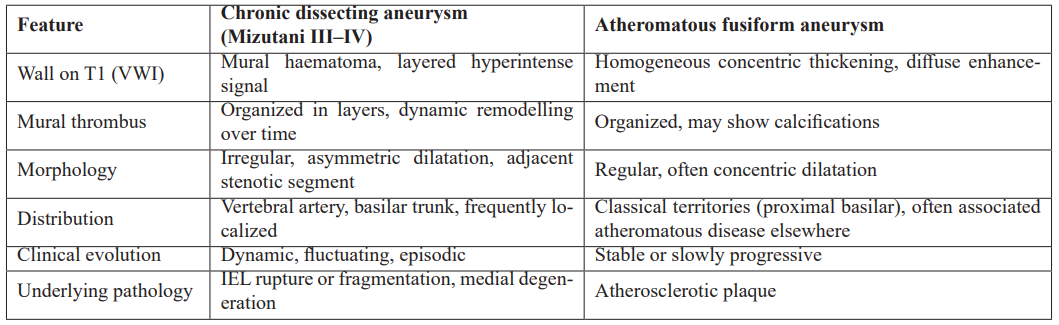
A formal distinction is rarely possible without histology. Nevertheless, several arguments may shift the balance in favour of a chronic dissecting aetiology in our patient: the irregular, asymmetric dilatation; the presence of a layered mural thrombus on VWI; the absence of widespread atheromatous burden in other vascular territories despite advanced age; and the dynamic clinical evolution — an abrupt vertigo followed within hours by acute brainstem ischaemia [8,10].
Park's behavioural framework: complementing Mizutani
Whereas the Mizutani classification describes what the lesion is (the wall pathology), Park's framework describes what the lesion does (its clinical phenotype).5 Park and colleagues stratified vertebrobasilar non-saccular aneurysms into four clinical subgroups: haemorrhagic, ischaemic/embolic, compressive, and asymptomatic. Each pattern is associated with a distinct natural history, distinct management priorities and distinct risks. Our patient presented with an ischaemic-embolic phenotype, which carries a recurrence risk that justifies considering antithrombotic therapy — yet the underlying chronic dissecting pathology raises the spectre of haemorrhage and warrants caution.
Integrating both frameworks yield a more nuanced clinical picture: in our patient, the lesion is most likely a Mizutani type III or IV (wall) presenting with a park ischaemic phenotype (behaviour). Each axis informs a different therapeutic question — antithrombotic strategy, surveillance interval, and the role of endovascular treatment.
Therapeutic implications
There is no standardized treatment for fusiform vertebrobasilar aneurysms. Therapeutic decisions must integrate the suspected wall pathology, the dominant clinical phenotype, the lesion's growth trajectory, the involvement of perforating branches and the patient's comorbidities [5,11,12]. Three main therapeutic strategies coexist:
(i) Conservative management. Indicated in stable asymptomatic lesions or in elderly patients with significant comorbidities. It comprises strict control of vascular risk factors (blood pressure, lipid profile, smoking cessation), and periodic imaging surveillance (typically magnetic resonance angiography every 6–12 months, with VWI when feasible).
(ii) Medical antithrombotic therapy. Single or dual antiplatelet therapy may be considered when the dominant phenotype is ischaemic and the haemorrhagic risk is judged acceptable on the basis of wall imaging. Therapeutic anticoagulation remains controversial; in patients with chronic dissecting aneurysms or laminated mural thrombus, the haemorrhagic potential generally outweighs the antithrombotic benefit [11,13].
(iii) Endovascular treatment. Flow-diverting stents, stent-assisted coiling, and parent artery occlusion (after balloon test occlusion) are the principal endovascular options. Their main limitation in the basilar trunk is the presence of perforating arteries supplying the brainstem, which may be occluded by stent-related thrombosis, with potentially catastrophic consequences [12,14,15]. Surgical bypass with parent artery occlusion is reserved for selected cases unsuitable for endovascular approach.
In our patient, after multidisciplinary review and given the wall imaging features suggesting chronic dissection with a small ischaemic burden, conservative management was elected, with strict blood pressure control, smoking cessation counselling, and high-resolution MRI surveillance at three months. Single antiplatelet therapy was reintroduced cautiously after re-imaging confirmed stability of the mural haematoma signal.
Key Messages
- Not all fusiform aneurysms are atherosclerotic. A substantial proportion of vertebrobasilar fusiform lesions reflect a primary wall pathology — chronic dissection, IEL fragmentation, medial degeneration — rather than atherosclerosis.
- The Mizutani classification recognizes four distinct wall-based subtypes (acute dissection, segmental ectasia, dolichoectatic dissecting aneurysm, chronic dissecting aneurysm with mural thrombus), each with a distinct natural history.
- A laminated intramural thrombus is a hallmark of chronic dissecting aneurysm (Mizutani type IV) and a major diagnostic clue distinguishing it from atheromatous dolichoectasia.
- Vessel wall imaging is now essential. High-resolution black-blood T1 MRI characterizes the wall, identifies mural haematoma, and informs the choice of antithrombotic and interventional strategy.
- Management is individualized. The Mizutani–Park integrated framework — what the lesion is and what the lesion does — should guide therapeutic decisions. There is no "one size fits all" approach.
Conclusion
Fusiform vertebrobasilar aneurysms are not a homogeneous entity. Behind a superficially similar angiographic appearance, the underlying arterial wall may harbour an acute dissection, a chronic dissecting aneurysm, a dolichoectatic degeneration, or an atherosclerotic plaque — each with markedly different prognostic and therapeutic implications. The Mizutani classification, by anchoring the diagnosis in wall pathology, and the Park framework, by stratifying clinical behaviour, together provide the conceptual backbone of contemporary management. Vessel wall imaging is now indispensable to operationalize this framework at the bedside. Our case illustrates the diagnostic and therapeutic dilemma that arises when a patient presents with an ischaemic phenotype on a wall pathology with potential haemorrhagic risk — a situation in which the integrated approach is not merely academic but determines clinical decisions and long-term outcome.
References
- Flemming KD, Wiebers DO, Brown RD Jr, et al. The natural history of radiographically defined vertebrobasilar nonsaccular intracranial aneurysms. Cerebrovasc Dis, 2005; 20(4): 270–279.
- Wolfe TJ, Hussain MS, Suh DC, Levy EI. Endovascular treatment of dolichoectatic intracranial vertebrobasilar aneurysms. J Neurointerv Surg, 2010; 2(3): 246–250.
- Mizutani T, Miki Y, Kojima H, Suzuki H. Proposed classification of nonatherosclerotic cerebral fusiform and dissecting aneurysms. Neurosurgery, 1999; 45(2): 253–259.
- Mizutani T. A fatal, chronically growing basilar artery: a new type of dissecting aneurysm. J Neurosurg, 1996; 84(6): 962–971.
- Park SH, Yim MB, Lee CY, Kim E, Son EI. Intracranial fusiform aneurysms: it's pathogenesis, clinical characteristics and managements. J Korean Neurosurg Soc, 2008; 44(3): 116–123.
- Anson JA, Lawton MT, Spetzler RF. Characteristics and surgical treatment of dolichoectatic and fusiform aneurysms. J Neurosurg, 1996; 84(2): 185–193.
- Day AL, Gaposchkin CG, Yu CJ, Rivet DJ, Dacey RG Jr. Spontaneous fusiform middle cerebral artery aneurysms: characteristics and a proposed mechanism of formation. J Neurosurg, 2003; 99(2): 228–240.
- Mandell DM, Mossa-Basha M, Qiao Y, et al. Intracranial vessel wall MRI: principles and expert consensus recommendations of the American Society of Neuroradiology. AJNR Am J Neuroradiol, 2017; 38(2): 218–229.
- Choi YJ, Jung SC, Lee DH. Vessel wall imaging of the intracranial and cervical carotid arteries. J Stroke, 2015; 17(3): 238–255.
- Sacho RH, Saliou G, Kostynskyy A, et al. Natural history and outcome after treatment of unruptured intradural fusiform aneurysms. Stroke, 2014; 45(11): 3251–3256.
- Passero SG, Calchetti B, Bartalini S. Intracranial bleeding in patients with vertebrobasilar dolichoectasia. Stroke, 2005; 36(7): 1421–1425.
- Siddiqui AH, Abla AA, Kan P, et al. Panacea or problem: flow diverters in the treatment of symptomatic large or giant fusiform vertebrobasilar aneurysms. J Neurosurg, 2012; 116(6): 1258–1266.
- Schwarz S, Egelhof T, Schwab S, Hacke W. Vertebrobasilar volume flow assessment and prediction of stroke in patients with vertebrobasilar dolichoectasia. Neurology, 1997; 48(5): 1238–1242.
- Natarajan SK, Lin N, Sonig A, Rai AT, Carter RR, Levy EI. The safety of Pipeline flow diversion in fusiform vertebrobasilar aneurysms: a consecutive case series. Neurosurgery, 2015; 77(5): 705–714.
- Kiyofuji S, Graffeo CS, Perry A, et al. Meta-analysis of treatment outcomes of posterior circulation non-saccular aneurysms by flow diverters. J Neurointerv Surg, 2018; 10(5): 493–499.
- Brinjikji W, Nasr DM, Cloft HJ, Rabinstein A, Lanzino G. Spontaneous coronary and intracranial artery dissection: a systematic review. AJNR Am J Neuroradiol, 2014; 35(8): 1410–1414.
- Nasr DM, Brinjikji W, Rouchaud A, Kadirvel R, Flemming KD, Kallmes DF. Imaging characteristics of growing and ruptured vertebrobasilar non-saccular and dolichoectatic aneurysms. Stroke, 2016; 47(1): 106–112.
- Drake CG, Peerless SJ. Giant fusiform intracranial aneurysms: review of 120 patients treated surgically from 1965 to 1992. J Neurosurg, 1997; 87(2): 141–162.
- Coert BA, Chang SD, Do HM, Marks MP, Steinberg GK. Surgical and endovascular management of symptomatic posterior circulation fusiform aneurysms. J Neurosurg, 2007; 106(5): 855–865.
- Echiverri HC, Rubino FA, Gupta SR, Gujrati M. Fusiform aneurysm of the vertebrobasilar arterial system. Stroke, 1989; 20(8): 1741–1747.