
Email id: info@ijclinmedcasereports.com
When Renal Angiomyolipoma Follow-up Reveals Tuberous Sclerosis: An Unexpected Radiological Revelation
Soukaina Bahha*, Kaoutar Imrani, Salma El Aouadi, Asmae Guennouni and Ittimade Nassar
Central Radiology Department, Ibn Sina Hospital Center, Rabat, Morocco
Received Date: 19/05/2026; Published Date: 29/07/2026
*Corresponding author: Soukaina Bahha, Radiology Department of the National Oncology Hospital, Rabat, Morocco
Abstract
Tuberous Sclerosis Complex (TSC) is a rare genetic disorder characterized by the growth of benign tumors in multiple organs, including the kidneys, brain, lungs, and skin. This case report describes a 28-year-old female with a medical history of right nephrectomy performed 6 years ago for a renal angiomyolipoma. Following the nephrectomy, no systematic long-term follow-up was carried out. The patient was referred to our department for an abdominal-pelvic CT scan due to intermittent abdominal pain and left lumbar heaviness, without significant changes in her general health. Radiological findings revealed a large exophytic angiomyolipoma in the left kidney, along with multiple millimetric fat-density formations in the renal parenchyma. The multifocal and unilateral nature of the lesions, combined with the patient's history, raised suspicion for a syndromic condition, particularly TSC. Additional CT imaging revealed subependymal nodules with calcifications in the brain and pulmonary cysts consistent with lymphangioleiomyomatosis. Osteocondensing lesions in the lumbar and thoracic vertebrae were also noted. The combination of these radiological features strongly suggested a diagnosis of TSC. The patient was managed by a multidisciplinary team, including nephrology, neurology, pulmonology, and genetic counseling. Regular follow-up was initiated, including renal monitoring, brain MRIs, pulmonary assessments, and genetic testing, to prevent potential complications and provide comprehensive care.
Keywords: Tuberous Sclerosis Complex; Renal Angiomyolipoma; Radiological Diagnosis; Asymptomatic Presentation
Introduction
Renal Angiomyolipoma (AML) is a benign mesenchymal tumor composed of adipose tissue, smooth muscle, and dysmorphic blood vessels. It is the most common benign renal neoplasm and is frequently detected incidentally through imaging modalities such as ultrasound, Computed Tomography (CT), and Magnetic Resonance Imaging (MRI) [1]. While the majority of AMLs are sporadic, approximately 20% are associated with Tuberous Sclerosis Complex (TSC), a multisystem autosomal dominant disorder characterized by the development of hamartomatous lesions in various organs [2].
TSC results from mutations in the TSC1 or TSC2 genes, leading to dysregulation of the mTOR signaling pathway and subsequent abnormal cellular proliferation and differentiation [3]. Renal manifestations are among the most common features of TSC, with angiomyolipomas occurring in up to 70–80% of affected individuals. These lesions are typically multiple, bilateral, and larger in size compared to their sporadic counterparts, and they carry a higher risk of complications, including hemorrhage and progressive renal impairment [4].
Beyond renal involvement, TSC affects multiple organ systems, including the central nervous system (cortical tubers and subependymal nodules), lungs (lymphangioleiomyomatosis), skin, and heart. Early diagnosis is therefore essential to ensure appropriate surveillance and multidisciplinary management, as the disease course can vary widely in severity [2,5].
Imaging plays a pivotal role not only in the identification and follow-up of renal AML but also in the recognition of associated features suggestive of TSC. In certain cases, what appears initially as an isolated renal lesion may represent the first manifestation of an underlying systemic disorder, only revealed through careful radiological assessment and longitudinal follow-up.
In this report, we present a case in which routine imaging follow-up of a renal angiomyolipoma led to the unexpected diagnosis of tuberous sclerosis complex, highlighting the critical role of radiological vigilance in uncovering occult syndromic conditions.
Case Report
This is a 28-year-old female with no significant family history, who has a notable medical history of a right nephrectomy performed 6 years ago for a renal tumor, histologically confirmed as an angiomyolipoma. No systematic long-term follow-up was conducted after the initial surgery.
The patient was referred to our department for an abdominal-pelvic CT scan as part of an etiological workup for a clinically suspected deep tumor syndrome. She presented with intermittent abdominal pain and a sensation of left lumbar heaviness that had been progressing for several months, without any significant change in her general condition. Upon clinical examination, there was no palpable mass or significant tenderness on abdominal palpation. However, her complaints raised concerns about potential renal involvement.
The CT scan, performed with contrast injection, revealed a large exophytic mass in the left kidney, occupying the entire posterior perirenal space. The mass was hypodense, containing vascular structures and areas of fat, suggesting an angiomyolipoma with a dominant angiomatous component. In addition, multiple millimetric fat-density formations were observed in the renal parenchyma of the same kidney, with no signs of acute hemorrhagic complication. The appearance of these lesions was multifocal and unilateral, confined to the single remaining kidney, which prompted further investigation into a potential underlying syndromic condition.
A detailed review of the CT images also revealed extra-renal involvement. Notably, subependymal nodules containing calcifications were seen in the cerebral imaging, along with pulmonary abnormalities, including scattered cysts that were consistent with lymphangioleiomyomatosis. Additionally, osteocondensing lesions were identified on the lumbar and thoracic vertebrae, with abnormal densification of certain vertebral areas, suggesting "sclerotic-type lesions."
These clinical and radiological findings collectively pointed to a strong suspicion of Tuberous Sclerosis Complex (TSC), a genetic condition characterized by the growth of non-cancerous tumors in multiple organs, which can present with a variety of systemic manifestations, including renal, neurological, and pulmonary involvement.
After the diagnosis of Tuberous Sclerosis Complex, the patient was managed by a multidisciplinary team including nephrology, neurology, pulmonology, and genetic counseling. This approach allowed for the monitoring of various manifestations of the disease and tailored management:
- Nephrology: Regular monitoring of renal function, with ultrasounds to track renal angiomyolipomas and prevent any hemorrhagic complications.
- Neurology: Surveillance of subependymal nodules and the risk of seizures through follow-up brain MRIs.
- Pulmonology: Monitoring of pulmonary lesions related to lymphangioleiomyomatosis through chest CT scans, despite the absence of respiratory symptoms.
- Genetic Follow-up: Confirmation of the TSC2 mutation and genetic counseling for the patient and her family.
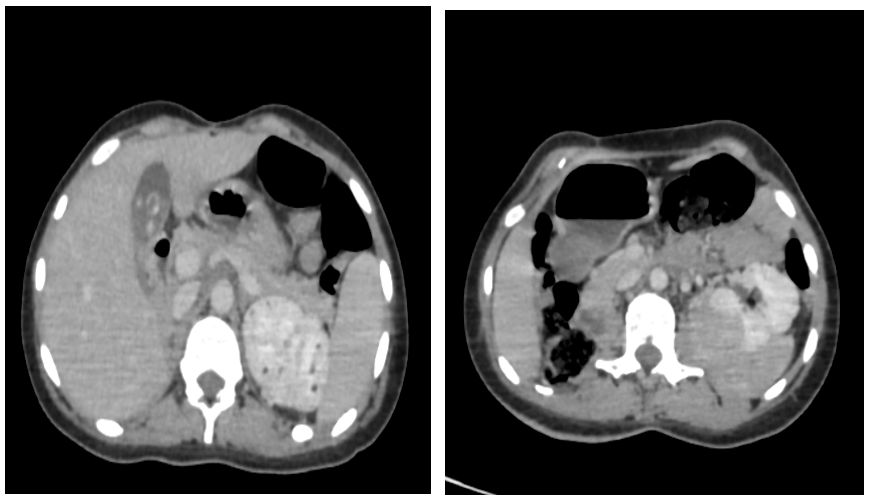
Figure 1: Abdominal CT scan in axial slices at portal phase showing a large exophytic mass in the left kidney with vascular structures and fat areas, suggestive of an angiomyolipoma. Multiple millimetric fat-density formations are also present in the renal parenchyma.
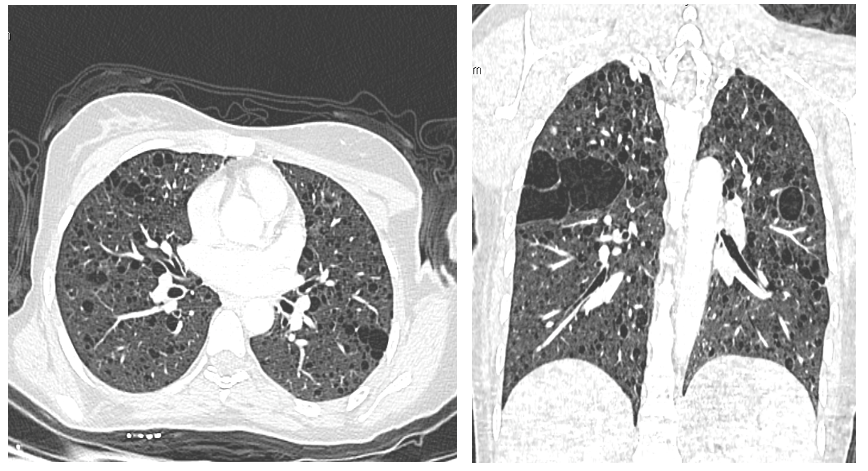
Figure 2: Chest CT scan in parenchymal window, in axial and coronal slices, showing multiple diffuse bilateral pulmonary cystic lesions in both lung fields, some of which are confluent, suggestive of thoracic lymphangioleiomyomatosis.
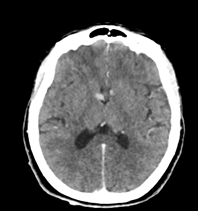
Figure 3: CT scan of the brain in axial slices showing two well-defined, oval-shaped extra-axial subependymal formations, hyperdense, containing calcifications, suggestive of hamartomas.
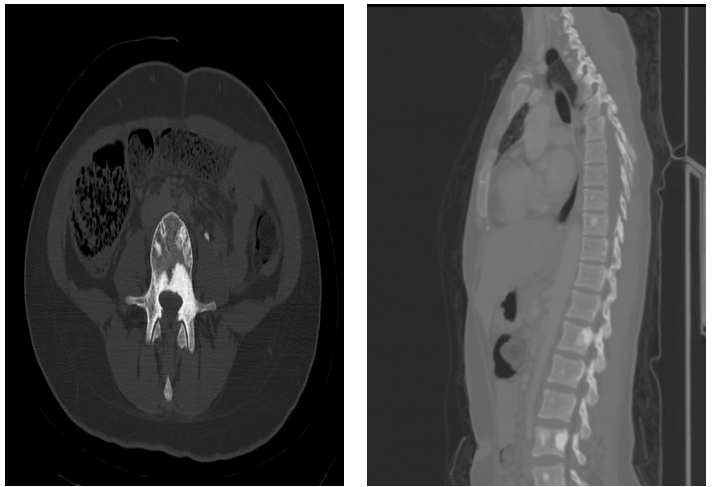
Figure 4: CT scan images in bone window, axial and sagittal cuts, showing diffuse and layered osteocondensing lesions in the thoracolumbar vertebrae without cortical rupture.
Discussion
Tuberous Sclerosis Complex (TSC) primarily arises from heterozygous pathogenic variants in the TSC1 or TSC2 tumor suppressor genes. The inactivation of these genes dysregulates cell proliferation, promoting the development of hamartomas such as renal angiomyolipoma (AML) [1].
Angiomyolipomas (AML) occur in 70 to 80% of patients with Tuberous Sclerosis Complex (TSC) and are often multiple and bilateral [2,3].
Renal angiomyolipoma (AML) is a key marker of TSC, and several data help position the present case within existing knowledge. In large TSC cohorts, AML affects about half to four‑fifths of patients, usually multiple and bilateral, and often arises in childhood or adolescence [4,5]. The clinical spectrum of renal AML includes, in decreasing order of frequency: pain, hypertension, hemorrhage, hematuria, and renal failure. The decline in renal function is multifactorial, resulting from acute hemorrhagic episodes, nephron loss following surgical intervention or nephrectomy, and tumor mass effect causing compression of the adjacent parenchyma [6,7].
Pulmonary LAM affects about 26–39% of women with TSC and may be asymptomatic at diagnosis [8].
Bone involvement in TSC frequently presents as multiple small, round sclerotic foci within the spine and axial skeleton. In particular, the identification of four or more such lesions on CT serves as a highly specific radiological feature to differentiate TSC-associated lymphangioleiomyomatosis (TSC-LAM) from sporadic LAM [9].
Calcified subependymal nodules are highly prevalent and characteristic hamartomas of TSC, located along the walls of the lateral ventricles and easily visualized on CT. Reflecting long-standing lesions, they can progress into SEGAs and constitute a cornerstone of radiological diagnosis, particularly when presenting as multiple, bilateral, and periventricular lesions in a young patient [10].
For prognosis, careful, lifelong multidisciplinary follow‑up with imaging‑based risk stratification and early mTOR/embolization in this solitary kidney is critical to preserve renal function and prevent hemorrhagic complications [11].
Conclusion
This case demonstrates that routine renal angiomyolipoma follow-up can unexpectedly provide the diagnostic key to uncovering underlying tuberous sclerosis complex. Finding atypical, multiple, or bilateral renal AMLs must always prompt clinicians to look beyond isolated lesions and actively screen for systemic involvement. Ultimately, this unexpected radiological revelation ensures timely multi-system evaluation, targeted mTOR-inhibitor therapy, and lifelong surveillance to prevent life-threatening hemorrhagic complications.
References
- Curatolo P, Bombardieri R, Jozwiak S. Tuberous sclerosis. Lancet, 2008; 372 (no 9639): p. 657‑668. doi: 10.1016/S0140-6736(08)61279-9.
- Nephrology Dialysis Transplantation | Oxford Academic. OUP Academic, 2026.
- Hunter-Dickson M, Wu P, Athavale A, Wang AY. Management of Renal Angiomyolipomas in Tuberous Sclerosis Complex: A Case Report and Literature Review. Journal of Clinical Medicine, 2022; 11 (no 20): p. 6084. doi: 10.3390/jcm11206084.
- Renal angiomyolipoma in patients with tuberous sclerosis complex: findings from the TuberOus SClerosis registry to increase disease Awareness | Nephrology Dialysis Transplantation | Oxford Academic,
- Tuberous Sclerosis Complex: Renal Imaging FindingsRadiology, 2026.
- Kingswood JC, et al. Renal angiomyolipoma in patients with tuberous sclerosis complex: findings from the TuberOus SClerosis registry to increase disease Awareness. Nephrol Dial Transplant, 2019; 34 (no3): p. 502‑508. doi: 10.1093/ndt/gfy063.
- Kingswood JC, et al.TuberOus SClerosis registry to increase disease Awareness (TOSCA) - baseline data on 2093 patients. Orphanet J Rare Dis, 2017; 12 (no 1): p. 2. doi: 10.1186/s13023-016-0553-5.
- Sisay B, et al.Tuberous sclerosis complex: A clinical diagnosis in Ethiopian patients. Medicine, 2024; 103 (no 6): p. e37135. doi: 10.1097/MD.0000000000037135.
- Avila NA, Dwyer AJ, Rabel A, Darling T, Hong CH, Moss J. CT of Sclerotic Bone Lesions: Imaging Features Differentiating Tuberous Sclerosis Complex with Lymphangioleiomyomatosis from Sporadic Lymphangioleiomymatosis. Radiology, 2010; 254 (no 3): p. 851‑857. doi: 10.1148/radiol.09090227.
- Nixon J, Houser O, Gomez M, Okazaki H. Cerebral tuberous sclerosis: MR imaging. Radiology, 1989; 170 (no 3): p. 869‑873. doi: 10.1148/radiology.170.3.2916045.
- Wang MX, et al. Tuberous Sclerosis: Current Update. RadioGraphics, 2021; 41 (no 7): p. 1992‑2010. doi: 10.1148/rg.2021210103.