
Email id: info@ijclinmedcasereports.com
A Rare Encounter: Anal Metastasis Arising from Rectal Adenocarcinoma
Soukaina Bahha1,*, Sara Hdiye2, Salma EL Aouadi1, Asmae Guennouni1, Youssef Omor1 and Rachida Latib1
¹Radiology Department of the National Oncology Hospital, Rabat, Morocco
²Mohammed V Military Hospital Gastroenterology Department, Rabat, Morocco
Received Date: 19/05/2026; Published Date: 27/07/2026
*Corresponding author: Soukaina Bahha, Radiology Department of the National Oncology Hospital, Rabat, Morocco
Abstract
Metastasis to the anal region from rectal adenocarcinoma is an extremely rare phenomenon, with only a few documented cases in the literature. We present the case of an 87-year-old female patient initially diagnosed with rectal adenocarcinoma. Several months later, she presented with rectal bleeding, a deterioration in her general condition, and the development of a palpable mass in the anal region. Colonoscopy revealed an ulcerating mass in the lower rectum, highly suggestive of malignancy. Biopsies from both the rectal lesion and the anal mass confirmed moderately differentiated rectal adenocarcinoma with metastatic spread to the anal region. Further imaging, including MRI, showed circumferential wall thickening in the rectum and an additional lesion in the anal region measuring 20 x 13 mm, consistent with anal metastasis from the rectal cancer. This case highlights the rare occurrence of anal metastasis in advanced rectal cancer and underscores the importance of thorough diagnostic evaluation and ongoing follow-up in colorectal cancer patients.
Keywords: Anal Metastasis; Rectal Adenocarcinoma; MRI
Case Report
This case concerns an 87-year-old female patient who presented with a several-month history of rectal bleeding (rectorrhagia) and a deterioration in general condition. Her symptoms were followed by the onset of a palpable mass in the anal region approximately one month ago. Given the persistence and nature of her symptoms, the patient sought consultation with a gastroenterologist. After a thorough evaluation, the gastroenterologist performed a colonoscopy, which revealed and ulcerating, fungating process in the lower rectum (Figure 4). The mass exhibited characteristics suggestive of malignancy, prompting the decision to perform biopsies from both the rectal lesion and the anal mass. The biopsy results confirmed the presence of rectal adenocarcinoma (Moderately differentiated) with metastatic spread to the anal region, a rare but clinically significant complication in the context of advanced rectal cancer. Given the diagnosis, the patient was referred for further imaging, specifically a rectal MRI, to assess the extent of disease and better understand the local spread. MRI shows a Circumferential wall thickening of the lower and mid-rectum, irregular in shape, showing intermediate signal on T2 (Figure 1), hypointense on T1, and hyperintense on diffusion (Figure 2), with a low ADC. The lesion shows heterogeneous enhancement after contrast injection (Figure 3), measuring a maximum thickness of 19 mm, extending over 62 mm, and located 46 mm from the anal margin, with the presence of a tumor deposit near the anus, showing the same signal characteristics as the previously described lesion; it is in contact with the inferior pole of the internal sphincter, showing heterogeneous enhancement after contrast injection, measuring 20 x 13 mm, suggesting an anal metastasis from the previously described rectal cancer.
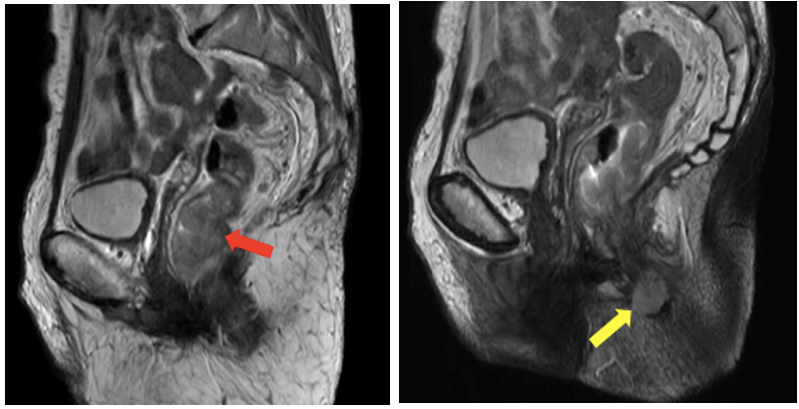
Figure 1: Abdominopelvic MRI weighted in T2, sagittal sections, showing the rectal tumor of the lower and mid-rectum (red arrow), irregular in shape, showing intermediate signal on T2 and the anal mass (yellow arrow) showing the same signal characteristics.
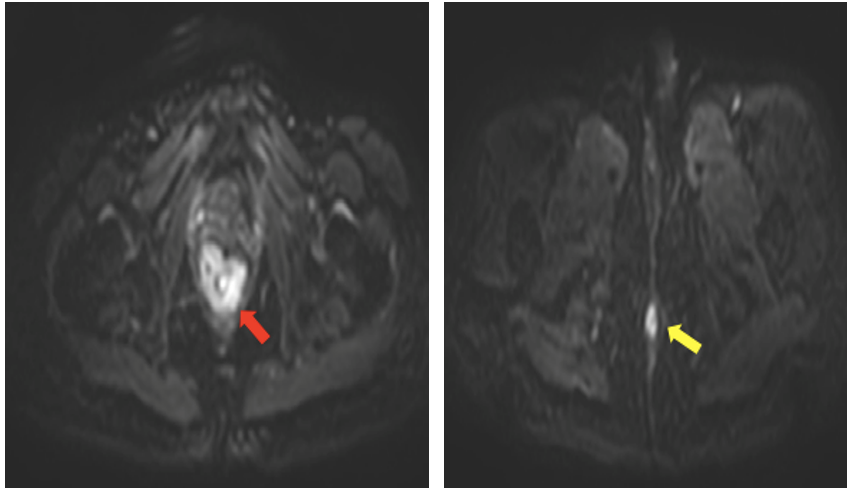
Figure 2: Abdominopelvic MRI with diffusion-weighted sequence, axial sections, showing the rectal (red arrow), and anal (yellow arrow) masses with hyperintense diffusion signal.
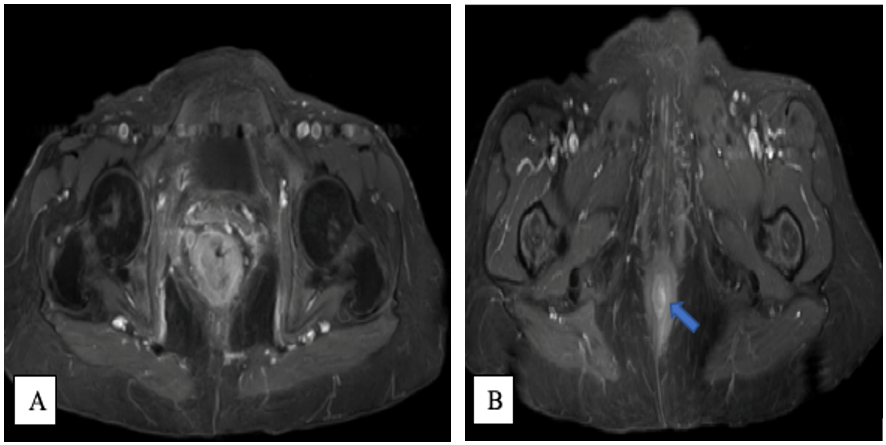
Figure 3: Axial sections of pelvic MRI with T1 FAT-SAT sequence after contrast injection, showing heterogeneous enhancement of the rectal tumor mass (A) and anal mass (B).
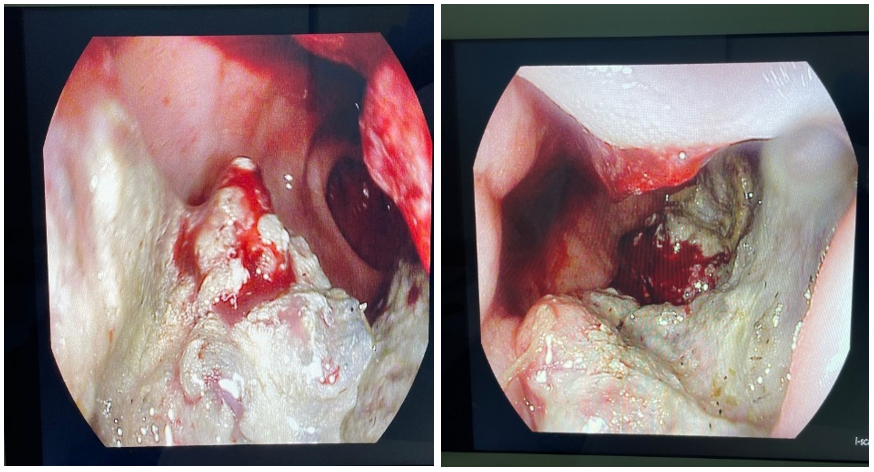
Figure 4: Colonic images of rectal carcinoma showing a vegetating endoluminal mass with associated bleeding. The mass appears irregular and raised, indicative of malignant growth.
Discussion
Although many colorectal cancer patients develop metastases, anal metastasis is uncommon. Moreover, rectal carcinoma with synchronous anal metastasis is extremely rare [1].
Propagation mechanisms include exfoliation implantation, where cancer cells from the rectum detach, "descend" along the anal canal, and graft onto a pre-existing lesion (such as a fissure, fistula, or surgical wound). Local extension occurs when a tumor in the lower rectum crosses the pectinate line to directly invade the anal canal. Lymphatic or hematogenous spread is also possible, though less common for such a nearby site to the primary focus [2]. MRI played a crucial role in assessing the extent of the tumor and its spread to adjacent structures. The similarity in signal characteristics between the rectal tumor and the anal metastasis on MRI was a key clue in the differential diagnosis. The definitive diagnosis was made through an anal biopsy, which confirmed the presence of cancer cells originating from the rectum, with immunohistochemical markers positive for CK20 and CDX2, specific to colorectal cancers. This type of histopathological confirmation is essential for establishing a definitive diagnosis and excluding a primary anal carcinoma [3].

The treatment of anal metastases from rectal cancers primarily involves surgery. The therapeutic choice depends on the nature of the lesion and the patient's condition: an excision of the anal tumor may be considered for superficial lesions in elderly or frail patients [4][5][6], while an abdominoperineal resection, a radical treatment, is recommended to prevent local recurrences [7][8]. In addition to surgery, adjuvant radiotherapy, either alone or combined with chemotherapy, may be offered, although there is no strong evidence supporting their efficacy [8].
The prognosis for these advanced cases is not as bleak, as many patients have survived without recurrence. In numerous reported cases, the follow-up duration was insufficient. Therefore, it is necessary to gather more data from cases with long-term follow-up [3].
Conclusion
Anal metastases from rectal adenocarcinomas are a rare but significant complication that requires careful follow-up. Although imaging can provide clues, the final diagnosis relies on histopathological analysis. A multidisciplinary approach, including surgery, radiotherapy, and chemotherapy, is crucial for effective management and improving patient outcomes.
Acknowledgements: The authors would like to thank the gastroenterology and radiology teams for their invaluable contributions to the diagnosis and management of the patient. And we appreciate the patient’s consent and cooperation, which made this study possible.
References
- Anal metastasis of colorectal carcinoma origin: implications for diagnosis and treatment strategy – PubMed,
- El Barni R, Lahkim M, Fihri JF, Mejdane A, Bouchama R, Achour A. Métastase anale d’un adénocarcinome du sigmoïde: la partie visible de l’iceberg. Pan Afr. Med. J., 2014; 18: p. 177. doi: 10.11604/pamj.2014.18.177.3659.
- Ikeda T, Nanashima A, Ichihara A, Kitamura E, Nagatomo K, Tanaka H. A rare case of rectal cancer with perianal metastasis: a case report, World J. Surg. , 2019; 17: p. 149. doi: 10.1186/s12957-019-1692-7.
- Scott NA, Taylor BA, Wolff BG, Lieber MM. Perianal metastasis from a sigmoid carcinoma—Objective evidence of a clonal origin: Report of a case. Dis. Colon Rectum, 1988; 31(1): p. 68. doi: 10.1007/BF02552574.
- Anal implantation metastases | BJS | Oxford Academic. Consulté le, 2026.
- Penfold JCB, Mann CV. An unusual metastasis of carcinoma of rectum. Br. J. Surg., 1973; 60(4): p. 325. doi: 10.1002/bjs.1800600417.
- Lee SH, Zucker M, Sato T. Primary adenocarcinoma of an anal gland with secondary perianal fistulas. Hum. , 1981; 12(11): p. 1034-1037. doi: 10.1016/s0046-8177(81)80263-8.
- Raiss M. Adénocarcinome des glandes anales. Ann. Chir., 2001; 126(5): p. 452-455. doi: 10.1016/S0003-3944(01)00529-6.