
Email id: info@ijclinmedcasereports.com
Dose-dependent Morbidity in Women Exposed to Radioactive Iodine During Pregnancy as a Result of the Chernobyl Accident
Stojarov AN1,* and Khrustalev VV2
1Professor, Department of Radiation Medicine and Ecology, Belarusian State Medical University, Minsk, Belarus
2Dean of the Faculty of Biology, Belarusian State University, Minsk, Belarus
Received Date: 21/05/2026; Published Date: 22/07/2026
*Corresponding author: Stojarov AN, Department of Radiation Medicine and Ecology, Belarusian State Medical University, 220116, Minsk, Belarus
Abstract
A study of the primary morbidity of women exposed to radioactive iodine as a result of the Chernobyl nuclear power plant disaster, according to the ICD-10 classification, revealed varying dose-dependent pathology onset patterns. Some pathology classes (endocrine, genitourinary, and muscular) were characterized by two peaks of incidence. A three-phase pattern was somewhat more common and was typical for diseases of the circulatory system, respiratory diseases, digestive organs, nervous system, and mental disorders. Four peaks were observed in the analysis of the incidence of primary (essential) hypertension. For all types of pathology, general values of absorbed doses to the thyroid gland were characteristic in the range of < 80 and 151-200 mGy, which stimulated morbidity. The obtained data are discussed from the point of view of the expressive activity of a number of thyrocyte genes, which can change their activity depending on the doses formed on this organ and subsequently, due to hormonal or secretory-mediator activity, change the functions of organs and systems, leading to the emergence of pathology.
Keywords: Ionizing radiation; Pregnancy; Radioactive iodine; Morbidity; Thyroid gland
Abbreviation: TG – thyroid gland; ICD – International Classification of Diseases
Introduction
Over several years, we studied the morbidity of women (1986-2016) who, during pregnancy, were exposed to the radioactive cloud that passed through southern Belarus as a result of the Chernobyl nuclear power plant accident. The radioactive cloud contained radioisotopes of iodine, which primarily affected the thyroid gland (TG). The TG, as is known, influences all organs and systems of the body, regulating their functions and overall metabolism, through hormone production or other mechanisms.
As a result, we obtained data on the heterogeneity of morbidity rates in a sample of pregnant women, which was compared with a group of women who were also pregnant, but later, when there was no radioactive iodine in the environment, but who lived in the same conditions and were of comparable social status. It was found that women exposed between 1986 and 2016 had: An increased incidence of primary cardiovascular disease [1], primarily in the form of essential hypertension [2]. A similar picture was observed after the analysis of nervous and genitourinary systems pathologies [3,4]. However, no similar incidence of gastrointestinal or respiratory pathology was detected in irradiated women [5,6].
A study of the dose dependence of primary morbidity in the study group of women showed that this indicator exhibits both general patterns and differs depending on the specific pathology.
The aim of this study was to analyze the dose dependence of identified pathology in a sample of irradiated pregnant women.
Case Series
The study included women who were at various stages of pregnancy in the first days after the Chernobyl nuclear power plant accident and lived in the Stolin district of the Brest region. Immediately after the accident, a radioactive cloud passed through this region, containing, in addition to a wide range of radionuclides, iodine isotopes (I-131, I-133, etc.). Those had been ingested and inhaled by residents, accumulated in the TG, and thus resulted in varying absorbed doses. The cohort of these women included 221 residents of the Stolin district of the Brest region.
Incidence data were obtained from the State Register of Persons Affected by the Chernobyl Nuclear Power Plant Accident. Only data from updated diagnoses of primary morbidity were used in the study. Statistical data processing was carried out using the computer applications Statistics 10.0 (StatSoft.Inc, USA) and SigmaPlot 12.5 (Systat Software Inc., Germany) and Origin 2021 (OriginLab Corp. USA).
The results of the dependences constructed in the coordinates of the absorbed dose to the TG - the standardized incidence for various types of pathology according to the ICD-10 classification differed from each other. Among them, three groups of patterns could be identified, characterized by the presence of two, three, or even four incidence maxima. Thus, two maxima were characteristic of pathology of the endocrine system, nutritional disorders, and metabolic disorders (E01.0-E66.9, N=32) (hereinafter, the designations of disease classes according to ICD-10), the genitourinary system (N10-N95.1, N=51), and the musculoskeletal system and connective tissue (M05.9-M75, N=113). The three-phase dependence was expressed somewhat more frequently and is characteristic of diseases of the circulatory system (I09.9-I86, N=236), diseases of the respiratory system (J00-J45.9, N=153), digestive system (K21-K91.5, N=97), nervous system (G20-G98.9, N=35) and mental disorders and behavioral disorders (F20.3-F48, N=48). Four maxima were found in the case of analysis of the incidence of primary (essential) hypertension (I10-I10.9, N=86). Figure 1 a and b show the first two types of dose dependences, and Figure 2 shows the incidence of essential hypertension, in which 4 peaks are revealed (Figure 1, 2).
It is clearly evident that genitourinary system disease is characterized by two peaks—at 74 and 160 mGy—while gastrointestinal system pathology demonstrates maximum values for absorbed doses to the TG at 70, 120, and 170 mGy. The graphs were plotted with an absorbed dose increment of 50 mGy. Other peak thyroid dose values for pathology in other organ systems are shown in Table 1 In this case, the entire range of absorbed doses recorded in women was divided into three parts: 0-80, 80-150 and 151-200 mGy.
Table 1: Maximum absorbed doses to the TG of pregnant women causing increased incidence of various organ and system diseases (ICD-10).
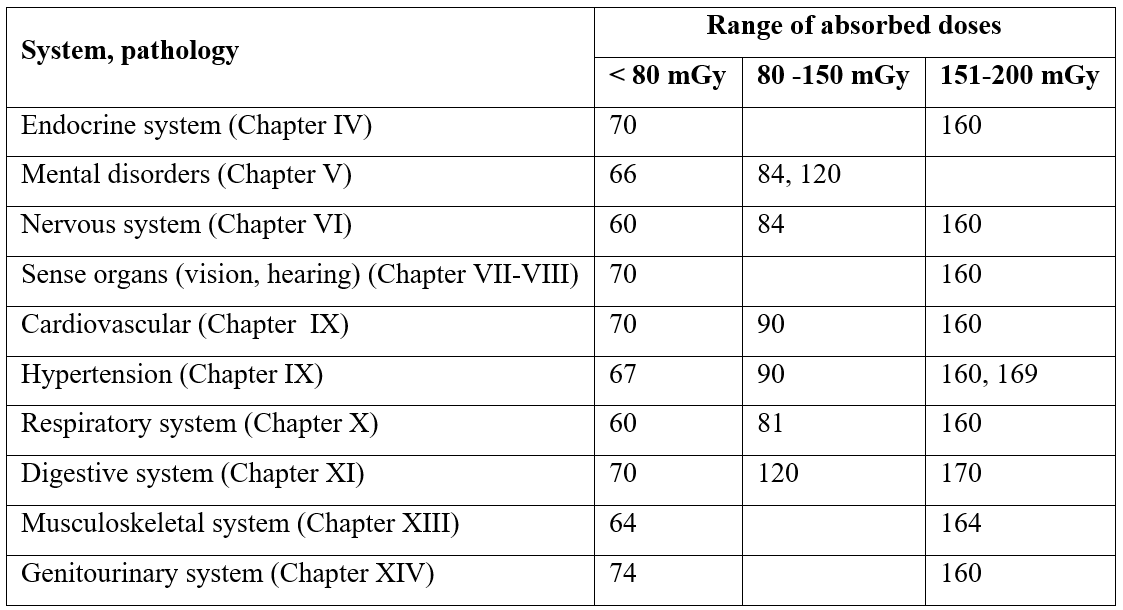
Two facts are noteworthy. Without exception, two dose ranges are significant in the development of diseases affecting various organs and systems: 0-80 mGy and 151-200 mGy. In the lower dose range, values vary from 64 to 74 mGy. In the highest, from 160 to 170 mGy. Of interest is the existence of a third, intermediate range of absorbed doses to the TG. It is characteristic of diseases affecting the respiratory, digestive, and nervous systems, as well as mental disorders. Dose values range from 81 to 120 mGy. For hypertension, as noted above, four incidence peaks are identified at 67, 90, 160, and 169 mGy. It should be noted that in the case of registration of all types of cardiovascular diseases in the region of 90 mGy, a wide shoulder is also detected, masking the existence of another peak, with the same maximum as in the case of essential hypertension.
It is interesting to analyze the prevalence of various pathologies within the aforementioned dose ranges induced in the thyroid glands of pregnant women by radioactive iodine (Figure 3). As can be seen, different ranges of absorbed thyroid doses are characterized by a predominance of various delayed morbidities. Thus, the increase in cardiovascular pathologies in the cohort studied was most pronounced at high thyroid doses (151-200 mGy) and least pronounced at absorbed doses in the range of 80-150 mGy. Respiratory diseases (Chapter X) exhibited a similar pattern of changes. Conversely, an increase in gastrointestinal diseases was observed at moderate thyroid doses (80-150 mGy). This pattern also applies to genitourinary pathologies and mental disorders (Chapter V).
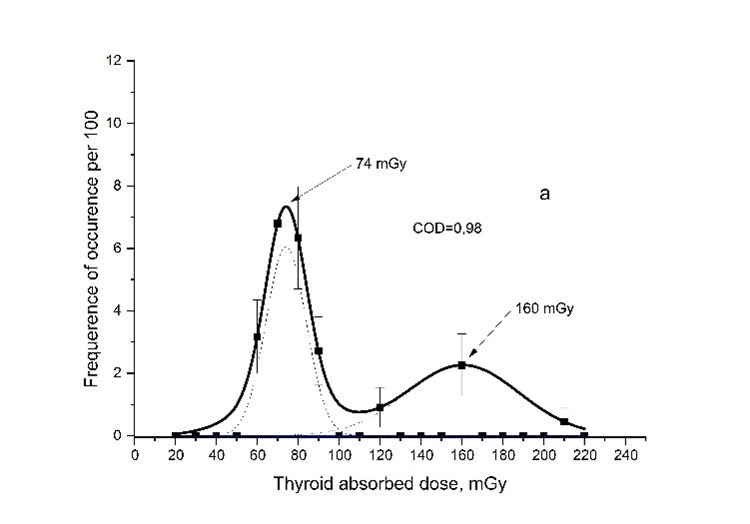
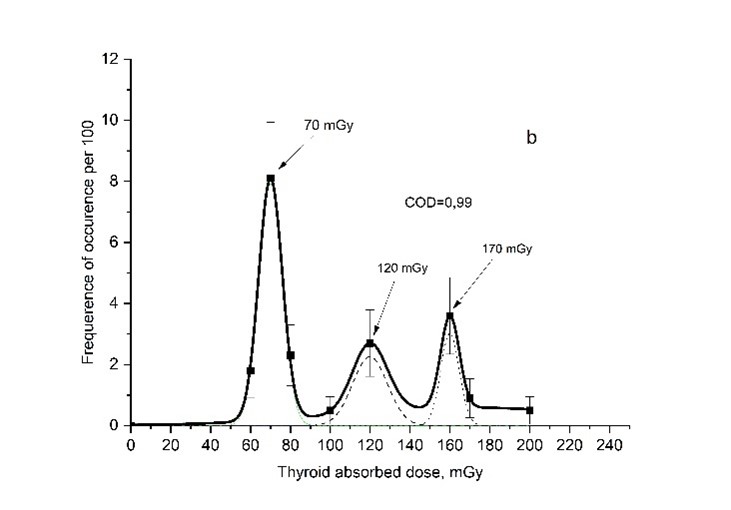
Figure 1: Dose dependences of morbidity of the genitourinary system (a) and digestive organs (b). COD is the coefficient of determination.
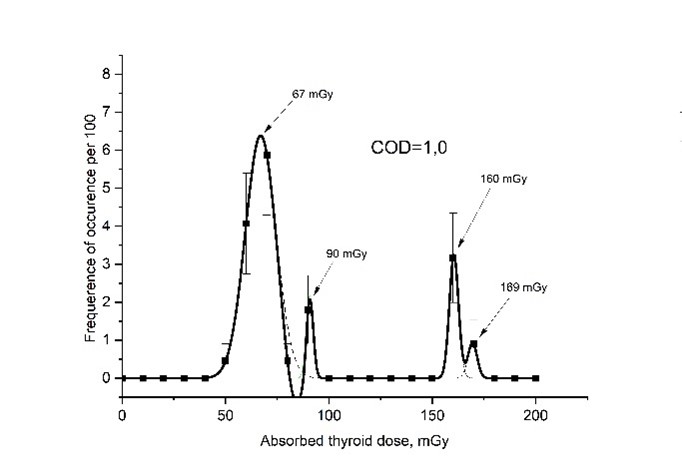
Figure 2: Dose dependence of primary hypertension incidence.
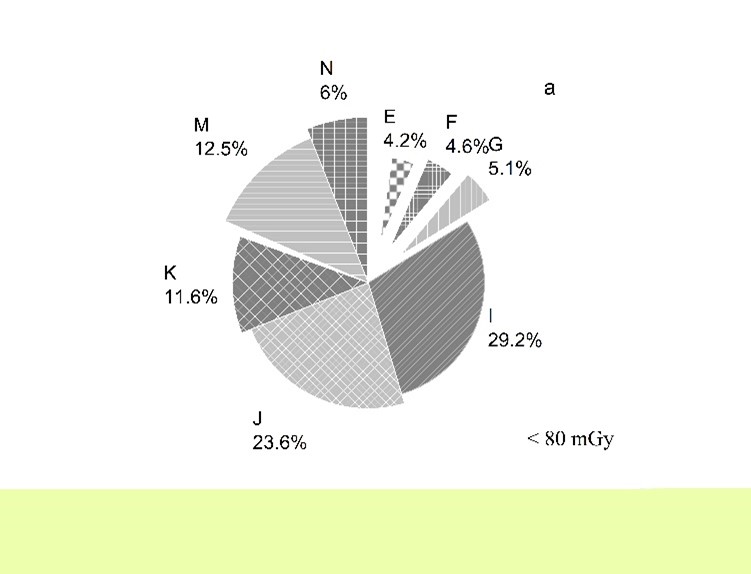
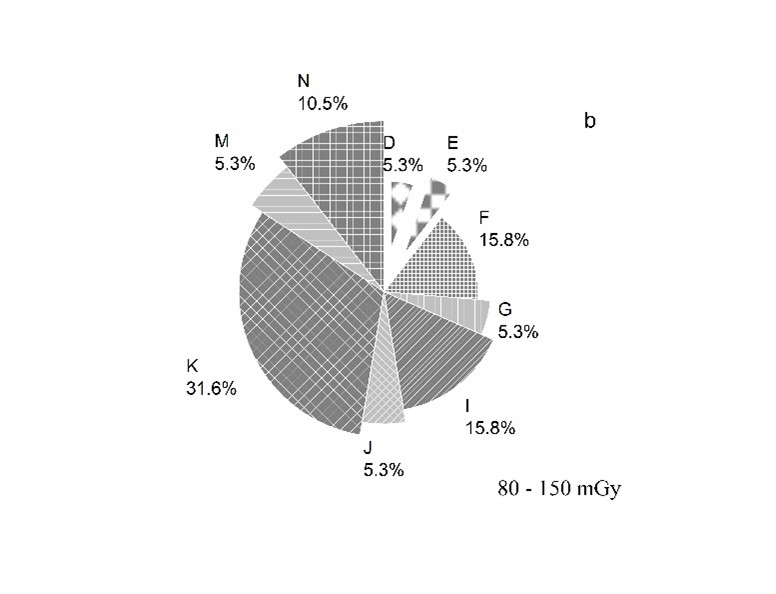
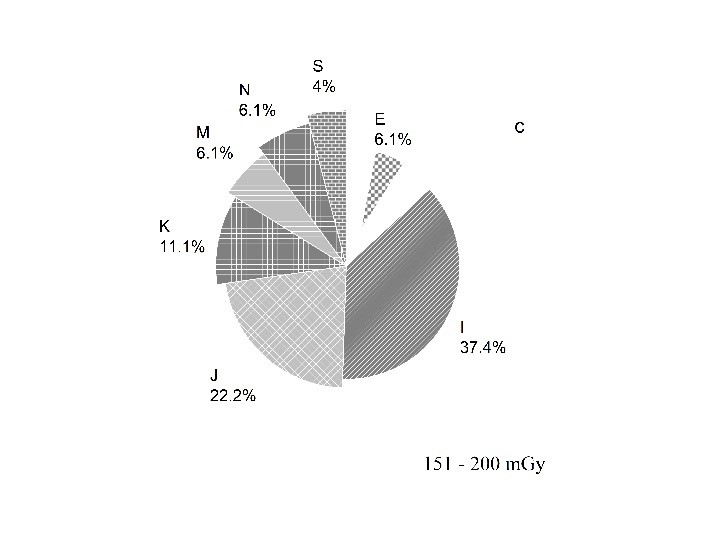
Figure 3: The structure of morbidity at different absorbed doses on the thyroid gland of pregnant women (a - <80 mGy, b – 80-150 mGy, c – 151-200 mGy).
Discussion
It should be noted that the relationships we discovered differ sharply from generally accepted notions of dose dependence in relation to morbidity and mortality from radiation exposure. Linear or linear-quadratic relationships predominate [7,8]. However, in the aforementioned cases, the focus was on total body irradiation. In our case, we analyze the effects of irradiation of one organ of the endocrine system, specifically the TG, due to the incorporation of radioactive iodine. This, in our opinion, may influence the nature of the observed effects. Nevertheless, an explanation for these findings is necessary.
Previously, studies of the effects of I-131 identified 27 genes in the thyroid gland capable of reversibly regulating their activity [9]. A number of genes (Pax8, Sic5a5, Tg, Tpo), which play an important role in thyroid function, the synthesis of its hormones, the excretion of specific protein mediators, and the influence on the metabolism of peripheral cells, exhibit low expression activity at low doses formed by I-131 and change their activity with increasing radiation exposure. There are other examples. For example, the aforementioned Sic5a5 gene, under conditions of varying activity of the exposing I-131, exhibits a biphasic nature: at low and medium activities of radioiodine, it is inhibited to a greater extent than at intermediate levels, while at high activities, it is activated. From this perspective, the above data on the existence of several peaks in the increase in the incidence of various organs and systems among pregnant women who were irradiated with radioactive iodine in April-May 1986 can be explained. The women were exposed to different absorbed doses, which could be responsible for the change in gene expression activity and the appearance of several peaks. It is well known that the TG plays a crucial role in the functioning of all body systems through the production of its hormones [10].
At the same time, it is known that radiation induces genomic instability [11]. This instability is a persistent functional state that leads to disruption of genetic control and is a key factor in the subsequent development of pathology. These changes can become entrenched in the bodies of pregnant women, and that is why we observe these effects many years after the Chernobyl accident.
Clearly, the development of general somatic effects over long periods of time after radiation exposure differs significantly from stochastic effects, which are characterized by a non-threshold nature and a gradual increase in morbidity according to a particular model. The data we have described concerns a single organ – the thyroid gland, which is largely a "conductor" in the body and regulates numerous functions. However, it should be taken into account that the mechanisms we have proposed may only be inherent in pregnant women, due to the fact that this physiological state is characterized by tension in many body systems, including the endocrine system, and may be the cause of genomic instability under conditions of radiation exposure.
Conclusion
The absorbed doses to the TG of pregnant women, due to I-131 incorporation, influence the subsequent development of pathologies in various organs and systems. Several dose-dependent relationships have been identified that influence disease incidence. Furthermore, each absorbed dose range corresponds to the severity of a specific pathology. The obtained data can be explained in terms of the sensitivity of certain thyroid genes to radioactive iodine, thyroid hormone imbalance, the production of protein mediators, and gene lability.
Acknowledgments: Doses absorbed by the TG due to I-131 incorporation were calculated by the head of the laboratory for the reconstruction of radiation doses for the population of the State Research Center of the Federal Medical Biophysical Center named after A.I. Burnazyan Federal biomedical agency (FMBA) of Russia, Doctor of Technical Sciences, Shinkarev S.M. Doses were calculated using a semiempirical 2004 iteration model.
Authorship Criteria:
Stojarov A.N. Concept and design of study. Guarantor.
Khrustalev V.V. Revision of the manuscript critically for important intellectual content.
Conflicts of Interest: There is no conflict of interest.
Grant Information: The authors received no specific funding for this work.
References
- Stojarov AN, Khrustalev VV, Adzintsova-Stazharava DA. Cardiovascular Pathology in Women Who Received Radioactive Iodine Exposure During Pregnancy as a Result of the Chernobyl Accident. Biomedical Journal of Scientific & Technical Research, 2021; 37(2): 29320–29328.
- Stojarov AN, Khrustalev VV. Essential Hypertension after Radiation Exposure. JSM Environmental Science & Ecology, 2021; 9(1): 1076–1080.
- Stozharov AN, Khrustalev VV. Delayed Pathology of the Nervous System in Women Exposed to Radioactive Iodine During Pregnancy and their Children. American Journal of Biomedical Science & Research, 2023; 19(5): 567–569.
- Stojarov AN, Khrustalev VV. Pathology of the Genitourinary System in Women Who Received Radiation Exposure with Radioactive Iodine During Pregnancy as a Result of the Accident at the Chernobyl NPP. International Journal of Clinical Studies & Medicl Case Reports, 2024; 38(3): 1-3.
- Stozharov AN, Khrustalev VV. Gastrointestinal Pathology in the Long-Term Period After the Chernobyl Accident in Women Exposed to Radioactive Iodine During Pregnancy, American Journal of Biomedical Science & Research, 2023; 19(6): 733–736.
- Stojarov AN, Khrustalev VV. Delayed Consequences of The Radioactive Iodine Intake by Pregnant Women from The Side of Respiratory System. American Journal of Biomedical Science & Research, 2022; 15(2): 208–214.
- Gillies M, Richardson DB, Cardis E, et al. Mortality from Circulatory Diseases and other Non-Cancer Outcomes among Nuclear Workers in France, the United Kingdom and the United States (INWORKS). Radiation Research, 2017; 188: 276-290.
- Shimizu Yo, Kodama K, Nishi N, et al., Radiation exposure and circulatory disease risk: Hiroshima and Nagasaki atomic bomb survivor data. 1950-2003. BMJ, 2010; 340: 1-8.
- Rudqvist N. Radiobiological effects of the thyroid gland. University of Gothenburg, 2015; Gothenburg: 69p.
- Navid A, Faisal A, Masehullah S, et al. Thyroid gland dysfunction and its effect on the cardiovascular system: a comprehensive review of the literature. Endokrynol Pol, 2020; 71(5): 466-478.
- Vorobtsova I. Transgenerative transmission of radiation-induced instability of the genome. Rad.Biology.R adioecology, 2006; 46(4): 441-446.