
Email id: info@ijclinmedcasereports.com
Late-Onset Myoclonic Epilepsy with Ragged Red Fiber-Spectrum Mitochondrial Disease: A Case Report and Review of the Diagnostic Approach
Iftee Shahriar1, Raymond Chiang1, Anna Okabe1, Ning Zhong2, Ning Wu2 and Forshing Lui3,*
1Neurology, California Northstate University College of Medicine, Elk Grove, USA
2Neurology, Kaiser Permanente South Sacramento Medical Center, Sacramento, USA
3Clinical Sciences, California Northstate University College of Medicine, Elk Grove, USA
Received Date: 19/05/2026; Published Date: 17/07/2026
*Corresponding author: Forshing Lui, Clinical Sciences, California Northstate University College of Medicine, Elk Grove, USA
Abstract
Myoclonic Epilepsy with Ragged-Red Fibers (MERRF) is a rare heterogeneous disorder driven by Mitochondrially encoded tRNA lysine (MT-TK) dysfunction and is known for its broad neurologic, cardiac, and respiratory involvement. Classically described as a childhood or early-adult-onset encephalomyopathy, MERRF exhibits broad phenotypic heterogeneity, which provides diagnostic difficulty and often prolonged misdiagnoses. We present a case of late-onset MERRF-spectrum mitochondrial disease in a 69-year-old male who presented with decades of long-standing myoclonus and photic-induced jerks previously mislabeled as epilepsy, early sensory neuropathy and imbalance, progressive proximal and axial weakness with paraspinal fatty atrophy, cardiomyopathy with atrial fibrillation and reduced ejection fraction, and restrictive respiratory involvement. Diagnosis was achieved through whole genome sequencing, underscoring the need for broad genetic approaches, including mtDNA analysis, in patients with unexplained multisystem involvement.
Keywords: Myoclonic epilepsy with ragged red fibers; MERRF-spectrum mitochondrial disease; MT-TK gene mutation; Late-onset MERRF; Mitochondrial disease
Introduction
Myoclonic Epilepsy with Ragged-Red Fibers (MERRF) is a rare multisystem mitochondrial syndrome historically characterized by the iconic, red-ragged fibers seen on muscle biopsy [1,2]. Nonetheless, the biopsy finding is not present in all patients, especially in late-onset or mild cases. Although classically described as a childhood or early-adult-onset encephalomyopathy, MERRF exhibits broad phenotypic heterogeneity. Patients without a classic mitochondrial pattern, or those initially labeled with alternative diagnoses such as epilepsy, neuropathy, cardiomyopathy, or functional respiratory disease, are especially prone to prolonged diagnostic odysseys. Factors such as incomplete syndromic features, late-onset presentations, and various non-neurologic involvement can further obscure the diagnosis. The modern diagnosis of MERRF relies primarily on detecting pathogenic variants in the MT-TK gene, particularly the m.8344A>G mutation [3-5]. The emergence of Whole-Genome Sequencing (WGS) has improved the ability to identify pathogenic mtDNA variants with greater sensitivity than targeted gene panels.
Dozens of MT-TK variants have been associated with MERRF-spectrum disease, including m.8315A>C, m.5703G>A, and m.8344A>G. Among the MT-TK variants, m.8344A>G substitution accounts for about 80% of all cases [6-8]. The m.8344A>G mutation mechanistically disrupts the mitochondrial tRNA (Lys) function to impair the translation of respiratory chain protein, leading to defective oxidative phosphorylation [9]. The defect results in heteroplasmic mitochondrial burden with variable isolated or multisystem clinical manifestations [10,11]. The different level of mutation across tissues, known as heteroplasmy, characteristic for mitochondrial inherited disorders, explains the phenotypic variability and the absence of biopsy findings in some cases [12]. Herein, we present a patient with late-onset MERRF-spectrum mitochondrial disease, a heterogeneous disorder driven by MT-TK dysfunction.
Case Presentation
We present a patient with a >30-year history of episodic imbalance, chronic photic-induced myoclonus misdiagnosed as epilepsy, progressive axial and proximal weakness, cardiomyopathy with atrial fibrillation, and restrictive respiratory dysfunction. The patient's earliest documented symptoms began in 1993, at age 37, with an episode of transient imbalance and ataxia. Brain MRI at that time was reported as normal, and the symptoms resolved spontaneously. In the early 2000s, he developed burning and tingling sensations in the right foot following a fibular fracture. These symptoms were attributed to peripheral neuropathy, though nerve conduction studies were normal. No neuromuscular diagnosis was made, and symptoms were managed conservatively.
In 2005, the patient developed recurrent myoclonus in addition to jerks triggered by alcohol or photic stimuli, occasionally described as “drop-like” but without loss of awareness. EEG demonstrated generalized 4-Hz spike-wave discharges with photic stimulation, diagnosed with primary generalized epilepsy. He was treated with valproate for more than 15 years. In the 2010s, he further developed falls and imbalance, described as “unable to catch himself when stumbling”. A physical examination in 2018 showed mild hyperreflexia. Despite a course of rehabilitation, he continued experiencing recurrent falls and transitioned to using a wheelchair in 2022.
Between 2017 and 2025, the patient developed progressive cardiac and pulmonary dysfunction. An echocardiogram in 2017 showed an ejection fraction (EF) of ~50%. From 2018 to 2022, he developed permanent atrial fibrillation with intolerance to beta-blockers and diuretics, managed with digoxin and anticoagulation treatment. Repeat echocardiogram in 2022 indicated an EF decline to 45% with severe left atrial enlargement but no ischemia. Pulmonary function testing in 2022 demonstrated a restrictive ventilatory defect (FVC ~53%). Despite stable spirometry through 2025 (FVC 53–63%), the patient reported worsening dyspnea with reduced maximal inspiratory and expiratory pressures (MIP 42%, MEP 54%).
MRI studies in 2022 revealed progressive fatty infiltration of the paraspinal and posterior pelvic musculature compared to imaging from 2018 (Figure 1). Nerve conduction studies of the peripheral nerves were normal, and electromyography of distal extremity muscles was also normal. In contrast, paraspinal electromyography demonstrated myopathic changes characterized by small motor unit potentials, early recruitment, and complete interference, without evidence of neuropathic changes. EEG tracings with photic stimulation demonstrated photo-myoclonic responses without evidence of ictal epileptic activity (Figure 2).
In late 2025, WGS evaluation identified a heteroplasmic pathogenic MT-TK m.8344A>G mutation (62%), supporting a definitive diagnosis of MERRF-spectrum mitochondrial disease that unifies the patient’s long-standing multisystem presentation. A neuromuscular gene panel also revealed a variant of uncertain significance detected in the DES gene (c.250G>A, p.Gly84Ser).
Summary of Tests
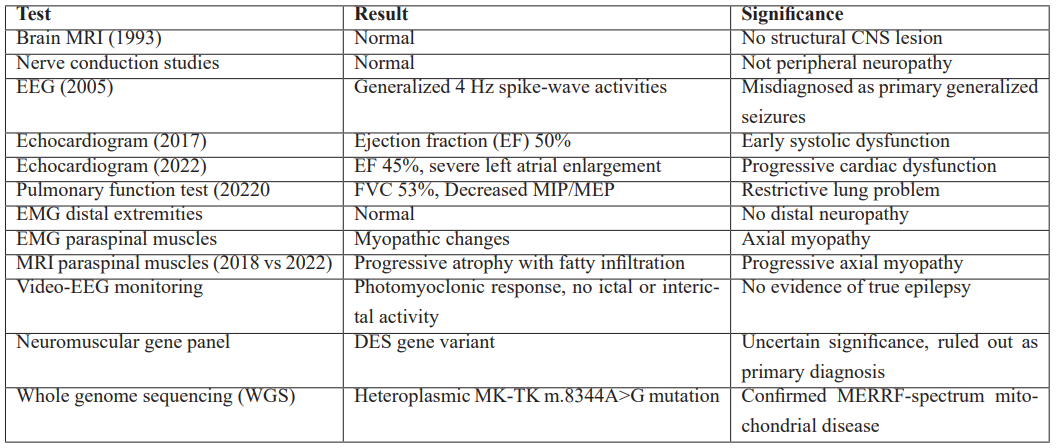
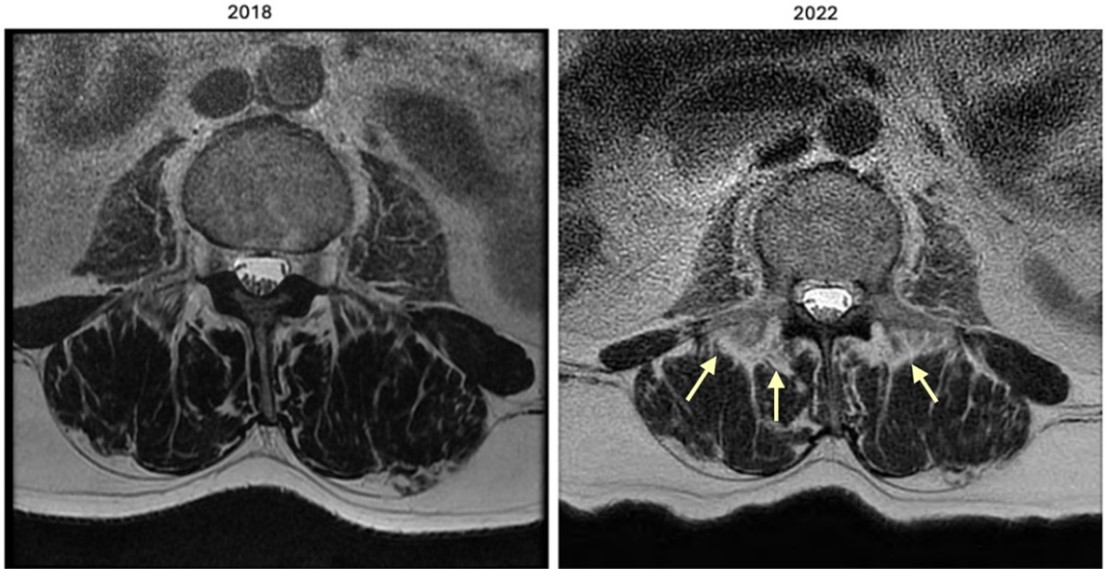
Figure 1: Paraspinal muscle MRI images. MRI images from 2018 and 2022 demonstrating progressive fatty infiltration of the paraspinal and posterior pelvic muscles. The 2022 image (yellow arrows) highlights areas consistent with fatty replacement, which is markedly more prominent compared to the 2018 baseline.
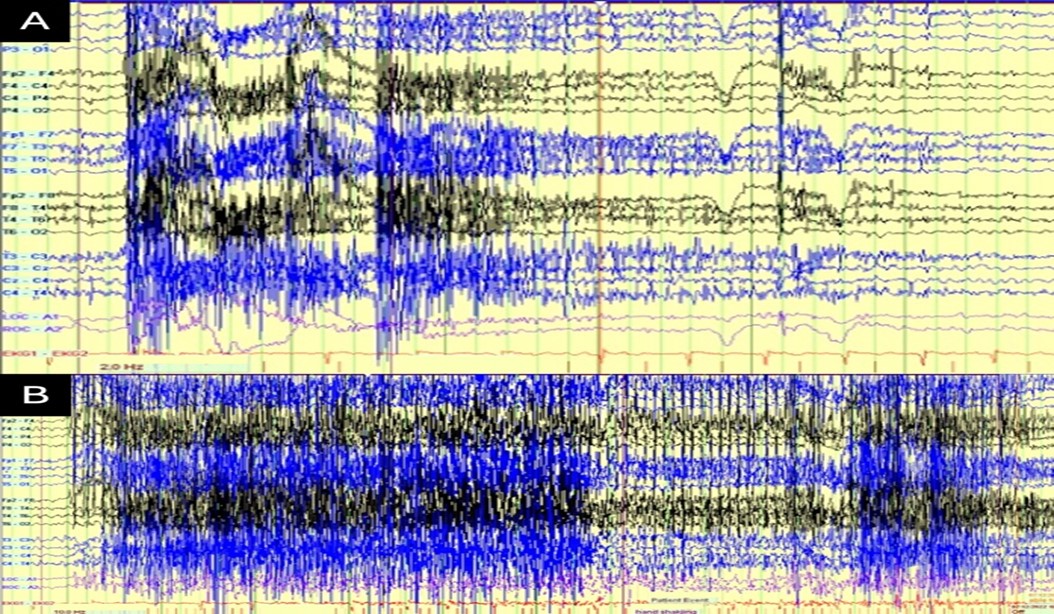
Figure 2: Electroencephalogram demonstrating photo-myoclonic response. EEG tracings of the patient's typical photo-myoclonic responses. (A) Tracing performed at 2 Hz photic stimulation and (B) at 10 Hz photic stimulation, both demonstrating generalized muscle artifact consistent with myoclonic jerks without any evidence of any epileptic activity.
Discussion
This case describes an almost three-decade-long diagnostic mystery that was ultimately solved by multidisciplinary clinical suspicion and comprehensive genetic analysis. The patient’s pattern of neurological, muscular, cardiac, and respiratory symptoms led to multiple misdiagnoses which are often the case in mitochondrial disorders. More than half of patients with mitochondrial disease receive one or more incorrect diagnoses before the true cause is found [13]. The underlying disease was uncovered through a combination of high clinical suspicion and broad genome-wide testing which confirmed MERRF-spectrum mitochondrial disease.
Classically, MERRF begins in childhood or adolescence with a mean onset in the early 20s [3]. Onset in middle-aged adults is rare. A large German registry found that the oldest onset among 34 MERRF patients to be 48 years [3]. Our patient, who did not develop overt myoclonic symptoms until his 50s, is an outlier that expands the phenotypic spectrum of MERRF into late adulthood. Among typical MERRF cases, only a subset develops the full “triad” of myoclonus, generalized seizures, and ataxia. In the German cohort, for example, these classic features were present in about 60 – 70% of patients. Instead, many patients exhibit other signs including sensorineural hearing loss, psychiatric or cognitive changes, and even respiratory muscle impairment [3]. Our patient’s presentation was consistent with the broader spectrum of MERRF symptoms. He has stimulus-sensitive myoclonus and ataxia, but no prolonged epileptic seizures. He also had developed progressive proximal muscle weakness with paraspinal atrophy, cardiomyopathy with atrial fibrillation, and restrictive respiratory dysfunction. This array of findings, spanning neurological and systemic domains, strongly pointed to a mitochondrial disorder as the unifying diagnosis.
The earliest misdiagnosis was labeling the patient’s jerking movements as primary generalized epilepsy. In retrospect, these episodes were likely nonepileptic myoclonus related to MERRF, which can be precipitated by photic stimulation or alcohol and may show generalized EEG spike-wave activity [2]. Photosensitive myoclonus in mitochondrial disease can be mistaken as epilepsy, as in this case. The patient was treated for epilepsy for over 15 years before video-EEG monitoring demonstrated the absence of epileptic ictal activity.
An additional diagnostic challenge was a variant of uncertain significance detected in the DES gene (c.250G>A, p.Gly84Ser) on a neuromuscular gene panel. Given the patient’s progressive proximal weakness, paraspinal muscle atrophy on MRI, reduced vital capacity, and cardiomyopathy, a late-onset desmin-related myofibrillar myopathy (desminopathy) was considered. Desminopathies cause combined skeletal muscle, cardiac, and respiratory muscle involvement, often presenting with limb-girdle weakness, restrictive lung disease, and dilated cardiomyopathy or arrhythmias [14]. Desminopathy does not typically produce stimulus-sensitive myoclonus, seizures, or cerebellar ataxia. Ultimately, the DES variant was ruled out as the source of the patient’s constellation of symptoms. This emphasizes the importance of correlating genetic findings with the entire clinical picture before ascribing causality.
A definitive diagnosis was achieved with comprehensive genetic testing that included the mitochondrial genome. Whole-genome sequencing identified a heteroplasmic m.8344A>G mutation in the MT-TK gene at a 62% variant load, which confirmed that the patient’s illness was a MERRF-spectrum mitochondrial disease. While a muscle biopsy may have demonstrated the hallmark ragged red fibers seen in MERRF, it was not necessary once the genetic diagnosis was found [1]. With the m.8344A>G mutation unifying the clinical picture, previously puzzling aspects of the case became clear. For instance, the early “peripheral neuropathy” symptoms and imbalance were likely manifestations of a mild neuropathic component of MERRF (which commonly includes peripheral neuropathy) [1], and the apparent EEG abnormalities in 2005 were consistent with photosensitive myoclonic activity rather than idiopathic epilepsy. The multi-organ involvement is consistent with MERRF’s spectrum, which is known to affect the heart and breathing musculature in addition to the nervous system [2].
This case highlights several important lessons for clinical practice. First, clinicians should keep mitochondrial disorders in the differential diagnosis of unexplained multisystem syndromes, even in older adults. Our patient’s age at diagnosis (late 60s) is unusual but demonstrative: mitochondrial disease is not purely pediatric and can remain latent until later in life [3]. Second, a targeted approach to genetic testing may miss the culprit in complex cases. In hindsight, standard gene panels and exomes focused on nuclear DNA did not detect the mtDNA mutation. It required broad whole-genome sequencing, with dedicated mtDNA analysis, to finally identify the cause. Third, the case illustrates the value of interdisciplinary and technology-augmented analysis. The synthesis of data from neurology, pulmonology, cardiology, imaging, and electrophysiology raised suspicion for a single unifying disorder.
Conclusion
We present a case of a patient with multisystem presentation with broad neurologic, cardiac, and respiratory involvement. After more than three decades of evolving symptoms, the final synthesis of multidisciplinary clinical findings (neurology, cardiology, pulmonology), along with imaging, electrodiagnostic, and genetic data, provided a unifying diagnosis of late-onset MERRF-spectrum mitochondrial disease.
This case expands the recognized phenotypic spectrum of MERRF by demonstrating that clinically significant disease may emerge in late adulthood and can masquerade as multiple unrelated disorders for decades. It underscores the need for broad genetic approaches, including mtDNA analysis, in patients with unexplained multisystem involvement. Finally, it highlights how revisiting longstanding diagnoses with modern genomic tools can meaningfully alter patient understanding and clinical care.
Authorship:
Iftee Shahriar, Raymond Chiang, and Anna Okabe designed and drafted the manuscript
Ning Zhong and Ning Wu managed the case and advice to the study
Forshing Lui advises and critically review the manuscript. He also serves as the corresponding author/guarantor
Conflicts of Interest: All authors declare no conflict of interest.
IRB: This study is IRB exempt with all patient information de-identified.
Informed consent: Informed consent has been obtained from the patient.
Funding and Grant: All authors received no specific funding for this work.
References
- Velez-Bartolomei F, Lee C, Enns G. MERRF. In: Adam MP, Bick S, Mirzaa GM, Pagon RA, Wallace SE, Amemiya A, eds. GeneReviews®. Seattle (WA): University of Washington, Seattle, 2003.
- Hameed S, Tadi P. Myoclonic Epilepsy and Ragged Red Fibers. In: StatPearls. Treasure Island (FL): StatPearls Publishing, 2023.
- Altmann J, Büchner B, Nadaj-Pakleza A, et al. Expanded phenotypic spectrum of the m.8344A>G "MERRF" mutation: data from the German mitoNET registry. J Neurol, 2016; 263: 961-972. 10.1007/s00415-016-8086-3.
- Blakely EL, Alston CL, Lecky B, et al. Distal weakness with respiratory insufficiency caused by the m.8344A > G "MERRF" mutation. Neuromuscul Disord, 2014; 24: 533-536. doi: 10.1016/j.nmd.2014.03.011.
- Mancuso M, Orsucci D, Angelini C, et al. Phenotypic heterogeneity of the 8344A>G mtDNA "MERRF" mutation. Neurology, 2013; 80: 2049-2054. doi: 10.1212/WNL.0b013e318294b44c.
- Fu J, Ma MM, Pang M, Yang L, Li G, Song J, Zhang JW. Broadening the phenotype of m.5703G>A mutation in mitochondrial tRNAAsn gene from mitochondrial myopathy to myoclonic epilepsy with ragged red fibers syndrome. Chin Med J (Engl), 2019; 132: 865-867. doi: 10.1097/CM9.0000000000000151.
- Štufková H, Kolářová H, Lokvencová K, Honzík T, Zeman J, Hansíková H, et al. A Novel MTTK Gene Variant m.8315A>C as a Cause of MERRF Syndrome. Genes (Basel), 2022; 13: 1245. doi: 10.3390/genes13071245.
- Shoffner JM, Lott MT, Lezza AM, Seibel P, Ballinger SW, Wallace DC. Myoclonic epilepsy and ragged-red fiber disease (MERRF) is associated with a mitochondrial DNA tRNA (Lys) mutation. Cell, 1990; 61: 931-937. 10.1016/0092-8674(90)90059-n.
- Yoneda M, Tanno Y, Horai S, Ozawa T, Miyatake T, Tsuji S. A common mitochondrial DNA mutation in the t-RNA(Lys) of patients with myoclonus epilepsy associated with ragged-red fibers. Biochem Int, 1990; 21: 789-796.
- Villanueva-Paz M, Povea-Cabello S, Villalón-García I, et al. Pathophysiological characterization of MERRF patient-specific induced neurons generated by direct reprogramming. Biochim Biophys Acta Mol Cell Res, 2019; 1866: 861-881. doi: 10.1016/j.bbamcr.2019.02.010.
- Ripolone M, Zanotti S, Napoli L, et al. MERRF Mutation A8344G in a Four-Generation Family without Central Nervous System Involvement: Clinical and Molecular Characterization. J Pers Med, 2023; 13(1): 147. doi: 10.3390/jpm13010147.
- Lorenzoni PJ, Scola RH, Kay CS, Silvado CE, Werneck LC. When should MERRF (myoclonus epilepsy associated with ragged-red fibers) be the diagnosis? Arq Neuropsiquiatr, 2014; 72: 803-811. doi: 10.1590/0004-282x20140124.
- Grier J, Hirano M, Karaa A, Shepard E, Thompson JLP. Diagnostic odyssey of patients with mitochondrial disease: Results of a survey. Neurol Genet, 2018; 4: e230. doi: 10.1212/NXG.0000000000000230.
- Vlaeminck J, Uyttebroeck S, De Schutter E, et al. Case Report: A first case of desmin-related myofibrillar myopathy due to inheritance from a confirmed mosaic asymptomatic carrier. Front Genet, 2025; 16: 1597851. doi: 10.3389/fgene.2025.1597851.