Email id: info@ijclinmedcasereports.com
Unilateral Moyamoya Vasculopathy in Sickle Cell Disease: Clinical and Neuroimaging Insights from a Case Report
Khattab H1,*, Mouddane M1, Sikkal A1, Haddouali K1, Bellakhdar1, El Otmani H1,2, Rafai MA1,3 and El Moutawakil B1,2
¹Department of Neurology, CHU Ibn Rochd, Casablanca, Morocco
2Laboratory of Genetics and Molecular Pathology, Faculty of Medicine and Pharmacy, Casablanca, Morocco
3Research Laboratory on Nervous System Diseases, Neurosensory Diseases and Disability, Faculty of Medicine and Pharmacy, Casablanca, Morocco
Received Date: 07/05/2026; Published Date: 10/07/2026
*Corresponding author: Hajar Khattab, MD, Department of Neurology, CHU Ibn Rochd, Casablanca, Morocco
Abstract
Unilateral Moyamoya Disease (U-MMD) is an uncommon cerebrovascular disorder characterized by progressive steno-occlusive changes affecting a single cerebral hemisphere. Its natural history, particularly the risk of progression to bilateral disease, remains incompletely understood. We report the case of a 21-year-old patient with sickle cell disease who exhibited progressive radiological changes consistent with unilateral Moyamoya vasculopathy over long-term follow-up. Serial magnetic resonance imaging demonstrated worsening hemispheric atrophy and the appearance of cortical hyperintensities associated with the ivy sign, while angiography confirmed progressive stenosis of the terminal internal carotid artery and its branches with the development of collateral circulation. This case highlights the dynamic nature of unilateral disease and underscores the importance of longitudinal imaging and early therapeutic consideration. A review of current literature is provided to contextualize clinical, radiological, and pathophysiological aspects of U-MMD.
Introduction
Moyamoya disease is a chronic, progressive cerebrovascular arteriopathy of unknown etiology, characterized by progressive stenosis or occlusion of the terminal portions of the internal carotid arteries and their proximal branches. This process leads to the formation of a compensatory network of fragile collateral vessels at the base of the brain, which gives rise to the characteristic angiographic appearance described as a “puff of smoke.” Although the classical definition requires bilateral vascular involvement, unilateral forms have increasingly been recognized and were formally incorporated into diagnostic criteria in the 2012 Japanese guidelines [1].
Unilateral Moyamoya disease is defined by the presence of typical angiographic abnormalities confined to one hemisphere, with the contralateral side remaining either normal or only minimally affected. While initially considered an early stage of bilateral disease, accumulating evidence suggests that unilateral presentations may represent a distinct clinical entity in some patients. The reported prevalence varies but is generally estimated at approximately 10–15% of all Moyamoya cases. Despite growing recognition, the clinical course and predictors of progression remain subjects of ongoing investigation [2].
Case Presentation
We report the case of a 21-year-old patient with a history of sickle cell disease diagnosed in childhood, born to parents with heterozygous sickle cell trait. The patient had been followed clinically since the age of nine years for hematological and neurological complications.
Initial brain magnetic resonance imaging revealed sequelae of a left sylvian ischemic insult associated with marked left hemispheric atrophy, attributed to chronic hypoperfusion. Over time, serial neuroimaging demonstrated progressive worsening of cerebral atrophy. Follow-up fluid-attenuated inversion recovery sequences showed the emergence of cortical hyperintensities, reflecting slow flow within leptomeningeal vessels. Notably, the appearance of a bilateral ivy sign was observed, indicating the presence of compensatory pial collateral circulation and impaired cerebral hemodynamics (Figure 1).
Subsequent arterial time-of-flight angiography and conventional angiographic studies confirmed significant stenosis of the terminal internal carotid artery, as well as involvement of the anterior and middle cerebral arteries (Figure2). These abnormalities were predominantly localized to the left hemisphere and were associated with the development of an extensive collateral vascular network. The contralateral circulation remained relatively preserved, supporting the diagnosis of unilateral Moyamoya vasculopathy with progressive radiological evolution.
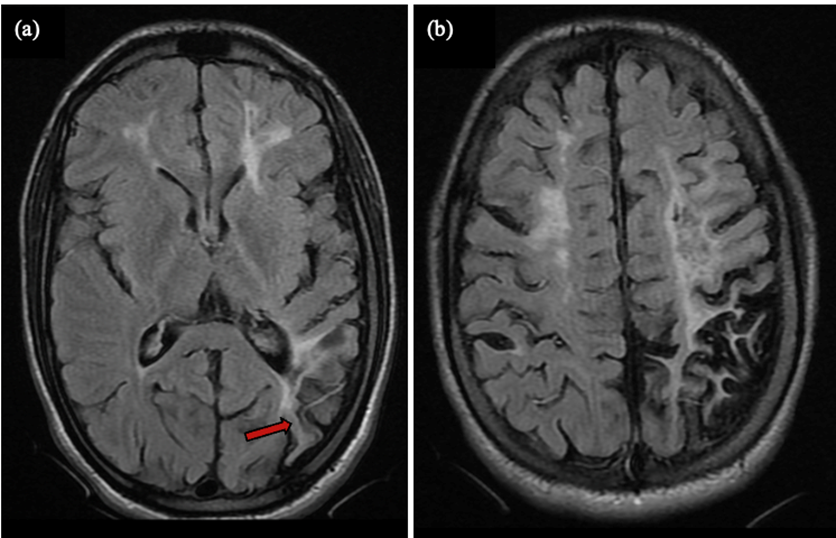
Figure 1: Axial FLAIR MRI images.
(a) Initial study showing leptomeningeal hyperintensity corresponding to the ivy sign (red arrow), suggestive of impaired cortical perfusion.
(b) Follow-up study demonstrating left hemispheric cerebral atrophy consistent with chronic ischemic changes in Moyamoya vasculopathy.
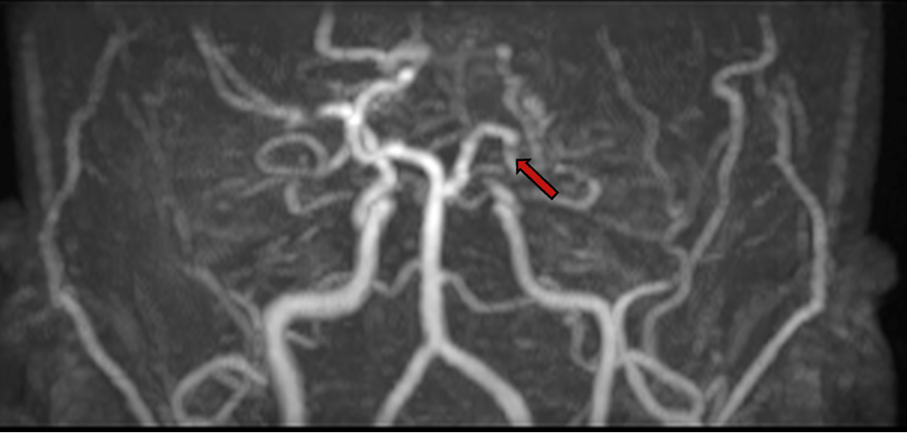
Figure 2: Arterial time-of-flight (TOF) angiography demonstrating stenosis of the terminal internal carotid arteries with a left-sided collateral vascular network.
Discussion
Unilateral Moyamoya disease represents a less common manifestation of Moyamoya vasculopathy and poses important diagnostic and therapeutic challenges. Epidemiological data indicate a heterogeneous distribution across populations, with some studies reporting a bimodal age distribution characterized by a peak in childhood and another in adulthood. Clinical presentation varies but is most often dominated by ischemic events, including transient ischemic attacks and completed strokes, although hemorrhagic manifestations may also occur [3].
In the present case, the coexistence of sickle cell disease is particularly noteworthy, as it suggests a diagnosis more consistent with Moyamoya syndrome rather than idiopathic Moyamoya disease. Sickle cell disease is a well-recognized risk factor for progressive cerebral vasculopathy, and its association with Moyamoya-like changes has been extensively documented. In such patients, chronic endothelial injury, inflammation, and abnormal rheology contribute to vascular stenosis and collateral formation, thereby increasing the risk of ischemic stroke at a young age.
The radiological evolution observed in this patient is consistent with previously reported findings in unilateral disease. Progressive arterial narrowing, increasing reliance on collateral circulation, and the appearance of the ivy sign reflect worsening hemodynamic compromise. The ivy sign, in particular, is considered a marker of slow cortical perfusion and has been correlated with reduced cerebrovascular reserve. Its bilateral presence in this case, despite predominantly unilateral angiographic involvement, may indicate more widespread hemodynamic stress than initially apparent.
A central issue in unilateral Moyamoya disease is the potential for progression to bilateral involvement. Although not all patients experience such progression, several risk factors have been identified, including younger age at diagnosis, the presence of subtle contralateral vascular abnormalities, and genetic predisposition. Variants in the RNF213 gene, especially the p.R4810K mutation, have been strongly associated with Moyamoya disease in East Asian populations and may also influence disease progression. Emerging evidence also implicates additional genetic factors, such as FOXM1, suggesting a more complex molecular basis than previously appreciated.
The management of unilateral Moyamoya disease remains a matter of clinical judgment and is largely guided by symptomatology and hemodynamic status. Surgical revascularization, either through direct or indirect bypass techniques, constitutes the cornerstone of treatment in symptomatic patients. These procedures aim to restore adequate cerebral perfusion and reduce the risk of recurrent ischemic events. In asymptomatic or minimally symptomatic individuals, a conservative approach with close radiological surveillance may be adopted. However, the progressive changes observed in this case highlight the importance of early recognition and timely intervention [4].
Prognosis in unilateral Moyamoya disease is generally favorable when appropriate management is instituted. Nevertheless, long-term follow-up is essential, particularly in younger patients and in those with underlying conditions such as sickle cell disease, given the risk of disease progression and recurrent neurological events.
Conclusion
This case illustrates the progressive nature of unilateral Moyamoya disease and emphasizes the critical role of longitudinal imaging in detecting hemodynamic deterioration. The association with sickle cell disease further underscores the complexity of Moyamoya syndrome and the need for multidisciplinary management. While surgical revascularization remains the most effective strategy for preventing ischemic complications, optimal timing and patient selection require further clarification. Future research, particularly multicenter prospective studies and investigations into genetic and molecular mechanisms, will be essential to improve our understanding of disease progression and to refine therapeutic approaches.
Acknowledgments: The authors would like to thank the Department of neurology, CHU Ibn Rochd for their institutional support.
Conflicts of interest: The authors have no potential conflicts of interest to disclose.
Funding: No funding was received for this study.
Ethical Approval: Ethical approval was not required for this case report.
References
- Elmahdi M, Fadalla T, Suliman M, Elsayed M, Awad Elhaj AM, Hussein H, et al. Moyamoya syndrome and stroke among pediatric sickle cell disease patients in Sudan: A cross-sectional study. Ann Med Surg (Lond), 2022; 78: p. 103815. doi: 10.1016/j.amsu.2022.103815.
- Scott RM, Smith ER, et al. Moyamoya disease and moyamoya syndrome. N Engl J Med, 2009; 360 (no12): p. 1226‑1237. doi: 10.1056/NEJMra0804622.
- Hao X, et al. Research progress in unilateral moyamoya disease. Front Hum Neurosci, 2025; 19: p. 1503639. doi: 10.3389/fnhum.2025.1503639.
- Kuroda S, Houkin K. Moyamoya disease: current concepts and future perspectives. Lancet Neurol, 2008; 7 (no 11): p. 1056‑1066. doi: 10.1016/S1474-4422(08)70240-0.