
Email id: info@ijclinmedcasereports.com
Unusual Central Nervous System Involvement in a Patient with Multiple Myeloma in Bone Marrow Remission: A Case Report and Literature Review
Kiran Ghodke1,*, Sneha Ann Oommen2, Sharad Maheshwari3 and Sameer Tulpule4
1Consultant Hematopathologist, Department of Hematology, Kokilaben Dhirubhai Ambani Hospital and Research Institute, Rao Saheb Achutrao Patwardhan Marg, India
2Associate consultant Hematopathologist, Department of Hematology, Kokilaben Dhirubhai Ambani Hospital and Research Institute, Rao Saheb Achutrao Patwardhan Marg, India
3Consultant, Department of Radiology, Kokilaben Dhirubhai Ambani Hospital and Research Institute, Rao Saheb Achutrao Patwardhan Marg, India
4Consultant, Department of Hematology and BMT, Kokilaben Dhirubhai Ambani Hospital and Research Institute, Rao Saheb Achutrao Patwardhan Marg, India
Received Date: 28/04/2026; Published Date: 01/07/2026
*Corresponding author: Kiran Ghodke, MD (Pathology), Consultant Hematopathologist, Department of Hematology, Kokilaben Dhirubhai Ambani Hospital and Research Center, Rao Saheb Achutrao Patwardhan Marg, Four Bungalows, Andheri (W),Mumbai, Maharashtra 400053, India
Abstract
Central Nervous System (CNS) involvement by Multiple Myeloma (MM) is exceedingly rare, occurring in ~1% of cases. We report a 72-year-old man with IgG-κ MM diagnosed in 2023 who achieved Complete Remission (CR) after standard chemotherapy, as confirmed by bone marrow morphology and flow cytometry. Months later he developed new neurologic symptoms (headache and seizures). Neuroimaging (contrast CT) revealed leptomeningeal enhancement. Lumbar puncture showed plasma cells on CSF cytospin. Multicolor flow cytometry of the CSF identified a monoclonal plasma cell population (CD38+, CD138+, CD19–, CD45 dim, κ-restricted), confirming CNS involvement by plasma cells despite concurrent marrow remission. The patient received CNS-directed therapy (intrathecal methotrexate/cytarabine, dexamethasone and cranial irradiation) but had rapid clinical decline. This case highlights the rarity of extramedullary relapse in the CNS despite systemic remission and underscores the importance of CSF flow cytometry for early diagnosis of CNS involvement in MM patients presenting with neurological symptoms. We review the relevant literature on CNS myeloma and discuss potential management strategies in this challenging clinical scenario.
Keywords: Multiple Myeloma; Central Nervous System Involvement; Leptomeningeal involvement; Bone Marrow Remission; Flow Cytometry
Introduction
Multiple Myeloma (MM) is a plasma cell malignancy that primarily involves the bone marrow. Extramedullary Disease (EMD) occurs in 10–30% of MM patients and portends a worse prognosis [1-3]. CNS involvement (neoplastic plasma cells in the brain or leptomeninges) is an extremely rare form of EMD, reported in roughly 1% of MM cases [2-5]. It is often associated with high-risk disease features (e.g., plasmablastic morphology, unfavourable cytogenetics) and typically arises late in the disease course [1-4]. Majority of cases of CNS involvement in myeloma mostly diagnosed by CSF cytology; only a few series describe the role of flow cytometry in this setting [5]. CNS involvement carries a dismal prognosis (median survival <6 months) [2]. We present a case of CNS involvement by MM in a patient who was otherwise in marrow remission, emphasizing the diagnostic role of CSF flow cytometry.
Case Report
A 72-year-old man was diagnosed with IgG-κ MM (ISS stage II) in early 2023 after workup for anemia and elevated protein levels. Bone marrow biopsy showed 35% clonal plasma cells. He received standard chemotherapy protocol consisting of bortezomib, cyclophosphamide, and dexamethasone (VCD) for 6 cycles, followed by maintenance therapy with lenalidomide. Subsequent bone marrow examination showed no morphologic evidence of myeloma. Ten colour flows cytometric immunophenotyping of the bone marrow aspirate confirmed the absence of residual monoclonal plasma cell population, indicating bone marrow remission.
Eight months later, the patient presented with new-onset holocranial headache and two generalized tonic-clonic seizures. Neurologic examination was non-focal. A Computed Tomography (CT) scan of the brain revealed leptomeningeal enhancement, raising suspicion for CNS involvement. Magnetic Resonance Imaging (MRI) of the brain with gadolinium contrast further confirmed diffuse leptomeningeal enhancement without any parenchymal lesions (Figure 1).
A lumbar puncture yielded clear CSF with elevated protein (150 mg/dL), normal glucose, and pleocytosis (WBC 50/mm³, 90% plasmacytoid cells). CSF cytospin preparations demonstrated numerous plasma cells (eccentric nuclei, basophilic cytoplasm) (Figure 2). Multicolor flow cytometry of the CSF was performed; gating on CD38+/CD138+ cells revealed a monoclonal plasma cell population (~90% of nucleated cells) that co-expressed aberrant CD56 and was negative for CD19, CD20, CD117 and CD45, with cytoplasmic κ light-chain restriction (Figure 3). These findings confirmed CNS involvement by Multiple myeloma.
A repeat bone marrow examination and flow cytometry were performed concurrently, which continued to show no evidence of myeloma involvement, confirming the isolated CNS relapse. Serum and urine studies showed no detectable monoclonal protein. No brain biopsy was performed due to the diffuse leptomeningeal involvement and the definitive diagnosis established by CSF analysis.
The patient was diagnosed with isolated CNS MM despite systemic remission. He underwent intrathecal chemotherapy (methotrexate 12 mg, cytarabine 50 mg, hydrocortisone 15 mg twice weekly) combined with high-dose intravenous steroids and whole-brain radiotherapy (20 Gy in 10 fractions). Systemic therapy with daratumumab, lenalidomide and dexamethasone was also initiated to cover any occult disease. The patient showed initial improvement in headache frequency and severity. However, he continued to experience occasional seizures despite anticonvulsant therapy (levetiracetam). Repeat CSF analysis after one month of treatment showed a decrease but not complete clearance of the monoclonal plasma cell population.
Given the rarity and aggressive nature of CNS myeloma, the prognosis remains guarded. The patient is currently under close follow-up with regular neurological assessments, imaging studies, and CSF monitoring. The treatment plan is being tailored based on his response and tolerance, with consideration for novel therapies and clinical trial enrolment if available. Options such as CAR-T therapy and bispecific antibodies are being explored.
Discussion
CNS involvement in MM is a rare, aggressive but increasingly recognized complication, potentially due to improved survival rates with modern therapies allowing for late relapses in sanctuary sites like the CNS [6]. This “sanctuary-site” relapse may reflect plasma cells seeding the leptomeninges where conventional therapy penetration is limited. Large series estimate its incidence at <1% [4]. The pathogenesis of CNS myeloma is not fully understood but is thought to involve hematogenous spread and direct extension from skull base plasmacytomas. It typically occurs as a relapse phenomenon after multiple lines of therapy [6]. In Jurczyszyn’s multinational cohort (172 patients), only 22% had CNS disease at initial MM diagnosis, while 78% developed it at relapse [6]. Known associations include plasmablastic morphology, high tumor burden, and poor-risk cytogenetics [5]. Our patient’s emergence of CNS disease during apparent marrow CR is exceptional; isolated CNS relapse during systemic remission has been documented only in a handful of case reports.
While imaging studies like CT and MRI can suggest leptomeningeal enhancement or parenchymal lesions, definitive diagnosis relies on CSF cytology demonstrating malignant plasma cells [7,8]. Flow cytometric immunophenotyping of CSF can be particularly useful in identifying the clonal nature of these cells and confirming the diagnosis, especially in cases with low cellularity on cytospin [8]. In our case, the discrepancy between the bone marrow remission status and the florid CNS involvement highlights the importance of considering CNS relapse even in patients with seemingly well-controlled systemic disease.
The diagnosis of CNS myeloma can be challenging and requires a high index of suspicion. Neurologic symptoms (headache, confusion, cranial neuropathies, seizures) should prompt evaluation with imaging and CSF analysis. MRI of the brain and spine is the preferred modality, with leptomeningeal enhancement or masses seen in the majority of cases [7]. In one review, MRI detected CNS involvement in 93% of cases versus 81% by CT [7]. However, imaging can be normal in some patients [7]. In our case, CT and MRI revealed diffuse leptomeningeal enhancement. Regardless, definitive diagnosis rests on CSF examination.
Conventional CSF cytology may demonstrate plasma cells, but sensitivity is limited and false-negatives are common (20–60%) [5]. Flow cytometry markedly improves detection by studying plasma cells clonality, as monoclonal plasma cells confirm the abnormality and malignant nature. In our patient, flow cytometry of CSF confirmed a clonal κ-restricted plasma cell population (bright CD38/CD138) that was not present in bone marrow. Flow methods can detect small numbers of aberrant cells, with reported sensitivity (~94%) superior to cytology (~68%). Indeed, multiparameter flow can identify monoclonal CD38+/CD138+ cells in ~90% of CNS-MM CSF samples [5]. Combining cytology (which allows morphologic and immunocytochemical assessment) with flow (which confirms clonality) is recommended [8]. This approach enabled rapid diagnosis in our patient despite the marrow being clear. Notably, Marini et al. described an MM patient with neurologic symptoms and normal MRI, where CSF flow cytometry (CD56+ plasma cells) provided the diagnosis.
Therapeutic options for CNS-MM are limited and largely palliative. Evidence is anecdotal, but multi-modality treatment is advocated [2]. Typical regimens include intrathecal chemotherapy (methotrexate, cytarabine, corticosteroids) and CNS-directed radiotherapy, often combined with systemic agents that can penetrate the blood–brain barrier (BBB) [9]. Agents like high-dose methotrexate or cytarabine have some CNS activity but limited myeloma efficacy. Bendamustine crosses the BBB and has shown benefit in case reports, usually with concurrent thalidomide/dexamethasone and irradiation [9]. Immunomodulatory drugs (thalidomide, lenalidomide) do penetrate the CNS to a degree [9], and pomalidomide has shown preclinical BBB penetrance [9]. Daratumumab (anti-CD38) has been used intrathecally and systemically in recent cases with some successes [2]. Autologous stem cell transplantation has been reported in some cases with CNS involvement, but its role in this setting remains to be fully defined [6]. Newer agents such as CAR-T cell therapy and bispecific antibodies targeting B-cell maturation antigen (BCMA) have shown promise in relapsed/refractory MM and are being investigated for CNS involvement [10]. In our patient, we instituted intrathecal therapy, CNS radiotherapy, and systemic daratumumab/lenalidomide/dexamethasone.
The prognosis of CNS involvement by MM is dismal [2,6]. In small series and reviews, median survival after CNS involvement is on the order of only a few months [2,6]. For example, Bommer et al. found median overall survival of only 82 days after diagnosis of CNS involvement by myeloma [5]. Jurczyszyn’s multicentre study reported median survival ~7 months from CNS diagnosis, with untreated patients dying even faster (median 2 months) [6]. In that analysis, any active treatment (systemic, IT, or radiation) modestly improved outcomes [6]. We emphasize that even in systemic CR, new neurologic symptoms in a myeloma patient must prompt CNS evaluation. Early CSF analysis including flow cytometry is critical, as it offers rapid and definitive diagnosis enabling timely CNS-directed therapy [5].
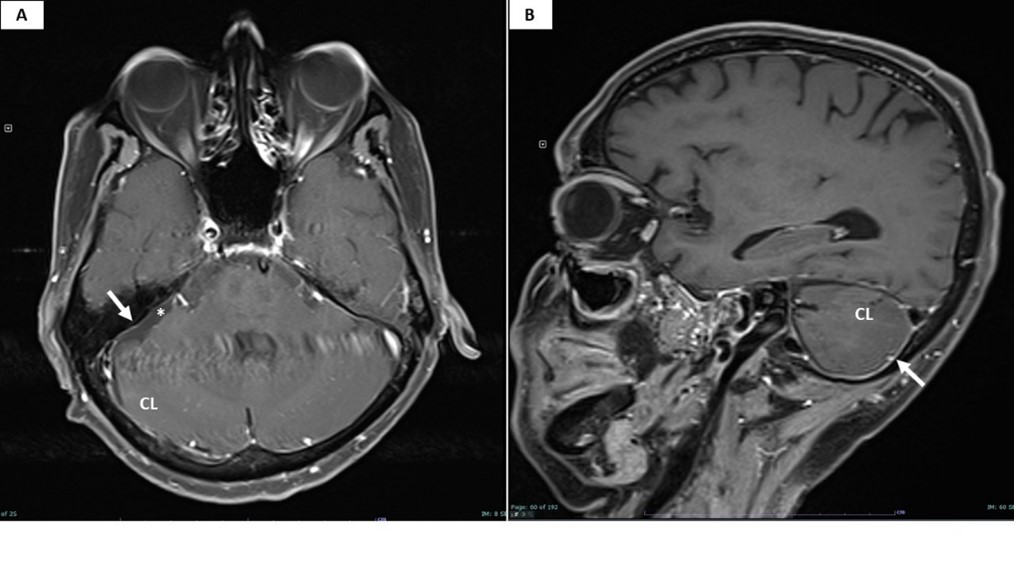
Figure 1: A - T1 W FS Post contrast axial demonstrating leptomeningeal enhancement (white arrow) along the right cerebellar hemisphere (CL). White star is subdural effusion, B - T1 W FS Post contrast sagittal vein demonstrating leptomeningeal enhancement (white arrow) along the right cerebellar hemisphere (CL).
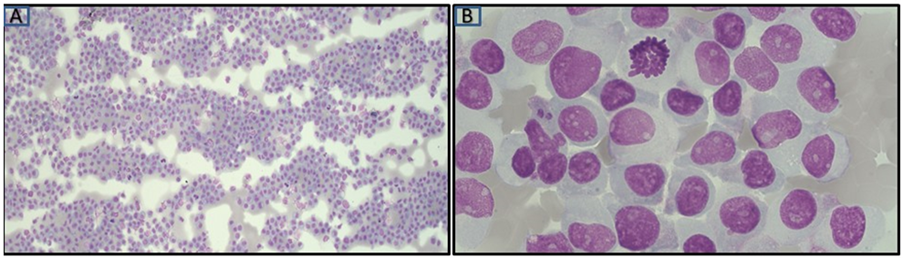
Figure 2: Photomicrograph of CSF cytospin preparation showing atypical plasma cells with eccentric nuclei, basophilic cytoplasm, and perinuclear hof (Wright-Giemsa stain, A – Scanner View, B - 1000x magnification).
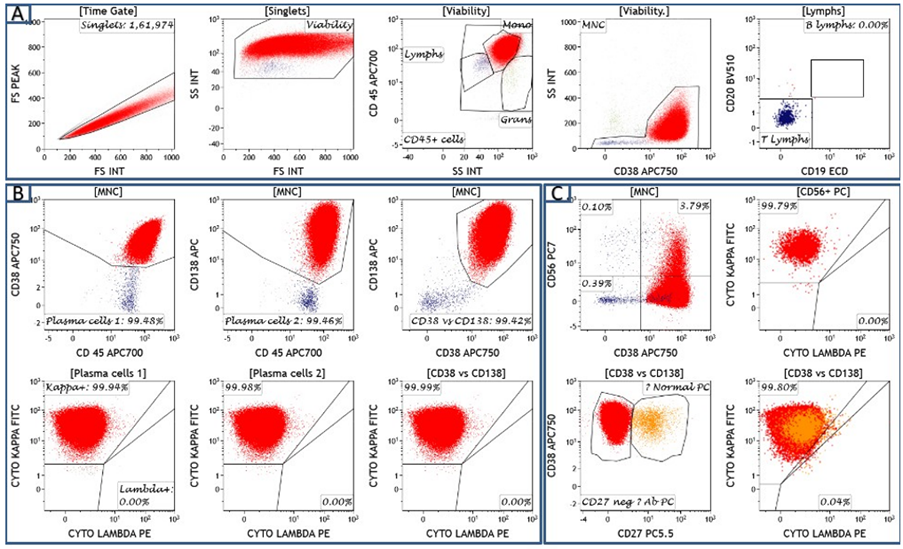
Figure 3: Flowcytometric immunophenotypic analysis performed on CSF, A – Sequential gating, B – Plasma cells (Red dots) gating after mononuclear gate (MNC) with different combinations CD38 vs CD45, CD138 vs CD45 and CD138 vs CD38 along with clonality assessment showing kappa clonality, C – Aberrant dim to negative expression of CD56 and downregulation of CD27 also showing kappa clonality. (Red and Orange dots – abnormal plasma cells, blue dots – T and NK lymphocytes).
Conclusion
CNS involvement in multiple myeloma during apparent systemic remission is extraordinarily rare and portends a poor prognosis. This case underscores the need for vigilance: new neurological symptoms in a myeloma patient should raise suspicion of CNS spread regardless of marrow status. CSF examination with combined cytology and flow cytometry is essential for diagnosis, as imaging may be inconclusive. Management remains challenging, prompt multimodal therapy is indicated, often involving intrathecal and systemic chemotherapy with CNS-penetrating agents. Novel therapies such as CAR-T cell therapy and bispecific antibodies warrant further investigation in this setting. The prognosis is generally poor, and further research and clinical trials are needed to improve outcomes for this rare and aggressive complication of multiple myeloma.
Acknowledgement: None
References
- Alaggio R, Amador C, Anagnostopoulos I, Attygalle AD, Araujo IBdO, Berti E, et al. The 5th edition of the World Health Organization classification of haematolymphoid tumours: lymphoid neoplasms. Leukemia, 2022; 36(7): 1720-1748.
- Sammartano V, Cerase A, Venanzi V, Mazzei MA, Vangone BE, Gentili F, et al. Central Nervous System Myeloma and Unusual Extramedullary Localizations: Real Life Practical Guidance. Front Oncol, 2022; 12: 934240. doi: 10.3389/fonc.2022.934240.
- Ghodke K, Shet T, Epari S, Sengar M, Menon H, Gujral S. A retrospective study of correlation of morphologic patterns, MIB1 proliferation index, and survival analysis in 134 cases of plasmacytoma. Ann Diagn Pathol, 2015; 19(3): 117-123. doi: 10.1016/j.anndiagpath.2015.02.006.
- Gozzetti A, Cerase A, Lotti F, Rossi D, Palumbo A, Petrucci MT, et al. Extramedullary intracranial localization of multiple myeloma and treatment with novel agents: a retrospective survey of 50 patients. Cancer, 2012; 118(6): 1574-1584. doi: 10.1002/cncr.26447.
- Bommer M, Kull M, Teleanu V, Schwarzwälder P, Feuring-Buske M, Kroenke J, et al. Leptomeningeal Myelomatosis: A Rare but Devastating Manifestation of Multiple Myeloma Diagnosed Using Cytology, Flow Cytometry, and Fluorescent in situ Hybridization. Acta Haematol, 2018; 139(4): 247-254. doi: 10.1159/000489484.
- Jurczyszyn A, Grzasko N, Gozzetti A, Czepiel J, Cerase A, Hungria V, et al. Central nervous system involvement by multiple myeloma: A multi-institutional retrospective study of 172 patients in daily clinical practice. Am J Hematol, 2016; 91(6): 575-580. doi: 10.1002/ajh.24351.
- Parillo M, Vaccarino F, Quattrocchi CC. Imaging findings in a case of leptomeningeal myelomatosis, a rare but critical central nervous system complication of multiple myeloma. Neuroradiol J, 2023; 36(5): 616-620. doi: 10.1177/19714009221150849.
- Marini A, Carulli G, Lari T, Buda G, Lambelet P, Ciancia EM, et al. Myelomatous meningitis evaluated by multiparameter flow cytometry: Report of a case and review of the literature. J Clin Exp Hematop, 2014; 54: 129–136.
- Chen CI, Masih-Khan E, Jiang H, Rabea A, Cserti-Gazdewich C, Jimenez-Zepeda VH, et al. Central nervous system involvement with multiple myeloma: long term survival can be achieved with radiation, intrathecal chemotherapy, and immunomodulatory agents. Br J Haematol, 2013; 162(4): 483-488. doi: 10.1111/bjh.12414.
- Swan D, Madduri D, Hocking J. CAR-T cell therapy in Multiple Myeloma: current status and future challenges. Blood Cancer J, 2024; 14(1): 206. doi: 10.1038/s41408-024-01191-8.