
Email id: info@ijclinmedcasereports.com
High-Grade Serous Ovarian Carcinoma (HGSOC): Current and Future Diagnostic and Treatment Methods
Manon Jung1,#, Charles Cao2,#, John K Chan3 and Yihui Shi3,*
1Institute of Pharmaceutical and Biological Sciences, Université Claude Bernard Lyon 1, Lyon, France
2Rollins School of Public Health, Emory University, Atlanta, GA, USA
3Division of Gynecologic Oncology, California Pacific Medical Center Research Institute, Sutter Health, San Francisco, CA, USA
#Denotes equal contribution
Received Date: 16/04/2026; Published Date: 22/06/2026
*Corresponding author: Yihui Shi, California Pacific Medical Center Research Institute, Sutter Health, San Francisco, CA, USA
Abstract
Background: Ovarian cancer (OC) is the most lethal malignancy affecting the female reproductive tract. OC is a nonspecific term that includes several types of cancer. Among them, high-grade serous ovarian carcinoma (HGSOC) is the most severe and common form, with 225,000 new cases registered each year and a five-year survival rate of only 49.1%.
Objective: This review aims to first recapitulate basic knowledge of HGSOC, to then delve into diagnostic tools, current treatments, major research models, and significant effective prospects in advancing HGSOC treatment. HGSOC’s poor survival rate can be explained by the fact that HGSOC is a silent disease with a lack of specific symptoms, resulting in diagnosis at an advanced stage (stage III or IV), when it has already metastasized throughout the abdomen. Although research has focused on HGSOC for the past 50 years, overall survival has not improved since the 1980s. Several treatments exist, including surgery, platinum-based chemotherapy, and targeted therapy. However, patients usually develop resistance and become refractory, making them difficult to treat. This review addresses the current limitations in treatment and diagnosis.
Conclusion: Advancements in targeted gene therapy could lead to improved outcomes in those diagnosed with HGSOC, and artificial intelligence tools are promising developments in early diagnosis.
Keywords: Ovarian cancer (OC); High-grade serous ovarian carcinoma (HGSOC); Diagnostic tools; Genetic basic
Introduction
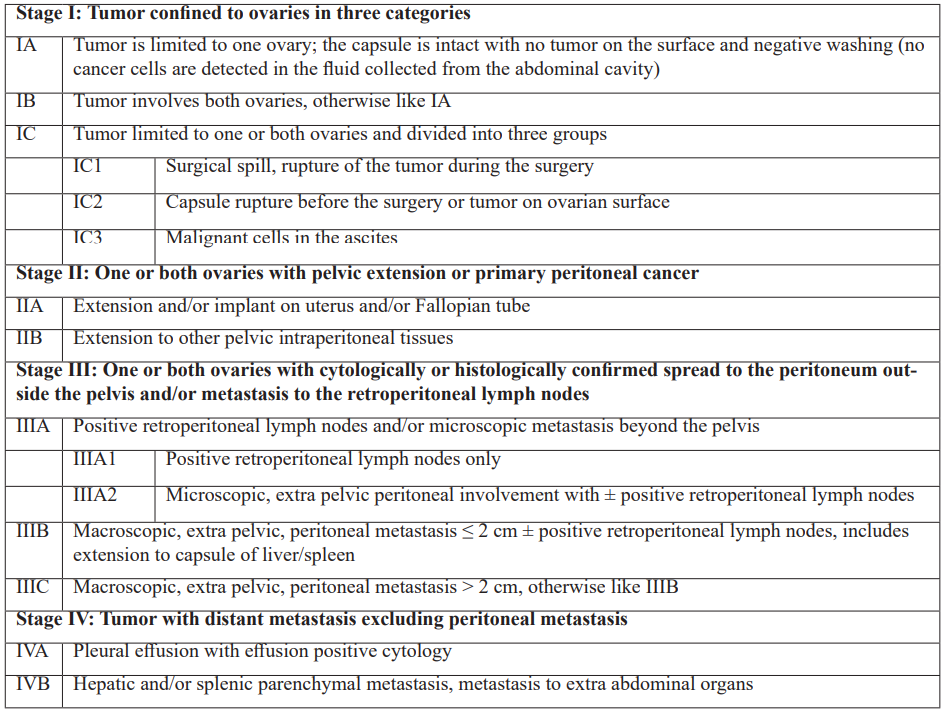
In 2022, 324,603 new cases of ovarian cancer were reported worldwide, and 206,956 women died from the disease. These numbers rank ovarian cancer as the 8th leading cause of cancer-related death among women. Approximately, 90% of OC are epithelial ovarian cancer [1]. Epithelial OC is a heterogeneous disease and has been divided into two subtypes based on genotypic and phenotypic characteristics. In 1980, the International Federation of Gynecology and Obstetrics (FIGO) established a staging system for ovarian cancer, later reassessed in 2014 to improve diagnostic accuracy [2]. Table 1 describes the stages and substages established by FIGO. Mutational analyses performed on EOC show that type I tumors carry somatic mutations in Kirsten rat sarcoma virus oncogene homologue (KRAS), B-raf serine/threonine-protein kinase (BRAF), phosphatidylinositol-4,5-bisphosphate 3-kinase catalytic subunit alpha (PIK3CA), phosphatase and tensin homolog (PTEN), catenin beta-1 (CTNNB1), and AT-rich interaction domain 1A (ARID1A) genes. They also exhibit low genomic instability, without genome-wide copy number changes. This group includes low-grade serous carcinoma, low-grade endometrioid carcinoma, clear-cell carcinoma, and mucinous carcinoma. In contrast, type II tumors are characterized by a high degree of genomic instability, with frequent deoxyribonucleic acid (DNA) copy number alterations and tumor protein 53 (TP53) mutations. About 70% of type II tumors are high-grade serous ovarian carcinoma HGSOC [3].
Table 1: The stages and substages of ovarian cancer are established by the International Federation of Gynecology and Obstetrics (FIGO). These stages are useful in determining how far the disease has spread in the body, guiding treatment plans, and predicting the future course of the disease [2].
HGSOC represents about 50% of cases among all ovarian cancers and about 75% among all epithelial ovarian cancers. HGSOC is classified as an epithelial, non-mucinous, serous, high-grade carcinoma, which means that it originates from epithelial cells, does not produce mucus, resembles fallopian tube cells, and is extremely aggressive with rapid growth and abnormal morphology [4]. Figure 1 details the progression of malignant ovarian cancer through the accumulation of mutations.
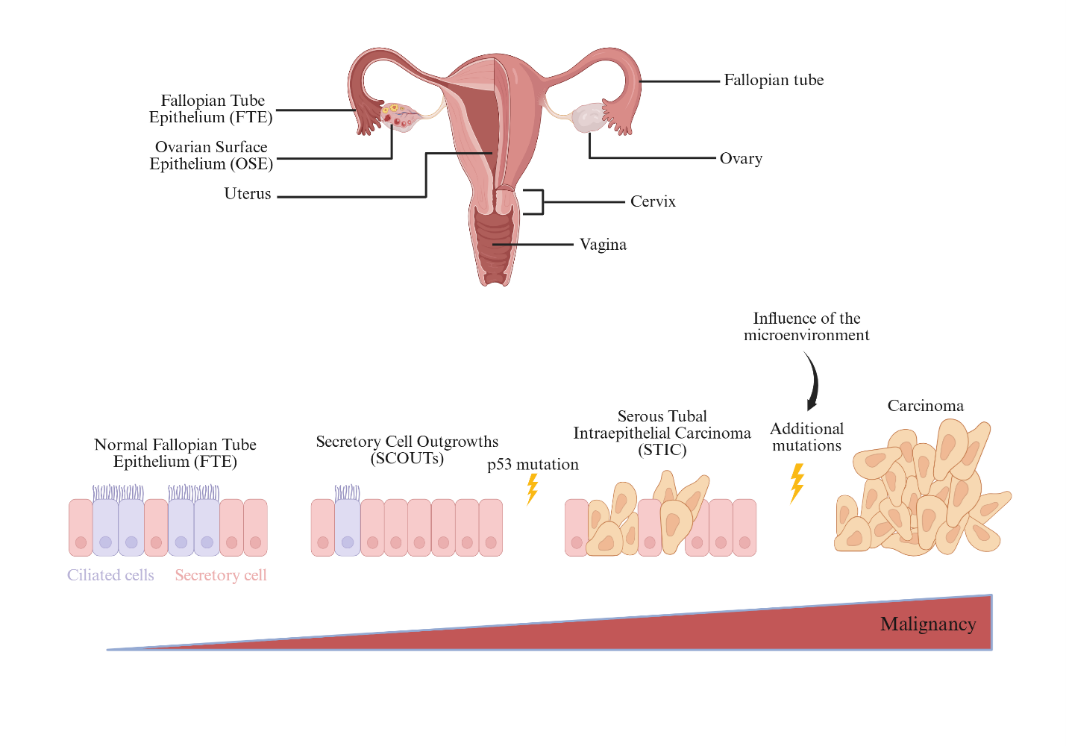
Figure 1: Progression of Ovarian Cancer. The accumulation of mutations, starting with the knockout of p53 tumor suppressor gene function, leads to the development of ovarian cancer from secretory epithelial cells in the fallopian tube, which has its location shown in the diagram of the female reproductive system [3].
Previous review papers and studies have focused on the origin and biomarkers of HGSOC. Two competing theories suggest that pro-inflammatory environments with reactive oxygen species may result in DNA damage and resulting mutations but differ in location. One theory purports that DNA damage on the ovarian surface epithelium occurs during ovulation-induced tissue rupture while the other theory purports that the initial site is from secretory epithelial cells from the fallopian tube migrate to the ovarian surface epithelium [5]. The important biomarkers for the mutations belong on Fanconi anemia–BRCA pathway and play important roles in DNA repair. Other research describes the features and molecular markers in detecting HGSOC. Santoro, et al. further details the biomarkers found in HGSOC cases, but the paper does not thoroughly detail the current and in development treatments for HGSOC. The paper does differentiate the morphological features into the classic pattern and SET (solid, pseudoendometrioid, and transitional) pattern [6]. In Dinkins, et al., different therapies for treating HGSOC are comprehensively detailed. The PARP inhibitors (PARPi) are olaparib, niraparib, rucaparib, and other newer PARPi. The review compiles recent phase III clinical trials that evaluate the effectiveness of these PARPi. The molecular targets also include angiogenesis inhibitors, which include vascular endothelial growth factor (VEGF), and receptor tyrosine kinases, which include epidermal growth factor receptor (EGFR). While vaccines and altering lipid metabolism offer potential therapeutic avenues for ovarian cancer and are addressed, there is limited research into this avenue [7]. This review delves deeper into the specific mutant genes that lead to HGSOC. This review seeks to synthesize research on genetic components, diagnostic tools, and research models to guide current and future treatments.
Materials and Methods
An extensive literature search was conducted in these online databases: ScienceDirect, PubMed, and ResearchGate. The search utilized these keywords: “HGSOC,” “ovarian cancer,” “epidemiology,” “methods,” and “diagnosis,” to capture a broad range of relevant studies with a preference for studies published after 2020. Titles and abstracts of the retrieved articles were screened prior to inclusion in the review. Governmental bodies and international organizations’ websites and reports provided some epidemiological data and classification criteria.
Epidemiology of high-grade serous ovarian carcinoma
HGSOC incidence is heterogeneous across the world, with most of ovarian cancer cases occurring in Asia, 51.8% in 2018 [8, 9]. HGSOC incidence distribution associated with higher exposure to certain risk factors. Like many cancers, age is a major risk factor. The median age at diagnosis is around 63 years, and almost 50% of women are diagnosed between ages 55 and 74 [10]. Age at menarche and menopause can also influence risk: late menarche and early menopause are associated with fewer lifetime ovulations and therefore a lower risk, while the opposite increases the likelihood of developing HGSOC [11].
Lifestyle-related factors are associated with a reduced risk of HGSOC. A lower number of ovulations across the lifespan appears protective, consistent with the “incessant ovulation” hypothesis. For example, each childbirth reduces the risk by 10–20%. Breastfeeding is also protective [12]. Similarly, long-term hormonal contraception use can reduce risk by up to 30%, and the longer the use, the greater the reduction [12].
HGSOC is characterized by one of the lowest 5-year survival rates among all ovarian cancers, mainly because of late diagnosis due to diverse and non-specific symptoms. Less than 35% of patients with advanced stage (III or IV) HGSOC survive for 5 years after diagnosis [13]. HGSOC accounts for 70-80% of ovarian cancer deaths [14]. Only 13% of serous ovarian cancers are detected at an early stage (I or II). General symptoms include abdominal bloating or swelling, early satiety and reduced appetite, changes in bowel habits, back and pelvic pain, an urgent need to urinate or increased frequency, abdominal or stomach pain, and unexplained fatigue. If these symptoms persist for more than two weeks, patients should see a physician. At advanced stages, respiratory symptoms may also occur. Some patients can be asymptomatic, particularly after relapse [11,15].
Genetic risk factors
Germline breast cancer gene 1/2 (BRCA1/2) mutations significantly increase cancer risk, up to 44% and 27% by age 70, respectively [11]. More broadly, mutations in several other genes—including Fanconi anemia complementation group proteins (FANCA, FANCI, FANCL, FANCC); partner and localizer of BRCA2 (PALB2; Ataxia-telangiectasia mutated (ATM); Ataxia-telangiectasia and Rad3-related protein (ATR); checkpoint kinase 1 (CHEK1), and checkpoint kinase 2 (CHEK2)—are found in approximately 50% of HGSOC patients with homologous recombination deficiency. As shown in Figure 2, the Fanconi anemia complementation group proteins (FANC) are important in repairing interstrand crosslinks (ICLs), which are DNA irregularities where opposing DNA strands are covalently linked. Mutations in the FANC family of proteins lead to accumulation of these covalent linkages that block replication and transcription processes [16]. CHEK1 and CHEK2 proteins are key signal transducers that halt the cell cycle if it senses DNA damage or initiate apoptosis when DNA damage is too severe. Thus, they are considered tumor suppressor genes. DNA damage also induces ATM/ATR-dependent phosphorylation of PALB2 which then with BRCA2, mediates the formation of Rad51 nucleofilaments. This Rad51 protein is crucial in homologous recombination (HR), a DNA repair pathway that is significantly less error-prone than non-homologous end joining (NHEJ) because an undamaged homologous sequence is utilized as a template to form the repaired DNA [17]. Accumulation of mutations on these proteins leads to chromosomal instability and resulting chromosomal defects.
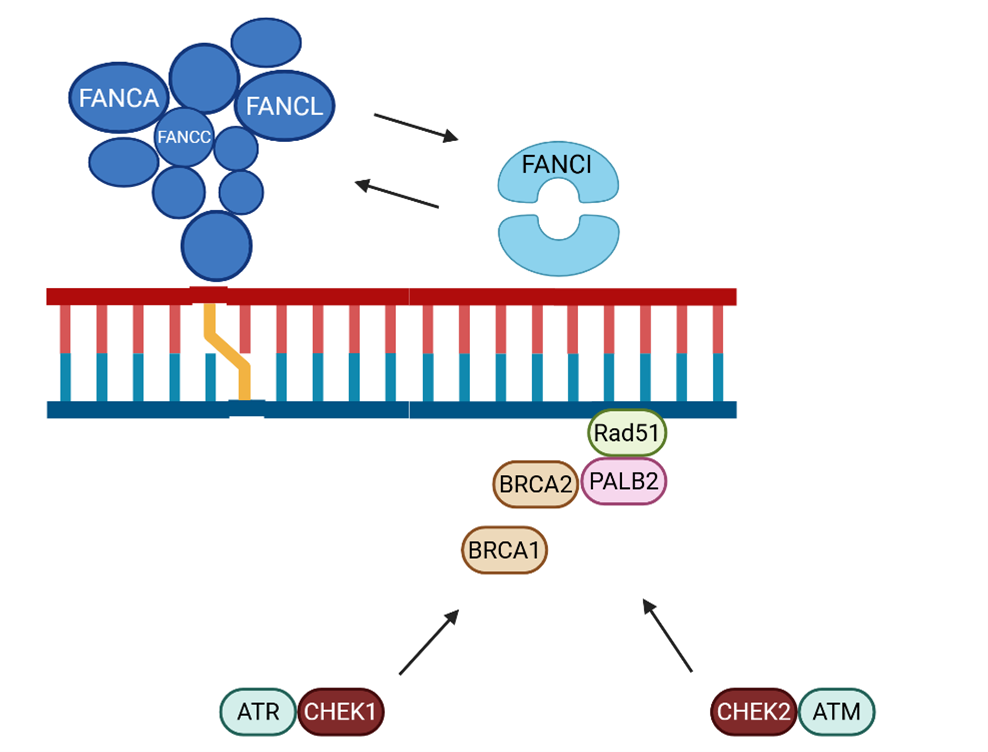
Figure 2: DNA Interstrand Crosslink (ICL) Repair Pathway. Fanconi anemia complementation group proteins (FANC) are integral to interstrand crosslink (ICL) repair. FANCA, FANCC, and FANCL form the FA core complex. FANCL, the E3 ligase, is one of the catalytic subunits that transform the ID complex that is comprised of FANCI and FANCD [16]. The ID complex stabilizes DNA to allow for Rad51 protein to attach to DNA and begin homologous recombination (HR) repair processes [17]. Checkpoint kinase 1 (CHEK1) and Ataxia-telangiectasia mutated (ATM) interaction and checkpoint kinase 2 (CHEK2) and Ataxia-telangiectasia and Rad3-related protein (ATR) interaction activates a signaling pathway. This pathway consists of breast cancer gene 1/2 (BRCA1/2) and the downstream partner and localizer of BRCA2 (PALB2) the ultimately activate Rad51 [11].
Lynch syndrome, or hereditary non-polyposis colorectal cancer (HNPCC), is another hereditary disorder caused by mutations in DNA MutL protein homolog 1 (MLH1), MutS homolog 2 (MSH2), MutS homolog 2 (MSH6), postmeiotic segregation increased 2 (PMS2), or epithelial cell adhesion molecule (EPCAM) [18]. As shown in Figure 3, two integral complexes, one comprised of MSH2 and MSH6 and the other of PMS2 and MLH1, are integral to DNA mismatch repair. Mutations of these four genes and resulting proteins lead to a faulty DNA repair mechanism and result in accumulation of errors in DNA which increases the risk of developing OC [19]. EPCAM, despite not playing a direct role in DNA repair processes, plays a role in MSH2 expression. EPCAM deletions lead to downstream transcriptional changes through MSH2 promoter’s DNA hypermethylation, resulting in loss of MSH2 expression [20]. People with Lynch syndrome have a 75% risk of colorectal cancer by age 70, and about a 15% risk of ovarian cancer by age 70 [21].
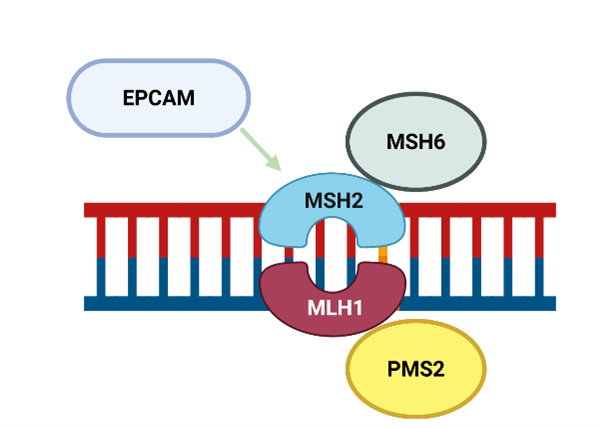
Figure 3: Lynch Syndrome pathway proteins. Two complexes, one comprised of MutS homolog 2 (MSH2) and MutS homolog 2 (MSH6) and the other of postmeiotic segregation increased 2 (PMS2) and MutL protein homolog 1 (MLH1), are integral to DNA mismatch repair. Epithelial cell adhesion molecule (EPCAM) indirectly affects this repair by interacting with the promoter of MSH2 [18].
Diagnostic Methods
Current diagnostic methods combine imaging techniques and physical examinations. A pelvic exam is usually performed by a primary care doctor or an obstetrician-gynecologist to detect structural changes in the reproductive organs. The exam includes both visual inspection and physical palpation. Detection of enlarged ovaries or the presence of abdominal fluid should raise suspicion [22]. Ultrasound, either abdominal or transvaginal, is used to detect abnormalities of the ovary, uterus, or fallopian tubes. With this technique, clinicians can identify enlarged ovaries, solid or cystic masses, papillary projections, or loculated structures (ovarian masses divided into multiple compartments) [23]. Its accuracy depends on the physician’s expertise and the quality of the equipment. In addition, ovarian size decreases after menopause, making detection more difficult in older patients [24].
Computed tomography (CT) uses X-rays to create cross-sectional images. It is often used as a first diagnostic tool and may also be performed before surgery to locate the tumor. CT can assess tumor size and evaluate the extent of spread to organs such as the kidneys, bladder, or lymph nodes. However, CT has limited ability to detect small tumors, which may lead to missed early-stage disease [25]. Magnetic resonance imaging (MRI) provides excellent visualization of pelvic structures and helps with tumor staging. It can detect cystic lesions with septa > 3 mm, nodules, papillary projections > 4 cm, and necrosis—features suggestive of ovarian cancer. MRI demonstrates a sensitivity of 91% and a specificity of 85% for ovarian cancer diagnosis [26-28].
Positron emission tomography (PET) uses FDG as a tracer to visualize metabolic activity. PET is mainly used to assess tumor growth, staging, and metastasis, often before surgery and sometimes in combination with ultrasound. Its sensitivity is around 73% and specificity about 97% [27, 28]. Chest X-ray is less commonly used for initial diagnosis but may help identify metastasis in the lungs or pleural effusion [28].
None of these imaging methods alone can diagnose HGSOC; they must be combined with other approaches. Diagnosis also involves blood tests to detect tumor biomarkers and genetic testing for mutations associated with ovarian cancer. To confirm HGSOC, a biopsy usually performed by laparoscopy, is required to assess histological features [29].
Biomarkers
The most common biomarker used in OC is cancer antigen-125 (CA-125) [30], a glycoprotein secreted by the Müllerian epithelium into the bloodstream. CA-125 is overexpressed in 80% of OC patients and promotes tumor growth and metastasis. However, its accuracy is limited in early-stage disease: it detects only about 50% of early cases, and 60% of patients with high CA-125 levels are not diagnosed with OC. Despite these limitations, it remains the most widely used biomarker for OC and EOC. Another well-known biomarker is human epididymis protein-4 (HE-4), a protease inhibitor involved in the innate immune response of epithelial tissues. HE-4 is overexpressed in OC tissue and shows a specificity of around 96% and a sensitivity of 67% [31].
The limited sensitivity of these biomarkers has led researchers to combine several markers into multivariate index assays (MIAs). Among the different MIAs developed, three have obtained FDA approval: ovarian cancer multivariate index assay (OVA1), Overa, and the risk of ovarian malignancy algorithm (ROMA) [32]. OVA1 measures the levels of CA-125, transthyretin, transferrin, beta-2 microglobulin, and apolipoprotein A-1 in serum, and provides a score between 0.00 and 10.00. The interpretation depends on whether the patient is premenopausal or postmenopausal [31]. This assay has a high sensitivity (92%), greater than CA-125 or HE-4 alone, but a relatively low specificity of around 42%. To improve this specificity, the Overa test was developed as a second-generation MIA. Overa also measures five biomarkers but replaces prealbumin and beta-2 microglobulin with HE-4 and follicle-stimulating hormone (FSH). These changes increase specificity to approximately 66% [30]. ROMA, approved by the FDA in 2010, combines CA-125, HE-4, and menopausal status to calculate a Predictive Index (PI), which is then converted into a probability score as depicted in the equations I, II, and III.
- Pre-menopausal Predictive Index: −12.0 + (2.38 × ln[HE4]) + (0.0626 × ln[CA 125])
- Pre-menopausal Predictive Index: −8.09 + (1.04 × ln[HE4]) + (0.732 × ln[CA125])
- Predicted Probability: ePI / [1 + ePI] × 100
ROMA is typically used after ultrasound detection of an ovarian abnormality. ROMA shows a sensitivity between 76–86% and a specificity between 74–95% [33], with generally higher sensitivity in postmenopausal women [31].
Treatment Methods
One of the first-line treatments for HGSOC is surgery. It is usually a debulking surgery performed by a gynecologic oncologist prior to chemotherapy and consists of the macroscopic removal of all disseminated tumor masses within the peritoneal cavity before starting the first round of chemotherapy. The level of primary cytoreduction is one of the most important prognostic factors for survival. It has been shown that removal of metastatic tumors improves overall survival [11,34]. A debulking surgery is considered successful when less than 1 mm of residual tumor remains [35]. Surgery remains one of the best options for patients with HGSOC, although it can be associated with significant comorbidities [36]. Patients with BRCA1/2 mutations, or more broadly with homologous recombination defects, may choose to undergo a risk-reducing salpingo-oophorectomy, which prevents the development of HGSOC in 85–90% of cases [11,37].
Neoadjuvant chemotherapy can be administered prior to surgery to reduce tumor size. However, most commonly, chemotherapy is given after surgery to eliminate remaining cancer cells. All HGSOC patients are recommended to receive chemotherapy regardless of stage. The most used agents are carboplatin, cisplatin, and paclitaxel. The combination of carboplatin and paclitaxel has been the standard of care for the past 20 years [11]. The typical regimen consists of cisplatin 75 mg/m² infusion, plus paclitaxel 135 mg/m² infused over 24 hours, every 3 weeks for a total of 6 cycles [11]. HGSOC is initially platinum-sensitive, but approximately 80% of patients eventually relapse. Heated intraperitoneal cisplatin and paclitaxel have been shown to increase drug penetration into the abdomen, but the clinical benefit of this technique remains unclear and further trials are needed [37].
Poly (ADP-ribose) polymerase inhibitors (PARPi) are now routinely used in combination with chemotherapy. The first FDA approval for PARPi was granted in 2014 for Olaparib as monotherapy in fourth-line treatment. Later, niraparib and rucaparib were also approved in 2016 and 2017, respectively. PARP enzymes are key sensors of DNA damage—both single-strand (SSB) and double-strand breaks (DSB)—and play crucial roles in DNA repair by catalyzing the addition of ADP-ribose at damage sites. This promotes chromatin decompaction and recruitment of proteins involved in base excision repair (BER), NHEJ, or HR. PARP inhibitors exploits the concept of synthetic lethality: two defects that are non-lethal individually become lethal when combined. When PARP proteins are inhibited, unrepaired SSBs convert into DSBs. In the absence of functional BRCA, HR-deficient cells accumulate lethal DSBs, leading to mitotic catastrophe and cell death. Approximately half of HGSOC tumors show features of homologous recombination deficiency [35], but PARPi provide benefit in all patients. Unfortunately, resistance to PARPi can develop. Cancer cells use several strategies to escape treatment, like HR restoration through gene re-expression (e.g., BRCA1/2), epigenetic modifications activation of alternative repair pathways, or rebalancing HR/NHEJ replication fork protection, often via loss of chromatin remodelers [38].
Currently, immune checkpoint inhibitors (ICI) are not part of standard HGSOC treatment. This may be due to low programmed death-ligand 1 (PD-L1) expression, low mutation burden, and weak immunogenicity. However, PARPi such as olaparib can induce PD-L1 expression, potentially sensitizing tumors to ICIs [39].
The MEDIOLA trial showed encouraging anti-tumor activity, and several other trials are ongoing [39] that target growth factors, like VEGF. To target the tumor microenvironment (TME), anti-VEGF therapies such as bevacizumab are also used in combination with chemotherapy. Bevacizumab is a humanized antibody targeting VEGF-A, a key driver of tumor angiogenesis [11]. In the International Collaboration on Ovarian Neoplasms 7 (ICON7) study, adding bevacizumab significantly improved progression-free survival [40].
For women with platinum-resistant disease, mirvetuximab soravtansine-gynx (MIRV) is another treatment option. It is an antibody–drug conjugate targeting folate receptor alpha (FR-α), expressed in ~80% of primary and recurrent EOC. After internalization, the attached anti-tubulin toxin (DM4) disrupts mitosis and induces apoptosis. Toxicity is relatively low due to the specificity for FR-α–positive cells. In the MIRASOL study, MIRV improved median PFS (5.6 vs 3.9 months) and OS (16.5 vs 12.8 months) in platinum-resistant patients. For platinum-sensitive patients, MIRV may be combined with chemotherapy, though more evidence is needed [41].
Many clinical trials are currently exploring new treatments for HGSOC. The DENALI trial (NCT05128825) tests azenosertib, a selective mitosis inhibitor protein kinase Wee1 inhibitor, in platinum-resistant HGSOC [42]. The BEACON trial (NCT03363867) evaluates bevacizumab + atezolizumab + cobimetinib in platinum-resistant patients [43].
Research models
To discover new drugs and their potential effects on the body, research models are very helpful and essential. Since the beginning of research on HGSOC, many of them have been elaborated, either in vitro or in vivo.
Commercial ovarian cancer cell lines are widely used in research due to their ease of culture and relatively low cost. A broad range of these cell lines is readily available from suppliers, enabling a wide variety of experiments, from drug screening and resistance studies to molecular profiling and therapeutic development. Despite their many advantages, these cell lines also have notable limitations. They have typically undergone numerous passages, exposing them to strong selection pressures. As a result, they tend to accumulate additional, often irrelevant mutations, which can compromise the biological relevance of the model and potentially distort experimental results.
A study analyzing the most used ovarian cancer cell lines, primarily in the context of HGSOC research, has shown that SKOV3 and A2780 do not accurately reflect the molecular characteristics of HGSOC. Notably, these cell lines lack TP53 mutations, which are present in approximately 95% of HGSOC cases, and instead carry mutations in other genes such as PI3K, BRAF, or PTEN. Furthermore, they exhibit very few copy number alterations, which contrast sharply with the high genomic instability typically observed in HGSOC.
Interestingly, the less commonly used cell lines, those with few citations on PubMed, are the ones most closely resembling high-grade serous ovarian carcinoma (HGSOC). Kuramochi, human high-grade serous ovarian cancer (OVSAHO), and Seoul National University-119 (SNU119) cell lines all carry TP53 mutations and exhibit a high number of copy number alterations. The selection of a particular cell line depends on several factors, including the study’s objectives and the culture characteristics. For drug testing, considering the molecular profile is particularly relevant, as a high degree of molecular similarity to patient tumors may improve the predictive value for treatment response [3, 44].
Xenografts are widely used as in vivo models in oncology research. They involve the transplantation of human cells, tissues, or organs into immunodeficient mice, enabling the study of tumor growth and therapeutic responses in a living system. To prevent immune rejection of the graft, various strains of immunocompromised mice are employed, including athymic nude mice (which lack T lymphocytes), Severe Combined Immunodeficiency (SCID) mice (deficient in both T and B lymphocytes), and NOD scid gamma mouse (NSG) (NOD/SCID/IL2Rγnull) mice (which lack both adaptive immunity and natural killer cells). These models allow for successful engraftment and development of human tumors in a murine host. Two main approaches are used for tumor implantation. Subcutaneous implantation offers a technically simple procedure and easy monitoring of tumor growth. However, it does not accurately recapitulate the tumor’s native microenvironment, limiting its physiological relevance.
Orthotopic implantation, where tumor cells are engrafted into their original anatomical site (e.g., human ovarian cancer cells into the mouse ovarian bursa), provides a more faithful representation of the tumor microenvironment. Despite the absence of a functional immune system, these models retain some stromal and tissue-specific characteristics that influence tumor behavior. In addition, it allows the study of peritoneal dissemination and ascites formation. Nevertheless, orthotopic models are technically more demanding, particularly for internal organs, and often require advanced imaging modalities such as bioluminescence to monitor tumor progression [3, 35]. This technique can be used as a model for preclinical development. For instance, it has been used to show the capacity of monoclonal antibodies against human VEGF to have a synergistic effect in combination with paclitaxel on tumor growth and ascites formation.
Patient-derived xenografts (PDX) are a particular type of xenograft in which fresh tumor tissue, directly obtained from a patient, is implanted either subcutaneously or orthotopically into immunodeficient mice. The original tumor tissue can originate from a primary tumor, a metastatic site, or represent different clinical stages, such as untreated or chemoresistant disease. Among the available mouse models, NSG mice are commonly used, as they provide higher engraftment success rates. Typically, it takes between 2 to 6 months for the tumor to grow to the maximum authorized size. For example, in the case of HGSOC, the engraftment success rate is approximately 77%. The PDX model represents a major advancement in tumor modeling, as it is capable of preserving key characteristics of the original tumors, such as histology, mutational profile, and DNA copy number. It is commonly used for pre-clinical drug development and drug screening to help clinicians. However, this model also presents several challenges. Over time, the human stromal components can be replaced by murine stroma, which may alter the tumor microenvironment. Furthermore, it is an expensive model that requires the use of animals, specialized equipment, and trained personnel to maintain the mice under appropriate conditions. Additionally, setting up PDX studies takes time due to the regulatory paperwork and organizational complexity involved [3, 35].
In 2021, Iyer, Sonia et al. developed several syngeneic models of high-grade serous tubo-ovarian carcinomas (HGSC) recapitulating the most common features of patients. A syngeneic model consists of implanting a cell line into mice with the same genetic background (C57BL/6), allowing the growth of a tumor in a microenvironment with a complete immune system. The emergence of this kind of model is crucial to investigate the implication of the immune system in the tumor microenvironment in HGSOC and assess the potential efficacy of immune checkpoint blockade therapies already employed in other cancer types. In this case, the transformed murine fallopian tube epithelial (m-FTE) cell line was genetically engineered to be HR-deficient, with a TP53 missense mutation and knockout of BRCA1, PTEN, and neurofibromin (NF1), as well as an overexpression of Myc, called BPPNM. In addition, they created an m-FTE cell line with undetermined HR status called PPNM, with the same mutations as the BPPNM model except the PPBM cell line still has a wild-type BRCA1. They also created three m-FTE HR-proficient models with a p53 mutation, an overexpression of cyclin E1 (CCNE1) and protein kinase B beta (AKT2), and one of the following modifications: bromodomain-containing protein 4 (BRD4) overexpression (BPCA); SWI/SNF-related, matrix-associated, actin-dependent regulator of chromatin, subfamily A, member 4 (SMARCA4) overexpression (SPCA); or KRASG12V, an oncogenic mutant form of KRAS, (KPCA).
These models all harbor histopathological and clinical features found in HGSC patients, such as ascites and peritoneal metastasis, showing that they are robust models for HGSOC. Moreover, after an analysis of the immune microenvironments, they demonstrated that it differs according to genotype. The BPPNM type showed more inflammation with a higher rate of CD3-positive cells and more tumor-associated macrophages than the KPCA or PPNM types. On the other hand, KPCA tumors exhibited a tenfold higher rate of exhaustion markers than BPPNM [3, 35, 45]. These exhaustion markers include programmed cell death protein 1 (PD-1), T-cell immunoglobulin and mucin domain 3 (TIM-3), and T-cell immunoreceptor with Ig and ITIM domains (TIGIT). These markers demonstrate T-cell exhaustion and ensuing poor immunosuppressive efforts against tumor cells.
Genetically engineered animal models include spontaneous animal models. These spontaneous animal models consist of introducing genetic mutations found in the cancer of interest into an animal model to develop a spontaneous tumor. This type of model offers several advantages, such as genetic similarity to the target cancer and development in an animal with a competent immune system. However, it usually takes a long time for the tumor to appear and grow.
To introduce these mutations, various methods are used. Connolly and colleagues developed a transgenic epithelial ovarian cancer model closely resembling HGSC. They achieved this by expressing the early region of Simian Virus 40 (SV40) under the transcriptional control of the Müllerian inhibiting substance type II receptor (MISIIR) gene, which is expressed in the ovary. In this model, 100% of female offspring develop bilateral ovarian tumors after an average of 152 days, showing features similar to HGSC, including peritoneal metastases and ascites formation. This specific model has been used to evaluate the efficacy of the mTOR inhibitor RAD001 in ovarian neoplasms.
Kim and colleagues created a conditional model by deleting endoribonuclease Dicer (DICER)—an essential gene for miRNA processing—and PTEN, using an anti-Müllerian hormone receptor type 2-directed Cre (Amhr2-Cre) and locus of X-over P1 (LoxP) system. Their model is show in Figure 4. These Dicerflox/flox Ptenflox/flox Amhr2cre/+ tumors display aggressive development, arising from the fallopian tube, spreading to the ovaries, and metastasizing throughout the abdomen, including the diaphragm, peritoneal membrane, omentum, and even the pancreas. Primary tumors and metastases also show histological similarities to HGSC, such as pleomorphic nuclei, prominent nucleoli, and high mitotic activity. Despite the absence of TP53 mutations, the model appears accurate, as TP53 expression is low. It is possible that DICER deletion mimics the effect of TP53 mutation, given the role of p53 upstream of DICER [3,35,46].
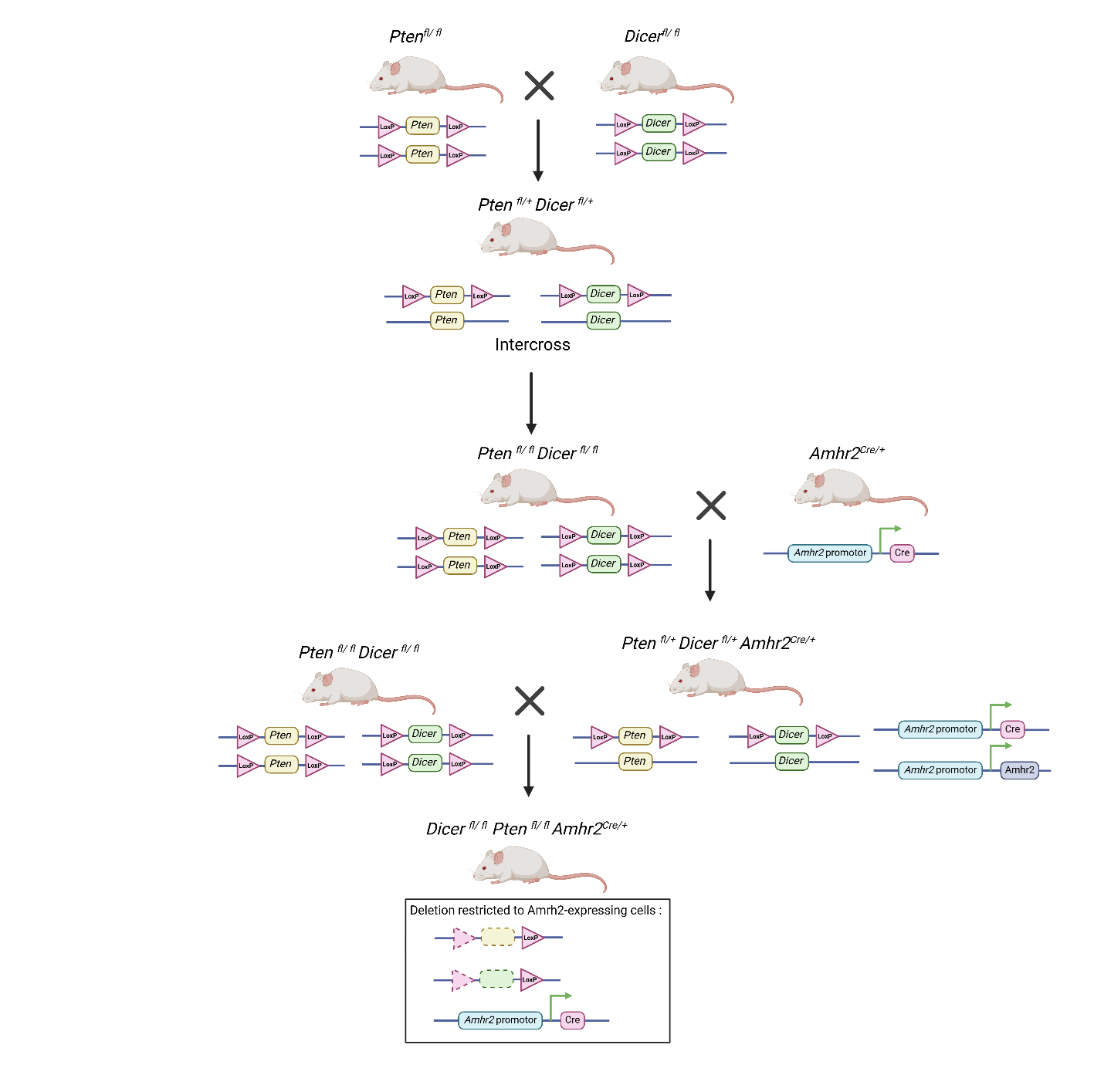
Figure 4: Murine models with deletion endoribonuclease Dicer (DICER). Deletion of endoribonuclease Dicer (DICER) and phosphatase and tensin homolog (PTEN) genes in murine models lead to development of tumors that aggressive metastasize. The Amhr2-Cre murine model with the double knock-out display high-grade serous carcinomas arise from the fallopian tube like high-grade serous ovarian cancer (HGSOC) [46].
Conclusion
Ovarian cancer, and particularly HGSOC still are a major health issue worldwide with 225,000 new cases registered each year. This emphasizes the need to continue research on this domain. This review synthetized knowledge about HGSOC and highlights some of the unmet needs in research. HGSOC still lacks early detection tools.
Development of strong and more specific biomarkers could help and improve the clinical outcome. In addition, novel therapies are still necessary to treat the heterogeneity of patients and especially the poor responder of classic treatment. With all the new concepts emerging, new leads could be explored in the tumoral microenvironment and in immunotherapy. Finaly, the necessity to develop new strategies to overcome treatment resistance is increasing. Regarding this, the progression of Artificial Intelligence (AI) provides promising evidence to help predict platinum response and could eventually guide physicians for patient’s care [47].
Acknowledgement: We thank Biorender.com for the creation of the figures.
Funding Statement: The authors received no specific funding for this study.
Author Contributions: Jung Manon and Charles Cao equally prepared and edited the manuscript; Yihui Shi supervised, reviewed, and edited the manuscript. All authors reviewed and approved the final version of the manuscript.
Availability of Data and Materials: Not applicable.
Ethics Approval: Not applicable.
Conflicts of Interest: The authors declare no conflicts of interest.
References
- Wei Y-F, Ning L, Xu Y-L, Ma J, Li D-R, Feng Z-F, et al. Worldwide patterns and trends in ovarian cancer incidence by histological subtype: a population-based analysis from 1988 to 2017. eClinicalMedicine, 2025; 79.
- FIGO ovarian cancer staging guidelines (January 2014) Chicago, IL: Society of Gynecologic Oncology, 2014.
- Konstantinopoulos PA, Matulonis UA. Current Status and Evolution of Preclinical Drug Development Models of Epithelial Ovarian Cancer. Frontiers in Oncology, 2013; 3.
- Narayanan B, Buddenkotte T, Smith H, Shah M, Freeman S, Hulse D, et al. Growth kinetics of high-grade serous ovarian cancer: implications for early detection. British Journal of Cancer, 2025; 133(4): 533–538.
- Punzón-Jiménez P, Lago V, Domingo S, Simón C, Mas A. Molecular Management of High-Grade Serous Ovarian Carcinoma. Int J Mol Sci, 2022; 23(22).
- Santoro A, Angelico G, Travaglino A, Inzani F, Spadola S, Pettinato A, et al. The multiple facets of ovarian high grade serous carcinoma: A review on morphological, immunohistochemical and molecular features. Critical Reviews in Oncology/Hematology, 2025; 208: 104603.
- Dinkins K, Barton W, Wheeler L, Smith HJ, Mythreye K, Arend RC. Targeted therapy in high grade serous ovarian Cancer: A literature review. Gynecol Oncol Rep, 2024; 54: 101450.
- Khazaei Z, Namayandeh SM, Beiranvand R, Naemi H, Bechashk SM, Goodarzi E. Worldwide incidence and mortality of ovarian cancer and Human Development Index (HDI): GLOBOCAN sources and methods 2018. J Prev Med Hyg, 2021; 62(1): E174–e84.
- Yang Y, Miao R, He H, Zhang N, Wan X, Gao Y, et al. The Burden and Trends of Gynecological Cancers in Asia from 1980 to 2021, with Projections to 2050: A Systematic Analysis for the Global Burden of Disease Study, 2021. Curr Oncol, 2025; 32(6).
- Institute NC. Cancer Stat Facts: Ovarian Cancer: National Institutes of Health; 2021 [
- Lisio MA, Fu L, Goyeneche A, Gao ZH, Telleria C. High-Grade Serous Ovarian Cancer: Basic Sciences, Clinical and Therapeutic Standpoints. Int J Mol Sci, 2019; 20(4).
- Luan NN, Wu QJ, Gong TT, Vogtmann E, Wang YL, Lin B. Breastfeeding and ovarian cancer risk: a meta-analysis of epidemiologic studies. Am J Clin Nutr, 2013; 98(4): 1020–1031.
- Hu J, Wang Z, Zuo R, Zheng C, Lu B, Cheng X, et al. Development of survival predictors for high-grade serous ovarian cancer based on stable radiomic features from computed tomography images. iScience, 2022; 25(7): 104628.
- Bowtell DD, Böhm S, Ahmed AA, Aspuria PJ, Bast RC, Jr., Beral V, et al. Rethinking ovarian cancer II: reducing mortality from high-grade serous ovarian cancer. Nat Rev Cancer, 2015; 15(11): 668–679.
- Ciucci A, Zannoni GF, Buttarelli M, Martinelli E, Mascilini F, Petrillo M, et al. Ovarian low and high grade serous carcinomas: hidden divergent features in the tumor microenvironment. Oncotarget, 2016; 7(42): 68033–68043.
- Jones MJ, Huang TT. The Fanconi anemia pathway in replication stress and DNA crosslink repair. Cell Mol Life Sci, 2012; 69(23): 3963–3974.
- Ahlskog JK, Larsen BD, Achanta K, Sørensen CS. ATM/ATR-mediated phosphorylation of PALB2 promotes RAD51 function. EMBO Rep, 2016; 17(5): 671–681.
- Peltomäki P, Nyström M, Mecklin J-P, Seppälä TT. Lynch Syndrome Genetics and Clinical Implications. Gastroenterology, 2023; 164(5): 783–799.
- Duraturo F, Liccardo R, De Rosa M, Izzo P. Genetics, diagnosis and treatment of Lynch syndrome: Old lessons and current challenges. Oncol Lett, 2019; 17(3): 3048–3054.
- Forster VJ, Aronson M, Zhang C, Chung J, Sudhaman S, Galati MA, et al. Biallelic EPCAM deletions induce tissue-specific DNA repair deficiency and cancer predisposition. NPJ Precis Oncol, 2024; 8(1): 69.
- Idos G, L. V. Lynch Syndrome. Adam MP, Bick S, Mirzaa GM, editors. Seattle, WA: University of Washington, Seattle, 2021.
- Practice Bulletin No. 174: Evaluation and Management of Adnexal Masses. Obstet Gynecol, 2016; 128(5): e210–e226.
- Kamal R, Hamed S, Mansour S, Mounir Y, Abdel Sallam S. Ovarian cancer screening-ultrasound; impact on ovarian cancer mortality. Br J Radiol, 2018; 91(1090): 20170571.
- Sharma A, Burnell M, Gentry-Maharaj A, Campbell S, Amso NN, Seif MW, et al. Factors affecting visualization of postmenopausal ovaries: descriptive study from the multicenter United Kingdom Collaborative Trial of Ovarian Cancer Screening (UKCTOCS). Ultrasound Obstet Gynecol, 2013; 42(4): 472–477.
- Suh-Burgmann EJ, Alavi M. Detection of early stage ovarian cancer in a large community cohort. Cancer Med, 2019; 8(16): 7133–7140.
- D'Amario A, Ambrosini R, Gullino A, Grazioli L. Role of Imaging Techniques in Ovarian Cancer Diagnosis: Current Approaches and Future Directions. Cancers (Basel), 2026; 18(1).
- Engbersen MP, Van Driel W, Lambregts D, Lahaye M. The role of CT, PET-CT, and MRI in ovarian cancer. Br J Radiol, 2021; 94(1125): 20210117.
- Pullen RL, Jr. Ovarian cancer. Nursing, 2024; 54(6): 17–28.
- Spencer JA, Anderson K, Weston M, Wilkinson N, Hewitt M. Image guided biopsy in the management of cancer of the ovary. Cancer Imaging, 2006; 6(1): 144–147.
- Fritsche HA, Bullock RG. A reflex testing protocol using two multivariate index assays improves the risk assessment for ovarian cancer in patients with an adnexal mass. Int J Gynaecol Obstet, 2023; 162(2): 485–492.
- Zhang R, Siu MKY, Ngan HYS, Chan KKL. Molecular Biomarkers for the Early Detection of Ovarian Cancer. International Journal of Molecular Sciences, 2022; 23(19): 12041.
- Kumari S. Serum Biomarker Based Algorithms in Diagnosis of Ovarian Cancer: A Review. Indian J Clin Biochem, 2018; 33(4): 382–386.
- Dochez V, Caillon H, Vaucel E, Dimet J, Winer N, Ducarme G. Biomarkers and algorithms for diagnosis of ovarian cancer: CA125, HE4, RMI and ROMA, a review. J Ovarian Res, 2019; 12(1): 28.
- Lengyel E. Ovarian cancer development and metastasis. Am J Pathol, 2010; 177(3): 1053–1064.
- Wang Y, Duval AJ, Adli M, Matei D. Biology-driven therapy advances in high-grade serous ovarian cancer. J Clin Invest, 2024; 134(1).
- Tsonis O, Gkrozou F, Vlachos K, Paschopoulos M, Mitsis MC, Zakynthinakis-Kyriakou N, et al. Upfront debulking surgery for high-grade serous ovarian carcinoma: current evidence. Annals of Translational Medicine, 2020; 8(24): 1707.
- Werger M, Ardestani SK, Sobel M. Opportunistic salpingectomy to decrease the risk of ovarian cancer. Canadian Medical Association Journal, 2024; 196(22): E765.
- Soberanis Pina P, Lheureux S. Overcoming PARP inhibitor resistance in ovarian cancer. International Journal of Gynecological Cancer, 2023; 33(3): 364–376.
- Xiao F, Wang Z, Qiao L, Zhang X, Wu N, Wang J, et al. Application of PARP inhibitors combined with immune checkpoint inhibitors in ovarian cancer. Journal of Translational Medicine, 2024; 22(1): 778.
- Aravantinos G, Pectasides D. Bevacizumab in combination with chemotherapy for the treatment of advanced ovarian cancer: a systematic review. Journal of Ovarian Research, 2014; 7(1): 57.
- Silverstein J, Smick A, Johnson B, Konecny GE. Mirvetuximab soravtansine for the treatment of epithelial ovarian, fallopian tube, or primary peritoneal cancer. Future Oncology, 2025; 21(17): 2143–2153.
- K-Group B, Inc. A Study of Azenosertib (ZN-c3) in Subjects With Platinum-Resistant High-Grade Serous Ovarian, Fallopian Tube or Primary Peritoneal Cancer (DENALI), 2026.
- Manoharan S, Bressel M, James P, Ko Y-A, Hamilton AL, Scott CL, et al. Beacon: A phase II study of bevacizumab, atezolizumab, and cobimetinib in patients with recurrent, platinum resistant, high grade serous ovarian cancer. Journal of Clinical Oncology, 2024; 42(16_suppl): 5565.
- Domcke S, Sinha R, Levine DA, Sander C, Schultz N. Evaluating cell lines as tumour models by comparison of genomic profiles. Nature Communications, 2013; 4(1): 2126.
- Iyer S, Zhang S, Yucel S, Horn H, Smith SG, Reinhardt F, et al. Genetically Defined Syngeneic Mouse Models of Ovarian Cancer as Tools for the Discovery of Combination Immunotherapy. Cancer Discovery, 2021; 11(2): 384–407.
- Kim J, Coffey DM, Creighton CJ, Yu Z, Hawkins SM, Matzuk MM. High-grade serous ovarian cancer arises from fallopian tube in a mouse model. Proceedings of the National Academy of Sciences, 2012; 109(10): 3921–3926.
- Bergstrom EN, Abbasi A, Díaz-Gay M, Galland L, Ladoire S, Lippman SM, et al. Deep Learning Artificial Intelligence Predicts Homologous Recombination Deficiency and Platinum Response From Histologic Slides. Journal of Clinical Oncology, 2024; 42(30): 3550–3560.