
Email id: info@ijclinmedcasereports.com
Novel Strategies for the Modulation of Autophagy in the Prevention of Cardiovascular Disease
Sukhwinder K Bhullar1, Jaideep K Gill1, Lorrie A Kirshenbaum1,2, Ruchi Tandon3 and Naranjan S Dhalla1,2,*
1Institute of Cardiovascular Sciences, St. Boniface Hospital Albrechtsen Research Centre, Canada
2Department of Physiology and Pathophysiology, Max Rady College of Medicine, University of Manitoba, Winnipeg, Canada
3Centre for Drug Discovery, BRIC Translational Health Science and Technology Institute, Faridabad, India
Received Date: 17/04/2026; Published Date: 19/06/2026
*Corresponding author: Dr. Naranjan S Dhalla, PhD, MD (Hons), DSc (Hons), Institute of Cardiovascular Sciences, St. Boniface Hospital Albrechtsen Research Centre, Winnipeg, Manitoba, Canada
Abstract
Autophagy is a critical homeostatic process in the cardiovascular system, which preserves cardiomyocyte viability under diverse pathophysiological conditions. In healthy heart, different intracellular signaling molecules activate the autophagy pathway that link mitochondrial quality control, redox balance, and inflammatory regulation to maintain cardiac function. However, in diseased heart, dysregulation of cardiac homeostasis is associated with disruption of autophagy flux, reduction of mitochondrial clearance, amplification of reactive oxygen species production, promotion of inflammasome activation, impairment of the autophagy signaling pathway and induction of cardiomyocyte death. The impaired autophagy has been reported to contribute to the development of cardiovascular complications including ischemic heart disease, diabetic cardiomyopathy, drug-induced cardiotoxicity, and heart failure. A shift in autophagic mode from an activated state to maladaptive impaired condition following calcium imbalance, oxidative stress, mitochondrial dysfunction, and chronic inflammation during the progression of heart disease. Several pharmacological agents, which exert beneficial effects in cardiovascular diseases, have been shown to modulate the process of autophagy. It is suggested that specific modulation of the autophagic process may offer novel strategies for the development of therapeutic interventions for the treatment of cardiovascular diseases.
Keywords: Activated autophagy; Impaired autophagy, Intracellular Ca2+-overload; Oxidative stress; Cardiac inflammation
Introduction
Autophagy is a crucial process that removes damaged organelles and misfolded proteins in addition to recycling their components to promote cell survival and maintain cellular homeostasis. Activated autophagy also serves as an adaptive mechanism as it protects against diverse stressful situations [1–5]. In the heart, autophagy maintains contractile function by preserving energy production and structural integrity of cardiomyocytes as well as preventing the reactive oxygen species (ROS)-induced damage [6–13]. In fact, the activated autophagy is essential in the heart because cardiomyocytes are terminally differentiated and highly energy-dependent cells with limited regenerative capacity [14,15]. Hence, abnormalities in autophagy during chronic pathological conditions such as ischemic- or nutrient stress can result in cell death and cardiac dysfunction [2,3]. However, the mechanism that underlie autophagy regulation in health and disease remain poorly understood. In this review we provide an updated brief view of the role played by adaptive and maladaptive autophagy in the pathogenesis of cardiovascular disease. In particular, the involvement of impaired autophagy in development of ischemic heart disease, diabetes- or drug-induced cardiomyopathy and heart failure will be discussed. We also provide novel insight into the signaling mechanisms and molecular pathways that modulate or regulate autophagy in the heart under normal and disease conditions. Furthermore, information is provided on pharmacological and nutraceutical interventions that may improve cardiovascular outcomes in individuals with heart disease. It should be pointed out that appropriate literature for this article was searched from MEDLINE via PubMed, using the term cardiac autophagy in health and disease, and only some pertinent articles related to the pathophysiology and pharmacotherapy of autophagy in cardiac dysfunction were selected for citation.
General Consideration for the Role of Activated vs Impaired Autophagy in Heart Disease
Several pre-clinical studies have demonstrated that activated autophagy exerts significant cardioprotective effects under different stress-induced pathological conditions including starvation, nutrient deprivation, ischemia, hypoxia, hemodynamic overload, aging and cancer therapy exposure [16–29]. Activated autophagy has also been shown to support cardiomyocyte survival and cardiac function by preserving mitochondrial quality control, improving Ca²⁺ handling, limiting oxidative stress, and [4,30–36]. During ischemia-reperfusion injury (I/R) as a consequence of nutrient and oxygen deprivation, autophagy supplies metabolic substrates through intracellular recycling, limits cardiomyocyte death and reduces infarct size [37]. Autophagy is also involved in removing damaged mitochondria and interaction with different Bcl-2 family proteins such as Beclin-1 to inhibit cell death. At initial stages, autophagy is protective whereas at late stages, impaired autophagy activation may contribute to enhanced cardiac function following I/R [20]. Also, impaired mitophagy has been reported to cause depletion of damaged mitochondria, leading to reduced ATP production, contractile dysfunction, cardiac remodeling and heart failure [38–40]. In pressure overload induced cardiac hypertrophy, autophagy maintains protein quality control thereby preventing accumulation of misfolded proteins, that would otherwise result in cell death and heart failure [21,41]. Additionally, the anti-inflammatory effects of autophagy for removing activated inflammasomes and limiting the release of damage-associated molecular patterns (DAMPs) are well-known [42–46]. It should be noted that, Ca²⁺ has also been reported to influence autophagy by regulating autophagosome formation, mitochondrial quality control and development of oxidative stress; however, excessive amount of Ca2+ has been shown to impair the autophagic process and cause cardiomyocyte death [33,47,48]. These observations support the view that autophagy can be adaptive or maladaptive resulting from excess or impaired activation.
Role of Key Regulators of Autophagy in Cardiac Dysfunction
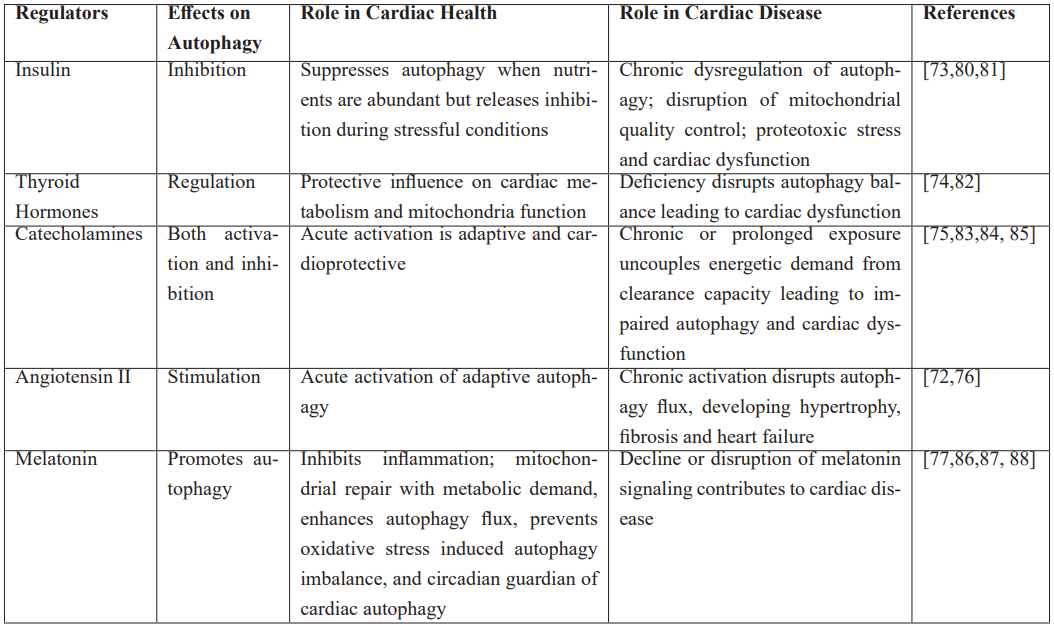
In pathological settings, autophagy may shift from a cardioprotective mechanism to a contributor to cardiomyocyte injury due to degradation of sarcomeric proteins, myocardial thinning, ventricular dilation and cardiac dysfunction [5,49–53]. There is over welcoming evidence that impaired autophagy contributes to the development of cardiovascular diseases such as IR injury, hypertension, atherosclerosis, cardiomyopathies, drug-induced cardiotoxicity, cardiac remodeling and heart failure [20,22,29,38,54–59]. Furthermore, incomplete autophagy flux, accumulation of autophagosomes and defective lysosomal clearance have resulted in the leakage of damaged organelles and activation of inflammatory pathways in the hearts [60–63]. Moreover, dysregulation of Ca2+ homeostasis reportedly leads to impaired autophagy pathways and protein aggregate protein clearance cardiac disease states such as I/R injury, cardiac hypertrophy, coronary heart disease, diabetic cardiomyopathy and heart failure [64-69]. Likewise, activated autophagy declines with aging [70], contributing to cardiac dysfunction, fibrosis, and reduced stress tolerance [24,71,72]. As well, certain drugs such as chemotherapeutic agents, have been shown to produce impaired autophagy by inhibiting lysosomal function, and thus result in cardiomyocyte death and cardiomyopathy [25–28]. Additionally, marked effects of hormones induced regulation and dysregulation of autophagy in the context of cardiac health and disease have been demonstrated [73–77]. A dual role of autophagy, promoting cell survival or cell death, has been considered to be controlled by various complex signaling networks and regulatory pathways [78,79]. Modification of autophagy in both healthy and diseased hearts by hormones, have been shown to affect autophagy, are shown in Table 1 [80-88]. Furthermore, key intracellular regulators such as mTOR (Mechanistic target of Rapamycin), AMPK (AMP-activated protein kinase), ULK1 (Unc-51-like autophagy activating kinase), TFEB (Transcription factor EB), FOXO (Forkhead box class O), UPR (Unfolded protein), ER (Endoplasmic reticulum) are depicted in Table 2 [89−100]. It is noteworthy that the regulatory pathways including 5'-AMP-activated protein kinase (AMPK), Beclin-1–mediated autophagosome, SIRT1 signaling autophagy-related genes (ATGs) and the ULK1 complex initiate autophagy in cardiomyocytes [101−103]. On the other hand, accumulation of LC3-II and degradation of p62 indicate dysregulation of autophagy, suggesting impaired autophagic flux and cell death [104,105]. It is also pointed out that prolonged exposure of cardiomyocytes to several activators of autophagy also leads to defective lysosomal degradation, imbalance between autophagy and apoptosis pathways, mitochondrial dysfunction, intracellular Ca²⁺-overload and chronic inflammation for the progression of cardiac remodeling, and heart failure [90,106]. These observations suggest the formulation of new strategies to develop clinical interventions for the prevention of cardiovascular diseases by modulating targets associated with autophagy regulation and dysregulation [90,106,107].
Table 1: Modification of autophagy in cardiac health and disease by some hormones.
Modulation of Impaired Autophagy in Heart Disease
In view of the fact that mTOR-AMPK-SIRT1 axis is a key regulatory pathway in autophagy, it is the
Table 2: Modification of autophagy in cardiac health and disease by some regulators such as protein kinases, transcription factors and other intracellular biologically active proteins.
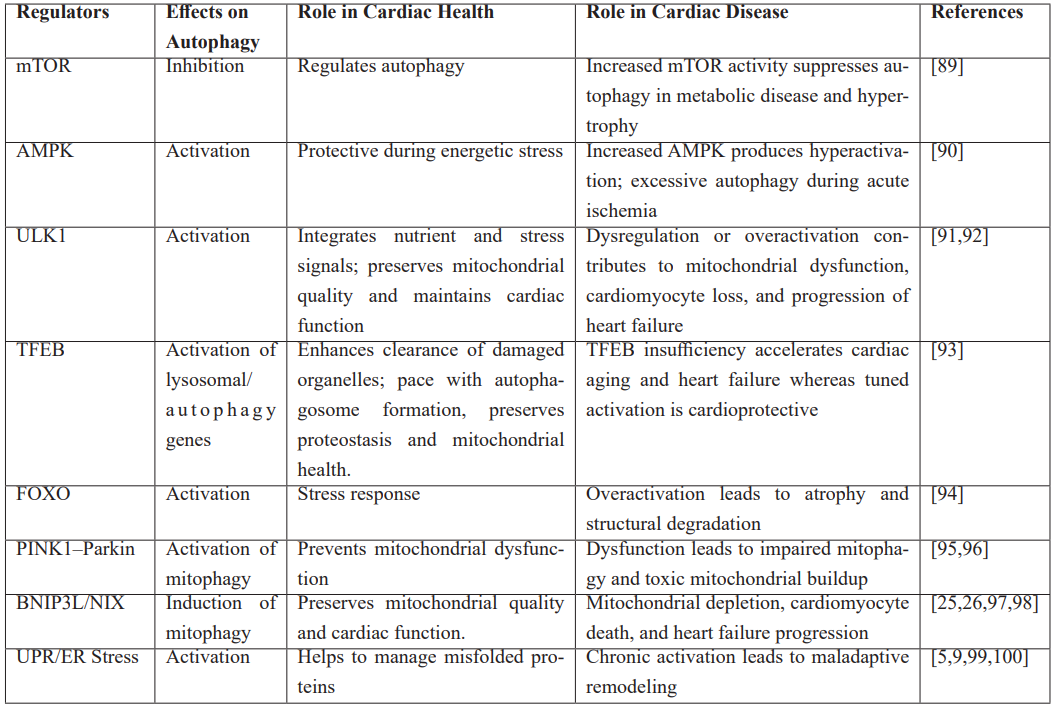
mTOR, Mechanistic target of Rapamycin; AMPK, AMP-activated protein kinase; ULK1, Unc-51-like autophagy activating kinase; TFEB, Transcription factor EB; FOXO, Forkhead box class O; UPR, Unfolded protein; ER, Endoplasmic reticulum target of various pharmacological interventions for the improvement of cardiac function in cardiovascular disease [108−112]. Autophagy activators, such as everolimus and rapamycin have been shown to reduce hypertrophy, improve post-infarction remodeling, enhance contractile recovery, and promote mitochondrial clearance by inhibiting mTOR, activating ULK1 and promoting autophagosome formation [9,53,113]. The mTOR inhibitor, metformin, has been reported to protect the heart under disease conditions such as diabetic cardiomyopathy and I/R injury by stimulating ULK1 to enhance autophagic flux, thereby improving cardiac energetics, reducing apoptosis, and promoting mitophagy [92]. Leptin, a protein involved in obesity, inhibited autophagy by depressing the intracellular free Ca2+ via increasing oxidative stress [114]. Moreover, Pim1 overexpression enhanced autophagy via AMPK/mTOR/ATG5 pathway and decreased apoptosis in hypoxic cardiomyocytes [115]. Also, the AMPK activator, AICAR (5-Aminoimidazole-4-carboxamide ribonucleoside), has been shown to promote autophagy in ischemic and hypertrophic models by reducing oxidative stress. Furthermore, a potent SIRT1 activator, SRT1720, was found to restore mitochondrial quality and reduce fibrosis in models of heart failure and aging by promoting autophagy via deacetylation [99]. Additionally, elevated levels of nicotinamide adenine dinucleotide, resulting from the SIRT1 activator nicotinamide riboside, has been shown associated with enhanced SIRT1 activity, increased autophagy, improved mitochondrial biogenesis, and heightened autophagy turnover due to I/R and heart failure [116]. Adiponectin has been reported to activate AMPK-dependent autophagy, particularly in ischemia and diabetic cardiomyopathy, thereby improving survival and reducing hypertrophy by inhibiting an H2O2-induced AMPK/mTOR/ERK-dependent activity in mice [117]. Several pharmacological agents, which are known to exert beneficial effects in myocardial infarction, heart failure and cardiomyopathies, have also been reported to modulate impaired autophagy [25,51,53,58,77,91,63]. Furthermore, physiological activities, such as exercise and caloric restriction, induce autophagy via the AMPK-SIRT1-mTOR signaling pathways which is crucial for addressing aging and metabolic syndrome, preserve mitochondrial health and cardiac contractility [106].
Several nutraceutical agents have been demonstrated to exert cardioprotective effects in some cardiovascular diseases by modulating impaired autophagy [24,118−121]. In this regard, it is pointed out that berberine, a natural compound, activates AMPK and inhibits mTOR, thereby inducing autophagy; this agent has been shown to preserve myocardial contractility and reduce inflammation in ischemia and diabetic cardiomyopathy [118]. Another compound, curcumin has been reported to attenuate hypertrophy in a pressure overload model by modulating autophagy via the AMPK and phosphoinositide 3-kinase (PI3K)/Akt pathways [120,121]. Curcumin maintained cardiomyocyte function and attenuated myocardial injury by inhibiting autophagy-dependent ferroptosis via Sirt1/AKT/FoxO3a signaling in rats [120]. Moreover, chronic curcumin treatment protected against diabetic cardiomyopathy and ameliorated cardiac dysfunction by restoring cardiac autophagy and suppressing apoptotic cell death in cardiomyocytes [121]. Furthermore, quercetin was found to protect against ROS and apoptosis by promoting autophagy via enhanced AMPK-Beclin1 signaling in doxorubicin-induced cardiotoxicity and oxidative stress injury [119]. SIRT1 activators, resveratrol, have been shown to deacetylate autophagy-related proteins, such as Atg5, Atg7, and LC3 improve cardiac contractility, mitigates apoptosis, and enhances autophagic flux in ischemic and doxorubicin cardiomyopathy [103]. Resveratrol has been shown to restore autophagy and decrease apoptosis in various experimental models, including diabetic cardiomyocyte cultures, pressure-overload rat models, and ischemic myocardium in high-cholesterol diet animals, [63], thereby, enhancing cardiac function by attenuating autophagy inhibition via the mTOR pathway [103]. Baicalein, a natural flavonoid, attenuated cardiac hypertrophy in mice by suppressing oxidative stress and activating autophagy in cardiomyocytes [118]. Quercetin exerted cardioprotective effects by regulating autophagy to drive M2 macrophage polarization in myocardial reperfusion injury in rats [28,119]. These observations provide a solid evidence that various nutraceutical agents improve cardiac function by modulating impaired autophagy in different cardiovascular diseases.
Conclusion
From the forgoing discussion, it is evident that activated autophagy plays a vital role in removing the damaged organelles and promoting cell survival for maintaining cardiac homeostasis and function. On the other hand, impaired autophagy as a consequence of oxidative stress, intracellular Ca2+-overload and cardiac inflammation promotes cardiomyocyte loss, mitochondrial dysfunction, myocardial damage and maladaptive remodeling during the development of I/R injury, pressure overload, hypertension, aging, and heart failure. There appears to be a shift from activated autophagy to impaired autophagy during the progression of cardiovascular disease; however, the mechanisms for such a shift are poorly understood at present. Accordingly, several pharmacological and nutraceutical interventions that modulate impaired autophagy have been reported to produce beneficial effects in cardiac diseases by affecting various key hormonal and intracellular protein associated signal transduction mechanisms. The modulation of several autophagy associated signaling molecules including AMPK and mTOR has been shown to reduce the risk and delay the progression of heart disease. However, there is a challenge in developing specific interventions targeting autophagy signaling regulators for improved treatment of patients with cardiovascular disease.
Conflict of interest statement: The authors have no conflict of interest. All authors have read and edited this manuscript and have approved its submission for publication.
Acknowledgements: The infrastructure support for the preparation of this article was provided by St. Boniface Hospital Albrechtsen Research Centre. The authors wish to thank Parneet Kaur for her help in the preparation of this manuscript.
Contributions: SKB made contribution in searching the literature and preparing the first draft. Both JKG and RT helped in critically analyzing the information and revising the manuscript. Both LAK and NSD are responsible for conception of this project as well as for the final revision of this article.
Human Ethics and Consent to Participate declarations: Not applicable.
Clinical trial number: Not applicable.
Consent for Publication: Not applicable.
Competing interests: The authors declare no competing interests.
Funding: The authors declare that no funds, grants, or other support were received during the preparation of this manuscript.
References
- Gatica D, Lahiri V, Klionsky DJ. Cargo recognition and degradation by selective autophagy. Nat Cell Biol, 2018; 20(3): 233–242.
- Choi AMK, Ryter SW, Levine B. Autophagy in human health and disease. N Engl J Med, 2013; 368(7): 651–662.
- Ichimiya T, Yamakawa T, Hirano T, Yokoyama Y, Hayashi Y, Hirayama D, et al. Autophagy and autophagy-related diseases: a review. Int J Mol Sci, 2020; 21(3): 8974.
- Codogno AJM. Autophagy and signaling: their role in cell survival and cell death. Cell Death Differ, 2005; 12(2): 1509–1518.
- Ji C, Zhang Z, Li Z, She X, Wang X, Li B, et al. Mitochondria-associated endoplasmic reticulum membranes: inextricably linked with autophagy process. Oxid Med Cell Longev, 2022; 2022(1): 7086807.
- Sciarretta S, Maejima Y, Zablocki D, Sadoshima J. The role of autophagy in the heart. Annu Rev Physiol, 2018; 80(1): 1–26.
- Liu CP. Myocardial injury: where inflammation and autophagy meet. Burns Trauma, 2023; 11: tkac062.
- Lavandero S, Chiong M, Rothermel BA, Hill JA. Autophagy in cardiovascular biology. J Clin Invest, 2015; 125(1): 55–64.
- Daniels LJ, Varma U, Annandale M, Chan E, Mellor KM, Delbridge LMD. Myocardial energy stress, autophagy induction, and cardiomyocyte functional responses. Antioxid Redox Signal, 2019; 31(6): 472–486.
- Dutta D, Xu J, Kim JS, Dunn WA Jr, Leeuwenburgh C. Upregulated autophagy protects cardiomyocytes from oxidative stress-induced toxicity. Autophagy, 2013; 9(3): 328–344.
- Zhang R, Krigman J, Luo H, Ozgen S, Yang M, Sun N. Mitophagy in cardiovascular homeostasis. Mech Ageing Dev, 2020; 188: 111245.
- Wai T, Langer T. Mitochondrial dynamics and metabolic regulation. Trends Endocrinol Metab, 2016; 27(2): 105–117.
- Gatica D, Chiong M, Lavandero S, Klionsky DJ. Molecular mechanisms of autophagy in the cardiovascular system. Circ Res, 2015; 116(3): 456–467.
- Lavandero S, Troncoso R, Rothermel BA, Martinet W, Sadoshima J, Hill JA. Cardiovascular autophagy: concepts, controversies, and perspectives. Autophagy, 2013; 9(10): 1455–1466.
- Mizushima N, Levine B. Autophagy in mammalian development and differentiation. Nat Cell Biol, 2010; 12(9): 823–830.
- Singh R, Cuervo AM. Autophagy in the cellular energetic balance. Cell Metab, 2011; 13(5): 495–504.
- Nakai A, Yamaguchi O, Takeda T, Higuchi Y, Hikoso S, Taniike M, et al. The role of autophagy in cardiomyocytes in the basal state and in response to hemodynamic stress. Nat Med, 2007; 13(5): 619–624.
- Kroemer G, Mariño G, Levine B. Autophagy and the integrated stress response. Mol Cell, 2010; 40(2): 280–293.
- Mialet-Perez J, Vindis C. Autophagy in health and disease: focus on the cardiovascular system. Essays Biochem, 2017; 61(1): 721–732.
- Lu J, Boheler KR, Jiang L, Chan CW, Tse WW, Keung W, et al. Polycystin-2 plays an essential role in glucose starvation-induced autophagy in human embryonic stem cell-derived cardiomyocytes. Stem Cells, 2018; 36(4): 501–513.
- Wu S, Guo X, Chen N. The role of autophagy in myocardial ischemia and reperfusion. Eurasian J Med Oncol, 2023; 7: 1.
- Shirakabe A, Ikeda Y, Zai P, Saito T, Sadoshima J. Autophagy protects the heart against pressure overload induced heart failure. Circulation, 2015; 132: A17583.
- Zhu H, Tannous P, Johnstone JL, Kong Y, Shelton JM, Richardson JA, et al. Cardiac autophagy is a maladaptive response to hemodynamic stress. J Clin Invest, 2007; 117(7): 1782–1793.
- Zhang Y, Lu QM, Hu HC, Yang CC, Zhao QH. Inhibition of autophagy by esketamine attenuates hypoxia/reoxygenation injury in cardiomyocytes via Ca2+/CaMKKβ/AMPK/mTOR pathway. J Physiol Pharmacol, 2025; 76.
- Shirakabe A, Ikeda Y, Sciarretta S, Zablocki DK, Sadoshima J. Aging and autophagy in the heart. Circ Res, 2016; 118(10): 1563–1576.
- Rabinovich-Nikitin I, Dhingra R, Guberman M, Aguilar F, Margulets V, Kirshenbaum LA. Dual mitophagy and necrosis dependent pathways functionally couple mitochondrial death protein Bnip3 to doxorubicin cardiomyopathy. J Mol Cell Cardiol, 2018; 120: 6.
- Dhingra R, Margulets V, Chowdhury SR, Thliveris J, Jassal D, Fernyhough P, et al. Bnip3 mediates doxorubicin-induced cardiac myocyte necrosis and mortality through changes in mitochondrial signaling. Proc Natl Acad Sci USA, 2014; 111(43): E5537–E5544.
- Van J, Hahn Y, Silverstein B, Li C, Cai F, Wei J, et al. Metformin inhibits autophagy, mitophagy and antagonizes doxorubicin-induced cardiomyocyte death. Int J Drug Discov Pharmacol, 2023; 2(1): 37.
- Bian WH, Wang SH, Kang ZC, Xu Y, Li YN, Yang MZ, et al. Quercetin ameliorates doxorubicin-induced atrial fibrillation via EGFR-mediated restoration of autophagic flux. Phytomedicine, 2025; 157357.
- Dewaele M, Maes H, Agostinis P. ROS-mediated mechanisms of autophagy stimulation and their relevance in cancer therapy. Autophagy, 2010; 6(8): 838–854.
- Diao RY, Gustafsson ÅB. Mitochondrial quality surveillance: mitophagy in cardiovascular health and disease. Am J Physiol Cell Physiol, 2022; 322(3): C218–C230.
- Pickles S, Vigié P, Youle RJ. Mitophagy and quality control mechanisms in mitochondrial maintenance. Curr Biol, 2018; 28(4): R170–R185.
- Hu YX, Han XS, Jing Q. Ca2+ ion and autophagy. Autophagy Biol Dis Basic Sci, 2019: 151–166.
- Cárdenas C, Foskett JK. Mitochondrial Ca2+ signals in autophagy. Cell Calcium, 2012; 52(1): 44–51.
- Hariharan N, Zhai P, Sadoshima J. Oxidative stress stimulates autophagic flux during ischemia/reperfusion. Antioxid Redox Signal, 2011; 14(7): 2179–2190.
- Mughal W, Dhingra R, Kirshenbaum LA. Striking a balance: autophagy, apoptosis, and necrosis in a normal and failing heart. Curr Hypertens Rep, 2012; 14(6): 540–547.
- Shaw J, Kirshenbaum LA. Molecular regulation of autophagy and apoptosis during ischemic and non-ischemic cardiomyopathy. Autophagy, 2008; 4(4): 427–434.
- Dahmane S, Kerviel A, Morado DR, Shankar K, Ahlman B, Lazarou M, et al. Membrane-assisted assembly and selective secretory autophagy of enteroviruses. Nat Commun, 2022; 13(1): 5986.
- Zhang X, Shao S, Li Q, Wang Y, Kong M, Zhang C. Roles of autophagy, mitophagy, and mitochondria in left ventricular remodeling after myocardial infarction. Rev Cardiovasc Med, 2025; 26: 28195.
- Saito T, Hamano K, Sadoshima J. Molecular mechanisms and clinical implications of multiple forms of mitophagy in the heart. Cardiovasc Res, 2021; 117(11): 2730–2741.
- Turkieh A, El Masri Y, Pinet F, Dubois-Deruy E. Mitophagy regulation following myocardial infarction. Cells, 2022; 11(1): 199.
- Shirakabe A, Zhai P, Ikeda Y, Saito T, Maejima Y, Hsu CP, et al. Drp1-dependent mitochondrial autophagy plays a protective role against pressure overload–induced mitochondrial dysfunction and heart failure. Circulation, 2016; 133(15): 1249–1263.
- Chen L, Mao L, Xue JY, Jian YH, Deng ZW, Mazhar M, et al. Myocardial ischemia-reperfusion injury: the balance mechanism between mitophagy and NLRP3 inflammasome. Life Sci, 2024; 355: 122998.
- Zhang D, He Y, Ye X, Cai Y, Xu J, Zhang L, et al. Activation of autophagy inhibits NLRP3 inflammasome activation and attenuates myocardial ischemia-reperfusion injury in diabetic rats. J Diabetes Investig, 2020; 11(5): 1126–1136.
- Buckley LF, Libby P. Inhibiting NLRP3 inflammasome activity in acute myocardial infarction: a review of pharmacologic agents and clinical outcomes. J Cardiovasc Pharmacol, 2019; 74(4): 297–305.
- Santovito D, Steffens S, Barachini S, Madonna R. Autophagy, innate immunity, and cardiac disease. Front Cell Dev Biol, 2023; 11: 1149409.
- Kargapolova Y, Rehimi R, Kayserili H, Brühl J, Sofiadis K, Zirkel A, et al. Overarching control of autophagy and DNA damage response by CHD6 revealed by modeling a rare human pathology. Nat Commun, 2021; 12(1): 3014.
- Shaikh S, Troncoso R, Criollo A, Bravo-Sagua R, García L, Morselli E, et al. Regulation of cardiomyocyte autophagy by calcium. Am J Physiol Metab, 2016; 310(7): E587–E596.
- Smaili SS, Pereira GJS, Costa MM, Rocha KK, Rodrigues L, Do Carmo LG, et al. The role of calcium stores in apoptosis and autophagy. Curr Mol Med, 2013; 13(3): 252–265.
- Li Y, Meng W, Hou Y, Li D, Wang X, Wu K, et al. Dual role of mitophagy in cardiovascular diseases. J Cardiovasc Pharmacol, 2021; 78: e30–e39.
- Shao R, Li J, Qu T, Liao Y, Chen M. Mitophagy: a potential target for pressure overload–induced cardiac remodelling. Oxid Med Cell Longev, 2022; 2022: 2849985.
- Rohini A, Agrawal N, Koyani CN, Singh R. Molecular targets and regulators of cardiac hypertrophy. Pharmacol Res, 2010; 61(3): 269–280.
- Yerra VG, Batchu SN, Kaur H, Kabir MDG, Liu Y, Advani SL, et al. Pressure overload induces ISG15 to facilitate adverse ventricular remodeling and promote heart failure. J Clin Invest, 2023; 133(11): e161453.
- McMullen JR, Sherwood MC, Tarnavski O, Zhang L, Dorfman AL, Shioi T, et al. Inhibition of mTOR signaling with rapamycin regresses established cardiac hypertrophy induced by pressure overload. Circulation, 2004; 109(24): 3050–3055.
- Martinet W, De Meyer GRY. Autophagy in atherosclerosis: a cell survival and death phenomenon with therapeutic potential. Circ Res, 2009; 104(3): 304–317.
- Tong M, Sadoshima J. Mitochondrial autophagy in cardiomyopathy. Curr Opin Genet Dev, 2016; 38: 8–15.
- Wang EY, Biala AK, Gordon JW, Kirshenbaum LA. Autophagy in the heart: too much of a good thing? J Cardiovasc Pharmacol, 2012; 60(2): 110–117.
- Mughal W, Kirshenbaum LA. Cell death signalling mechanisms in heart failure. Exp Clin Cardiol, 2011; 16(2): 102.
- Hu F, Yan S, Lin L, Qiu X, Lin X, Wang W. Sacubitril/valsartan attenuated myocardial inflammation, fibrosis, apoptosis and promoted autophagy in doxorubicin-induced cardiotoxicity mice via regulating the AMPKα–mTORC1 signaling pathway. Mol Cell Biochem, 2025; 480: 1891–1908.
- Roth GA, Mensah GA, Johnson CO, Addolorato G, Ammirati E, Baddour LM, et al. Global burden of cardiovascular diseases and risk factors, 1990–2019: update from the GBD 2019 study. J Am Coll Cardiol, 2020; 76(25): 2982–3021.
- Mao S, Chen P, Pan W, Gao L, Zhang M. Exacerbated post-infarct pathological myocardial remodelling in diabetes is associated with impaired autophagy and aggravated NLRP3 inflammasome activation. ESC Heart Fail, 2022; 9(1): 303–317.
- Lv S, Liu H, Wang H. The interplay between autophagy and NLRP3 inflammasome in ischemia/reperfusion injury. Int J Mol Sci, 2021; 22(16): 8773.
- Xu X, Hua Y, Sreejayan N, Zhang Y, Ren J. Akt2 knockout preserves cardiac function in high-fat diet-induced obesity by rescuing cardiac autophagosome maturation. J Mol Cell Biol, 2013; 5(1): 61–63.
- Kaur S, Bhatti GK, Khullar N, Singh Sidhu I, Navik U, Bhatti JS. Calcium signalling and organelle crosstalk in cardiovascular disease: an interplay of cardiac cell death pathways. Mol Biol Rep, 2025; 52: 907.
- Li S, Wu J, Han H, Li J, Xie D, Zhong Y, et al. The role of TRPC6-mediated autophagy in myocardial ischaemia/reperfusion injury. 2024.
- Gutiérrez T, Parra V, Troncoso R, Pennanen C, Contreras-Ferrat A, Vasquez-Trincado C, et al. Alteration in mitochondrial Ca2+ uptake disrupts insulin signaling in hypertrophic cardiomyocytes. Cell Commun Signal, 2014; 12(1): 68.
- Dong Y, Chen H, Gao J, Liu Y, Li J, Wang J. Molecular machinery and interplay of apoptosis and autophagy in coronary heart disease. J Mol Cell Cardiol, 2019; 136: 27–41.
- Huang X, Liu S, Wu D, Cheng Y, Han H, Wang K, et al. Facilitated Ca2+ homeostasis and attenuated myocardial autophagy contribute to alleviation of diabetic cardiomyopathy after bariatric surgery. Am J Physiol Circ Physiol, 2018; 315(6): H1258–H1268.
- Marks AR. Cardiac intracellular calcium release channels: role in heart failure. Circ Res, 2000; 87(1): 8–11.
- Mehdipour M, Liu Y, Liu C, Kumar B, Kim D, Gathwala R, et al. Key age-imposed signaling changes that are responsible for the decline of stem cell function. Biochem Cell Biol Ageing Part I Biomed Sci, 2019: 119–143.
- Dan LX, Xie SP. Autophagy in cardiac pathophysiology: navigating the complex roles and therapeutic potential in cardiac fibrosis. Life Sci, 2025: 123761.
- Krylatov AV, Tsibulnikov SY, Mukhomedzyanov AV, Boshchenko AA, Goldberg VE, Jaggi AS, et al. The role of natriuretic peptides in the regulation of cardiac tolerance to ischemia/reperfusion and postinfarction heart remodeling. J Cardiovasc Pharmacol Ther, 2021; 26(2): 131–148.
- Troncoso R, Díaz-Elizondo J, Espinoza SP, Navarro-Marquez MF, Oyarzún AP, Riquelme JA, et al. Regulation of cardiac autophagy by insulin-like growth factor 1. IUBMB Life, 2013; 65(6): 593–601.
- Bi W, Jia J, Pang R, Nie C, Han J, Ding Z, et al. Thyroid hormone postconditioning protects hearts from ischemia/reperfusion through reinforcing mitophagy. Biomed Pharmacother, 2019; 118: 109220.
- Cai M, Wu P, Ni W, Huang D, Wang X. mTORC1 hyperactivation and resultant suppression of macroautophagy contribute to the induction of cardiomyocyte necroptosis by catecholamine surges. Physiol Rep, 2024; 12: e15966.
- Zhou L, Ma B, Han X. The role of autophagy in angiotensin II-induced pathological cardiac hypertrophy. J Mol Endocrinol, 2016; 57(3): R143–R152.
- Rahmani S, Roohbakhsh A, Pourbarkhordar V, Hayes AW, Karimi G. Melatonin regulates mitochondrial dynamics and mitophagy: cardiovascular protection. J Cell Mol Med, 2024; 28: e70074.
- He C, Klionsky DJ. Regulation mechanisms and signaling pathways of autophagy. Annu Rev Genet, 2009; 43(1): 67–93.
- Aviv Y, Shaw J, Gang H, Kirshenbaum LA. Regulation of autophagy in the heart: “you only live twice”. Antioxid Redox Signal, 2011; 14(12): 2245–2250.
- Ren J, Anversa P. The insulin-like growth factor I system: physiological and pathophysiological implication in cardiovascular diseases associated with metabolic syndrome. Biochem Pharmacol, 2015; 93(3): 409–417.
- Riehle C, Abel ED. Insulin regulation of myocardial autophagy. Circ J, 2014; 78(12): 2569–2576.
- Ohba K, Iwaki T. Role of thyroid hormone in an experimental model of atherosclerosis: the potential mediating role of immune response and autophagy. Endocr J, 2022; 69(10): 1043–1052.
- Laurent AC, Bisserier M, Lucas A, Tortosa F, Roumieux M, De Regibus A, et al. Exchange protein directly activated by cAMP 1 promotes autophagy during cardiomyocyte hypertrophy. Cardiovasc Res, 2015; 105(1): 55–64.
- Fan C, Tang X, Ye M, Zhu G, Dai Y, Yao Z, et al. Qi-Li-Qiang-Xin alleviates isoproterenol-induced myocardial injury by inhibiting excessive autophagy via activating AKT/mTOR pathway. Front Pharmacol, 2019; 10: 1329.
- Li R, Wu Y, Zhao X, Chen Y, Jiang W, Li X. Renalase ameliorates myocardial ischemia-reperfusion injury by inhibiting autophagy through the Akt/mTOR pathway. Int Heart J, 2025; 66(4): 628–638.
- Ge Y, Li M, Wang B, Zhang Y, Zhou X, Zhang Y, et al. Melatonin ameliorates sepsis-induced myocardial dysfunction by promoting autophagy via SIRT1-mediated TFEB deacetylation. Int Immunopharmacol, 2026; 170: 116098.
- Chen WR, Liu HB, Chen YD, Sha Y, Ma Q, Zhu PJ, et al. Melatonin attenuates myocardial ischemia/reperfusion injury by inhibiting autophagy via an AMPK/mTOR signaling pathway. Cell Physiol Biochem, 2018; 47(6): 2067–2076.
- Wu J, Bai Y, Wang Y, Ma J. Melatonin and regulation of autophagy: mechanisms and therapeutic implications. Pharmacol Res, 2021; 163: 105279.
- Sciarretta S, Forte M, Frati G, Sadoshima J. New insights into the role of mTOR signaling in the cardiovascular system. Circ Res, 2018; 122(3): 489–505.
- Beauloye C, Bertrand L, Horman S, Hue L. AMPK activation, a preventive therapeutic target in the transition from cardiac injury to heart failure. Cardiovasc Res, 2011; 90(2): 224–233.
- Cai C, Guo Z, Chang X, Li Z, Wu F, He J, et al. Empagliflozin attenuates cardiac microvascular ischemia/reperfusion through activating the AMPKα1/ULK1/FUNDC1/mitophagy pathway. Redox Biol, 2022; 52: 102288.
- Xie C, Luo J, Hu H, Wang L, Yu P, Xu L, et al. A novel danshensu/tetramethylpyrazine derivative attenuates oxidative stress-induced autophagy injury via the AMPK-mTOR-Ulk1 signaling pathway in cardiomyocytes. Exp Ther Med, 2021; 21(1): 118.
- Medina DL, Di Paola S, Peluso I, Armani A, De Stefani D, Venditti R, et al. Lysosomal calcium signalling regulates autophagy through calcineurin and TFEB. Nat Cell Biol, 2015; 17(3): 288–299.
- Ning Y, Li Z, Qiu Z. FOXO1 silence aggravates oxidative stress-promoted apoptosis in cardiomyocytes by reducing autophagy. J Toxicol Sci, 2015; 40(5): 637–645.
- Zhu Q, Combs ME, Liu J, Bai X, Wang WB, Herring LE, et al. GRAF1 integrates PINK1-Parkin signaling and actin dynamics to mediate cardiac mitochondrial homeostasis. Nat Commun, 2023; 14(1): 8187.
- Billia F, Hauck L, Konecny F, Rao V, Shen J, Mak TW. PTEN-inducible kinase 1 (PINK1)/Park6 is indispensable for normal heart function. Proc Natl Acad Sci USA, 2011; 108(24): 9572–9577.
- Zhang J, Ney PA. Role of BNIP3 and NIX in cell death, autophagy, and mitophagy. Cell Death Differ, 2009; 16(7): 939–946.
- Wang EY, Gang H, Aviv Y, Dhingra R, Margulets V, Kirshenbaum LA. p53 mediates autophagy and cell death by a mechanism contingent on Bnip3. Hypertension, 2013; 62(1): 70–77.
- Chen C, Dai G, Fan M, Wang X, Niu K, Gao W. Mitochondria-associated endoplasmic reticulum membranes and myocardial ischemia: from molecular mechanisms to therapeutic strategies. J Transl Med, 2025; 23: 277.
- Peoples JN, Saraf A, Ghazal N, Pham TT, Kwong JQ. Mitochondrial dysfunction and oxidative stress in heart disease. Exp Mol Med, 2019; 51(7): 1–13.
- Matsui Y, Takagi H, Qu X, Abdellatif M, Sakoda H, Asano T, et al. Distinct roles of autophagy in the heart during ischemia and reperfusion: roles of AMP-activated protein kinase and Beclin 1 in mediating autophagy. Circ Res, 2007; 100(6): 914–922.
- Gelmetti V, De Rosa P, Torosantucci L, Marini ES, Romagnoli A, Di Rienzo M, et al. PINK1 and BECN1 relocalize at mitochondria-associated membranes during mitophagy and promote ER-mitochondria tethering and autophagosome formation. Autophagy, 2017; 13(4): 654–669.
- Price NL, Gomes AP, Ling AJY, Duarte FV, Martin-Montalvo A, North BJ, et al. SIRT1 is required for AMPK activation and the beneficial effects of resveratrol on mitochondrial function. Cell Metab, 2012; 15(5): 675–690.
- Pugsley HR. Assessing autophagic flux by measuring LC3, p62, and LAMP1 co-localization using multispectral imaging flow cytometry. J Vis Exp, 2017: 55637.
- Jiang P, Mizushima N. LC3- and p62-based biochemical methods for the analysis of autophagy progression in mammalian cells. Methods, 2015; 75: 13–18.
- Wu S, Zou MH. AMPK, mitochondrial function, and cardiovascular disease. Int J Mol Sci, 2020; 21(9): 4987.
- Guatimosim S, Dilly K, Santana LF, Jafri MS, Sobie EA, Lederer WJ. Local Ca2+ signaling and EC coupling in heart: Ca2+ sparks and the regulation of the [Ca2+]i transient. J Mol Cell Cardiol, 2002; 34(7): 941–950.
- Ballesteros-Álvarez J, Andersen JK. mTORC2: The other mTOR in autophagy regulation. Aging Cell, 2021; 20(8): e13431.
- Wang J, Huang Y, Wang Z, Liu J, Liu Z, Yang J, et al. The mTOR signaling pathway: key regulator and therapeutic target for heart disease. Biomedicines, 2025; 13(2): 397.
- Lagunas-Rangel FA. Sirtuins in mitophagy: Key gatekeepers of mitochondrial quality. Mol Cell Biochem, 2025; 480(12): 5877–5896.
- Mandic M, Misirkic Marjanovic M, Janjetovic K, Bosnjak M, Harhaji-Trajkovic L, Trajkovic V, et al. Multifaceted role of AMPK in autophagy: more than a simple trigger? Am J Physiol Cell Physiol, 2025; 329: C1380–C1397.
- Wang S, Li H, Yuan M, Fan H, Cai Z. Role of AMPK in autophagy. Front Physiol, 2022; 13: 1015500.
- Vakifahmetoglu-Norberg H, Xia H, Yuan J. Pharmacologic agents targeting autophagy. J Clin Invest, 2015; 125(1): 5–13.
- Luo LJ, Liu YP, Yuan X, Zhang GP, Hou N, Wu XQ, et al. Leptin attenuates the contractile function of adult rat cardiomyocytes involved in oxidative stress and autophagy. Acta Cardiol Sin, 2016; 32(6): 723.
- Zhu H, Wang X, Sun Y, He W, Liang J, Mo B, et al. Pim1 overexpression prevents apoptosis in cardiomyocytes after exposure to hypoxia and oxidative stress via upregulating cell autophagy. Cell Physiol Biochem, 2018; 49(6): 2138–2150.
- Ou X, Lee MR, Huang X, Messina-Graham S, Broxmeyer HE. SIRT1 positively regulates autophagy and mitochondria function in embryonic stem cells under oxidative stress. Stem Cells, 2014; 32(5): 1183–1194.
- Essick EE, Wilson RM, Pimentel DR, Shimano M, Baid S, Ouchi N, et al. Adiponectin modulates oxidative stress-induced autophagy in cardiomyocytes. PLoS One, 2013; 8(7): e68697.
- Liu B, Li L, Liu G, Ding W, Chang W, Xu T, et al. Baicalein attenuates cardiac hypertrophy in mice via suppressing oxidative stress and activating autophagy in cardiomyocytes. Acta Pharmacol Sin, 2021; 42(5): 701–714.
- Hu S, Lv L, Hu W, Shen J. Quercetin improves myocardial ischemia–reperfusion injury by regulating macrophage M2 polarization through Bcl-2/Beclin-1 complex. Eur J Med Res, 2025; 30(1): 780.
- Zhao ST, Qiu ZC, Xu ZQ, Tao ED, Qiu RB, Peng HZ, et al. Curcumin attenuates myocardial ischemia-reperfusion-induced autophagy-dependent ferroptosis via Sirt1/AKT/FoxO3a signaling. Int J Mol Med, 2025; 55(3): 51.
- Yao Q, Ke Z, Guo S, Yang X, Zhang F, Liu X, et al. Curcumin protects against diabetic cardiomyopathy by promoting autophagy and alleviating apoptosis. J Mol Cell Cardiol, 2018; 124: 26–34.