
Email id: info@ijclinmedcasereports.com
Diseases Mimicking Intussusception- A Case Series of Intussusception Mimickers Presenting in Pediatric Emergency
Surishta Kumari*, Chandan Gumra and Navpreet Singh
Department of Surgery, Sri Guru Ram Das Institute of Medical Science and Research, Amritsar, Punjab, India
Received Date: 29/03/2026; Published Date: 10/06/2026
*Corresponding author: Dr. Surishta Kumari, Department of Surgery, Sri Guru Ram Das Institute of Medical Science and Research, Amritsar, Punjab, India
Abstract
Intussusception is a common abdominal emergency in pediatric patients. There are also other conditions that may mimics intussusception findings clinically or radiologically and thus can challenge the preoperative diagnosis and may affect the management also. We present retrospective analysis of 4 patients presenting in pediatric emergency department at our institution, who presented with pain abdomen and other non- classical symptoms and were having intussusception findings on ultrasonography but on laparotomy had a final diagnosis other than intussusception. All the ultrasonograms in these patients were performed by different radiologists. Out of all these cases, two patients underwent repeat scan to confirm the radiological findings. After initial medical management, all these patients underwent laparotomy due to the persistent of the clinical symptoms. These patients intraoperatively showed no intussusception and were managed for that presenting pathology. In conclusion, ultrasonography although is the standard investigation used for diagnosing intussusception but at times other pathologies might mimic the ultrasonographic findings of intussusception and also the findings are observer dependent too. Thus, the possibility of other diseases mimicking intussusception, should always be kept in mind while planning for the management of such patients.
Keywords: Gastrointestinal trichobezoar; Rapunzel syndrome; Peutz jegher syndrome; Mesenteric lymphadenopathy; Preileal appendicitis; Intussusception
Introduction
Intussusception is a condition where the proximal segment (intussusceptum) of the bowel telescopes into the distal segment (intussuscipiens) causing obstruction [1]. It is often seen in children from four months to two years age, with a peak incidence during four to nine months of life [2]. It is the commonest cause of acute intestinal obstruction in children under two years of age with less than 25% of cases occurring in children aged more than two years [1,3]. It is seen in both genders with male to female ratio of 4:1 [1]. The classic triad of symptoms in this disease consists of abdominal pain, vomiting and blood in stools [1]. However, patient at later age may present with non-classical symptoms too such as listlessness, decreased feeding, appearing unwell, looking pale, fever or palpable lump. Classic triad during presentation is seen in less than one- third of patients [1,4,5].
Intussusception was first described by Barbette in 1674 and its surgical pathology by Hunter in 1789 [6,7]. The aetiology of intussusception remains unclear and is idiopathic in most cases. There are two main theories as dietary and infective [8]. Lead point may be identified in cases with underlying pathology as appendicitis, Meckel’s diverticulum, intestinal polyp, coeliac disease, Henoch-Schönlein Purpura vasculitis or others [1]. However, a specific lead point is found only in 10% of the cases, while 90% can present with no lead point. A lead point is often demonstrated in older children presenting with intussusception [1,8]. Lead point in the intestine allows a bowel segment with its mesentery to telescope into the adjoining distal segment thus causing the obstruction [1,4]. Mucosal bleeding occurs due to the strangulation of these segments, thus producing the classic ‘redcurrant jelly’ stool. Intussusception may also occur in starvation, dehydration secondary to severe gastroenteritis, cystic fibrosis, sickle cell crisis or foreign body ingestion like multiple magnet ingestion [1,5]. Abdominal examination may be normal early in the disease course and later the abdomen may become distended, tender and sausage shaped mass may be palpable in the right upper quadrant while the lower quadrant feels empty termed as “Dance sign” [1,5].
Hirschsprung in 1876, was the first to described the intussusception management by hydrostatic reduction methods [9]. Patients in which non-operative reduction does not correct the disease or where other concurrent pathology is also expected, require open or laparoscopic surgery for bowel reduction and correction of the underlying disease as well. In cases of delayed management, bowel gangrene, necrosis or perforation may occur due to strangulation and bowel resection and anastomosis might be required. This disease may be fatal within two to five days if left untreated [1].
Ultrasonography is the gold standard for diagnosis of intussusception and also used for therapeutic reduction of intussusception using air or water. Radiological findings may at times mimic other conditions and thus patient with intussusception seen on ultrasonography might have no intussusception found intraoperatively and some other pathology might be present. Patients having radiological finding as intussusception only, may have other concurrent pathology too, that might go unnoticed on scan, such patient if subjected to simple non-operative reduction, will have early or delayed complications due to missed concurrent pathology. Intussusception diagnosis clinically and radiologically thus should be established cautiously and accurately, keeping all other findings in mind that closely mimic the diagnosis. This helps to prevent delay in surgery where it is needed and also prevent unnecessary surgical exploration in cases where only conservative management can be adequate. We present four pediatric cases, who presented with intussusception as initial diagnosis on ultrasonography but had different intraoperative findings, with a view of heightening the awareness of other diseases mimicking this condition.
Case Presentations
Case 1:
A 11year old male, presented with fever, pain abdomen, decreased appetite and melena to pediatric emergency. Patient started with intermittent fever and poor appetite 2 weeks before presentation and fever intensity increased for last 4 days. Pain abdomen was sudden in onset, started 2 days back and increased progressively in intensity. It starting at periumbilical region and later got generalised in whole abdomen. There was history of altered marron -black coloured stool for 2 days. There was no history of vomiting, diarrhoea or constipation. There was history of black pigmentated lesions on lips, oral cavity, fingers and toes since birth. Patient had no history of previous illness or hospitalisation for any abdominal or other complaints. There was no family history for similar illness. On clinical examination vitals were normal, abdomen has mild distension with tenderness at periumbilical site. No guarding, rigidity or lump seen on palpation. Haemoglobin was low, while rest of the blood investigations were normal. Abdomen X-ray showed few air fluid levels suggesting subacute intestinal obstruction and ultrasonography revealed bowel in bowel appearance in left hypochondrium suggesting small bowel intussusception. Patient underwent medical management but did not improve and thus subsequently taken up for exploration due to persistence of symptoms. On exploration there were interbowel adhesions in proximal small bowel. Gross dilated jejunal loops were released after adhesiolysis and on examination no intussusception segment was present. On further thorough examination, palpable intraluminal masses were noticed starting from 15cm distal to duodenojejunal junction and these were involving about 30cm of jejunal segment. No palpable masses noticed in rest of the small bowel, stomach and large bowel. This jejunal segment was resected and end to end primary bowel anastomosis was done. Patient recovered well postoperatively and discharged on postoperative day 7. Histopathology report of the specimen revealed features suggestive of Peutz jegher polyps with mild dysplasia. After 2weeks of discharge patient developed severe abdominal pain, distension and constipation and was admitted again in emergency. Patient did not respond to conservative management and re-exploration was done. Dense interbowel small bowel adhesions were present causing obstruction and all the adhesions were released. Previous anastomotic site was normal in patency; no palpable intraluminal mass was noted in whole of intestine. Patient recovered postoperatively and discharged after 6 days. Patient is doing well on regular follow ups for 1.5 year and is planned for endoscopic evaluation. Clinical images of Case 1 are shown in (Figure 1a-1c) as Lips & Oral Mucosal lesions (a), Resected polyp bearing bowel segment (b) and Large intraluminal jejunal polyp seen in cut section (c) respectively.
Case 2:
A 6year female child presented to emergency with chief complaints of abdominal pain for 3 days. Pain started in right upper abdomen and periumbilical region, which was dull aching initially for 2 days and became severe and generalised on presentation day. There was history of nausea followed by 2 episodes of non-bilious, non-projectile vomiting while traveling to hospital. No history of any other episode of vomiting, constipation, diarrhoea, blood in stool, fever or any other complaint in this patient. This child had recent history of fever and cough 15 days back that improved over 3-4 days. Clinically patient was stable with normal vitals. Abdomen examination revealed vague mobile lump in right side abdomen at the level of umbilicus. Xray abdomen has normal gas pattern and ultrasonography revealed suspicion of ileocolic intussusception. Patient was taken for explorative laparotomy; right transverse incision was given at site of 2cm below the umbilicus in preview of ileocolic intussusception. Intraoperatively there was no intussusception observed and no apparent lump was palpable on initial abdominal inspection. On further examination of small bowel, there was intraluminal palpable content in distal ileum extending proximally. Small enterotomy was performed at distal ileum with suspicion of intestinal worms. On opening bowel lumen, thick long strand matted with stool was delivered out. Attempt was made to take out this content completely but failed, as the small bowel loops were just getting rolled over, while gentle attempt was being made to pull out the content. Bowel assessment was then repeated and palpation of stomach revealed a firm to hard mass within. Lower abdomen incision was then increased medially and diagnosis of a giant gastrointestinal trichophytobezoar was confirmed on gastrotomy. Trichobezoar was completely abutting stomach wall with no intraluminal mobility and was filling whole of the lumen. Mass was removed after fragmentation initially and later complete mass taken out along with its long extending distal tail. Both gastrotomy and enterotomy sites closed in two layers after thorough saline wash. Patient recovered well and discharged on postoperative day 5. On further evaluation child had no history of tillomania or any other behavioural or psychiatric disorder. Clinical pictures of Case 2 are shown in (Figure 2a-2d), as Intestinal trichobezoar tail at distal ileum (a), Initial fracturing of giant gastric trichobezoar (b) and Gastrointestinal Trichobezoar removed through gastrotomy (c & d) respectively.
Case 3:
A 2year male child, presented to emergency with complaint of pain abdomen for 2 days. Pain was in right lower abdomen, sudden in onset and got severe in intensity of progression. There was no history of fever, vomiting, constipation, blood in stool, diarrhoea or any other complaints. On clinical examination, patient has normal vitals and abdomen was soft, not tender and had mild distended with no guarding or rigidity and no palpable lump. Abdomen X-ray has normal gas pattern and on ultrasonography there was whorled appearance of gut loop in subhepatic region with mesenteric vessels seen in centre of gut mass and impression of intussusception was given on scan. Blood investigations showed raised counts and rest were all normal. Patient underwent explorative laparotomy and intraoperatively there were large mesenteric lymph nodes present, largest 4x5cm size was present in terminal ileal mesentery and rest multiple mated with few discreate lymph nodes scattered all over the mesentery. Terminal ileal segment 2-3cm appeared edematous and dilated, appendix was normal in appearance with no inflammation. There was no intussusception present at that site or any other location. Large bulky lymph nodes were excised and since biggest lump was near ileocecal junction, thus appendectomy was performed too because of the adjacent proximity and vascularity compromise to appendix. Child recovered well postoperatively and discharged after 3 days. Histopathology report showed inflammatory pathology as mesenteric lymphadenitis. Clinical images of Case 3 are shown in (Figure 3a, 3b), as Multiple mesenteric lymph nodes and dilated thickened terminal ileum (a) and Mesenteric lymphadenectomy at terminal ileal large mesenteric lymph nodes (b) respectively.
Case 4:
A 5-year male child, presented to the emergency with chief complaint of pain periumbilical region and vomiting. Pain was severe in intensity and gradually generalised in whole abdomen. Vomitus was non-bilious 2-3 episodes following meals. No history of constipation, blood in stool, diarrhoea, fever or any other symptoms. All blood investigations were normal for this case. Abdomen X-ray has normal gas pattern and ultrasonogram showed bowel in bowel appearance at terminal ileocecal region, appendix could not be separately visualised. Patient was taken up for exploration, there was no intussusception segment on examination. There were adhesions at the terminal ileum with clumping together with appendix and caecal base. Appendix was preileal in location, inflamed, edematous and dilated with dense adhesions at ileocecal junction. On complete dissection of mesoappendix, base was resting on the junction of cecum and terminal ileum. Atypical site for insertion of base of appendix and appendicular position was noted while appendectomy in this case. Patient discharged in stable condition on post operative day 5. Clinical images of this Case 4 are shown in (Figure 4a, 4b) as Edematous terminal ileum with atypical preileal inflamed appendix (a) and Preileal appendix with base resting at terminal ileum and caecal junction (b) respectively.
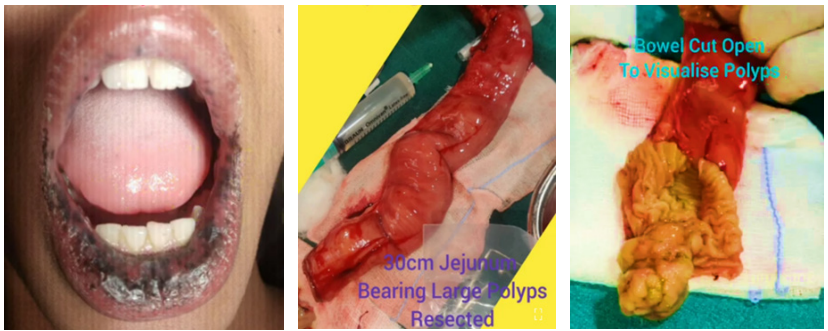
Figure 1a-1c
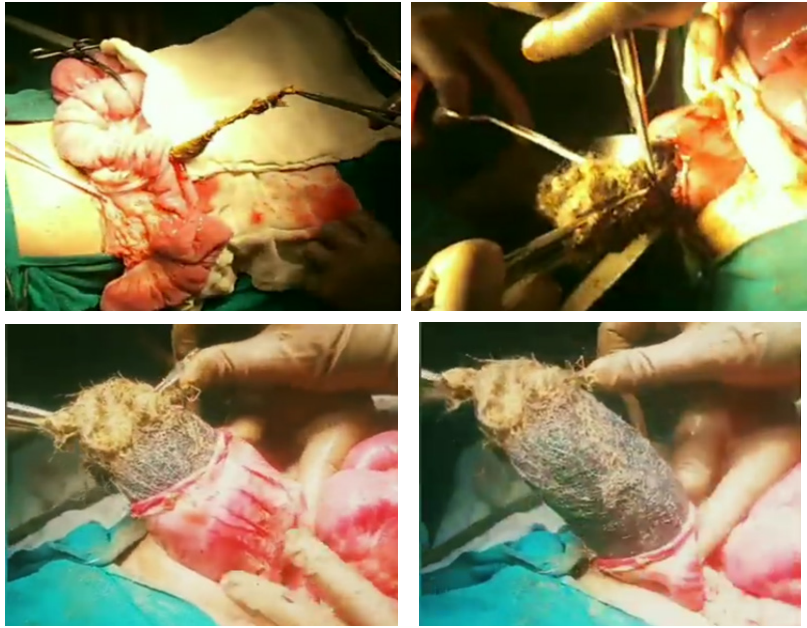
Figure 2a-2d
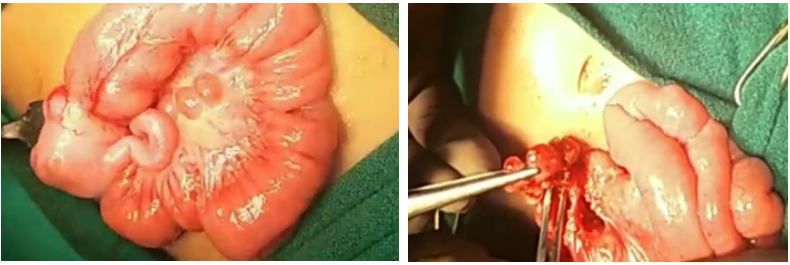
Figure 3a, 3b
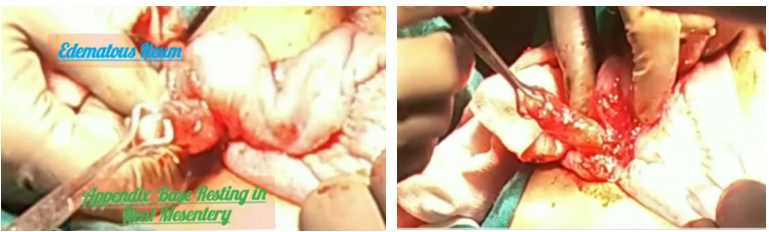
Figure 4a,4b
Discussion
A child presenting with intussusception needs thorough assessment as the initial presentation may be unclear and may mimic other serious pathologies too. Ultrasound has a high sensitivity and specificity in diagnosing intussusception and thus commonly used for establishing the diagnosis. On ultrasound, intussusceptions may appear as a ring on axial sections (varies with edema) and only two layers are apparent in severe cases as described by some authors as “doughnut sign”. In transverse view, an intussusception appears as a target due to a central hyper-echogenicity consisting of the intussusceptum with its associated mesenteric fat surrounded by a more hypoechoic peripheral rim representing the edematous intussuscipiens. Although, there are other pathologies that mimic a target sign. In the literature, this “target sign mimic” has been described in dogs in various scenarios [10], but there is no literature on humans. In dogs these mimics typically have a thinner, ill-defined outer wall of the intussuscipiens, which is an important differentiator of intussusception from healthy tissue.
Intussusception finding of target sign seen on ultrasonography may mimics other pathologies like intestinal polyps, large mesenteric lymph nodes, perforated appendix, trichobezoar and others. Peutz-Jeghers Syndrome (PJS) is an autosomal dominant inherited disorder also called as familial hamartomatous polyposis syndrome and is characterized by multiple gastrointestinal polyps associated with mucocutaneous melanin pigmentation as a result of the presence of pigment-laden macrophages in the dermis [11]. Clinical presentation of PJS is abdominal pain, intestinal obstruction, biliary obstruction, gastric outlet obstruction or gastrointestinal bleeding (anemia, hematochezia, melena or hematemesis [12]. Our 11year male patient of PJS had mucosal pigmentation and anaemia, short history of melena along with abdominal pain. PJS polyp presenting as an acute emergency just at the end of first decade is quite uncommon since the polyp usually requires time for their development to reach a considerable size and thus patients often manifest and become symptomatic after the second decade. Intussusception was present on ultrasonography in our patient as Zacharias SA et al [13] reported a case to have intussusception mimicking on radiology in a PJS case. On ultrasound, a target sign was noted, suggesting a small bowel-small bowel intussusception. Laparoscopy found no evidence of intussusception or bowel obstruction in this patient. This patient previously developed small bowel intussusception caused by polyp requiring small bowel resection. Side-to-side anastomosis in this patient had mimicked an intussusception in the ultrasound of this case, that lead to diagnostic laparoscopy.
Trichobezoars is a rare condition that occurs when hair strands are retained in the folds of the gastric mucosa due to their slippery surface preventing propulsion by peristalsis. Trichophagia when continued adds more and more hair and peristalsis causes them to be enmeshed until a mass is formed that eventually assumes the shape of the stomach. Rapunzel syndrome includes a trichobezoar with a tail that extends at least to the jejunum and causes symptoms suggestive of obstruction and was originally described in 1968 [14]. Bezoars may be asymptomatic, but can present with symptoms of mass effect such as gastric pain, early satiety, nausea, and vomiting [15]. Trichotillomania (compulsive pulling of hair) most commonly presents in the pediatric population, with a large female predominance between the ages of 9 and 13 years [16]. Trichobezoars have been well-documented as a source of a pathological lead point, and thus a cause of intussusception in children [15,17,18]. Giant Trichobezoars that extend through the pylorus and reaching up to terminal small bowel are even more uncommon especially for as young age as 6 years in our case and only few case reports are present. Bowel in bowel appearance on ultrasonography may lead to misdiagnosis in such patient as this led in our case into an unnecessary initial enterotomy for delivering intraluminal cord like structure. Singh S et al [19] in their case report on Complicated Rapunzel syndrome mimicking intussusception has presented a 5-year-old girl presenting with a 3-day history of abdomen pain, distension, bilious vomiting, bleeding per rectum and a hard lump in the left iliac fossa which mimicked as intussusception on clinical findings. Intraoperatively this patient has trichobezoar extending up-to hepatic flexure and having large ileal perforation due to impaction. Sutrave HV et al [20] also presented a case of Rapunzel Syndrome presenting with intussusception and pancreatitis. Duration of illness in our case was very short of 3 days, with no previous illness. Au et al [21] described a case that also shares common features with our patient’s presentation; this 5-year-old boy presented with a 3-day history of abdominal pain and nonbilious vomiting, also associated with obstipation and also as in our case, the location of the obstructing bezoar was also terminal ileum.
Although mesenteric lymph nodes act as lead point for intussusception, yet they can falsely mimic intussusception too. Mesenteric adenitis can be divided into two groups as nonspecific (or primary) and secondary. Primary mesenteric adenitis is mostly a right-sided lymphadenopathy and without an identifiable acute inflammatory process. Our 3rd case as discussed, had intussusception on radiology but intraoperatively has primary mesenteric adenitis with edematous terminal ileum with no intussusception. There are studies showing presentation of mesenteric lymphadenitis clinically mimicking intussusception, inflammatory bowel diseases, acute appendicitis, Meckel’s diverticulum, ovarian torsion, and others [22-24].
Appendicitis mimics as intussusception and thus ileoileal, ileocecal or ileocecocolic intussusception may always be looked for concurrent appendicitis. Such patients may present as true intussusception with concurrent findings of appendicitis and appendiceal intussusception with mucocele or presenting as caecal mass or invagination appendicitis [25,26]. Appendiceal intussusception happens when appendix segment is pulled into itself or into the cecum is rare and occurs only in 0.01 % cases. Samee A et al [27] reported a case of appendiceal duplication presenting as intussusception on radiology and found intraoperatively a diffuse mass in the ileocaecal region enclosing a tubular structure. Newman B. et al [28] encountered multiple cases in which the ultrasound appearance of ruptured appendicitis mimicked intussusception, resulting in diagnostic and therapeutic delay and multiple additional imaging studies. All initial US studies demonstrated a multiple-ring-like appearance (target sign, most apparent on transverse views) with diagnostic consensus supportive of intussusception and central echogenicity caused by debris/appendicolith was misinterpreted as fat. All showed perilesional hyper echogenicity that in retrospect, represented inflamed fat “walling off” of the perforated appendix. US target appearance, with inner and outer rings representing the dilated appendix and walled-off appendiceal rupture, respectively. A computed tomography scan showed an ileocolic intussusception with no strangulation and diffuse wall thickening of the appendix trapped within the intussusception. In general, one does not investigate for the leading point because many cases of ileocolic intussusception in young infants are not associated with a leading point. Author concluded that, if they would not have considered the presence of an associated disease in their case, they would have only performed a simple reduction and the diagnosis of ruptured appendicitis could have been missed. Therefore, it is necessary to investigate for associated diseases when patients with intussusception visit the hospital.
Conclusion
Intussusception can present a diagnostic dilemma especially presenting with non-classical symptoms. Intussusception mimickers on ultrasonography can have two scenarios of presentation: First scenario can be, radiology showing only intussusception and concealing underlying pathology, for example ileocecal intussusception may have underlying perforated appendicitis, appendiceal mucocele, appendiceal or caecal duplication, Meckel’s diverticulum, intestinal polyps or trichobezoar that if missed on ultrasonography and managed by simple hydrostatic reduction can lead to delayed management or complications. Second scenario can be intussusception shown on ultrasonography but no bowel in bowel appearance found intraoperatively, in such cases any surgical exploration could have been avoided at the first place, for example mesenteric lymphadenitis, edematous ileocecal valve or previous side to side anastomosis mimicking at times as intussusception. Pediatric patients presenting in emergency with complaints of abdominal pain with other non-classical symptom with intussusception findings on scan should be carefully looked for other clinical findings to suspect all the mimicking conditions such as Peutz-Jegher syndrome, Trichobezoar and others as discussed so far.
Conflict of Interests: None
Financial support: Nil
Informed Consent: Obtained
Ethical Clearance: Not Required
References
- Nelson KA, Hostetler MA. A listless infant with vomiting. Hospital Physician, 2002; 40-46.
- Kong FT, Liu WY, Tang YM, et al. Intussusception in infants younger than 3 months: a single center’s experience. World J Pediatr, 2010; 6(1): 55-59.
- Chang HGH, Smith PF, Ackelsberg J, et al. Intussusception, rotavirus diarrhea and rotavirus vaccine use among children in New York State. Pediatrics, 2001; 108(1): 54-60.
- Kleizen KJ, Hunck A, Draaisma JM Th. Neurologic symptoms in children with intussusception. Acta Paediatrica, 2009; 98: 1822-1824.
- Turner D, Rickwood AMK, Brereton RJ. Intussusception in older children. Arch Dis Child, 1980; 55: 544-546.
- Madanur MA, Mula VR, Patel D, et al. Periampullary carcinoma presenting as duodenojejunal intussusception: a diagnostic and therapeutic dilemma. Hepatobiliary Pancreat Dis Int, 2008; 7: 658-660.
- Lewis JH. Jejunal intussusception of the newborn. Am J Dis Child, 1939; 58(3): 558-563.
- Knox EG, Court SDM, Gardner PS. Aetiology of intussusception in children. BMJ, 1962; 2(5306): 692-697.
- Bisset III GS, Kirks DR. Intussusception in infants and children: diagnosis and therapy. Radiology, 1988; 168: 141-145.
- Patsikas MN, Papazoglou LG, Papaioannou NG, Dessiri AK. Normal and abnormal ultrasonographic findings that mimic small intestinal intussusception in the dog. J Am Anim Hosp Assoc, 2004; 40(2): pp. 147-151.
- Utsunomiya J, Gocho H, Miyanaga T, et al. Peutz-Jeghers syndrome: its natural course and management. Johns Hopkins Med J, 1975; 136: 71–82.
- Sinha N, Chatterjee U, Sarkar S. Jejunal carcinoma in a patient with Peutz-Jeghers syndrome. Can J Surg, 2009; 52(6): 299–300.
- Zacharias SA, Prasad R, Kazmi F, Pall H. Side-to-side bowel anastomosis mimicking intussusception in a 2-year-old child with Peutz-Jeghers syndrome. Radiol Case Rep, 2018; 13(4): 839-842. doi: 10.1016/j.radcr.2018.05.012.
- Vaughan ED Jr, Sawyers JL, Scott HW Jr. The Rapunzel syndrome. An unusual complication of intestinal bezoar Surgery, 1968; 63: pp. 339-343.
- Byrne WJ. Foreign bodies, bezoars, and caustic ingestion. Gastrointest Endosc Clin N Am, 1994; 4(1): 99–119.
- Sah DE, Koo J, Price VH. Trichotillomania. Dermatol Ther, 2008; 21(1): 13–21. doi: 10.1111/j.1529-8019.2008.00165.x.
- Rabine JC, Nostrant TT. Gastric bezoars. In: Yamada T, Alpers DH, Kaplowitz N, editors. Textbook of Gastroenterology. 4th ed. Lippincott Williams & Wilkins, 2003; pp. 1461–1463.
- Iwamuro M, Okada H, Matsueda K, et al. Review of the diagnosis and management of gastrointestinal bezoars. World J Gastrointest Endosc, 2015; 7(4): 336–345. doi: 10.4253/wjge.v7.i4.336.
- Singh S, Wakhlu A, Pandey A, Gupta A, Ahmed I, Chandra N. Complicated Rapunzel syndrome mimicking intussusception. BMJ Case Rep, 2011; 2011: bcr0820103277. doi: 10.1136/bcr.08.2010.3277.
- Sutrave HV, Valliappan A, Jayakumar S. Rapunzel Syndrome Presenting with Intussusception and Pancreatitis: A Case Report. World J Lap Surg, 2023; 16(2): 105–107.
- Au VA, Wong JP, Venu I, et al. Failing to thrive, abdominal pain and vomiting: A hairy situation. Paediatr Child Health, 2018; 23(3): 173–175. doi: 10.1093/pch/pxx210.
- Blattner RJ, Acute mesenteric lymphadenitis, The Journal of Pediatrics, 1969; 74: no. 3, 479–481, https://doi.org/10.1016/S0022-3476(69)80210-6.
- Toorenvliet B, Vellekoop A, Bakker R, Wiersma F, Mertens B, Merkus J, et al. Clinical differentiation between acute appendicitis and acute mesenteric lymphadenitis in children, European Journal of Pediatric Surgery, 2011; 21(2): 120-123, https://doi.org/10.1055/s-0030-1267979.
- Lim KJ, Lee K, Yoon DY, Moon JH, Lee H, Kim M-J, et al. The role of US in finding intussusception and alternative diagnosis: a report of 100 pediatric cases, Acta Radiologica, 2014; 56(2): 228-233. https://doi.org/10.1177/0284185114524088.
- Basim Aljalabneh, Amro Mureb, Nadeem Aljundi, Kholoud Al-Qasem, Mahmoud Al-Masri. Inverted appendix in a patient with colon cancer: A case report and long-term follow-up, Journal of Surgical Case Reports, 2023; 4. doi: 10.1093/jscr/rjad206.
- Hamza Abdulkarim Nasif, Omar H Salloum, Sundus Imran Al-Atrash, Taha Z Makhlouf, Orwa Al-Fallah, Rafiq Salhab. Type IV appendiceal intussusception with mucocele and acute appendicitis: a rare case and diagnostic challenge, Journal of Surgical Case Reports, 2025; 5: rjaf282. https://doi.org/10.1093/jscr/rjaf282.
- Samee A, Alibhai M, Ameer N, Sparks M, Morgan A, Halliday M. Appendicitis in a duplex appendix mimicking intussusception. BMJ Case Rep, 2010; 2010: bcr12.2009.2516. doi: 10.1136/bcr.12.2009.2516.
- Newman B, Schmitz M, Gawande R, Vasanawala S, Barth R. Perforated appendicitis: an underappreciated mimic of intussusception on ultrasound. Pediatric radiology, 2014; 44(5): 535-541. https://doi.org/10.1007/s00247-014-2873-8.