
Email id: info@ijclinmedcasereports.com
Sloughing Esophagitis: An Underrecognized Benign Esophageal Disorder
Mouslim Imane*, Touibi A, Ouahid S, Berrag S, Nejjari F, Adioui T and Tamzaourte M
Department of Gastroenterology I, Mohammed V Military Hospital, Rabat, Morocco
Received Date: 06/04/2026; Published Date: 08/06/2026
*Corresponding author: Mouslim Imane, Department of Gastroenterology I, Mohammed V Military Hospital, Rabat, Morocco
Abstract
Esophagitis Dissecans Superficialis (EDS) is an infrequent benign esophageal disorder characterized by superficial epithelial necrosis and subsequent sloughing of extensive sheets of squamous mucosa. It predominantly affects elderly patients and is frequently associated with mucosal irritants, particularly medications such as bisphosphonates and nonsteroidal anti-inflammatory drugs. We report the case of a 64-year-old woman presenting with acute odynophagia and progressive dysphagia accompanied by retrosternal burning pain and vomiting of whitish mucosal fragments. Upper gastrointestinal endoscopy revealed extensive sheets of sloughed mucosa involving the middle and distal esophagus, with underlying intact mucosa and no deep ulceration. Histopathological examination demonstrated superficial squamous epithelial necrosis with intraepithelial splitting and epithelial detachment, without evidence of infection or dysplasia. Discontinuation of the suspected offending agents and initiation of proton pump inhibitor therapy resulted in rapid clinical improvement. This case highlights the characteristic clinical, endoscopic, and histological features of EDS and underscores the importance of recognizing this underdiagnosed entity to avoid misinterpretation and unnecessary invasive management.
Keywords: Desquamative esophagitis; Mucosal sloughing; Esophagitis dissecans superficialis
Introduction
Sloughing esophagitis, formerly known as Esophagitis Dissecans Superficialis (EDS), is a rare and generally benign endoscopic entity characterized by the sloughing of large fragments of esophageal squamous mucosa into the esophageal lumen [1,2]. Clinically, this desquamation may lead to vomiting or even regurgitation of mucosal casts, although some cases are discovered incidentally during endoscopic evaluation [3].
The pathogenesis of EDS remains incompletely elucidated. While a proportion of cases are considered idiopathic, others have been associated with mucosal irritants, including certain medications particularly nonsteroidal anti-inflammatory drugs tobacco use, alcohol consumption, hot beverages, and bullous dermatologic disorders [4]. Chronic exposure to these agents is thought to contribute to epithelial injury and subsequent mucosal detachment.
Clinical presentation is heterogeneous, ranging from asymptomatic incidental findings to significant esophageal symptoms such as dysphagia, odynophagia, or epigastric pain [3]. Despite its distinctive endoscopic appearance, the diagnosis is frequently overlooked, as histopathological assessment may be limited by specimen fragmentation or contamination [5].
To date, only a limited number of cases have been reported in the literature, underscoring both the rarity of this condition and the importance of increasing clinical awareness [6].
Case Report
A 64-year-old woman was admitted to our department with a 5-day history of painful dysphagia. She reported the sudden onset of severe odynophagia, initially to solid food and rapidly progressing to liquids, associated with retrosternal burning pain. She also described two episodes of vomiting that contained whitish, filamentous tissue fragments suggestive of sloughed mucosal material. She denied caustic ingestion, recent foreign body ingestion, or fever, and there was no significant weight loss or marked deterioration in her general condition. Her medical history was significant for hypertension, osteoporosis, and chronic low back pain. Her regular medications included amlodipine and alendronate, which had been prescribed six months earlier. She also reported frequent use of ibuprofen as self-medication during the preceding weeks. On physical examination, the patient was in good general condition. Vital signs were stable, with a blood pressure of 135/75 mmHg, heart rate of 82 beats per minute, and body temperature of 36.8°C. Oropharyngeal examination was unremarkable. Mild retrosternal tenderness was noted on palpation, without abdominal guarding or clinical signs of mediastinal complication. Laboratory investigations revealed a normal complete blood count, mildly elevated C-reactive protein levels, and normal liver function tests.Upper gastrointestinal endoscopy showed circumferential white exudates with focal erosive areas in the distal third of the esophagus, without evidence of luminal narrowing or obstruction (Figure 1). The detached mucosal membranes were easily removable, revealing an underlying pink mucosa without deep ulceration or evidence of transmural necrosis. The gastric and duodenal mucosa appeared macroscopically normal. Multiple esophageal biopsies were obtained.
Discontinuation of potentially offending medications and initiation of proton pump inhibitor therapy resulted in rapid clinical improvement. Dysphagia progressively resolved within a few days, with complete symptom resolution after approximately ten days.
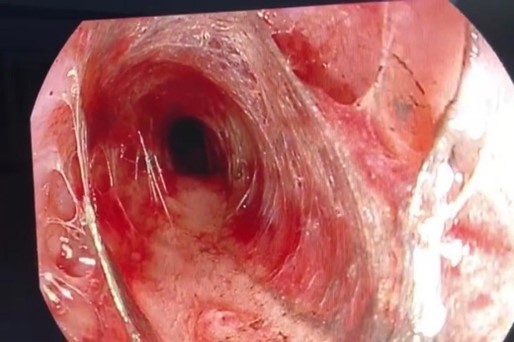
Figure 1: Upper gastrointestinal endoscopy showed circumferential white exudates with focal erosive areas in the distal third of the esophagus, without evidence of luminal narrowing or obstruction.
Discussion
Esophagitis Dissecans Superficialis (EDS) is a rare, benign, and usually self-limited disorder characterized by sloughing of the esophageal squamous mucosa. Its exact etiology remains unclear, though it has been associated with medications such as NSAIDs and bisphosphonates, smoking, alcohol, and autoimmune conditions, while some cases remain idiopathic [7,8]. Older, chronically medicated patients appear at higher risk [9,10]. Clinical presentation varies from asymptomatic cases to severe dysphagia, odynophagia, epigastric pain, nausea, vomiting, and rarely, expectoration of sloughed mucosal fragments [11,12].
Endoscopic findings typically reveal strips of sloughed superficial mucosa with intact underlying tissue and absence of adjacent ulceration, while histology shows parakeratosis and epithelial splitting with minimal inflammation [1]. In our patient, endoscopy revealed extensive sloughed mucosa in the middle and distal esophagus, and biopsies confirmed superficial epithelial necrosis with intraepithelial splitting, consistent with characteristic EDS features. The low prevalence of EDS (0.03% in large EGD series) and frequent biopsy contamination contribute to underdiagnosis and misinterpretation [12,13].
Management focuses on removing potential precipitating factors and supportive therapy, most commonly high-dose proton pump inhibitors, which mitigate further mucosal injury rather than treating the underlying cause [14,15]. Autoimmune-related or idiopathic cases may respond to corticosteroids [3,16]. In our case, discontinuation of oral diclofenac and initiation of high-dose pantoprazole led to complete symptom resolution, illustrating the favorable prognosis of EDS when triggers are addressed. Although follow-up endoscopy has been suggested in some reports, current evidence does not establish its routine benefit [17].
Conclusion
This case highlights Esophagitis Dissecans Superficialis (EDS) as a rare and often underrecognized esophageal disorder that can significantly affect patient comfort and quality of life. In patients presenting with dysphagia, odynophagia, or sloughing mucosa especially when the etiology is unclear or symptoms persist despite conventional therapy a high index of suspicion for EDS is warranted. Early recognition and management, including withdrawal of offending medications and supportive proton pump inhibitor therapy, can lead to rapid symptom resolution and prevent unnecessary interventions.
References
- Carmack SW, Vemulapalli R, Spechler SJ, Genta RM. Esophagitis Dissecans Superficialis (“Sloughing esophagitis”): A Clinicopathologic Study of 12 Cases, American Journal of Surgical Pathology, 2009; 33 (no 12): p. 1789‑1794. doi: 10.1097/PAS.0b013e3181b7ce21.
- Hart PA, Romano RC, Moreira RK, Ravi K, Sweetser S. Esophagitis Dissecans Superficialis: Clinical, Endoscopic, and Histologic Features, Dig Dis Sci, 2015; 60 (no 7): p. 2049‑2057. doi: 10.1007/s10620-015-3590-3.
- Qasim A, Jyala A, Ghazanfar H, Baqui A, Patel H. Esophagitis Dissecans Superficialis: Unveiling the Enigmatic Entity of Esophageal Mucosal Sloughing, Cureus, 2023. doi: 10.7759/cureus.43549.
- De S, Williams G. Esophagitis Dissecans Superficialis: A Case Report and Literature Review », Canadian Journal of Gastroenterology, 2013; 27 (no 10): p. 563‑564. doi: 10.1155/2013/923073.
- Patil R, Sunkara T, Ona MA, Gaduputi V, Reddy M. Fungal Esophagitis Presenting with Esophagitis Dissecans Superficialis: Cause or Concurrence? A Diagnostic Conundrum, Gastroenterol Res, 2016; 9 (no6): p. 108‑110. doi: 10.14740/gr739w.
- Prasoppokakorn T, Panarat P. First Case of Esophagitis Dissecans Superficialis in an HIV Patient: A Case Report and Literature Review, Case Reports in Infectious Diseases, 2019; 2019: p. 1‑9. doi: 10.1155/2019/4616937.
- Purdy JK, Appelman HD, McKenna BJ. Sloughing esophagitis is associated with chronic debilitation and medications that injure the esophageal mucosa », Modern Pathology, 2012; 25(no5): p. 767‑775. doi: 10.1038/modpathol.2011.204.
- Silva JR, et al. Acute and Residual Soccer Match-Related Fatigue: A Systematic Review and Meta-analysis », Sports Med, 2018; 48(no3): p. 539‑583. doi: 10.1007/s40279-017-0798-8.
- Brownschidle SS, Ganguly EK, Wilcox RL. Identification of Esophagitis Dissecans Superficialis by Endoscopy », Clinical Gastroenterology and Hepatology, 2014; 12(no9): p. e79‑e80. doi: 10.1016/j.cgh.2014.02.030.
- Purdy JK, Appelman HD, McKenna BJ. Sloughing esophagitis is associated with chronic debilitation and medications that injure the esophageal mucosa, Modern Pathology, 2012; 25(no5): p. 767‑775. doi: 10.1038/modpathol.2011.204.
- Jaben I, Schatz R, Willner I. The Clinical Course and Management of Severe Esophagitis Dissecans Superficialis: A Case Report, Journal of Investigative Medicine High Impact Case Reports, 2019; 7: p. 2324709619892726. doi: 10.1177/2324709619892726.
- Fiani E, Guisset F, Fontanges Q, Devière J, Lemmers A. Esophagitis dissecans superficialis: a case series of 7 patients and review of the literature, Acta Gastroenterol Belg, 2017; 80(no3): p. 371‑375.
- Rokkam VR, Aggarwal A, Taleban S. Esophagitis Dissecans Superficialis: Malign Appearance of a Benign Pathology, Cureus, 2020. doi: 10.7759/cureus.8475.
- De S, Williams G. Esophagitis Dissecans Superficialis: A Case Report and Literature Review », Canadian Journal of Gastroenterology, 2013; 27(no10): p. 563‑564. doi: 10.1155/2013/923073.
- Moawad FJ, Appleman HD. Sloughing esophagitis: a spectacular histologic and endoscopic disease without a uniform clinical correlation, Annals of the New York Academy of Sciences, 2016; 1380(no1): p. 178‑182. doi: 10.1111/nyas.13112.
- Jaben I, Schatz R, Willner I. The Clinical Course and Management of Severe Esophagitis Dissecans Superficialis: A Case Report, Journal of Investigative Medicine High Impact Case Reports, 2019; 7: p. 2324709619892726. doi: 10.1177/2324709619892726.
- Albert DM, Ally MR, Moawad FJ. The Sloughing Esophagus: A Report of Five Cases, American Journal of Gastroenterology, 2013; 108(no11): p. 1816‑1817. doi: 10.1038/ajg.2013.230.