
Email id: info@ijclinmedcasereports.com
An Unusual Case of Ischemic Stroke: Bilateral Corpus Callosum Infarction Secondary to Cerebral Venous Sinus Thrombosis
Timothy Jeong1, Sina Erteza1, Aadith Santhosh1, John J Geraghty2 and Forshing Lui1,*
¹Department of Medicine, California Northstate University, Elk Grove, CA, USA
²Department of Neurology, Kaiser Permanente Medical Center, Roseville, CA, USA
Received Date: 01/04/2026; Published Date: 03/06/2026
*Corresponding author: Forshing Lui MD California Northstate University, College of Medicine, 9700 West Taron Drive, Elk Grove, CA
Abstract
Background: Isolated infarction of the corpus callosum (CC) is considered rare and accounts for less than about 1% of ischemic strokes in most reports. One possible reason for this is that the CC has a relatively robust arterial supply from both the anterior and posterior circulations. Because of this, infarcts in this region are not commonly seen. In this report we describe a case of bilateral CC infarction that occurred due to cerebral venous sinus thrombosis (CVST) rather than the more typical arterial cause. The CVST appeared to occur in the setting of severe urosepsis and hyperglycemia.
Case Report: A 67-year-old female with a history of poorly controlled type 2 diabetes (HbA1c 16.1%) and hypertension presented with confusion and imbalance. Initial workup showed urosepsis caused by E. coli, along with hyperglycemia and hyponatremia. Despite treatment with antibiotics, her confusion persisted. MRI of the brain obtained on hospital day demonstrated four areas of restricted diffusion within the bilateral corpus callosum on DWI sequences. This pattern appeared somewhat unusual because it does not align with any arterial vascular territory. CT angiography was then performed and revealed a thrombus in the superior sagittal sinus extending into the torcula and left transverse sinus, consistent with CVST. Thrombophilia workup was negative.
Conclusion: This case shows a rare cause of corpus callosum infarction. When ischemic lesions appear in non-arterial distributions on imaging, CVST should be considered in the differential diagnosis, especially in patients with systemic inflammatory or hypercoagulable conditions such as severe infection, sepsis, or hyperglycemia as in our case.
Keywords: Corpus callosum; Cerebral venous sinus thrombosis; Stroke; Urosepsis
Introduction
The Corpus Callosum (CC) is the largest commissural white matter structure in the brain and connects the left and right cerebral hemispheres. Infarction isolated to the CC is relatively uncommon. Reported prevalence ranges from about 0.49% to 7.9% of ischemic strokes in some retrospective studies [1,2].
One reason this type of infarction is rare is the rich blood supply to the corpus callosum. The CC receives arterial supply mainly from the Anterior Cerebral Artery (ACA), specifically the pericallosal artery, as well as contributions from the posterior cerebral artery (PCA). These vessels form a pial arterial network that helps protect the region from ischemia [3,4,9].
Because of this protective circulation, lesions in the corpus callosum are more often associated with other processes such as demyelinating diseases (for example multiple sclerosis or Marchiafava-Bignami disease), tumors, trauma, or metabolic causes [5]. When ischemic infarcts do occur, they are typically related to embolic disease or atherosclerosis of the vessels supplying the area [2,6].
Cerebral venous sinus thrombosis (CVST) is another potential but uncommon cause of stroke. It accounts for around 0.5–1% of strokes and can present with a wide range of symptoms including headache, seizures, focal deficits, or altered mental status [7]. Infarcts related to CVST do not follow typical arterial territories. In this report we describe a case of bilateral corpus callosum infarction resulting from extensive CVST in the setting of urosepsis and hyperglycemia.
Case Report
A 67-year-old female with a past medical history significant for hypertension and poorly controlled type 2 diabetes mellitus presented to the emergency department with confusion and imbalance. According to family members, these symptoms began about 24 hours before presentation.
A stroke alert was initially activated. However, neurological examination at that time was largely non-focal, and the patient was outside the window for acute thrombolytic therapy.
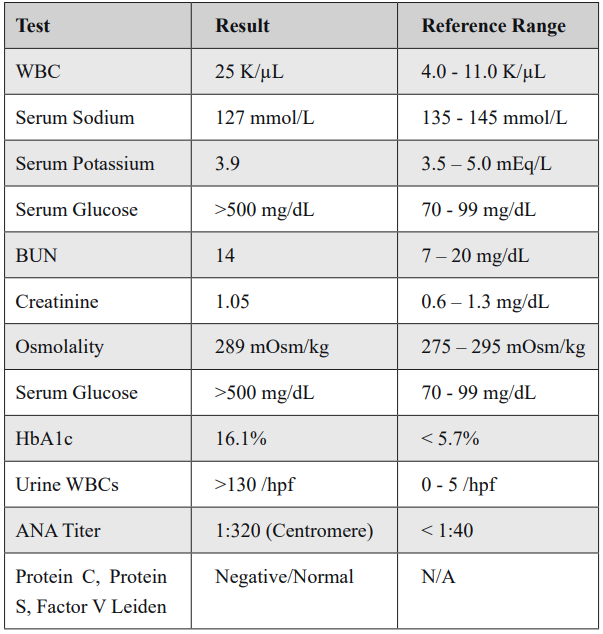
Initial laboratory evaluation showed significant leukocytosis (WBC 25 K/µL with left shift), pyuria (>130 WBCs on urinalysis), severe hyperglycemia (>500 mg/dL), and hyponatremia (sodium 127 mmol/L). Her HbA1c was measured at 16.1%, indicating poorly controlled diabetes.
A CT scan of the abdomen was obtained to identify the source of infection and revealed a 4 mm left ureterovesicular junction stone with associated hydroureter and hydronephrosis. Blood and urine cultures later grew Escherichia coli, confirming urosepsis. The patient was started on intravenous ceftriaxone.
Although the patient’s infectious markers began to improve with treatment, her mental status did not return to baseline. Because of this persistent confusion, an MRI of the brain was obtained on hospital day four.
MRI diffusion-weighted imaging (DWI) showed areas of restricted diffusion involving the bilateral corpus callosum, particularly the genu and body (Figure 1A, 1B). This pattern was somewhat unusual because it did not follow typical arterial vascular territory.
To further evaluate possible vascular causes, CT angiography (CTA) of the head was obtained. This study did not show large arterial vessel occlusion. However, it did reveal a filling defect within the superior sagittal sinus that extended into the torcula and the left transverse sinus (Figure 1C), consistent with cerebral venous sinus thrombosis.
A thrombophilia workup was performed including Protein C, Protein S, Factor V Leiden, lupus anticoagulant, anticardiolipin antibodies, and Beta-2 glycoprotein antibodies, all of which were negative. Inflammatory markers such as ESR and CRP were mildly elevated. ANA testing was positive at a titer of 1:320 with a centromere pattern, though the clinical significance of this finding in the acute setting was unclear.
The patient was started on therapeutic intravenous heparin. Over the following days she demonstrated gradual neurological improvement and was eventually transitioned to oral anticoagulation prior to discharge to a rehabilitation facility.
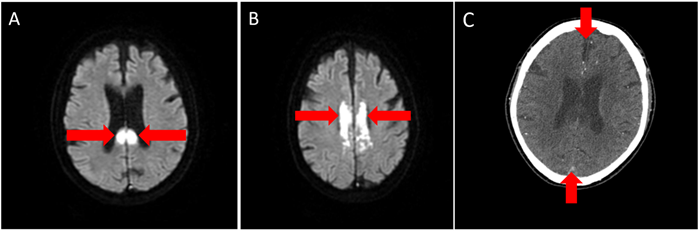
Figure 1: Neuroimaging Findings.
- (A) Axial DWI: Demonstrates areas of restricted diffusion in the bilateral corpus callosum.
- (B) Axial DWI (different slice): Bilateral extensive corpus callosum infarction
- (C) CTA: Shows a filling defect (thrombus) within the superior sagittal sinus (arrow), confirming cerebral venous sinus thrombosis.
Table 1: Pertinent Laboratory Findings.
Discussion
This case describes bilateral corpus callosum infarction occurring in the setting of cerebral venous sinus thrombosis. Two aspects of this case are unusual: the location of the infarcts within the corpus callosum and the venous rather than arterial cause of the ischemia.
Infarcts of the corpus callosum are rare. The literature explains that this is because the corpus callosum receives blood supply from multiple sources [10]. According to Ture et al. [4], the anterior cerebral artery supplies the front part, and the posterior cerebral artery helps supply the back. This rich, dual blood supply makes the corpus callosum relatively resistant to ischemia. In most cases where a callosal infarct does happen, studies have shown that it is usually caused by an arterial problem. For example, research by Sun et al. [2] and Chaudhari et al. [6] found that emboli from the heart or atherosclerosis in the feeding arteries are common culprits. In our patient, we initially considered this, but the imaging did not show a blockage in these arteries.
In this patient, the cause of the stroke appeared to be venous rather than arterial. As discussed in the introduction, arterial causes like embolism or atherosclerosis are the most common reasons for callosal infarcts when they do occur [2,6]. However, in our patient, the CT angiogram did not show any blockages in the major arteries, such as the anterior cerebral or posterior cerebral arteries, that supply the corpus callosum. This prompted us to consider other mechanisms.
Cerebral venous sinus thrombosis (CVST) can lead to stroke through a different mechanism than arterial blockages. When a vein or sinus like the superior sagittal sinus becomes thrombosed, it impairs the drainage of blood from the brain. This can cause blood to back up, leading to increased venous pressure. If the pressure becomes high enough, it can reduce the overall perfusion pressure and prevent oxygen from reaching the brain tissue, resulting in a venous infarct [7, 11]. This is what happened in the patient.
The location of the thrombus is important for understanding why the corpus callosum was affected. While the corpus callosum receives blood from multiple arteries, its venous drainage ultimately connects to deep venous structures mainly the internal cerebral veins, which drain toward the vein of Galen and the straight sinus. The straight sinus then meets the superior sagittal sinus at the torcula. In our patient, the thrombus was not isolated to the superior sagittal sinus; it extended into the torcula and the left transverse sinus. As described by Ture et al. [4] in their anatomical study, the deep venous system is responsible for draining the white matter tracts. It is hypothesized that this extensive clot burden caused significant venous congestion in the deep system, which then led to reduced perfusion and infarction in the bilateral corpus callosum.
Clinically, this case was also challenging because the patient's symptoms were non-specific. Kasow et al. [5] and Garcia-Sarreon et al. [8] have described classic "disconnection syndromes" associated with corpus callosum lesions, such as apraxia especially of the left hand, visual agnosia, pure alexia, and alien hand syndrome, where a patient's hand seems to move on its own. Our patient did not exhibit these specific findings. Instead, she presented with confusion and altered mental status. This is consistent with larger studies. Sun et al. [2] reviewed 127 cases of corpus callosum infarction and found that many patients present with generalized symptoms like confusion or cognitive decline rather than the classic syndromes. Our patient's presentation, therefore, fits with the more common yet less recognized clinical picture described in the literature.
Another important educational value of this case is the importance of imaging in guiding the diagnosis. The initial MRI showed restricted diffusion in the bilateral corpus callosum, which is a sign of acute infarction. However, the pattern was unusual because it was bilateral and centrally located, rather than following the territory of a single artery like the anterior cerebral artery. According to the review by Li et al. [1], callosal infarcts are usually small and unilateral. Because our patient's imaging did not fit this typical arterial pattern, the team pursued further vascular imaging with CT angiography. This decision was critical, as it revealed the superior sagittal sinus thrombosis that was not visible on the initial MRI sequences. This highlights a key clinical pearl: when stroke patterns on MRI do not match arterial territories, unusual causes like CVST should be suspected [12].
Finally, we considered what might have triggered the thrombosis in this patient. The thrombophilia workup, including testing for Protein C, Protein S, Factor V Leiden, and antiphospholipid antibodies, was negative. This suggests that she does not have a chronic, inherited clotting disorder. However, the patient presented with severe urosepsis and hyperglycemia. Sepsis is known to create a pro-thrombotic state. Systemic inflammation can activate the coagulation cascade and cause dysfunction in the endothelial cells that line the blood vessels. Given that her infection was severe and her workup for other causes was negative, we believe the urosepsis was the most likely provoking factor for the development of CVST in this case, although it is impossible to prove causation definitively.
Conclusion
We describe a rare case of bilateral corpus callosum infarction caused by cerebral venous sinus thrombosis in a patient with severe urosepsis and hyperglycemia. This case highlights that CVST should be considered when ischemic lesions appear in atypical locations or do not follow a typical arterial pattern on imaging. It also suggests that severe systemic infection may act as a trigger for venous thrombotic events.
Authorship:
Timothy Jeong, Sina Erteza, and Aadith Santhosh designed and drafted the manuscript
John J Geraghty provided and managed the case, and provided analysis and interpretation of the data
Forshing Lui provide critical revisions and serves as the guarantor and corresponding author
Conflicts of Interest: All authors declare no conflicts of interests
Grant Information: The author(s) received no specific funding for this work.
References
- Li S, Sun X, Bai YM, et al. Infarction of the corpus callosum: a retrospective clinical investigation. PLoS One, 2015; 10(3): e0120409.
- Sun X, Li J, Fan C, et al. Clinical, neuroimaging and prognostic study of 127 cases with infarction of the corpus callosum. Eur J Neurol, 2019; 26(8): 1075-1081.
- Katsuki M, Kato H, Niizuma H, Nakagawa Y, Tsunoda M. Homonymous Hemianopsia Due to the Infarction in the Splenium of the Corpus Callosum. Cureus, 2021; 13(11): e19574. doi: 10.7759/cureus.19574.
- Ture U, Yasargil MG, Krisht AF. The arteries of the corpus callosum: A microsurgical anatomic study. Neurosurgery, 1996; 39: 1075-1085.
- Kasow DL, Destian S, Braun C, et al. Corpus callosum infarcts with atypical clinical and radiologic presentations. AJNR Am J Neuroradiol, 2000; 21: 1876-1880.
- Chaudhari D, Renjen PN, Arora AS. Acute corpus callosum infarct. Neurol India, 2019; 67: 930-931.
- Stam J. Thrombosis of the cerebral veins and sinuses. N Engl J Med, 2005; 352(17): 1791-1798.
- Garcia-SarreoGarcía, Alexis Cano Nigenda, Vanessa. Corpus Callosum Stroke: A Rare Localization for an Isolated Cerebral Infarction. Practical Neurology. n A, Cano-Nigenda V, Jongutud K, et al.
- Salih N, Aljaberi K, Palat A, et al. Acute Isolated Corpus Callosum Infarction: A Case Report. Cureus, 2024; 16(12): e75984. doi:10.7759/cureus.75984.
- Zhang Z, Meng X, Liu W, Liu Z. Clinical Features, Etiology, and 6-Month Prognosis of Isolated Corpus Callosum Infarction. Biomed Res Int, 2019; 2019: 9458039. doi: 10.1155/2019/9458039.
- Singh J, Munakomi S, Baruffi S. Cerebral Venous Sinus Thrombosis. In: StatPearls [Internet]. Treasure Island (FL): StatPearls Publishing, 2026.
- Saposnik G, Bushnell C et al. Diagnosis and Management of Cerebral Venous Thrombosis: A Scientific Statement from the American Heart Association. Stroke, 2024; 55: e77–e90. DOI: 10.1161/STR.0000000000000456.