
Email id: info@ijclinmedcasereports.com
Sequential Hypophysitis and Delayed Severe Hepatitis After Ipilimumab/Nivolumab- Treatment in a Patient Suffering from Stage III Melanoma
Magdalena Köhler1,3, Christian Sebesta1,3,*, Georg Tatzreiter1,3, Alfons Schmid1,3, Mary Reithofer1,3, Reinhard Ruckser1,3, Patrick Meier1,3, Johannes Schmidt2 and Katharina Paulina Huber1,3
1Department of Gastroenterology, Hepatology, Hematology and Oncology, Vienna, Austria
2Department of Dermatology, Langobardenstr, Vienna, Austria
3Science Center Donaustadt, Vienna, Austria
Received Date: 02/03/2026; Published Date: 25/05/2026
*Corresponding author: Prof. Dr. Christian Sebesta, Clinic Donaustadt, Department of Gastroenterology and Hepatology, Hematology and Oncology, Langobardenstr, 122, 1220 Vienna, Austria
Abstract
Immune-related Adverse Events (irAEs) may occur weeks after immune checkpoint inhibition and can affect different organs sequentially. A 57-year-old woman with BRAF V600E-mutant recurrent melanoma received two neoadjuvant cycles of ipilimumab plus nivolumab, followed by inguinal lymphadenectomy (pN3b). Fifty-nine days after the first dose she developed ACTH–cortisol deficiency consistent with hypophysitis and improved on replacement-dose prednisolone/hydrocortisone. Several weeks later, during a planned switch to dabrafenib/trametinib, she developed life-threatening hepatitis (AST/ALT peak 3580/2992 U/L; bilirubin peak 12.3 mg/dL) requiring hospitalization and escalation to high-dose intravenous methylprednisolone with biochemical recovery. This case emphasizes that physiologic hydrocortisone replacement is not an immunosuppressive therapy and that delayed immune-mediated hepatitis must remain within the spectrum of differential diagnoses even after therapy switch.
Keywords: Melanoma; Immune-related adverse event; Hypophysitis; Immune-mediated hepatitis; Hydrocortisone; Methylprednisolone; Nivolumab; Ipilimumab; Dabrafenib; Trametinib
Introduction
In resectable macroscopic stage III melanoma, neoadjuvant combined CTLA-4 and PD-1 blockade with ipilimumab plus nivolumab, followed by surgery and response-driven adjuvant therapy, improves event-free survival (NADINA) [1] and is increasingly incorporated into European treatment guidance [2]. However, combined checkpoint inhibition is associated with a higher risk of grade ≥3 immune-related adverse events (irAEs), particularly hypophysitis and hepatitis [3]. Severe Immune-related adverse events such as hepatitis require prompt immunosuppression (prednisone or methylprednisolone 1–2 mg/kg/day with taper), whereas immune-related hypophysitis without compressive symptoms is usually managed with hormone replacement [3,4]. Delayed irAEs remain biologically plausible after discontinuation, as nivolumab binding on memory T cells can persist for >20 weeks [5]. This case illustrates the clinical relevance of the differing immunosuppressive potency and pharmacokinetics of glucocorticoid derivatives in the management of immune checkpoint inhibitor-related adverse events. It further underscores that physiologic hydrocortisone replacement for hypophysitis does not protect against subsequent immune-mediated toxicities.
Case Report
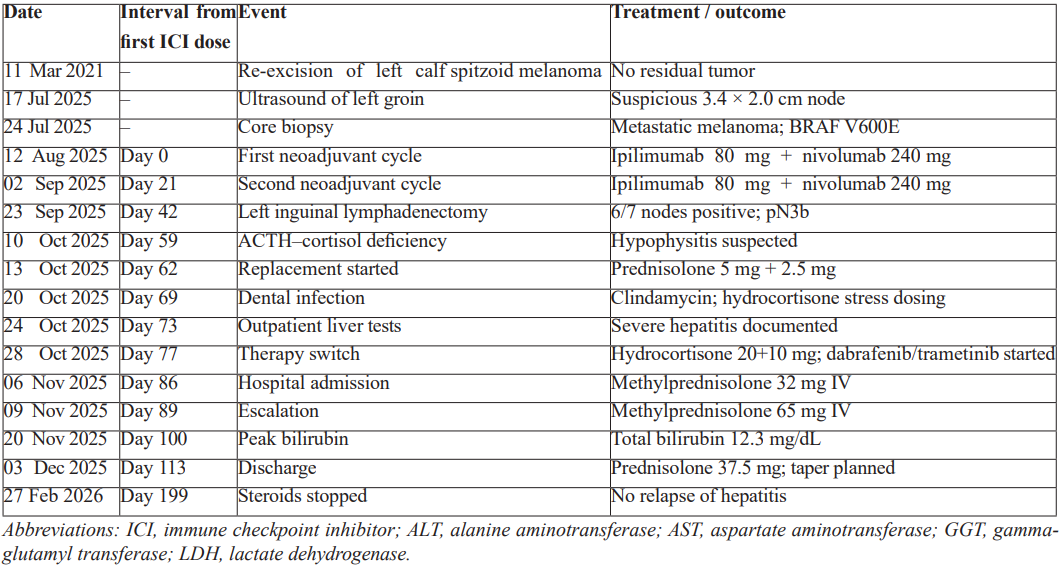
A 57-year-old woman underwent complete excision of a spitzoid melanoma of the left calf in 2021 (Breslow thickness, 0.88 mm); re-excision on 11 March 2021 demonstrated no residual tumor. In July 2025, she noted a progressively enlarging mass in the left inguinal region. Ultrasonography revealed a suspicious lymph node measuring 3.4 × 2.0 cm, and core needle biopsy confirmed metastatic melanoma with S100 and SOX10 positivity and a BRAF V600E mutation. Magnetic resonance imaging of the brain and contrast-enhanced computed tomography of the chest and abdomen showed no evidence of distant metastases. After completion of staging, the recurrence was classified as pT1bN2bM0, corresponding to the American Joint Committee on Cancer stage IIIB.
The patient received neoadjuvant ipilimumab (80 mg) plus nivolumab (240 mg) on 12 August 2025 and 2 September 2025. Left inguinal lymphadenectomy on 23 September 2025 demonstrated persistent melanoma in six of seven lymph nodes (pN3b), but restaging magnetic resonance imaging of the brain and computed tomography of the chest and abdomen on 3 October 2025 remained negative for distant disease.
On 10 October 2025 (59 days after the first dose), routine laboratory evaluation revealed markedly decreased adrenocorticotropic hormone and serum cortisol levels, consistent with secondary adrenal insufficiency. Clinically, the patient reported fatigue, hypotension, and tachycardia up to 110 beats per minute. Immune-related hypophysitis was diagnosed. Because hydrocortisone was temporarily unavailable, physiologic replacement with prednisolone (5 mg in the morning and 2.5 mg at midday) was initiated on 13 October 2025 with prompt symptomatic improvement and was converted to hydrocortisone (20 mg in the morning and 10 mg at midday; total 30 mg per day) on 28 October 2025.
Given the absence of a major pathological response and the presence of a BRAF V600E mutation, adjuvant therapy with dabrafenib and trametinib was planned. Initiation of that protocol was delayed by a dental infection treated with clindamycin on 20 October 2025, during which hydrocortisone was increased to 40 mg in the morning, 20 mg at midday, and 10 mg in the evening as stress dosing. Notably, outpatient laboratory testing on 24 October 2025- prior to targeted therapy- had already documented severe hepatitis in the treating records.
Finally, Dabrafenib and trametinib were initiated on 28 October 2025. The patient developed fever up to 39.2°C and was admitted on 6 November 2025 for progressive liver injury. On admission, aspartate aminotransferase (AST) and alanine aminotransferase (ALT) were 2307 U/L and 2171 U/L, respectively; total bilirubin was 3.6 mg/dl; and the international normalized ratio (INR) was 1.37. Intravenous methylprednisolone (32 mg per day) was started. Transaminases peaked at 3580 U/L (AST) and 2992 U/L (ALT), prompting escalation on 9 November 2025 to methylprednisolone 65 mg intravenously (approximately 1 mg per kilogram per day). Blood cultures remained repeatedly negative and C-Reactive Protein (CRP) levels were unremarkable; therefore, antibiotic therapy was not initiated. Under high-dose corticosteroids, transaminases decreased, whereas total bilirubin peaked later at 12.3 mg/dl on 20 November 2025.
Corticosteroids were subsequently tapered and transitioned to oral prednisolone from 29 November 2025. The patient was discharged on 3 December 2025 on prednisolone 37.5 mg per day with a slow gradual dose reduction; prednisolone was discontinued on 27 February 2026 without relapse. At follow-up on 21 January 2026, ALT was 39 U/L, gamma- glutamyl transferase (yGT) was 62 U/L, and S100 was 0.164 µg/L. Dabrafenib and trametinib remained paused, with re-initiation planned after hepatology reassessment. The clinical course is summarized in Table 1.
Table 1: Chronological timeline of the case.
Discussion
This case presents two immune-related adverse events associated with checkpoint inhibitor therapy in a single patient with malignant melanoma, occurring sequentially as symptomatic hypophysitis [6] followed by delayed, life-threatening hepatitis [3] several weeks after the last ipilimumab/nivolumab dose.
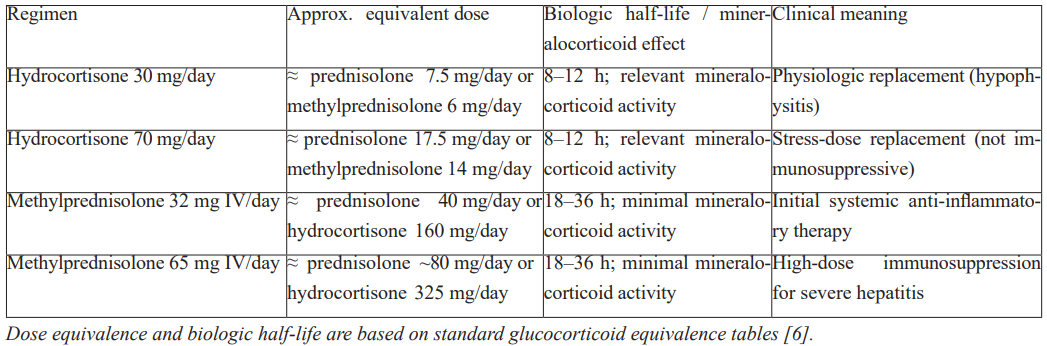
Mechanistically, ipilimumab-associated hypophysitis is thought to arise from direct immune recognition of ectopic CTLA-4 expressed on pituitary endocrine cells, which can trigger complement activation, lymphocytic infiltration, pituitary enlargement, and multi- axis dysfunction [8,9,11]. Immune-mediated hepatitis reflects a significant loss of hepatic immune tolerance after CTLA-4 and PD-1 pathway blockade. Enhanced T-cell priming and effector activity, together with impaired regulatory T-cell control, pro-inflammatory cytokine signaling, and secondary innate immune activation, promote hepatocellular injury [12]. For isolated immune checkpoint inhibitor-related hypophysitis without compressive symptoms, endocrine guidance and emerging trial data support hormone replacement rather than routine high-dose glucocorticoids [8–10]. The course of illness of our patient, as reported here, impressively proves the meaningfulness and necessity of this approach by supporting the role and importance of appropriate glucocorticoid dosing when immune checkpoint inhibitor-associated hypophysitis with cortisol deficiency coexists with immune-mediated hepatitis. requiring additional systemic corticosteroid therapy. The exogenous hydrocortisone alone, administered as physiologic replacement for pituitary insufficiency is not equivalent to immunosuppressive corticosteroid therapy and does not prevent subsequent immune checkpoint inhibitor-associated hepatitis. Thus, hydrocortisone treats adrenal insufficiency but does not provide the immunosuppressive intensity recommended for grade 3-4 hepatitis (1-2 mg/kg/day with taper) [3,4]. Table 2 summarizes dose equivalences relevant to this case [6].
Table 2: Corticosteroid equivalence relevant to the present case.
Taken together, this case highlights that delayed irAEs can emerge even after discontinuation and therapy switch. Physiologic hydrocortisone replacement restores endocrine function but is not an immunosuppressive therapy and should not delay escalation when a new high-grade non-endocrine irAE develops. Ongoing multidisciplinary monitoring and a clear distinction between replacement dosing and immunosuppressive dosing are essential for safe management of checkpoint inhibitor toxicity.
Patient Consent: Written informed consent was obtained from the patient for publication of this case report and any accompanying data.
Conflict of Interest: The authors declare no conflict of interest.
Funding: None.
References
- Blank CU, Rozeman EA, Fanchi LF, et al. Neoadjuvant nivolumab and ipilimumab in resectable stage III melanoma. N Engl J Med, 2024; 391: 1696-1708. doi: 10.1056/NEJMoa2402604.
- Garbe C, Amaral T, Peris K, et European consensus-based interdisciplinary guideline for melanoma. Part 2: Treatment – Update 2024. Eur J Cancer, 2025; 215: 115153. doi: 10.1016/j.ejca.2024.115153.
- Schneider BJ, Naidoo J, Santomasso BD, et Management of immune-related adverse events in patients treated with immune checkpoint inhibitor therapy: ASCO guideline update. J Clin Oncol, 2021; 39: 4073-4126. doi: 10.1200/JCO.21.01440.
- Haanen J, Obeid M, Spain L, et al. Management of toxicities from immunotherapy: ESMO Clinical Practice Guideline for diagnosis, treatment and follow-up. Ann Oncol, 2022; 33(12): 1217-1238. doi: 10.1016/j.annonc.2022.10.001.
- Osa A, Uenami T, Koyama S, et al. Clinical implications of monitoring nivolumab immunokinetics in non-small cell lung cancer patients. JCI Insight, 2018; 3: e59125. doi: 10.1172/jci.insight.59125.
- Nicolaides NC, Pavlaki AN, Magiakou MA, Chrousos GP. Glucocorticoid therapy and adrenal suppression. In: Feingold KR, Anawalt B, Blackman MR, et al., editors. Endotext [Internet]. South Dartmouth (MA): MDText.com, Inc, 2000.
- Novartis Pharmaceuticals TAFINLAR (dabrafenib) prescribing information, 2025.
- Yuen KCJ, Samson SL, Bancos I, et al. American Association of Clinical Endocrinology Disease State Clinical Review: Evaluation and Management of Immune Checkpoint Inhibitor-Mediated Endocrinopathies: A Practical Case-Based Clinical Approach. Endocr Pract, 2022; 28(7): 719-731. doi: 10.1016/j.eprac.2022.04.010.
- Sakurai A, Hakata T, Yamauchi I, et al. Distinct patterns of pituitary dysfunction in combination immunotherapy with nivolumab and ipilimumab. Eur J Endocrinol, 2026; 194(2): 254-263. doi: 10.1093/ejendo/lvag031.
- Theiler-Schwetz V, Trummer C, Schmitt L, et High-dose glucocorticoid treatment vs glucocorticoid replacement in immune checkpoint inhibitor associated hypophysitis (CORTICI): an open, randomised controlled trial. Ann Med, 2025; 57(1): 2453829. doi: 10.1080/07853890.2025.2453829.
- Iwama S, De Remigis A, Callahan MK, et Pituitary expression of CTLA-4 mediates hypophysitis secondary to administration of CTLA-4 blocking antibody. Sci Transl Med, 2014; 6(230): 230ra45. doi: 10.1126/scitranslmed.3008002.
- Shojaie L, Ali M, Iorga A, Dara Mechanisms of immune checkpoint inhibitor- mediated liver injury. Acta Pharm Sin B, 2021; 11(12): 3727-3739. doi: 10.1016/j.apsb.2021.10.003.