
Email id: info@ijclinmedcasereports.com
An Atypical Hemolytic Uremic Syndrome Associated with Pseudomembranous Colitis Caused by Clostridium Difficile
Imane Mouslim*, Salma Ouahid, Chaimae Jioua, Sanae Berrag, Fouad Nejjari, Tarik Addioui and Tamzaourte Mouna
Department of Gastroenterology I, Mohamed V Military Training Hospital, Rabat, Morocco
Received Date: 20/02/2026; Published Date: 18/05/2026
*Corresponding author: Imane Mouslim, Department of Gastroenterology I, Mohamed V Military Training Hospital, Rabat, Morocco
Abstract
Atypical Hemolytic Uremic Syndrome (aHUS) is a rare and severe form of thrombotic microangiopathy characterized by microangiopathic hemolytic anemia, thrombocytopenia, and acute kidney injury, most commonly driven by dysregulation of the alternative complement pathway. Although infections are recognized triggers, Clostridioides difficile–associated colitis is an exceptionally rare precipitant, particularly in adults. We report the case of a 55-year-old patient presenting with acute bloody diarrhea, acute renal failure, thrombocytopenia, and laboratory evidence of mechanical hemolysis. Stool polymerase chain reaction testing was positive for C. difficile toxins and negative for Shiga toxin. Endoscopic and radiologic findings were consistent with pseudomembranous colitis. Despite appropriate antimicrobial therapy, renal function deteriorated, requiring hemodialysis, with subsequent hematologic improvement following corticosteroid therapy. This case highlights C. difficile infection as a rare but important trigger of aHUS and underscores the need for early recognition of this entity to guide appropriate diagnostic evaluation and timely therapeutic intervention.
Keywords: Atypical hemolytic uremic syndrome (aHUS); Thrombotic microangiopathy; Clostridioides difficile; Pseudomembranous colitis
Introduction
Hemolytic Uremic Syndrome (HUS) is a Thrombotic Microangiopathy (TMA) defined by the triad of microangiopathic hemolytic anemia, thrombocytopenia, and acute kidney injury. Both typical and atypical forms share these features but differ in their underlying triggers and pathophysiology [1]. Typical HUS is most commonly associated with Shiga toxin–producing Escherichia coli (STEC), whereas atypical hemolytic uremic syndrome (aHUS) results from dysregulation of the alternative complement pathway [2]. Atypical HUS is a rare and severe condition that may be precipitated by infections, medications, pregnancy, or other stressors. Among infectious triggers, Clostridioides difficile–associated colitis has been exceptionally rarely reported, particularly in adults [1]. We report a case of aHUS secondary to Clostridioides difficile colitis in an adult patient presenting with acute bloody diarrhea.
Case Report
A 55-year-old patient with no significant past medical history presented to the emergency department with a one-week history of acute bloody mucoid diarrhea, accompanied by diffuse colicky abdominal pain and vomiting.
Physical examination revealed slight psychomotor slowing with signs of dehydration and a rectal examination showing blood streaks on the examining finger; the rest of the physical examination was unremarkable.
On admission, laboratory workup was significant for acute renal failure, with serum creatinine of 37 mg/L (baseline creatinine was 13 mg/L one month ago) and blood urea nitrogen of 2,36 g/l, Complete blood count revealed thrombocytopenia at 33 000 /ul, and Hemoglobin was reduced to 14.8 g/dL from his previous baseline of 19 g/dl with white cell count of 15.0 x 10⁹/L. The patient had an LDH (lactate dehydrogenase) significantly elevated to 817 U/L, haptoglobin was low and total bilirubin was 20 mg/L, with fractionation revealing it to be primarily unconjugated. Liver function tests and coagulation profile were within the normal range. Peripheral blood smear examination demonstrated a moderate presence of schistocytes.
An infectious screening was done, and the multiplex stool PCR test was positive for C. difficile toxin A/B and negative for Shiga toxin on two occasions. Stool culture was negative for other enteric pathogens.
The combination of these clinical and biological signs supports a diagnosis of hemolytic uremic syndrome (HUS) secondary to Clostridium difficile enterocolitis.
The patient underwent morphological and endoscopic exploration, including a rectosigmoidoscopy, which indicated pseudomembranous colitis (Figures 1 and 2).
An abdominal CT scan revealed circumferential wall thickening of the entire colon (Figure 3). Intravenous contrast administration was withheld because of the patient’s renal insufficiency.
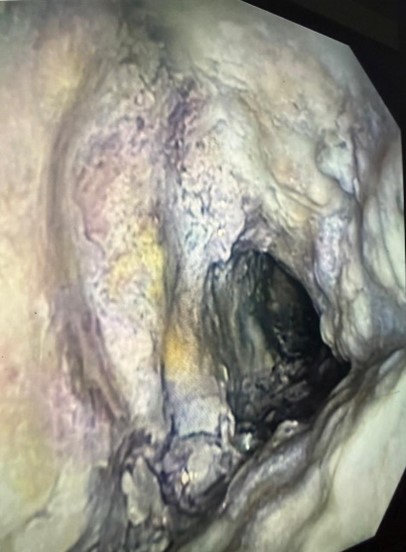
Figure 1: Colonoscopy image showing erosive and ulcerative colonic mucosa with two superficial ulcerations measuring <5 mm, associated with scattered raised yellowish plaques and pseudomembranous lesions, with contact bleeding, located 10 cm from the anal verge.
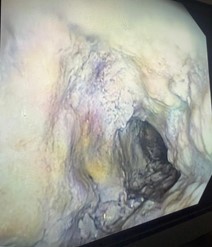
Figure 2: Colonoscopy image showing erosive mucosa with a few small superficial ulcerations, extending from 10 to 35 cm from the anal verge.
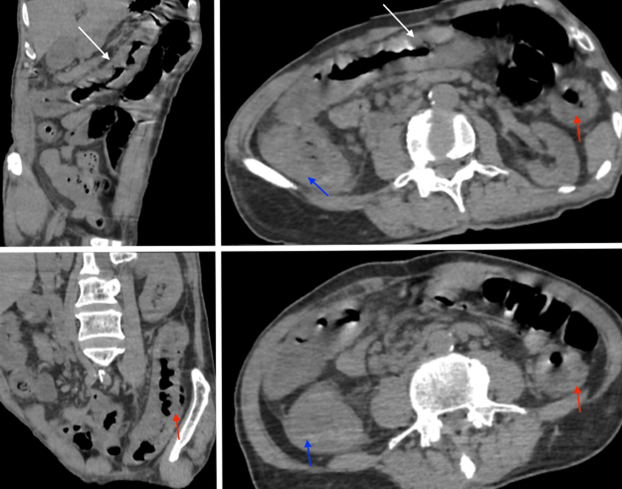
Figure 3: Oblique sagittal and coronal reconstructions along with axial images from a non-contrast-enhanced abdominal CT scan, showing regular circumferential colonic wall thickening. The blue arrow indicates the ascending colon, the red arrow the descending colon, and the white arrow the transverse colon.
Treatment for C. difficile infection was initiated with oral vancomycin. Renal function deteriorated during the hospital stay, leading to the requirement for hemodialysis. The patient received a five-day course of high-dose intravenous methylprednisolone, with subsequent improvement in platelet count to 90,000/mm³ at discharge. Given overall clinical improvement, he was discharged with a prolonged steroid taper and ongoing outpatient hemodialysis.
Discussion
Atypical hemolytic uremic syndrome (aHUS) is a rare and severe form of thrombotic microangiopathy (TMA) characterized by the clinical triad of microangiopathic hemolytic anemia, thrombocytopenia, and acute kidney injury. Unlike typical HUS, which is usually caused by Shiga toxin-producing Escherichia coli (STEC), aHUS is primarily mediated by the excess activation or dysregulation of the alternative complement pathway [3]. While various triggers such as pregnancy, drugs, and other infections exist, colitis caused by Clostridioides difficile is identified as an exceptionally rare precipitant of this syndrome [2]. Very few adult cases have been documented in the medical literature, particularly following abdominal surgery.
Clinical manifestations typically begin with gastrointestinal symptoms, including diffuse abdominal pain and diarrhea, which can range from watery to bloody stools. As the syndrome progresses, patients often develop severe acute renal failure, frequently presenting with anuria or oliguria and moderate to accelerated hypertension [3]. Extra-renal involvement is also common, affecting 10% to 30% of patients; this most frequently manifests as neurological complications such as encephalopathy, delirium, confusion, and severe headaches [1].
In terms of biology and laboratory findings, a diagnosis is established through evidence of mechanical hemolysis, including the presence of schistocytes (fragmented red blood cells) on a peripheral blood smear and an acute drop in hemoglobin. Other hallmark markers include a severely low platelet count, significantly elevated Lactate Dehydrogenase (LDH), and undetectable or very low haptoglobin levels. Renal function tests show a sudden and sharp rise in serum creatinine and blood urea nitrogen (BUN) [2]. To confirm aHUS and rule out other TMAs, it is essential to demonstrate normal ADAMTS13 activity (typically >5-10%) and the absence of Shiga toxins in stool samples. Stool studies must be positive for C. difficile toxins A or B or the GDH antigen to confirm the infection as the trigger [4].
Colonoscopy and rectosigmoidoscopy serve as useful tools to document the severity of the underlying colitis and assist in differential diagnosis. These procedures may reveal signs of pseudomembranous colitis, characterized by diffuse erythema, multiple superficial ulcerations, and a complete loss of healthy mucosa. Such findings correspond to high endoscopic severity scores and help distinguish C. difficile infection from other inflammatory or infectious causes of hemorrhagic diarrhea [4].
Imaging and radiology provide critical insights into organ involvement and complications. Renal ultrasound often shows normal-sized kidneys, which helps rule out obstructive causes like stones or hydronephrosis, though bilateral cortical thinning may be seen in cases with underlying chronic disease. Abdominal CT scans are vital for detecting acute renal infarctions secondary to branch artery thrombosis or evidence of severe colitis. For patients with neurological symptoms, head CT or MRI is necessary to identify chronic vascular ischemic changes, lacunar infarcts, or cerebral edema [1].
The treatment of C. difficile-associated aHUS requires a multifaceted approach, starting with aggressive supportive care, including hemodialysis for renal failure and blood transfusions for anemia. Specific antimicrobial therapy with oral vancomycin or metronidazole is mandatory to eradicate the C. difficile infection [5]. While plasma exchange and corticosteroids have historically been used, eculizumab—a monoclonal antibody that inhibits the C5 complement fraction—has emerged as a highly effective first-line therapy. The prognosis is generally favorable with early intervention, often leading to complete renal recovery and dialysis independence.
Conclusion
Clinical vigilance is required to identify C. difficile as a rare but potent trigger for aHUS, as prompt initiation of terminal complement inhibition is the key to preserving long-term kidney function [6].
References
- Rafiq A, Tariq H, Abbas N, Shenoy R. Atypical hemolytic-uremic syndrome: a case report and literature review. Am J Case Rep, 2015; 16: 109–114.
- Wadehra A, Alkassis S. Atypical Hemolytic Uremic Syndrome in the Setting of Acute Clostridium difficile Colitis. Cureus, 2021.
- Inglis JM, Barbara JA, Juneja R, Milton C, Passaris G, Li JYZ. Atypical Haemolytic Uraemic Syndrome Associated with Clostridium difficile Infection Successfully Treated with Eculizumab. Case Rep Nephrol, 2018; 2018: 1759138.
- Salvadori M. Update on hemolytic uremic syndrome: Diagnostic and therapeutic recommendations. WJN, 2013; 2(3): 56.
- Pourliotopoulou E, Karampatakis T, Kachrimanidou M. Exploring the Toxin-Mediated Mechanisms in Clostridioides difficile Infection. Microorganisms. 2024; 12(5): 1004.
- Moulton MN, Kay CL, Romain JT, Morrow BD, Bobele GM. Clostridioides Difficile-Associated Atypical Hemolytic-Uremic Syndrome Successfully Treated with Eculizumab: A Case Report and Literature Review. Critical Care Explorations, 2021; 3(7): e0475.