
Email id: info@ijclinmedcasereports.com
Localized Injection Site Reaction to Alirocumab 300 mg in a Patient with Polygenic Hypercholesterolemia and Statin Intolerance: A Case Report
Francesco Tassone*, Tecla Marchese and Marella Doglio
Territorial Diabetes Unit, ASL TO5, Ospedale Maggiore, Chieri (TO), Italy
Received Date: 18/02/2026; Published Date: 04/05/2026
*Corresponding author: Francesco Tassone, MD, PhD, Head of Territorial Diabetes Unit, ASL TO5, Ospedale Maggiore Via Demaria 1, 10023 Chieri (TO), Italy
Abstract
Proprotein convertase subtilisin/kexin type 9 (PCSK9) inhibitors have revolutionized the management of hypercholesterolemia. While their safety profile is well-established, injection site reactions (ISRs) are among the most common adverse events. However, detailed case reports of reactions to the 300 mg monthly dose of alirocumab are scarce. We present the case of a 65-year-old female with polygenic hypercholesterolemia and multiple lipid-lowering therapy intolerances who developed a significant, pruritic, erythematous plaque at the site of alirocumab 300 mg administration. The reaction was documented through patient-acquired photography, as it had largely subsided by the time of clinical consultation. Due to the recurrence, the drug was suspended. We discuss the importance of patient-reported outcomes and a sequential therapeutic strategy including evolocumab and inclisiran.
Keywords: Alirocumab; PCSK9 inhibitors; Injection site reaction; Hypercholesterolemia; Statin intolerance; Evolocumab; Inclisiran
Introduction
The clinical management of hypercholesterolemia has been transformed by monoclonal antibodies targeting PCSK9 [1]. Alirocumab has demonstrated significant LDL-C reductions and cardiovascular benefits [2]. Despite its efficacy, subcutaneous administration is associated with localized adverse effects. In the ODYSSEY phase III program, ISRs were reported in 3.8% of patients [3]. Most ISRs are mild and transient, but in "real-world" practice, robust inflammatory responses can threaten adherence, especially in patients with statin-associated muscle symptoms (SAMS) [4]. The 300 mg monthly dose provides convenience but involves a higher protein concentration and volume (2 mL), which may increase local immunogenicity [5,6].
Case Presentation
A 65-year-old female patient presented with polygenic hypercholesterolemia and secondary cardiovascular prevention. She had a documented history of severe intolerance to multiple statins and ezetimibe [7]. In December 2025, she was started on Alirocumab 300 mg every 4 weeks, after professional training on the pre-filled pen.
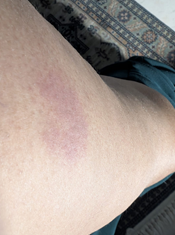
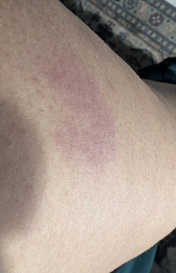
Following the second administration, the patient reported a warm, intensely pruritic erythematous plaque at the injection site (thigh) within 48 hours. When evaluated in our clinic shortly after, the reaction was no longer visible to the naked eye and could not be captured by clinical photography. However, the patient had documented the peak of the reaction at home.
The patient-provided images show a well-demarcated, circular erythematous area (~6 cm) with central induration. Written informed consent was obtained from the patient for the publication of these images and clinical data.
Clinical Management and Future Perspectives
Due to the intensity of the localized reaction, we advised the temporary suspension of alirocumab. A follow-up visit is scheduled in one month to repeat blood tests. We anticipate a significant worsening of the lipid profile (LDL-C rebound) following treatment cessation, which will necessitate an alternative therapeutic approach.
Our planned strategy is to first attempt treatment with Evolocumab (140 mg biweekly).
Should ISRs recur, we will transition to Inclisiran [8]. Inclisiran, a small interfering RNA (siRNA), requires only twice-yearly administration and has shown a lower incidence of recurrent ISRs in patients who reacted to monoclonal antibodies [9,10].
Discussion
Localized ISRs to monoclonal antibodies are often delayed-type hypersensitivity (Type IV) reactions or responses to excipients like polysorbate 80 [11,12]. The "evanescent" nature of the lesion highlights the vital role of patient-provided photographic evidence in outpatient monitoring.
The 300 mg dose of alirocumab is less frequently associated with published case reports of ISRs compared to the 75/150 mg doses. Bär et al. (2022) suggested that ISRs might be triggered by concurrent immune system activation [8]. Furthermore, Allevi et al. (2023) demonstrated that Inclisiran is a successful alternative for patients with recurrent ISRs to both alirocumab and evolocumab [9].
Conclusion
This case underscores the need for vigilance regarding ISRs with high-dose PCSK9 inhibitors. Photographic documentation by the patient is essential when clinical signs are transient. A structured switch to different molecular platforms is vital to maintain cardiovascular protection in statin-intolerant patients.
Conflicts of Interest: The authors declare that they have no competing interests regarding the publication of this report.
Funding: This work received no specific grant from any funding agency in the public, commercial, or not-for-profit sectors.
Ethical Approval and Patient Consent: The patient provided written informed consent for the publication of this case report and the accompanying clinical photographs. All identifying data have been removed to ensure patient confidentiality.
References
- Sabatine MS, et al. N Engl J Med, 2017; 376(18): 1713-1722.
- Schwartz GG, et al. N Engl J Med, 2018; 379(22): 2099-2107.
- Robinson JG, et al. N Engl J Med, 2015; 372(16): 1489-1499.
- Rosenson RS, et al. J Am Coll Cardiol, 2017; 70(10): 1290-1301.
- Roth EM, et al. J Clin Lipidol, 2020; 14(5): 707-719.
- Thomaidou E, Ramot Y. Dermatol Ther, 2019; 32(2): e12817.
- Lloyd-Jones DM, et al. J Am Coll Cardiol, 2022; 80(14): 1366-1418.
- Bär S, et al. Eur Heart J Case Rep, 2022; 6(5): ytac187.
- Allevi M, et al. Front Cardiovasc Med, 2023; 10: 1181720.
- Ray KK, et al. N Engl J Med, 2020; 382(16): 1507-1519.
- Corominas M, et al. J Investig Allergol Clin Immunol, 2014; 24(4): 212-225.
- Silverberg JI. Ann Allergy Asthma Immunol, 2018; 121(4): 464-468.e3.