
Email id: info@ijclinmedcasereports.com
Small Bowel Volvulus Associated with Segmental Stenosing Wall Thickening: A Case Report and Review of the Literature
Benjelloun Touimi Kenza¹, Benzidane Kamal¹,*, Rayadi Mahassine¹, Bouali Ichrak¹, Ettaoussi Abdelhak¹, Kamal Khadija¹, Abdessamad Majd¹, Bouali Mounir¹, Elbakouri Abdelillah¹, Khaleq Khalid2 and El Hattabi Khalid¹
¹Department of General Surgery, Ibn Rochd Hospital, Hassan II University, Faculty of Medicine and Pharmacy, Tarik Ibn Ziad Street, Casablanca, Morocco
2Department of Anesthesia and Resuscitation, Ibn Rochd Hospital, Hassan II University, Faculty of Medicine and Pharmacy, Tarik Ibn Ziad Street, Casablanca, Morocco
Received Date: 10/02/2026; Published Date: 27/04/2026
*Corresponding author: Benzidane Kamal, Department of General surgery, Faculty of Medicine and Pharmacy, Ibn Rochd University Hospital Center, Hassan II University, Casablanca, Morocco
Abstract
Small bowel volvulus is a rare cause of intestinal obstruction in adults and constitutes a surgical emergency. It may be primary or secondary to underlying pathological conditions. Association with segmental stenosing bowel wall thickening is uncommon and may indicate a secondary etiology.
We report the case of a 50-year-old woman presenting with acute abdominal pain and signs of small bowel obstruction. Abdominal computed tomography revealed a characteristic mesenteric whirl sign associated with segmental small bowel wall thickening without signs of ischemia. Emergency laparotomy confirmed a viable small bowel volvulus with two counterclockwise turns and a localized sub-stenotic thickened segment. Surgical management consisted of detorsion and segmental small bowel resection with primary anastomosis. Postoperative recovery was uneventful.
CT imaging plays a pivotal role in the early diagnosis of small bowel volvulus and in assessing intestinal viability. The presence of associated stenosing lesions suggests a secondary cause and warrants bowel resection to prevent recurrence and allow histopathological diagnosis. Prompt surgical intervention is essential to reduce morbidity and mortality.
Adult small bowel volvulus remains a rare but serious condition. Early CT diagnosis and timely surgical management are crucial. Segmental resection should be considered when associated stenosing lesions are present.
Keywords: Small bowel volvulus; Mesenteric whirl sign; Intestinal obstruction; Emergency surgery
Introduction
Small bowel volvulus refers to the twisting of a segment of the intestine around its mesenteric axis, leading to partial or complete vascular and intestinal obstruction [1]. It accounts for less than 10% of mechanical small bowel obstructions in adults [2]. Two main forms are described: primary volvulus, favored by anatomical abnormalities such as a long and narrow mesentery, and secondary volvulus, occurring in association with underlying pathological conditions including adhesions, tumors, inflammatory processes, or intestinal malrotation [3,4].
We report a rare case of small bowel volvulus associated with segmental stenosing wall thickening, highlighting the diagnostic, therapeutic, and prognostic aspects in light of the current literature.
Case Presentation
A 50-year-old female patient, with no significant past medical history, was admitted to the emergency department with abdominal pain evolving over five days, worsening with signs of bowel obstruction and bilious vomiting. On clinical examination, the patient was conscious and hemodynamically stable. Abdominal examination revealed diffuse tenderness, and digital rectal examination showed stool traces in the rectal ampulla.
Abdominal Computed Tomography (CT) demonstrated small bowel distension with a characteristic mesenteric whirl sign, consistent with volvulus, associated with segmental bowel wall thickening without signs of intestinal ischemia (Figure 1).
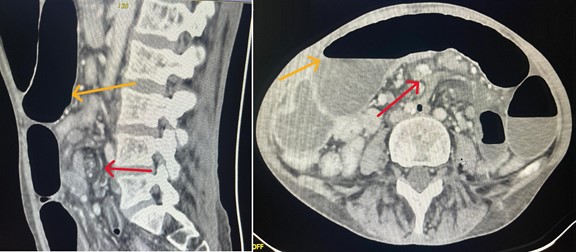
Figure 1: CT scan showing the mesenteric whirl sign (red arrow) and small bowel distension with air–fluid levels (yellow arrow).
Midline laparotomy revealed a moderate serous peritoneal effusion, a small bowel volvulus with two counterclockwise turns, and a thickened, sub-stenotic segment approximately 10 cm in length, located 160 cm from the ligament of Treitz. The bowel was viable.
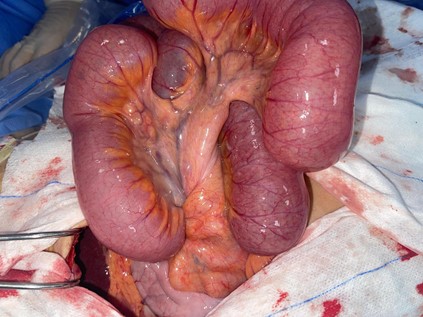
Figure 2: Intraoperative view showing the mesenteric twist with viable small bowel.
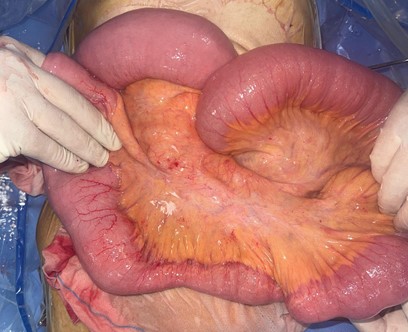
Figure 3: Intraoperative view showing the segmental sub-stenotic bowel wall thickening.
Detorsion of the small bowel followed by segmental resection of the thickened segment with hand-sewn end-to-end anastomosis was performed. Postoperative recovery was uneventful, and the patient was discharged on postoperative day four.
Histopathological analysis reveals chronic inflammatory remodeling without specific features and shows no evidence of malignancy.
Discussion
Small bowel volvulus in adults is an uncommon condition and represents a true surgical emergency, with prognosis largely dependent on early diagnosis [1,5]. Its incidence is estimated at approximately 1.7 per 100,000 in Europe and North America but remains higher in tropical and African regions [2,4].
The pathophysiology involves twisting of the mesenteric root, leading initially to venous obstruction followed by arterial compromise, which may progress to bowel necrosis if untreated. Primary volvulus is usually associated with anatomical predispositions, whereas secondary volvulus occurs in the presence of local pathological lesions such as postoperative adhesions, inflammatory strictures, tumors, or segmental bowel wall thickening [3,6]. In our case, the presence of sub-stenosing wall thickening suggested a secondary cause, requiring systematic histological analysis to rule out Crohn’s disease, intestinal tuberculosis, or neoplastic processes.
From a diagnostic standpoint, CT scan is the imaging modality of choice. The mesenteric whirl sign is considered pathognomonic, reflecting the twisting of bowel loops and mesenteric vessels around the vascular axis [7]. CT also al lows assessment of bowel viability by identifying signs of ischemia or impending necrosis.
Surgical management is mandatory. Simple detorsion may be sufficient if the bowel is viable and no associated lesion is present. However, bowel resection is indicated in cases of necrosis, doubtful viability, or localized pathological lesions [5,6]. Some authors advocate enteroplication to prevent recurrence, although its effectiveness remains controversial [4]. Mortality rates can reach up to 35% in cases of delayed diagnosis or intestinal necrosis [1].
This case emphasizes the importance of early CT diagnosis and prompt surgical intervention. The association with a stenosing lesion justifies segmental resection to prevent recurrence and obtain definitive histological diagnosis.
Conclusion
Adult small bowel volvulus is a rare but potentially life-threatening condition requiring rapid diagnosis and immediate surgical management. Abdominal CT scan is the cornerstone of diagnosis, enabling confirmation and evaluation of bowel viability. The presence of associated stenosing wall thickening should systematically prompt segmental bowel resection with histopathological examination. Early surgical intervention remains the key determinant of favorable outcomes.
References
- Roggo A, Ottinger LW. Acute small bowel volvulus in adults. Ann Surg, 1992; 216(2): 135-141.
- Huang JC, Shin JS, Huang YT, Chao CJ, Ho SC, Wu MJ. Small bowel volvulus among adults. J Gastroenterol Hepatol, 2005; 20(12): 1906-1912.
- Welch GH, Anderson JR. Volvulus of the small intestine in adults. World J Surg, 1986; 10(3): 496-500.
- Louahabi A, Benjelloun el B, Ousadden A, Mazaz K, Ait Taleb K. Volvulus du grêle primitif de l’adulte : à propos d’un cas et revue de la littérature. Pan Afr Med J, 2012; 12: 53.
- Frering V, Pradoura JM, Collet D, et al. Volvulus du grêle chez l’adulte: aspects cliniques et thérapeutiques. J Chir, 1998; 135(9): 393-399.
- Yeo H, Kaoutzanis C, DeCou JM. Small bowel volvulus in adults: management and outcomes. Am Surg, 2018; 84(4): 582-588.
- Fisher JK. Computed tomographic diagnosis of volvulus in intestinal malrotation. Radiology, 1981; 140(1): 145-146.