
Email id: info@ijclinmedcasereports.com
Diagnostic and Surgical Considerations in Strangulated Richter’s Hernia: A Case Study
Bouali Mounir1, Benzidane Kamal1, Zalarh Fadoua1, Bouali Ichrak1, Ettaoussi Abdelhak1, Kamal Khadija1, Elbakouri Abdelillah1, Khaleq Khalid2 and El Hattabi Khalid1
1Department of General Surgery, Ibn Rochd Hospital, Hassan II University, Faculty of Medicine and Pharmacy, Tarik Ibn Ziad Street, Morocco
2Department of Anesthesia and Resuscitation, CHU Ibn Rochd, Casablanca, Morocco
Received Date: 19/01/2026; Published Date: 06/03/2026
*Corresponding author: Zalarh Fadoua, Department of General Surgery, Ibn Rochd Hospital, Hassan II University, Faculty of Medicine and Pharmacy, Tarik Ibn Ziad Street, Morocco
Abstract
Richter’s hernia is a rare form of abdominal hernia characterized by incarceration or strangulation of only a portion of the intestinal wall. Unlike other strangulated hernias, it may rapidly progress to bowel ischemia and necrosis without causing intestinal obstruction, making diagnosis challenging and potentially delaying treatment.
We report the case of a 51-year-old man who presented to the emergency department with a painful, irreducible right femoral swelling, without symptoms of bowel obstruction. Clinical examination suggested a strangulated femoral hernia, and emergency surgical exploration was undertaken. Intraoperatively, a Richter’s hernia involving the femoral ring was identified, with necrosis of the antimesenteric border of a small-bowel loop. Resection of the necrotic segment followed by primary end-to-end small-bowel anastomosis was performed, and the hernia was repaired using the McVay technique without mesh.
Richter’s hernia is a deceptive surgical emergency due to the frequent absence of obstructive symptoms. Early diagnosis requires a high index of clinical suspicion, particularly in patients presenting with painful hernias. Prompt surgical intervention is essential to prevent severe complications such as bowel necrosis or perforation.
Keywords: Richter’s hernia; Femoral hernia; Strangulated hernia; Small bowel ischemia; Intestinal necrosis; Emergency surgery
Introduction
Richter’s hernia is a type of abdominal hernia in which only a portion of the intestinal wall is incarcerated or strangulated within the hernial orifice [1]. It was first comprehensively described by August Gottlob Richter in 1785 [2]. This rare form of hernia is particularly dangerous because it can lead to rapid ischemia and necrosis of the bowel wall without causing intestinal obstruction. Richter’s hernia may occur at any common hernial site, but it is more frequently encountered at small, rigid orifices, such as the femoral ring or the inguinal canal [3].
Despite the absence of obstructive symptoms, early surgical intervention is crucial when there is clinical suspicion of strangulation.
We report the case of a 51-year-old man presenting with an apparently strangulated femoral hernia. Emergency surgery confirmed the diagnosis of a Richter’s hernia with strangulation and necrosis of a segment of small bowel. Prompt surgical management resulted in a favorable outcome. This case highlights the importance of maintaining a high index of suspicion and ensuring early surgical management of Richter’s hernia in order to prevent severe complications such as intestinal perforation.
Case Presentation
A 51-year-old man, a chronic smoker with a history of 14 pack-years, presented to the emergency department with a painful, irreducible right femoral swelling. There were no symptoms of bowel obstruction, such as vomiting or cessation of bowel movements. Examination of the other hernial orifices was unremarkable.
Based on these findings, the diagnosis of a strangulated femoral hernia was established, and emergency surgical intervention was indicated. After appropriate preoperative preparation, the patient was transferred to the operating room.
The patient was positioned supine under spinal anesthesia. Following surgical field preparation, a right inguinal incision was performed. Opening of the hernial sac revealed necrosis of the antimesenteric border of a small-bowel loop (Figure 1).
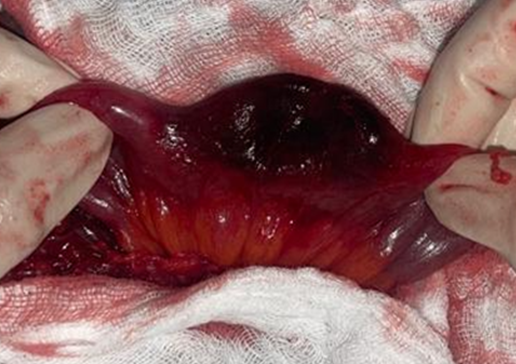
Figure 1: Intraoperative image showing necrosis of the antimesenteric border of a small-bowel loop.
Resection of the necrotic small-bowel segment was performed, followed by a hand-sewn end-to-end small-bowel anastomosis. The hernial contents were then reduced into the abdominal cavity, and the hernial sac was resected after closure. Finally, repair of the right femoral hernia was carried out using the McVay technique with non-absorbable sutures.
Histopathological examination of the resected specimen demonstrated necrotic and hemorrhagic changes, confirming the diagnosis of ischemic intestinal injury secondary to hernial strangulation.
The postoperative course was uneventful, with early return of bowel function on postoperative day two, progressive resumption of oral intake, and no signs of infection or wound complications. The patient was discharged on postoperative day four in good general condition. Follow-up clinical evaluation was satisfactory, with no evidence of recurrence or complications.
Discussion
Richter’s hernia was first reported by Fabricius Hildanus in 1598 [6] and later scientifically described in 1785 by the German surgeon August Gottlob Richter [2]. It represents a distinct type of hernia characterized by incarceration of only a portion of the intestinal circumference, often leading to rapid ischemia and necrosis without causing intestinal obstruction [6].
This condition is closely associated with specific anatomical characteristics of the hernial orifice, particularly its small size and rigid margins. Richter’s hernia most commonly occurs at the femoral ring (approximately 71%) and the deep inguinal ring (23%), while ventral hernias account for only about 6% of cases. In recent years, trocar sites following laparoscopic surgery have emerged as an increasingly frequent location for Richter’s hernia [4].
In the present case, the hernia was located at the femoral ring, which is the most frequently reported site in the literature. Although the distal ileum is most commonly involved, other segments of the gastrointestinal tract may also be affected [7].
Richter’s hernia accounts for approximately 5–15% of strangulated hernias [6], yet its clinical diagnosis remains challenging due to its often atypical presentation. High-resolution ultrasonography may help identify the hernial orifice and assess bowel viability, while computed tomography provides superior diagnostic sensitivity, particularly in equivocal cases [5]. In our patient, clinical findings suggested a strangulated hernia; however, the definitive diagnosis of Richter’s hernia was established intraoperatively, illustrating the diagnostic complexity of this entity.
As with all strangulated hernias, Richter’s hernia requires urgent surgical intervention [3]. Management involves reduction of the hernial contents and repair of the abdominal wall defect, and is determined by bowel viability and the presence or absence of local contamination [6,9]. In cases without ischemia or infection, mesh repair may be considered, whereas the use of prosthetic material is contraindicated in the presence of ischemic or perforated bowel due to the increased risk of infection [9].
Various surgical approaches have been described, including open and minimally invasive laparoscopic techniques, using either extraperitoneal or transperitoneal access [6]. In our case, given the clinical suspicion of strangulation and the need for direct assessment of bowel viability, an open inguinal approach was selected. The presence of ischemic bowel led us to perform a non-mesh repair in order to minimize the risk of postoperative infection.
The choice of surgical technique and repair method should be individualized based on patient anatomy, hernia characteristics, and the clinical context, to ensure durable repair while minimizing the risk of recurrence and complications [8].
Conclusion
Although rare, Richter’s hernia represents a true surgical emergency requiring prompt intervention to prevent severe complications such as bowel necrosis or perforation. Its diagnosis is often challenging due to the frequent absence of classical signs of intestinal obstruction, as incarceration of only the antimesenteric portion of the bowel wall does not usually result in complete luminal obstruction. A high index of clinical suspicion, early referral, and timely imaging are essential for effective management. Consequently, any painful hernia, even in the absence of obstructive symptoms, should raise suspicion for a strangulated Richter’s hernia.
References
- Steinke W, Hernie de Zellweger R. Richter et Sir Frederick Treves : une expérience clinique originale, une revue et un aperçu historique. Ann Surg, 2000; 232: 710–718.
- Richter AG. Abhandlung von den Brüchen. Göttingen: Johann Christian Dieterich, 1785.
- Smith CR, Chatzikonstantinou M. Early surgical intervention is critical for strangulated Richter's hernia. J Surg Case Rep, 2024; 2024(10): rjae642. doi: 10.1093/jscr/rjae642.
- Dev Santosh, Luitel Prajjwol, Paudel Sujan, Devkota Shishir, Khadka Laxman, Jha Sanjeev, et al. Richter supraumbilical hernia managed with invagination: a case report. Annals of Medicine & Surgery, 2024; 86(5): p 3090-3093. DOI: 10.1097/MS9.0000000000001943.
- Nieblas Serrano MG, Alvarado Echeverría MA, Lugo Rodríguez AD, Vargas Lugo JL, Barraza SC, León Barragán A de J, et al. Richter’s Hernia as a Cause of Acute Abdomen: An Unusual Case. International Journal of Medical Science and Clinical Research Studies, 2025; 5(07): 1183–1186. https://doi.org/10.47191/ijmscrs/v5-i07-27.
- Al-Jawad M, Alnasser S, Lbabidi NA, Sheikh A, Diarbakerly B, Kawas A. Prevascular Richter's hernia a rare and challenging presentation of a potentially life-threatening condition: A rare case report. Int J Surg Case Rep, 2024; 121: 110024. doi: 10.1016/j.ijscr.2024.110024.
- Bayeh A, Limenh S. Richter's Type Recurrent Indirect Inguinal Hernia, an Extremely Rare Occurrence: A Case Report. Open Access Emerg Med, 2022; 14: 323-326. doi: 10.2147/OAEM.S363212.
- Lobo DN, Clarke DJ, Barlow AP. Obturator hernia: a new technique for repair, 2024.
- Chen W, Liu L, Huang H, et al. A case report of spontaneous umbilical enterocutaneous fistula resulting from an incarcerated Richter’s hernia, with a brief literature review. BMC Surg, 2017; 17: 15.