
Email id: info@ijclinmedcasereports.com
Ray Amputation: Functional and Professional Challenges in Occupational Reintegration
Mariana Miller1,*, Vanessa Teófilo1, Salomé Moreira1, Sofia Pinelas1, Paulo Pinho1, Rui Ribeiro1, Pedro Norton1, Ivo Guerreiro2 and Vítor Vidinha3
1Occupational Health Service of Porto Hospital and University Center, Porto, Portugal
2Department of Orthopedics of Aveiro Hospital and University Center, Aveiro, Portugal
3Department of Orthopedics of Porto Hospital and University Center, Porto, Portugal
Received Date: 29/12/2025; Published Date: 12/02/2026
*Corresponding author: Mariana Miller, - Occupational Health Service of Porto Hospital and University Center, Alameda Professor Hernâni Monteiro, 4200-319 Porto, Portugal
ORCiD: https://orcid.org/0009-0002-1089-8881
Abstract
Ray amputation is a surgical procedure involving the removal of a metacarpal bone and its associated phalanges. It is commonly used for treating severe hand trauma, infections, tumors, and congenital abnormalities. While the procedure improves pain relief and cosmetic outcomes, concerns do exist regarding its impact on grip strength and hand function, especially in labor-intensive professions. In this study, we present the case of a 55-year-old factory worker who sustained a high-energy crush injury, resulting in an open fracture of the middle and proximal phalanges of the right ring finger. Initial treatment with Kirschner wires was performed but failed to restore function. Despite alternative surgical options, including arthrodesis, the patient opted for a Ray amputation to maximize functional recovery, and was able to restore full hand functionality with preserved grip strength and successfully returned to work with a phased adaptation plan. This case highlights the importance of patient-centered decision-making and tailored rehabilitation in work-related injuries. When properly indicated and supported by a structured return-to-work program, Ray amputation can provide a pain-free, functional outcome, enabling safe reintegration into the workforce.
Keywords: Ray amputation; Work-related injury; Occupational medicine; Grip strength; Patient-centered decision-making; Workplace adaptation
Introduction
Ray resection is a surgical procedure where one of the "rays" of a hand finger - metacarpal along with the phalanges - is removed. Ray resection with or without an adjacent ray transfer can be useful for treating vascular insufficiency, tumors, infection, trauma, recurrent Dupuytren contracture, and congenital abnormalities of the hand [1,2].
These conditions can result in a nonfunctional digit that is limited by pain, stiffness, insufficient or excessive length, or lack of sensation and may interfere with daily and work-related activities of the patients [1]. The goal of this surgery is to improve hand function, cosmesis and pain relief, to enhance patient satisfaction.
In trauma cases, like in work related accidents, resections are often performed later, once the patient has stabilized, allowing time to assess whether the injured digit’s function and appearance are acceptable. If resection is chosen, the damaged finger can provide valuable tissue for reconstructing other areas of the hand. However, delaying resection may require extended time off work for the patient [1].
Single-ray amputations offer better cosmetic results compared to partial finger amputations; however, they are associated with reduced grip and pinch strength compared to amputations at the proximal phalanx level. Despite these challenges, ray resection significantly contributes to restoring normal hand functionality [2].
Case Presentation
55-year-old male, factory worker within the footwear industry with 35 years of activity. He suffered a work accident in May 2024 which resulted in an exposed fracture of the middle and proximal phalanges of the right ring finger by high energy crushing in a pressing machine (Figure 1).
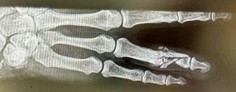
Figure 1: X-Ray of the exposed fracture of the middle and proximal phalanges of the right ring finger.
In an initial approach, a repositioning surgery was performed with two Kirschner wires, and it proceeded without complications.
However, when the patient returned to work after 3 months, he mentioned in the occupational health examination, pain and difficulties in gripping with the injured hand. Work activity before the accident consisted of the manufacturing of injection molds, hence job relocation was necessary. A temporary work ineptitude recommendation was made with the suggestion of finding an alternative job with an administrative focus, however, it was not possible to implement this job change. The worker continued to express his desire to maintain his original function.
An orthopedic re-examination took place after 6 months. During the examination the patient was diagnosed with pseudoarthrosis (Figure 2) and was advised to undergo arthrodesis of the proximal phalanx which he declined due to the loss in mobility inherent to the procedure. On the other hand, the patient proposed a Ray amputation which after clinical discussion and psychological approval of the patient took place successfully (Figure 3).
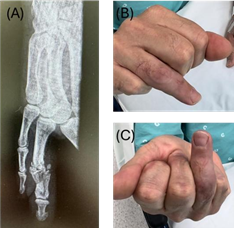
Figure 2: (A) X-Ray of the finger prior to the amputation (B,C) Preoperative photograph of the hand.
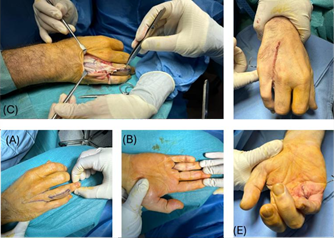
Figure 3: Photographs of the dorsal (a) and volar (b) aspects of the hand demonstrating the markings for a v-shaped incision for resection of the index finger and intraoperative (c, d, e) photographs.
The worker resumed professional activity 14 weeks after the surgery (Figure 4). In the occupational health examination, it was verified that he maintained some pain in the scar region. However, full recovery of hand joint mobility was observed, with no significant differences in grip strength between his hands. Hence, a conditional fitness was issued in order to provide a gradual increase in both workload and demand, for the first 60 days of readaptation to the job and limited frequent gripping movements with the right hand in line with the symptoms.
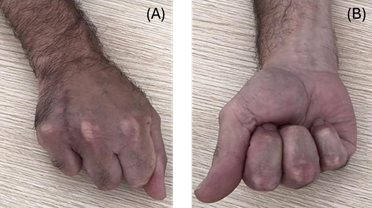
Figure 4: (A, B) Photographs of the grip after recovering from the surgery.
After this time, he was re-evaluated having reported that the pain had vanished, and on physical examination, no abnormalities were observed. After interdisciplinary discussion the patient was deemed fit with re-evaluations of the work fitness every 6 months.
Discussion
This case highlights the importance of personalized treatment and close follow-up of the workers, always looking to adapt the job and treatment to the physical and psychological conditions of the patient with their active involvement in the decision-making process.
Ray's amputation is a technique used since 1920 for the treatment of severe deformities of the fingers due to traumatic injury, and the goal of this surgery is to improve hand function, cosmesis and pain relief, to enhance patient satisfaction.
However, a 15% to 30% loss in grip and pinch strength has been reported, which led many authors to recommend against ray resections in laborers due to the importance of hand width and grip strength in this population [1,3-6]. Nevertheless, others have reported good results even in these patients, as we saw in this case [7].
Also, cold intolerance is a frequent issue reported, and moderate to severe pain tends to affect a significant percentage of the patients after the surgery [8].
This highlights the importance of a collaborative decision-making process between the surgeon and the patient to determine the most suitable treatment approach, as we saw in this case. This ensures that the patient assesses the significance of both functional and aesthetic outcomes before finalizing the treatment plan. Therefore, the primary contraindication for this surgery is any psychological barrier to amputation, as resection may cause emotional distress. Therefore, a psychological evaluation of the patient is essential before proceeding with this surgery.
After the resection, patients typically return to work around 10 to 16 weeks later, with the majority resuming their previous job roles [6,9].
It's also important to highlight that during the whole process it's vital to do a deep evaluation of the work post, both to identify the potential risks and mitigate accidents and to adapt the position according to the individual needs of the worker. In this case that was achieved primarily with a change in work post that would allow a safe recovery. Nevertheless, the worker felt that he didn't fit the position and treatment was pursued that would increase the likelihood that he would be able to return to his initial job. This desire was met a few months after the surgery, gradually, always with oversight from the team from occupational health.
Conclusion
It can be concluded that a clear understanding of the patient’s expectations is essential to tailor both
the treatment strategy and workplace adjustments to ensure alignment.
In this case, by opting for a Ray's amputation, which at first sight might seem like a procedure with a higher degree of mutilation and aggressiveness, the medical team was able to deliver not just a good result from a cosmetic standpoint, but also a complete recovery of the hand in terms of mobility and grip strength. This facilitated a phased and safe readjustment of the worker to his original job position, initially with restrictions that, under close monitoring, were gradually lifted as the patient regained full function of the affected hand, ultimately becoming fully fit for work with more frequent reassessments, as he had desired.
Funding: This research received no external funding.
Informed Consent Statement: Written informed consent has been obtained from the patient to publish this paper.
Declaration of Interest: The authors declare no conflict of interest.
References
- Blazar, Philip E, Garon Mark Ray Resections of the Fingers: Indications, Techniques, and Outcomes. Journal of the American Academy of Orthopaedic Surgeons, 2015; 23(8): p 476-484.
- MacKay B, Wall H, Weaver A, Sexson T, Wall J, Blue M, et al. A Novel Approach to Ray Resection of the Hand. J Hand Surg Glob Online, 2019; 2(1): 46-54. doi: 1016/j.jhsg.2019.11.001.
- Peacock EE. Metacarpal transfer following amputation of a central digit. Plast Reconstr Surg, 1962; 29(4): 345–355.
- Colen L, Bunkis J, Gordon L, Walton Functional assessment of ray transfer for central digital loss. J Hand Surg Am, 1985; 10(2): 232–237.
- Slocum DB, Pratt The principles of amputations of the fingers and hand. J Bone Joint Surg Am, 1944; 26(3): 535–546.
- Melikyan EY, Beg MS, Woodbridge S, Burke The functional results of ray amputation. Hand Surg, 2003; 8(1): 47–51.
- Gottlieb Metacarpal amputation: The problem of the four-finger hand. Acta Chir Scand Suppl, 1965; 343: 132–142.
- Steichen JB, Idler Results of central ray resection without bony transposition. J Hand Surg Am, 1986; 11(4): 466–474.
- Peimer CA, Wheeler DR, Barrett A, Goldschmidt Hand function following single ray amputation. J Hand Surg Am, 1999; 24(6): 1245–1248.