
Email id: info@ijclinmedcasereports.com
Prospective Echocardiographic Study for the Assessment of Right Ventricular Remodeling and Functional Impairment in COPD
Gulnora Rozikhodjaeva1,2, and Muxlisaxon Kasimova3,*
¹Department of Functional Diagnostics, Central Clinical Hospital No. 1 of the Head Medical Department under the Administration of the President of the Republic of Uzbekistan
²Department of Ultrasound Diagnostics, Center for the Development of Professional Qualifications of Medical Workers, Tashkent, Uzbekistan
³Military Medical Academy of the Armed Forces of the Republic of Uzbekistan
Received Date: 03/12/2025; Published Date: 05/01/2026
*Corresponding author: Professor Gulnora Rozikhodjaeva, Doctor of Medical Sciences, Head of the Department of Functional Diagnostics, Central Clinical Hospital N 1 of the Head Medical Department under the Administration of the President of the Republic of Uzbekistan, Tashkent, Uzbekistan.
ORCID: https://orcid.org/0000-0003-1291-9375
Abstract
Chronic Obstructive Pulmonary Disease (COPD) exerts a significant systemic impact on the cardiopulmonary system, leading to progressive remodeling and functional impairment of the right ventricle (RV). This study aimed to comprehensively evaluate RV structural and functional abnormalities in COPD patients using an extended echocardiographic protocol, and to compare findings with those of a control group without respiratory disease. A total of 150 individuals were examined, including 100 COPD patients and 50 healthy controls. Even at early disease stages, COPD patients demonstrated RV dilatation, increased RV wall thickness, reduced longitudinal systolic function, and elevated pulmonary artery systolic pressure. These abnormalities occurred significantly more often in the COPD group and indicate a high prevalence of subclinical right heart involvement. Extended multiparametric echocardiography provides important diagnostic value for early detection and monitoring of RV dysfunction in COPD.
Keywords: COPD; Right ventricle; Echocardiography; Pulmonary hypertension; Remodeling
Introduction
Chronic Obstructive Pulmonary Disease (COPD) is currently recognized as a multisystem disorder in which airway obstruction is accompanied by structural and functional cardiovascular alterations. International and national guidelines emphasize that right heart involvement is a major determinant of COPD progression and mortality [1,9,11].
Chronic hypoxemia, increased pulmonary vascular resistance, and pulmonary hypertension lead to structural and functional remodeling of the right ventricle (RV). Because the RV is physiologically adapted for a low-pressure environment, even modest increases in afterload compromise its ability to maintain adequate cardiac output, ultimately contributing to chronic cor pulmonale [3,7].
Recent studies show that RV remodeling and reductions in longitudinal systolic function (TAPSE, TDI S′) may occur even in COPD patients without clinically manifested pulmonary hypertension. These changes correlate with increased hospitalizations, reduced exercise tolerance, and worse long-term outcomes [4,5,8,10,14]. Echocardiography is the leading non-invasive method for assessing RV structure and pulmonary hemodynamics. However, standard protocols often lack the sensitivity needed to detect early subclinical alterations. Therefore, expert societies recommend a multiparametric echocardiographic approach incorporating structural indices, longitudinal RV function, the right ventricular myocardial performance index (RIMP), and pulmonary artery pressure estimation [6,13].
Aim and Objective:
- To provide a comprehensive assessment of RV structural and functional remodeling in COPD patients
- To compare these findings with those observed in a control group.
Materials and Methodology
The study included 150 participants: 100 patients diagnosed with COPD and 50 individuals without respiratory disorders (control group). Participant age ranged from 40 to 85 years (mean 60.8±12.4 years). The COPD group consisted of 60 men and 40 women; the control group-28 men and 22 women.
COPD diagnosis was based on clinical data and spirometry demonstrating a post-bronchodilator forced expiratory volume in 1 second to forced vital capacity ratio (FEV₁/FVC) <70%. COPD severity was classified according to GOLD criteria based on predicted FEV₁ values.
Exclusion criteria included interstitial lung diseases, congenital heart disease, significant valvular defects,left ventricular ejection fraction <45%, poor echocardiographic window quality.
Transthoracic echocardiography was performed according to ASE and European RV assessment recommendations [6,13]. The extended protocol included following:
measurement of basal RV diameter, RV free-wall thickness, and right atrial area;
assessment of longitudinal RV systolic function using TAPSE and tissue Doppler S′ velocity; calculation of the RV myocardial performance index (RIMP), also known as the TEI index; estimation of pulmonary artery systolic pressure (PASP) using peak tricuspid regurgitation velocity and the modified Bernoulli equation; when feasible, calculation of pulmonary artery diastolic (PADP) and mean pressures; evaluation of RV diastolic function using transtricuspid inflow velocities (E, A), deceleration time, and tissue Doppler e′/a′. Diastolic dysfunction was classified as impaired relaxation, pseudonormal, or restrictive filling.
Statistical analysis was performed using standard methods. Data were expressed as mean ± SD. Both parametric and non-parametric tests were applied; significance was accepted at p<0.05.
Results
A total of 150 individuals were examined, including 100 patients with confirmed COPD and 50 participants in the control group. The demographic distribution between groups was comparable, which allowed the observed echocardiographic differences to be attributed primarily to the underlying disease rather than age or sex differences.
Although left ventricular (LV) systolic function was preserved in both groups, a number of important distinctions emerged. Among COPD patients, the LV end-diastolic diameter (LVEDD) showed a modest but consistent increase (4.82±0.51 cm) compared with the control group (4.57±0.48 cm). A similar trend was observed for the LV end-systolic diameter (2.91±0.34 cm vs. 2.78±0.33 cm) (Table 1).
Table 1: Left ventricular and inferior vena cava parameters.
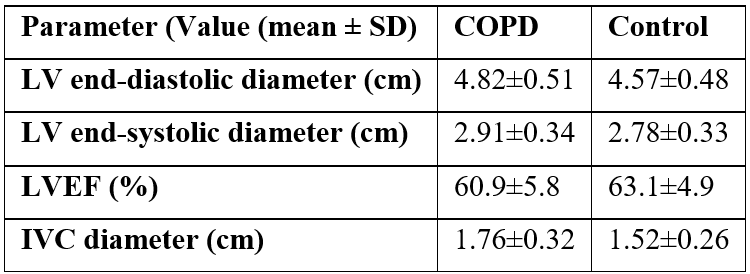
These changes, while remaining within the upper limits of normal, suggest a mild increase in cardiac preload, likely secondary to impaired venous return dynamics associated with chronic lung hyperinflation. The diameter of the inferior vena cava (IVC) further supports this interpretation: in COPD patients, IVC diameter averaged 1.76±0.32 cm compared with 1.52±0.26 cm in controls. These findings may indicate increased right atrial pressure and altered preload conditions in COPD patients [2,11]. Despite these structural trends, LV ejection fraction remained preserved in both groups (60.9±5.8% vs. 63.1±4.9%), indicating that COPD-associated cardiac involvement predominantly affects the right-sided chambers rather than the left ventricle.
More pronounced differences emerged in the assessment of the right ventricle (RV). Nearly all COPD patients demonstrated some deviation in RV measurements compared with the control group, highlighting the sensitivity of the RV to chronic pulmonary pathology (Table 2).
The basal RV diameter was significantly enlarged in COPD patients (4.18±0.59 cm) relative to controls (3.62±0.47 cm). This finding reflects early structural remodeling triggered by sustained elevation of pulmonary vascular resistance. Alongside chamber enlargement, the thickness of the RV free wall was markedly increased (0.69±0.13 cm in COPD vs. 0.47±0.08 cm in controls), indicating adaptive myocardial hypertrophy in response to chronic pressure overload.
Table 2: Right ventricular echocardiographic parameters.

These structural abnormalities underscore the development of concentric-eccentric remodeling patterns, consistent with the pathophysiological progression of chronic cor pulmonale. Longitudinal RV systolic performance, assessed by TAPSE and TDI-derived s′ velocity, was distinctly reduced among COPD patients: TAPSE 1.62±0.38 cm and 2.01±0.33 cm; TDI s′ velocity 14.4±2.36 cm/s and 17.2±2.08 cm/s (COPD vs control). These reductions were consistently observed across all COPD severity levels, including patients with mild disease. The decline in longitudinal RV function reflects early contractile impairment and highlights the vulnerability of the RV in the setting of chronic pulmonary pathology. A notable proportion of COPD patients displayed TAPSE values approaching or below the clinical threshold for RV dysfunction (<1.7 cm), reinforcing the sensitivity of the RV to small increases in afterload. Reduced TAPSE and TDI S′ values reflect impaired longitudinal RV systolic function-the earliest marker of RV involvement in COPD [14,8,10]. Elevated RIMP confirms combined systolic and diastolic RV dysfunction, consistent with recent research [6,7].
The RV Myocardial Performance Index (RIMP) showed a substantial elevation in COPD patients (0.61±0.18) compared with the control group (0.42±0.11). As RIMP incorporates both systolic and diastolic time intervals, its increase indicates a global impairment of RV performance rather than an isolated contractile deficit.
Pulmonary artery systolic pressure (PASP) also differed markedly between the groups: 48.5±14.7 mmHg and 28.3±6.1 mmHg (COPD vs control). This represents a significant elevation in RV afterload and is consistent with early or established pulmonary hypertension. Notably, several individuals within the COPD group had PASP values exceeding 50 mmHg, suggesting a moderate elevation of pulmonary pressures even in the absence of severe airflow limitation.
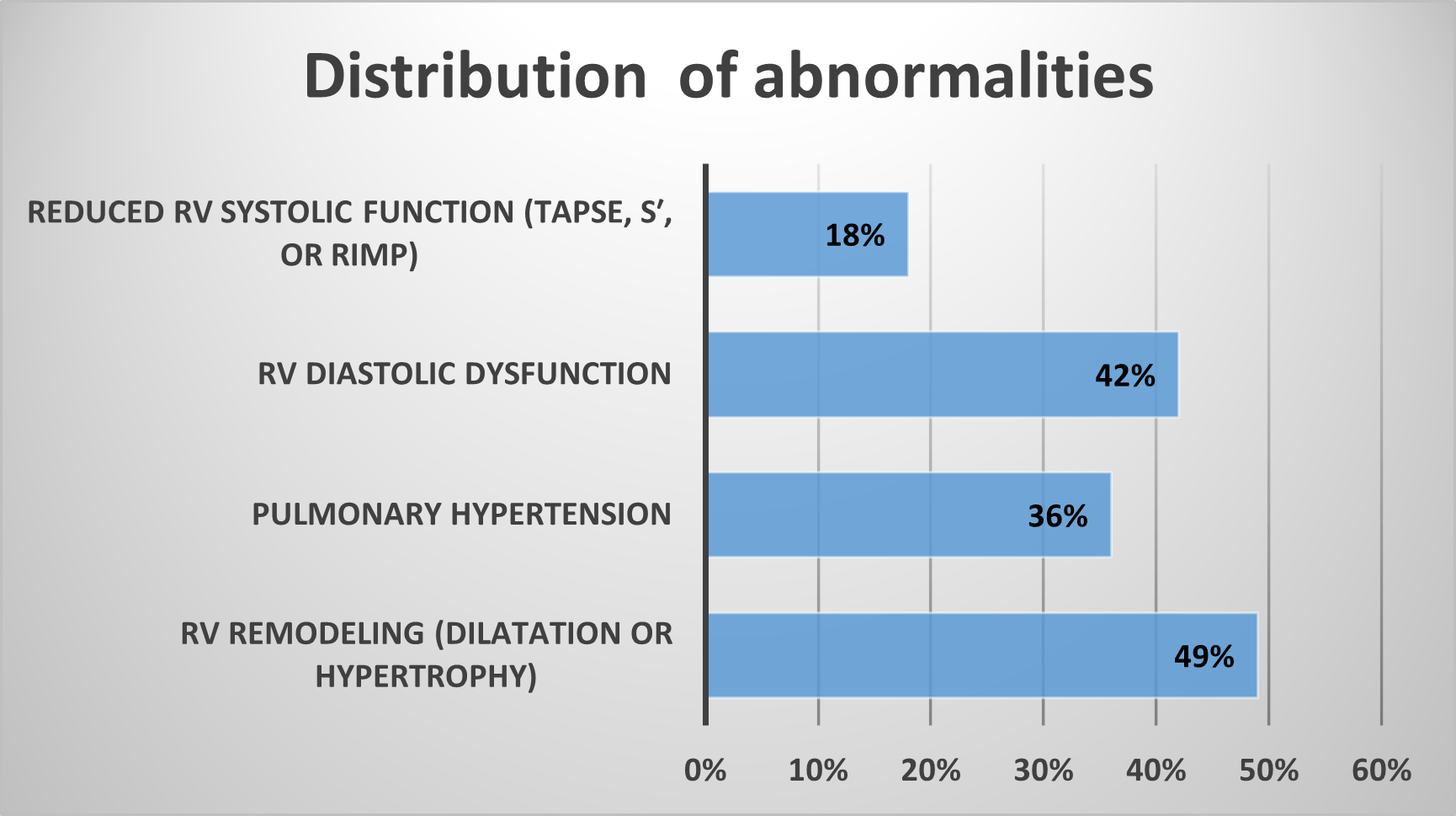
A detailed distribution analysis revealed that structural and functional RV abnormalities were highly prevalent among COPD.
Discussion
Importantly, many of these abnormalities were present in patients with mild-to-moderate COPD. This underscores the subclinical nature of RV involvement and suggests that cardiac impairment may precede overt respiratory deterioration. The control group demonstrated none of the structural abnormalities described above and only minimal variability in functional indices, reinforcing the conclusion that observed changes are closely associated with COPD-related pathophysiology.
Our echocardiographic results demonstrate that COPD is strongly associated with early structural RV remodeling, including chamber dilation and wall hypertrophy; impaired longitudinal systolic function, even in mild disease; elevated RIMP, signifying combined systolic and diastolic dysfunction; increased pulmonary artery pressures, suggesting early pulmonary hypertension; high prevalence of subclinical right heart involvement.
These findings confirm that the RV is highly sensitive to the hemodynamic burden imposed by COPD and that comprehensive echocardiographic assessment provides crucial insights into disease progression. The results demonstrate that COPD significantly affects RV structure and function from early disease stages. RV dilatation and free-wall thickening reflect chronic pressure overload and compensatory myocardial adaptation, as previously reported [1,3,7,12].
Particularly important is the observed reduction in longitudinal RV systolic function. TAPSE and TDI S′ are highly sensitive indicators of early RV dysfunction, often declining before the development of overt cor pulmonale [8,10,14].
Elevated PASP in over one-third of COPD patients corresponds with current understanding of pulmonary hypertension associated with chronic lung disease [9].
Our findings align with international studies highlighting the diagnostic value of multiparametric echocardiography for early detection of RV impairment in COPD [4,6,13].
This prospective study demonstrates that COPD is associated with significant structural and functional RV abnormalities, including chamber remodeling, reduced longitudinal systolic function, elevated RIMP, and increased pulmonary artery pressure. These abnormalities occur more frequently in COPD patients than in individuals without respiratory pathology and often remain subclinical.
Conclusion
Multiparametric echocardiography should be incorporated into routine evaluation of COPD patients for early diagnosis, risk stratification, and monitoring of disease progression.
References
- Antonaglia D, Caminati A, Harari S, et al. Pulmonary hypertension and chronic lung disease. Eur Respir Rev, 2019; 28(153):
- Guazzi M, Naeije R, Arena R. RV function in COPD. Chest, 2017; 151: 486–493.
- Harari S, Simonneau G, Ghofrani HA, et al. PH associated with lung disease: insights. Lancet Respir Med, 2023; 11: 140–156.
- Hilde JM, Skjørten I, Ashraf H, et al. RV dysfunction in COPD. Chest, 2016; 150: 306–313.
- Jatav VS, Meena SR, Jelia S, et al. Echo findings in COPD. Int J Adv Med, 2017; 4: 476–480.
- Kar S, Nanda NC. Echo evaluation of RV. Clin Cardiol, 2020; 43: 646–658.
- Mandoli GE, Sciaccaluga C, Bandera F, et al. Cor pulmonale and echocardiography. Heart Fail Rev, 2021; 26: 1399–1410.
- Martín-Yuste V, Romero-Bermejo FJ, et al. Cor pulmonale relevance in COPD. Front Cardiovasc Med, 2022; 9:
- Nathan SD, Barbera JA, Gaine SP, et al. Pulmonary hypertension in chronic lung disease. Eur Respir J, 2019; 53: 1801914.
- Petcu A, Lazăr M-A, Petrescu AM, et al. RV strain and prognosis in COPD. Diseases, 2025; 13: 344.
- Rozikhodjaeva G, Kasimova M. Multiparameter echocardiographic approach to assessing the structural-functional state of the right heart in chronic obstructive pulmonary disease J Biomed Pract, 2024; 1(1): 178–183.
- Rozikhodjaeva G, Rakhimova M. Experience with Handgrip Isometric Exercise in Elderly and Senile Patients in a Hospital Setting.Int J Clin Stud Med Case Rep, 2025; 52(1): 1–3.
- Rudski LG, Addetia K, Gallagher MJ, et al. Guidelines for the Echocardiographic Assessment of the Right Heart in Adults. J Am Soc Echocardiogr, 2025; 38(4): e1–e52.
- Taş Gülen Ş, Eryılmaz U. RV function in COPD. Ann Clin Anal Med, 2018; 9: 529–535.